
CCC - Certified Chef de Cuisine: Career Paths, Salary, and Requirements 2026 October
💡 Pass your CCC exam on the first attempt. Practice questions with detailed answer explanations, hints, and instant scoring.
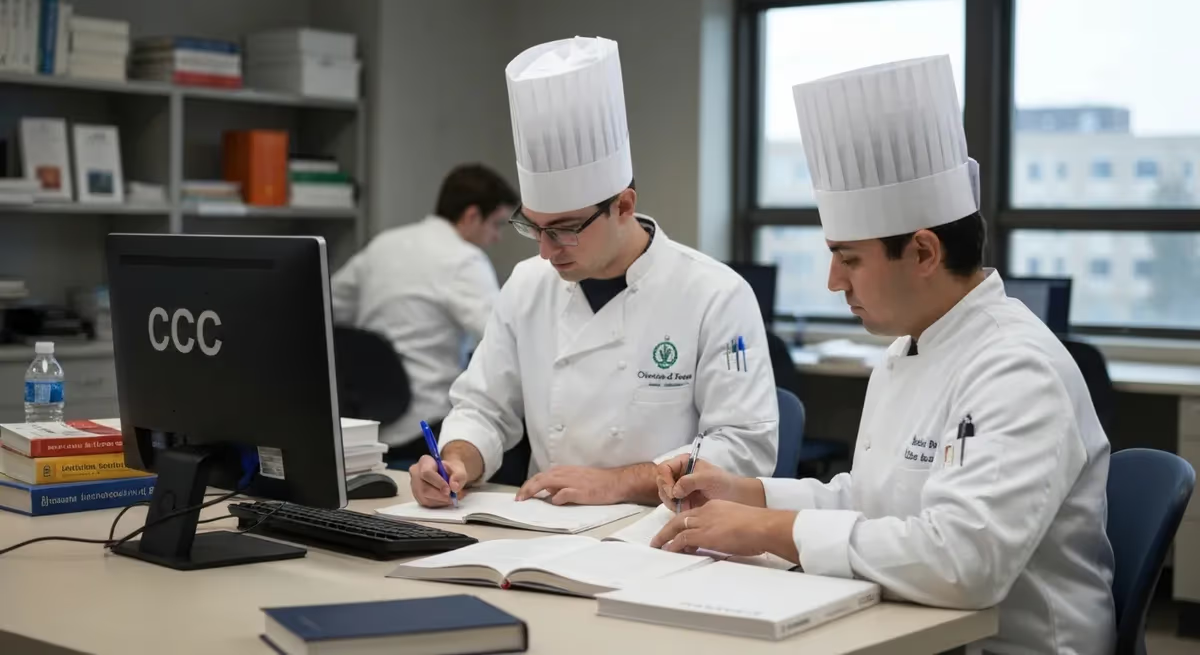
CCC Career Overview
Professionals holding the CCC - Certified Chef de Cuisine certification are in demand across multiple industries. The certification demonstrates validated expertise and commitment to professional development, making certified individuals more competitive in the job market.
Whether you are starting your career or looking to advance, the CCC certification provides a recognized credential that employers value. Begin your journey with free CCC practice tests to understand the knowledge areas covered by the certification.
Industry Demand
The demand for CCC-certified professionals continues to grow as organizations increasingly require validated expertise. Key factors driving demand include:
Students preparing for standardized admissions tests should also practice with our CCC practice test 2026, covering the quantitative, verbal, and analytical sections tested in the real exam.
- Regulatory compliance — Many industries require certified professionals to meet compliance standards
- Quality assurance — Organizations use certifications as a benchmark for hiring qualified candidates
- Professional standards — The certification ensures a consistent level of competency across the profession
- Competitive advantage — Certified professionals stand out in a competitive job market
CCC Salary and Compensation
Salary for CCC-certified professionals varies based on experience, location, industry, and specialization. Here is a general overview of compensation levels:
| Experience Level | Salary Range (Annual) | Key Factors |
|---|---|---|
| Entry Level (0-2 years) | $45,000 - $65,000 | Location, industry, education |
| Mid-Career (3-5 years) | $60,000 - $85,000 | Specialization, additional certifications |
| Senior (6-10 years) | $80,000 - $110,000 | Leadership roles, niche expertise |
| Expert (10+ years) | $100,000 - $140,000+ | Consulting, management, training |
Note: Salary ranges are approximate and vary significantly by geographic region, employer size, and industry sector. Major metropolitan areas typically offer 15-25% higher compensation.

CCC Requirements and Prerequisites
Meeting the requirements for the CCC - Certified Chef de Cuisine certification involves several steps. Here is what you need to get started:
Education Requirements
- Minimum education — Requirements vary by certification level; check the official certifying body for specific educational prerequisites
- Relevant coursework — Courses in the subject area strengthen your application and exam preparation
- Continuing education — Most certifications require ongoing learning credits for renewal
Experience Requirements
- Work experience — Some certification levels require documented professional experience in the field
- Supervised practice — Certain certifications mandate supervised work hours or mentorship
- Portfolio or documentation — Be prepared to verify your experience through employer references or work samples
Exam Preparation
Once you meet the prerequisites, focus on exam preparation using official study guides and CCC Culinary Foundations & Cooking Techniques and CCC Menu Planning & Kitchen Management. Consistent practice with exam-style questions is one of the most effective preparation methods.
CCC Career Advancement Paths
The CCC certification serves as a foundation for multiple career trajectories. Here are common advancement paths:
- Specialist Track — Deepen expertise in a specific area, pursue advanced certifications, become a subject matter expert
- Management Track — Move into team leadership, department management, and executive roles
- Consulting Track — Use certification and experience to provide independent consulting services
- Education Track — Transition into training, curriculum development, or academic roles
- Entrepreneurship — Start your own practice or firm using the credibility your certification provides
Continuing Professional Development
Maintaining your certification and advancing your career requires ongoing investment in professional development. Stay current with industry trends, pursue additional certifications, attend conferences, and build your professional network. Use free CCC practice tests regularly to keep your knowledge sharp.

CCC Pros and Cons
- +CCC salary data provides benchmarks that help professionals negotiate compensation and evaluate job offers objectively
- +Understanding salary ranges by experience level helps professionals plan career progression and timing of role changes
- +Geographic salary variation data helps candidates evaluate relocation decisions with accurate financial context
- +Specialty or certification premiums within the field provide clear ROI data for professional development investments
- +Published salary data creates transparency that reduces information asymmetry in compensation negotiations
- −Published salary averages may not reflect local market conditions — cost of living differences make national averages misleading in high-cost cities
- −Salary surveys may be based on self-reported data from non-representative samples, potentially skewing results
- −Entry-level salary data is often less accurate than mid-career data, as entry-level roles vary widely in scope and title
- −Benefits, bonuses, and total compensation can vary as much as base salary, making base salary comparisons incomplete
- −Salary data ages quickly in high-demand fields — reports more than 1–2 years old may significantly understate current market rates
Sample CCC - Certified Chef de Cuisine Practice Questions
Try these questions from our free CCC - Certified Chef de Cuisine practice tests. The correct answer and an explanation follow each question.
When delegating station responsibilities to a sous chef, the chef de cuisine should also transfer what?
- A. The authority needed to complete the task
- B. Full accountability for the outcome
- C. Their own performance evaluation duties
- D. Payroll approval rights
Answer: A. The authority needed to complete the task
Effective delegation pairs responsibility with the authority to act, while ultimate accountability stays with the delegator.
A Certified Chef de Cuisine is training a new cook on the principles of sous-vide cooking for a tough cut of meat like beef brisket. To achieve a tender, pasteurized product that is safe to hold for service, what is the most critical combination of factors to control?
- A. High water temperature and a short cooking time.
- B. Airtight vacuum seal and a rapid searing finish.
- C. Precise water temperature and sufficient cooking time.
- D. The brand of immersion circulator and the type of plastic pouch.
Answer: C. Precise water temperature and sufficient cooking time.
Sous-vide cooking relies on precise temperature control over an extended period to achieve specific results. For tough cuts of meat, a specific temperature is required to break down connective tissues into gelatin, and a sufficient duration at that temperature is necessary to ensure both tenderness and pasteurization for safety. While a good seal is important for heat transfer and searing provides a desirable finish, the core of the technique's success and safety lies in the time-temperature relationship.
An employee reports sexual harassment to the chef de cuisine. What must the chef do?
- A. Take the complaint seriously and follow the company's reporting procedure promptly
- B. Wait to see if the behavior happens again
- C. Tell the employee to work it out with the harasser
- D. Keep it confidential and take no action
Answer: A. Take the complaint seriously and follow the company's reporting procedure promptly
Supervisors are legally obligated to act promptly on harassment complaints through established procedures.
A Certified Chef de Cuisine is tasked with improving the profitability of the menu. Which of the following actions represents the most effective initial approach to food cost control?
- A. Increasing all menu prices by 10%.
- B. Switching to lower-quality suppliers for all ingredients.
- C. Implementing standardized recipes and conducting regular yield tests.
- D. Reducing the number of staff in the kitchen.
Answer: C. Implementing standardized recipes and conducting regular yield tests.
The foundation of effective food cost control lies in consistency and accurate data. Implementing standardized recipes ensures portion control and consistent quality, while yield testing determines the actual cost of ingredients after fabrication. This provides the accurate data needed for menu engineering and strategic pricing, which is a more sustainable and effective approach than arbitrarily raising prices or compromising quality.
CCC Questions and Answers

About the Author

Executive Chef & Culinary Arts Certification Educator
Culinary Institute of AmericaChef Marco Bellini is a Certified Executive Chef and graduate of the Culinary Institute of America with over 20 years of professional kitchen experience in Michelin-recognized restaurants. He teaches culinary arts certification, food safety, and hospitality exam preparation, having guided thousands of culinary students through their ServSafe, ProStart, and professional chef certifications.