
Certified Endoscope Reprocessor Practice Test: Free CER Exam Questions and Study Guide
🎯 Take a certified endoscope reprocessor practice test: free CER exam questions, AER and disinfectant topics, study tips, and a clear prep plan for 2026 October.
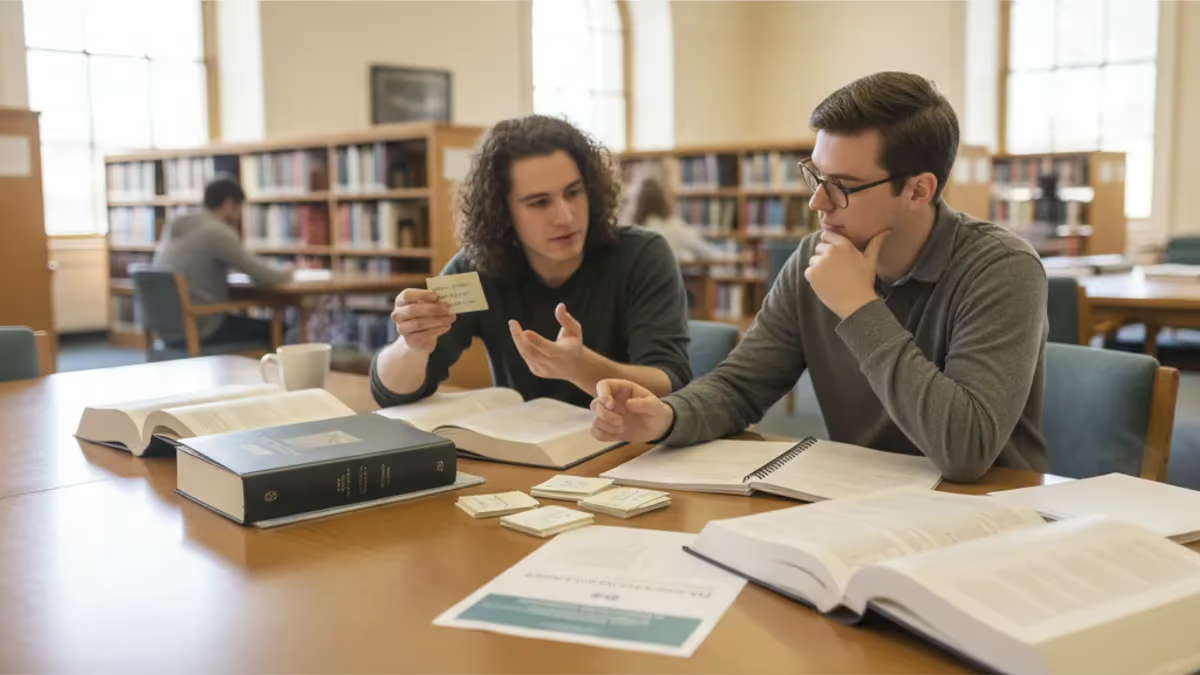
A certified endoscope reprocessor practice test is the fastest way to find out whether you really understand the steps behind safe scope turnaround or only recognize the vocabulary. The CER credential rewards people who can apply cleaning, disinfection, drying, and storage rules under pressure. It does not reward memorized glossaries. This guide explains what the exam covers, how to use practice questions well, and how to build a study plan around a busy reprocessing shift.
Many candidates begin by searching for an aaert cer exam quizlet deck, and that is a reasonable first step. Flashcards are good for definitions such as bioburden, high-level disinfection, and minimum effective concentration. They are weak at testing judgment, though. For a closer look at how questions are built, read this certified endoscope reprocessor practice test breakdown of format and pacing tips before you start timed sets.
Flexible endoscopes are some of the hardest devices to reprocess in any facility. They have long, narrow lumens, heat-sensitive materials, and moving parts that trap soil. A single missed brushing step or an improperly dried channel can leave organic material and moisture behind. Moisture lets bacteria multiply in storage. The CER exam tests whether you know where those failure points are and which control stops each one.
The questions usually sit in a workplace scenario. You may be asked what to do when a leak test fails, when a test strip reads below the minimum effective concentration, or when a scope sat past your facility's hang-time limit. Each answer should trace back to the manufacturer's instructions for use, national standards such as ANSI/AAMI ST91, and professional guidelines. If you can explain why an answer is right, you are ready.
Practice tests also train a skill that textbooks do not: reading the stem carefully. Exam writers often include words like first, best, or most important, and each one changes the correct answer. Pre-cleaning at the bedside comes before manual cleaning. A leak test comes before immersion. Sequence questions are common, so practicing them until the order feels automatic will save you real time on exam day.
This page gives you a structured route. You will see the reprocessing workflow, the topics worth the most study time, the pros and cons of different prep resources, and a checklist you can follow this week. You will also find links to topic quizzes on automated endoscope reprocessors and chemical disinfectants so you can test yourself immediately instead of only reading about the material.
One caution before you begin. Exam details such as question counts, time limits, fees, and eligibility rules are set by the credentialing body and can change. Treat any third-party summary, including this one, as a study aid. Confirm the current candidate handbook and application requirements on the official website before you schedule. Then use the practice questions below to turn that official content list into confident, repeatable knowledge.
CER Exam Prep by the Numbers

The Endoscope Reprocessing Workflow You Must Know
Right after the procedure, wipe the insertion tube and flush the air, water, and suction channels with detergent solution. This stops soil from drying and hardening, which makes every later step harder and less reliable.
Before the scope touches water, connect the leak tester and check the sheath for damage. A failed test means the scope must be removed from service and sent for repair, not immersed or processed further.
Immerse the scope in fresh enzymatic detergent, brush every channel with the correct size brush, and flush all lumens. Use single-use or properly reprocessed brushes, and follow the manufacturer's required soak and brushing counts.
Use an automated endoscope reprocessor or a manual soak with an approved disinfectant. Verify the minimum effective concentration, respect the labeled contact time and temperature, then rinse thoroughly and record the cycle.
Flush channels with alcohol, force air through each lumen, and wipe the exterior. Hang the scope vertically in a clean, ventilated cabinet without valves attached, since lingering moisture is a major source of contamination.
What the CER Exam Covers and How Questions Are Written
The CER exam measures whether you can reprocess flexible endoscopes safely and consistently. Expect content areas such as infection prevention principles, decontamination and cleaning, high-level disinfection, drying and storage, quality assurance, and documentation. Some questions test recall of numbers or terms. Most test application, such as choosing the right next action in a short scenario. Confirm the exact blueprint in the official handbook, because weighting can change between exam versions.
Infection prevention basics appear throughout the test. You should know the Spaulding classification and why gastrointestinal endoscopes are semicritical devices that require at least high-level disinfection. You should also understand standard precautions, personal protective equipment, and the difference between cleaning, disinfection, and sterilization. These ideas are the foundation. If they are shaky, advanced questions about duodenoscopes and automated systems become much harder to reason through.
Cleaning questions often focus on technique. Candidates must know that enzymatic detergent is mixed per the label, that solutions are changed between scopes, and that brushes must match channel diameter. You may see a scenario where a brush returns visibly soiled after a pass. The correct response is to keep cleaning with fresh brushes until it comes back clean, rather than moving on to disinfection and hoping the chemical will compensate.
Disinfection content centers on chemistry and verification. You need to recognize common high-level disinfectants such as ortho-phthalaldehyde, glutaraldehyde, and peracetic acid. For each one, know that contact time, temperature, and concentration all matter. Test strips confirm the minimum effective concentration, and the result must be logged. If a strip fails, the disinfectant is not used, and the question will usually reward the answer that removes it from service.
Quality and documentation questions are easy to underestimate. Traceability links each patient to the exact scope and the exact reprocessing cycle. Records typically include the scope serial number, the AER or soak station used, the operator, the date and time, and the result of any chemical test. Candidates should be able to explain why this chain matters during an outbreak investigation and why gaps in records are treated as seriously as gaps in cleaning.
Special attention goes to duodenoscopes, which have an elevator mechanism that is difficult to clean. After outbreaks of carbapenem-resistant bacteria linked to these devices, regulators and manufacturers issued stronger guidance, and facilities adopted extra measures such as enhanced cleaning, borescope inspection, culturing, or sterilization. You do not need to memorize every program, but you should understand the reason these measures exist and where they fit in the workflow.
For extra repetition, work through a free certified endoscope reprocessor practice test in printable form and mark every item you miss. Sort misses into three buckets: facts, sequence, and judgment. Fact misses call for flashcards. Sequence misses call for rewriting the workflow from memory. Judgment misses call for rereading the standard or the instructions for use. That sorting habit makes each study hour more productive than simply doing more questions.
Many readers pair this guide with the cer practice test to check their readiness before exam day.
Free Certified Endoscope Reprocessor Practice Test Options Compared
Searches for an aaert cer exam quizlet set are common because flashcards are free, fast, and easy to use on a phone between tasks. They work well for terms, abbreviations, contact times, and the order of workflow steps. Use them for short daily sessions of ten to fifteen minutes, ideally during a break or commute, to build steady recall without long study blocks.
The weakness is quality control. User-made decks may contain outdated numbers, brand-specific details, or plain mistakes, and nobody reviews them. Cross-check any figure you plan to memorize against the manufacturer's instructions or a current standard. Treat flashcards as a vocabulary tool, then move to scenario questions that force you to apply what you recall.
Is a Free CER Practice Test Enough to Pass the CER Exam?
- +Costs nothing, so you can start studying today
- +Shows your weak topics before you pay for an exam attempt
- +Builds familiarity with scenario-based question wording
- +Gives instant feedback that corrects misconceptions quickly
- +Reduces test anxiety through repeated low-stakes exposure
- +Fits into short breaks during a busy reprocessing shift
- −Free question banks may not match the current exam blueprint
- −Some sets contain outdated figures or unverified answers
- −Practice scores can create false confidence if you only repeat familiar items
- −They do not replace hands-on skill with real scopes
- −Explanations can be thin compared with a full course or textbook
- −They cannot tell you your facility's specific policies or IFU details
Weekly Study Checklist for the CER Exam
- ✓Download the current candidate handbook and read the content outline.
- ✓Write the full reprocessing workflow from memory and check it.
- ✓Take one timed certified endoscope reprocessor practice test each week.
- ✓Review every missed question and note the reason in one line.
- ✓Memorize contact times and concentrations only from current labels.
- ✓Read the key sections of ANSI/AAMI ST91 on cleaning and drying.
- ✓Practice explaining leak test failure steps out loud.
- ✓Quiz yourself on test strips, logs, and traceability records.
- ✓Study duodenoscope risks and why elevator channels are difficult.
- ✓Schedule your exam only after scoring consistently above your target.
Always Defer to the Instructions for Use
When two answer choices both sound reasonable, the manufacturer's instructions for use usually break the tie. Reprocessing steps, brush sizes, connectors, and compatible disinfectants vary by scope model, so the safest answer follows the device-specific IFU rather than a general habit.
Automated Endoscope Reprocessors and Chemical Disinfectants
Automated endoscope reprocessors reduce variation, but they do not remove the need for skill. An AER performs a leak check, flushes channels with detergent, circulates a high-level disinfectant, rinses, and often dries with air or alcohol. However, it only works on a scope that was manually cleaned first. Exam questions often test this point, so remember that an AER disinfects and rinses but does not replace brushing and flushing.
Connector setup is a frequent source of errors. Every channel on the scope needs the correct connector attached so that fluid actually flows through it. If a lumen is blocked or a connector is missing, that channel may not be disinfected even though the cycle finishes and prints a passing record. Many machines alarm when pressure or flow is wrong, and a good reprocessor treats every alarm as a reason to stop and investigate.
Compatibility matters because not every scope is approved for every machine or chemistry. Manufacturers publish compatibility lists, and using a device outside that list can damage the scope or leave channels poorly processed. The exam may describe a new scope arriving at the department and ask what to check before loading it. The best answer is to confirm compatibility and the validated connector set in the instructions rather than assuming a similar model works.
Chemistry questions center on three facts: the concentration, the contact time, and the temperature. Ortho-phthalaldehyde is commonly used at 0.55 percent with a labeled contact time that depends on temperature and whether processing is manual or automated. Glutaraldehyde and peracetic acid have their own labels and limits. Because products differ, always rely on the current label for your facility, and never recall a number from another product.
Verification is the heart of chemical safety. Disinfectants lose strength through dilution, reuse, and age, so facilities test the minimum effective concentration at intervals set by the label and policy. A failed strip means the solution must not be used and the incident should be documented. Scopes processed in a suspect solution may need to be reprocessed once the problem is fixed, and the exam favors answers that protect patients first.
Rinse water quality is another tested area. After disinfection, scopes must be rinsed to remove chemical residue, using water that meets the facility's standard, which may be filtered, sterile, or potable with a final alcohol flush depending on policy. Residual disinfectant can cause tissue injury, while contaminated rinse water can reintroduce microbes. Understand why filters are changed on schedule and why the rinse step is never shortened to save time.
Finally, think about worker safety. High-level disinfectants can irritate the eyes, skin, and airways, so employers provide gloves, gowns, eye protection, ventilation, and spill procedures. Safety data sheets explain hazards and first aid. Exam questions in this area are usually straightforward, yet they are easy to miss if you studied only the patient-safety side of reprocessing. Learn both, and practice them with the chemical disinfectants quiz linked later on this page.

Question counts, time limits, fees, eligibility, and renewal rules are set by the credentialing organization and may change. Check the official candidate handbook and application page before scheduling. Do not rely on a forum post or an old Quizlet deck for these details.
Building a Study Plan for the CER Exam
A good plan for the CER exam starts with an honest baseline. Take one untimed practice set before you study anything, and record your score by topic. Most people discover that they are strong in areas they handle daily, such as manual cleaning, and weaker in topics they rarely see, such as quality testing or documentation. That baseline tells you where the next two to four weeks of effort should go.
Break your study time into small, repeatable sessions. Four sessions of 45 minutes each week usually beat one long weekend cram because memory improves with spacing. Assign each session one job: workflow review, disinfectant facts, standards reading, or practice questions. When a session has a single purpose, you avoid the common trap of drifting through notes without testing whether you can actually recall the material.
Use active recall instead of rereading. Close your notes and write the workflow from pre-cleaning through storage, then compare it with your reference. Explain a leak test failure to an imaginary colleague. Say out loud what you would do when a test strip fails. These exercises feel harder than highlighting, and that difficulty is exactly why they work. Mistakes found now are cheap, while mistakes found on exam day are not.
Link your studying to daily work. If you reprocess scopes at your facility, read the IFU for one model each day and compare it to the exam concepts. Ask your supervisor why your department chose its drying method or hang-time policy. Real examples make abstract rules stick. Just remember that your facility's policy may be stricter than a national standard, and the exam expects the standard-based answer.
Plan a second pass focused entirely on errors. Keep a mistake notebook with the question topic, your wrong answer, the correct answer, and the principle behind it. Review the notebook twice a week. After a month you will see patterns, such as confusing contact time with concentration or mixing up the order of rinsing and drying. Patterns are fixable once you can name them.
Add a few full-length timed sessions about two weeks before your exam. Practice reading each question twice, eliminating clearly wrong options, and moving on when stuck so one hard item does not eat your time. Flag questions, finish the set, and return to flagged items with whatever time remains. This pacing routine becomes automatic with repetition and lowers stress when the real clock starts.
Finally, protect your readiness. Do not schedule the exam during an unusually heavy work stretch, and avoid studying new material the night before. Review your mistake notebook, sleep well, and eat a real meal. If your last three timed practice scores are comfortably above your target, you are likely prepared. If they are not, move the date. A short delay costs far less than a retake.
Final Prep Tips for Test Day
In the final week, shift from learning new material to sharpening what you already know. Read through your mistake notebook, redo the workflow from memory, and complete one or two timed sets. Focus on high-yield topics: leak testing, manual cleaning, high-level disinfection verification, drying, storage, and documentation. If you find a gap, fix it with the official standard or manufacturer instructions instead of a random forum answer.
Prepare logistics early. Confirm your appointment time, the testing location or remote proctoring rules, and the identification you must bring. Arrive early, or log in early if testing online, so a technical issue does not rattle you before the first question. Read the instructions on screen carefully. Small details, such as what you may keep at your desk, can cause problems if you ignore them.
Read every question stem slowly. Underline key words mentally: first, best, except, most likely, and not. Then predict the answer before looking at the options. If your prediction appears, it is probably correct. If not, eliminate options that skip a required step, ignore the instructions for use, or put the patient or worker at risk. Elimination often leaves two choices, and the safer, standard-based one usually wins.
Manage your time with a simple rule. Divide the time allowed by the number of questions to find your average pace, then check your progress at set points. If you fall behind, speed up on easy items rather than rushing hard ones. Mark uncertain questions and move on. A first guess is often right, so change an answer only when you can state a clear reason.
Stay calm when you meet unfamiliar wording. Exams are written to test principles, not brand names, so strip away the scenario and ask what principle applies: clean before disinfecting, verify concentration, follow the IFU, document everything, dry thoroughly, store safely. Nearly every question comes back to one of those ideas. Breathing slowly for a few seconds between difficult questions can also keep your thinking clear.
After the exam, whatever the outcome, write down what felt hard while it is fresh. If you pass, use those notes to mentor colleagues and to prepare for continuing education and renewal. If you do not pass, the notes become your retake plan, and your score report will show which areas need work. Many successful reprocessors needed a second attempt, so treat a setback as information rather than a verdict.
Keep learning once you are certified. Standards, scope designs, and disinfectant products change, and reprocessing departments update procedures in response. Read new FDA safety communications, attend in-services, and revisit your facility's competency checklists each year. The credential proves you met a bar on exam day, while your daily habits prove that you keep meeting it. That consistency is what protects patients, and it is the real purpose of every practice test.
CER Questions and Answers
About the Author

Educational Psychologist & Academic Test Preparation Expert
Columbia University Teachers CollegeDr. Lisa Patel holds a Doctorate in Education from Columbia University Teachers College and has spent 17 years researching standardized test design and academic assessment. She has developed preparation programs for SAT, ACT, GRE, LSAT, UCAT, and numerous professional licensing exams, helping students of all backgrounds achieve their target scores.
Join the Discussion
Connect with other students preparing for this exam. Share tips, ask questions, and get advice from people who have been there.
View discussion (7 replies)