
CDL Exam 2026 September: Practice Test, Medical Requirements & How to Pass
💡 Pass your CDL exam on the first attempt. Practice questions with detailed answer explanations, hints, and instant scoring.
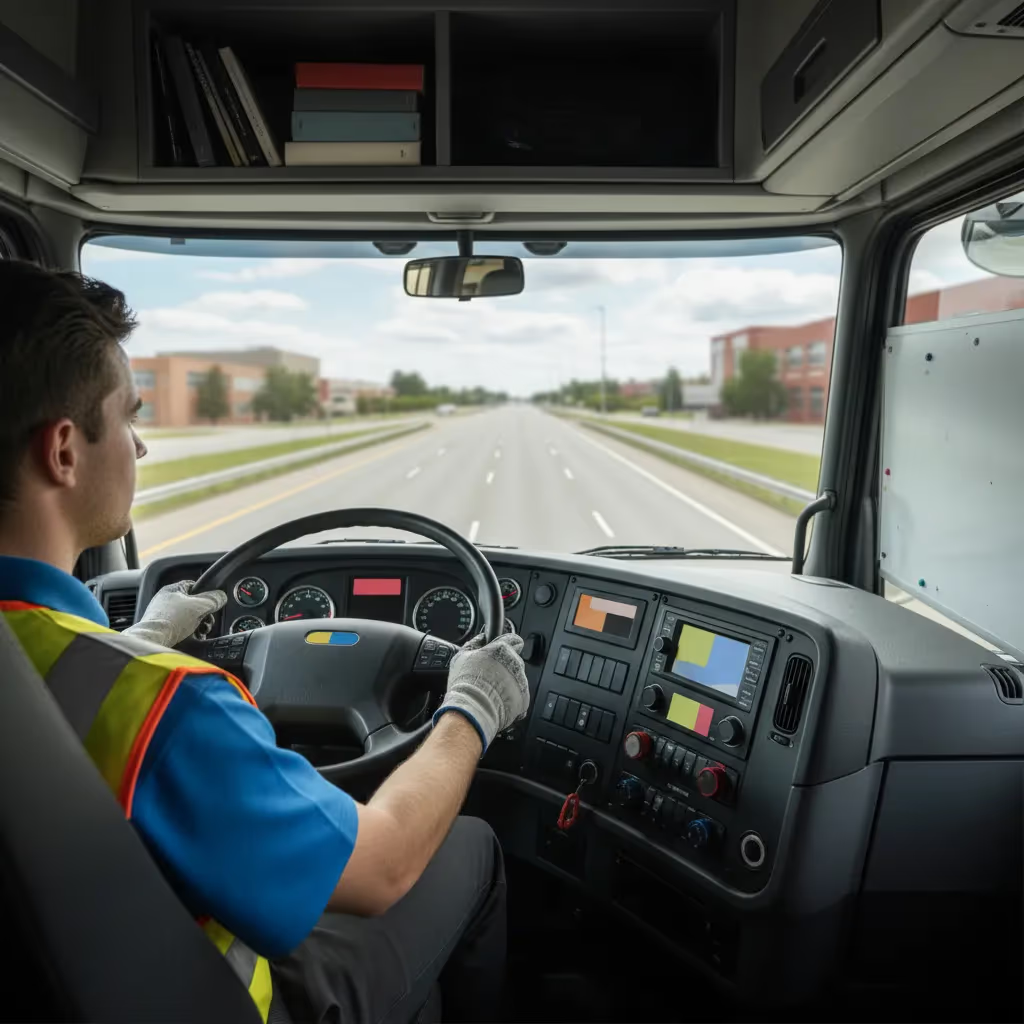
The CDL exam stands between you and a commercial driving career that pays $50,000 to $80,000 per year right out of training. But here's what most people don't realize until they're already enrolled in a CDL school: it's actually three separate tests, not one. You'll take a written knowledge test, a skills test with three parts, and a separate CDL medical exam — and you need to pass all of them before you can legally drive a commercial vehicle.
A sample CDL exam gives you the best preview of what you're up against on the knowledge test. The written portion covers general knowledge, air brakes, combination vehicles, and any endorsement-specific material you need. Each state administers its own version, but they're all based on the same Federal Motor Carrier Safety Administration (FMCSA) standards. The questions aren't tricky — they're straightforward if you've studied the CDL manual. The problem is the manual runs 100+ pages and most people don't read it cover to cover.
The CDL exam test process also includes a pre-trip vehicle inspection, basic vehicle control maneuvers, and an on-road driving test. Many candidates focus exclusively on the written test and show up to the skills test underprepared. That's a costly mistake — you'll pay the testing fee again if you fail, and in some states you'll wait weeks for a retest appointment. Studying for CDL exam success means preparing for all three components simultaneously.
This guide breaks down each CDL exam component, the medical requirements, endorsement options, and proven study strategies. We've included links to free CDL exam questions and practice tests that cover the exact topics you'll face on test day.
Free CDL exam questions are available from multiple sources — your state's DMV website, the FMCSA study guide, and practice test platforms like ours. The CDL practice exams free options vary in quality, so focus on questions that match your state's actual test format. Most states use multiple-choice questions with four answer options, and you need 80% correct to pass each section. General knowledge has the most questions (usually 50), while endorsement tests run shorter at 20-30 questions each.
Studying for CDL exam content is more about memorization than comprehension. The questions test whether you know specific numbers — stopping distances, weight limits, inspection intervals, air brake pressure readings. Flash cards work better than reading for this type of material. Create cards for every number mentioned in the CDL manual: 60 psi for air brake cutout, 100 psi for governor cutout, 20-second brake lag for full hydraulic braking, 4-second following distance for speeds under 40 mph. The test loves numerical questions.
CDL exam test preparation should include at least 500 practice questions across all sections you plan to take. Most candidates underestimate how many questions they need to practice. Doing 50 questions once gives you familiarity. Doing 500 questions builds the automatic recall that lets you answer confidently under test pressure. Repetition is the strategy — not reading the manual one more time.
The CDL medical exam is a Department of Transportation (DOT) physical that every commercial driver must pass before obtaining or renewing a CDL. You'll need to find a CDL medical exam near me location — DOT physicals are performed by FMCSA-certified medical examiners, not just any doctor. Use the FMCSA National Registry to find certified examiners in your area. Costs run $75 to $150, and your CDL school might include the medical exam fee in their program cost.
The CDL medical exam checks vision (20/40 in each eye with or without correction), hearing (forced whisper test at 5 feet), blood pressure (under 140/90 for a 2-year certificate), and overall physical capability. Conditions that can disqualify include uncontrolled diabetes requiring insulin (requires an exemption), epilepsy or seizure disorders, certain heart conditions, and severe sleep apnea without documented treatment compliance.
Your DOT medical card is valid for up to 2 years, though some conditions shorten it to 1 year with more frequent monitoring. Keep your medical card with your CDL at all times — driving commercially without a valid medical card is the same as driving without a valid license. Many drivers set calendar reminders 60 days before expiration to schedule their renewal physical and avoid any lapse in certification.
CDL Exam Test Sections Explained
The general knowledge test is mandatory for all CDL classes (A, B, and C). It covers vehicle inspection, basic control, safe driving practices, cargo handling, and federal regulations. Expect 50 questions — you need 40 correct (80%) to pass. Most questions come directly from the CDL manual, so candidates who've read it thoroughly have a massive advantage over those studying only from practice tests.
Key topics tested heavily: pre-trip inspection procedures, safe following distances by speed, hazardous conditions driving adjustments, load securement requirements, and hours-of-service regulations. The HOS rules change periodically — make sure your study materials reflect the most current 2024-2025 FMCSA regulations, not older versions that some outdated practice tests still reference.
The CDL skills test has three parts that you'll take on the same day at a state-approved testing location. First is the pre-trip vehicle inspection — you'll walk around the truck pointing out and explaining every component an examiner asks about. Lights, tires, brakes, fluid levels, steering, suspension, exhaust, coupling devices — you need to know what each part does and how to identify defects. This portion alone takes 30-45 minutes and requires genuine knowledge of the vehicle, not just test answers.
Basic vehicle control comes next. You'll perform straight-line backing, offset backing (alley dock), and parallel parking with a full-size commercial vehicle. These maneuvers test your spatial awareness and ability to control a vehicle that's 53 to 72 feet long. Most CDL schools dedicate significant yard time to these maneuvers because they're where most skills test failures occur. Practice until you can complete each maneuver within the time limit and pull-up allowances without hitting cones.
The on-road driving test is the final component — typically 30-45 minutes of actual driving in traffic. The examiner evaluates your lane changes, turns, highway merging, intersection navigation, railroad crossings, and general traffic awareness. Automatic failures include any collision, running a red light, or unsafe lane change. Point deductions accumulate for things like wide turns, not checking mirrors frequently enough, or rolling through a stop sign. Most candidates find this the easiest section because driving feels more natural than the yard maneuvers.
CDL endorsement tests add specialized driving privileges to your license. The most common and lucrative endorsement is the HazMat (H) endorsement — it requires a separate written test plus a TSA background check, but it opens jobs paying $5,000 to $15,000 more annually than standard freight. Tanker (N), doubles/triples (T), and passenger (P) endorsements each require their own written test but no additional skills test. The TWIC card required for port access is separate from CDL endorsements but often pursued alongside HazMat.
CDL practice exams free for endorsement sections are harder to find than general knowledge practice. Most free resources focus on the general knowledge and air brake tests because those have the highest demand. For endorsement-specific practice, check your state DMV's website first — some states publish official sample questions. Otherwise, our practice test library covers HazMat, tanker, doubles/triples, passenger, and school bus endorsement material based on the current FMCSA standards.
Each endorsement test runs 20 to 30 questions with an 80% passing requirement. You can take multiple endorsement tests on the same day as your general knowledge test — some states let you knock out everything in one visit. Budget 15 to 20 minutes per endorsement test. The questions are less technical than air brakes — mostly about regulations, placarding requirements, and specific procedures for the endorsed vehicle type. A weekend of focused study per endorsement is usually sufficient.
Is Getting a CDL Worth It in 2026?
- +Starting salaries of $50,000-$65,000 with experienced drivers earning $70,000-$90,000+
- +Massive driver shortage means high demand and job security across the industry
- +CDL training takes only 3-7 weeks — fastest path to a middle-class salary without a degree
- +Company-sponsored training programs often cover tuition in exchange for employment commitment
- +Multiple career paths: long-haul, local delivery, tanker, flatbed, specialized freight
- +Owner-operator potential once experienced — gross revenues of $150,000-$300,000 annually
- −Over-the-road drivers spend weeks away from home — local jobs pay less but offer daily returns
- −Physical demands including loading/unloading, vehicle inspection, and long hours of sitting
- −Strict drug and alcohol testing — random DOT testing throughout your career
- −Hours-of-service regulations limit driving time and earning potential during busy periods
- −Insurance costs for owner-operators can exceed $15,000 annually
- −Sedentary driving lifestyle contributes to health issues without deliberate exercise habits
CDL exam preparation timelines depend on whether you're studying independently for the permit or enrolled in a full CDL program. For the written knowledge test alone, most candidates need 1-3 weeks of daily study to pass comfortably. Read the CDL manual once cover-to-cover, then spend remaining time on practice tests. Don't just take practice tests passively — review every wrong answer and understand why the correct answer is correct. That review process teaches you more than the questions themselves.
The best CDL study approach combines reading with active recall. Read a chapter of the CDL manual, then immediately do 20 practice questions on that topic without looking back. Check your answers, reread the sections you missed, and repeat. This study method takes longer per session but produces dramatically better retention than passive reading or random practice test clicking. You're training your brain to retrieve information under pressure — exactly what the test demands.
Study groups work well for CDL exam preparation because the material is factual, not subjective. Quiz each other on air brake pressure readings, stopping distances, and inspection sequences. Having someone test you verbally is better than reading your own flash cards because it simulates the pressure of the actual test where you can't flip the card over to check. Two to three study partners who are all testing within the same month creates healthy accountability and competition.
CDL Exam Day Preparation Checklist
- ✓Bring valid driver's license, CDL permit, and DOT medical card to the testing location
- ✓Arrive 30 minutes early to complete paperwork and vehicle check-in procedures
- ✓Verify your test vehicle meets all state inspection requirements before arriving
- ✓Complete pre-trip inspection practice at least 10 times before the skills test date
- ✓Practice all basic vehicle control maneuvers until you can complete them without pull-ups
- ✓Score 85%+ on at least 5 consecutive full-length practice tests before the written exam
- ✓Memorize all critical air brake pressure readings and stopping distance formulas
- ✓Get a full night's sleep — fatigue impairs reaction time and decision-making on the road test
- ✓Review coupling/uncoupling sequence one final time if testing for Class A combination
- ✓Bring water and a snack — the full skills test can take 2-3 hours with waiting time
CDL exam cost varies by state but typically runs $50 to $150 for the complete testing process. That includes the written knowledge test fee, commercial learner's permit (CLP) issuance, and skills test appointment. Some states charge separately for each component — $10-$25 for the written test, $25-$50 for the CLP, and $50-$100 for the skills test. Endorsement tests usually add $5-$15 per endorsement. Your DOT physical is a separate cost ($75-$150) not included in state testing fees.
CDL school costs represent a much larger investment: $3,000 to $10,000 for a full program. But company-sponsored training programs offer an alternative — major carriers like Werner, Swift, CRST, and Schneider will train you for free in exchange for a 1-2 year employment commitment. If you leave before the commitment period, you'll owe the training cost. These programs are legitimate and how many successful drivers enter the industry, though the first-year pay is typically lower than starting with your own CDL from an independent school.
The CDL exam retake policy varies by state. Most states allow unlimited retakes on the written knowledge test with a 1-3 day waiting period between attempts. Skills test retakes usually require a 7-14 day wait and cost the full testing fee again. Some states limit you to 3 skills test attempts before requiring additional training documentation. Plan to pass on your first attempt — beyond the cost, repeated failures delay your earning timeline by weeks or months and can signal to employers that you struggled with the fundamentals.
The ELDT (Entry Level Driver Training) requirement that took effect in February 2022 changed how new CDL applicants prepare. You can no longer just study the manual, pass the written test, practice with a friend's truck, and take the skills test. First-time CDL applicants must now complete training at an FMCSA-registered training provider that includes both theory and behind-the-wheel instruction. Your training provider reports completion to the FMCSA's Training Provider Registry (TPR), and the state won't schedule your skills test without that verification.
Finding the right CDL school matters more since ELDT went into effect. Check that any school you consider is registered on the FMCSA TPR — unregistered programs can't fulfill the ELDT requirement regardless of their training quality. Compare programs on behind-the-wheel hours (more is better, minimum 30-40 hours for Class A), job placement rates, equipment condition, and instructor-to-student ratios. A program with 80 behind-the-wheel hours produces more confident drivers than one with the bare minimum of 30.
CDL exam preparation resources have improved significantly since ELDT raised the bar for training quality. Most registered training providers now include comprehensive written test preparation alongside their behind-the-wheel instruction. If yours doesn't, supplement with online practice tests covering general knowledge, air brakes, and combination vehicles. The written test knowledge and the skills test performance reinforce each other — understanding why you check a specific component during pre-trip makes you better at remembering that component during the actual inspection.
First-time CDL applicants must complete training at an FMCSA-registered provider before scheduling the skills test. Self-study alone no longer qualifies. Verify your training school is listed on the FMCSA Training Provider Registry (TPR) before enrolling — unregistered programs waste your time and money since the state won't accept their completion certificates.
Career paths after passing your CDL exam extend far beyond long-haul trucking. Local delivery drivers earn $50,000-$65,000 with daily home time. Tanker drivers handling fuel or chemicals earn $65,000-$85,000. Flatbed operators specializing in oversized loads can exceed $80,000. And specialized niches like ice road trucking, auto hauling, or heavy equipment transport push well into six figures for experienced drivers willing to take on challenging loads.
The trucking industry's driver shortage is projected to reach 160,000 unfilled positions by 2030 according to the American Trucking Associations. That shortage translates directly into better pay, signing bonuses, and improved working conditions for new CDL holders. Companies that struggled to attract drivers five years ago are now offering $5,000-$10,000 signing bonuses, guaranteed minimum weekly pay, and newer equipment to compete for qualified applicants.
Your CDL is a portable credential that works in every state and opens opportunities nationwide. Unlike many certifications tied to a single employer or region, a CDL holder can work for any carrier, in any state, hauling any legal cargo their license class and endorsements permit. That portability means you're never stuck — if your current employer's pay or conditions don't meet your expectations, dozens of other carriers are actively recruiting experienced drivers with clean records.
CDL Practice Test Questions
Prepare for the CDL - Commercial Driver's License exam with our free practice test modules. Each quiz covers key topics to help you pass on your first try.
CDL Alabama CDL Combination Vehicles Pract...
CDL Exam Questions covering Alabama CDL Combination Vehicles Practice Test. Master CDL Test concepts for certification prep.
CDL Alabama CDL General Knowledge Practice...
Free CDL Practice Test featuring Alabama CDL General Knowledge Practice Test #. Improve your CDL Exam score with mock test prep.
CDL Alabama General Knowledge CDL Practice...
CDL Mock Exam on Alabama General Knowledge CDL Practice Test. CDL Study Guide questions to pass on your first try.
CDL Airbrakes Practice Test
CDL Test Prep for Airbrakes Practice Test. Practice CDL Quiz questions and boost your score.
CDL Air Brakes Practice Test
CDL Questions and Answers on Air Brakes Practice Test. Free CDL practice for exam readiness.
CDL CLASS A COMMERCIAL DRIVER'S LICENSE PR...
CDL Mock Test covering CLASS A COMMERCIAL DRIVER'S LICENSE PRACTICE TEST. Online CDL Test practice with instant feedback.
CDL Class B Commercial Driver's License Pr...
Free CDL Quiz on Class B Commercial Driver's License Practice Test. CDL Exam prep questions with detailed explanations.
CDL Combination Vehicles Practice Test
CDL Practice Questions for Combination Vehicles Practice Test. Build confidence for your CDL certification exam.
CDL Doubles and Triples Practice Test
CDL Test Online for Doubles and Triples Practice Test. Free practice with instant results and feedback.
CDL Doubles Triples Practice Test
CDL Study Material on Doubles Triples Practice Test. Prepare effectively with real exam-style questions.
CDL General Knowledge Practice Test
Free CDL Test covering General Knowledge Practice Test. Practice and track your CDL exam readiness.
CDL General Knowledge Practice Test1
CDL Exam Questions covering General Knowledge Practice Test1. Master CDL Test concepts for certification prep.
CDL Hazardous Materials (Hazmat) Practice ...
Free CDL Practice Test featuring Hazardous Materials (Hazmat) Practice Test. Improve your CDL Exam score with mock test prep.
CDL Hazardous Materials Hazmat Practice Test
CDL Mock Exam on Hazardous Materials Hazmat Practice Test. CDL Study Guide questions to pass on your first try.
CDL Hazmat Practice Test
CDL Test Prep for Hazmat Practice Test. Practice CDL Quiz questions and boost your score.
CDL Passenger Transport Practice Test
CDL Questions and Answers on Passenger Transport Practice Test. Free CDL practice for exam readiness.
CDL Road Signs and Signals Practice Test
CDL Mock Test covering Road Signs and Signals Practice Test. Online CDL Test practice with instant feedback.
CDL School Bus Endorsement Practice Test
Free CDL Quiz on School Bus Endorsement Practice Test. CDL Exam prep questions with detailed explanations.
CDL School Bus Endorsement S Practice Test
CDL Practice Questions for School Bus Endorsement S Practice Test. Build confidence for your CDL certification exam.
CDL Tanker Practice Test
CDL Test Online for Tanker Practice Test. Free practice with instant results and feedback.
CDL Class A Commercial Driver's License Pr...
CDL Study Material on Class A Commercial Driver's License Practice Test -1. Prepare effectively with real exam-style questions.
CDL Class A Driver's License Practice Test -2
Free CDL Test covering Class A Driver's License Practice Test -2. Practice and track your CDL exam readiness.
CDL Class A Driver's License Practice Test -3
CDL Exam Questions covering Class A Driver's License Practice Test -3. Master CDL Test concepts for certification prep.
CDL Class A Driver's License Practice Test -5
Free CDL Practice Test featuring Class A Driver's License Practice Test -5. Improve your CDL Exam score with mock test prep.
CDL Class B Commercial Driver's License Pr...
CDL Mock Exam on Class B Commercial Driver's License Practice Test -2. CDL Study Guide questions to pass on your first try.
CDL Class C CDL with Hazmat Endorsement Pr...
CDL Test Prep for Class C CDL with Hazmat Endorsement Practice Test. Practice CDL Quiz questions and boost your score.
CDL Class C CDL with Hazmat Endorsement Pr...
CDL Questions and Answers on Class C CDL with Hazmat Endorsement Practice Test -2. Free CDL practice for exam readiness.
CDL Class C CDL with Hazmat Endorsement Pr...
CDL Mock Test covering Class C CDL with Hazmat Endorsement Practice Test -3. Online CDL Test practice with instant feedback.
If you're weighing CDL school against other career options, consider the math. A 4-7 week CDL program costing $3,000-$7,000 leads to a $50,000+ starting salary. Compare that to a 4-year degree costing $40,000-$100,000 that might lead to a $35,000-$45,000 entry-level salary with student debt. The CDL pays for itself within the first few months of employment. That financial equation is why the industry continues to attract career changers from office jobs, retail, food service, and other sectors where pay hasn't kept pace with living costs.
First-year CDL drivers should expect a learning curve regardless of how well they did on the exam. The test proves you meet minimum standards — actual trucking skill develops over your first 50,000 to 100,000 miles behind the wheel. Choose your first employer based on training support, not just top-line pay. Companies with strong mentorship programs, modern equipment, and reasonable first-year expectations produce drivers who stay in the industry long-term. The ones that throw new drivers into demanding routes immediately have the highest turnover rates for a reason.
Start your CDL exam preparation today. Read the CDL manual for your state (available free online from every state DMV), take practice tests until you're consistently scoring above 85%, and research training programs in your area. The sooner you begin, the sooner you'll have a CDL in your wallet and a career that puts you in control of your earning potential for decades to come. The industry needs drivers — and the exam is the only thing standing between where you are now and where you want to be.
CDL Questions and Answers
About the Author

Licensed Driving Instructor & DMV Test Specialist
Penn State UniversityRobert J. Williams graduated from Penn State University with a degree in Transportation Management and has spent 20 years as a certified driving instructor and DMV examiner consultant. He has personally coached thousands of applicants through written knowledge tests, skills assessments, and commercial driver licensing programs across more than 30 states.
Join the Discussion
Connect with other students preparing for this exam. Share tips, ask questions, and get advice from people who have been there.
View discussion (7 replies)