
How to Become a Truck Driver: Your Step-by-Step CDL Career Guide 2026
Pass your How to Become a Truck Driver: Your Step exam on the first attempt. Practice questions with detailed answer explanations, hints, and instant
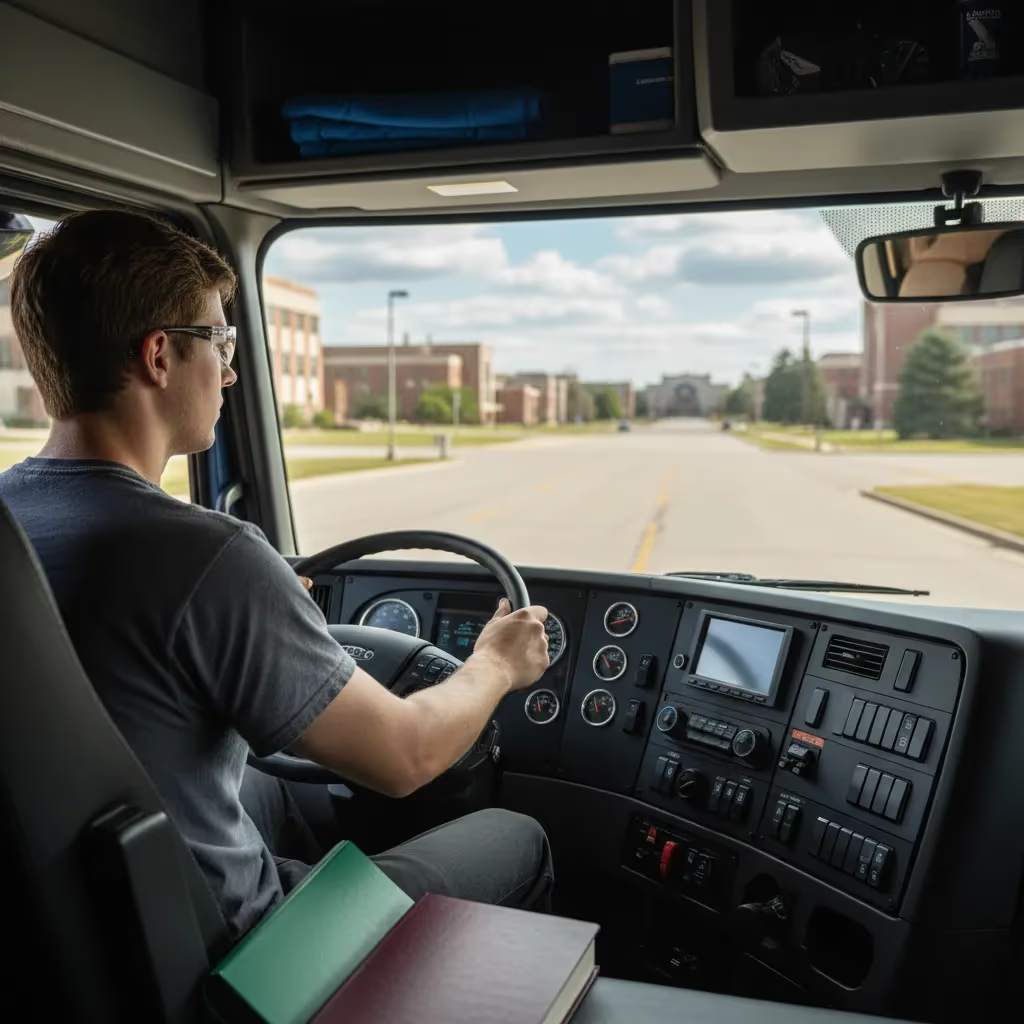
You don't need a college degree to earn $80,000 your first year on the road. That's the honest truth about trucking — it's one of the fastest career paths from zero experience to a real paycheck. If you've been wondering how to become a truck driver, the process is more straightforward than most people think. Get your CDL permit, complete training, pass the skills test, get hired. Four steps. No student loan debt hanging over you for decades. Practice with the free CDL practice test on PracticeTestGeeks (32 questions with answer explanations).
Here's what trips people up: what schooling or training to become a truck driver actually looks like. Since February 2022, the FMCSA requires Entry-Level Driver Training (ELDT) for all new CDL applicants. That means you can't just study a handbook and show up at the DMV anymore. You'll attend an accredited CDL school — most programs run three to seven weeks — where you'll log behind-the-wheel hours on real trucks. Some carriers offer company-sponsored training that covers tuition entirely. The catch? You'll typically commit to driving for that company for a year or two afterward.
Interstate driving requires you to be at least 21 years old. If you're 18 to 20, you can still drive intrastate — within your home state's borders. That's a real option for younger drivers who want to start building experience early. The pay gap between intrastate and interstate narrows as you gain endorsements and specialized skills. Starting salaries for new how to become a cdl truck driver typically range from $50,000 to $65,000, with experienced drivers clearing $80K or more depending on the freight type.
Free CDL Study Tools
Interactive CDL resources on PracticeTestGeeks, free to start:
- Class A Driver's License Practice Test -2 — 32 questions with instant scoring and answer explanations
- CDL flashcards — review key terms and concepts card by card
- CDL study guide — topic-by-topic overview of what the exam covers
- CDL cheat sheet — one-page printable summary for last-minute review

So what schooling or training to become a truck driver do you actually need? It depends on the path you pick. Private CDL schools charge anywhere from $3,000 to $10,000 for a full program. Community colleges sometimes offer CDL courses at lower rates, though availability varies by state. Company-sponsored programs — where a carrier pays your tuition — are free upfront but lock you into a driving contract. Break the contract early, and you'll owe back the tuition cost. Read the fine print.
How long does it take to become a truck driver? Most people go from complete beginner to licensed CDL holder in four to eight weeks. The breakdown: one to two weeks studying for your CLP (Commercial Learner's Permit), then three to seven weeks in a CDL training program. Some accelerated programs compress everything into three weeks, but those are intense — eight to ten hours a day behind the wheel and in the classroom. If you're working a current job, evening or weekend programs exist too, though they stretch the timeline to eight to twelve weeks.
The CDL knowledge test covers general knowledge, air brakes, and combination vehicles. You'll take this at your local DMV or licensing office to get your permit. Most states let you retake it if you fail, though there's usually a waiting period. Study the CDL manual for your state — the questions pull directly from it. Don't overthink the test. It's multiple choice, and the pass rate is decent if you actually read the material.
Wondering how to become a truck driver with no experience? You're not alone — almost every trucker started at zero. The industry is built around training new drivers. Large carriers like Werner, Swift, and CRST run their own CDL training programs specifically for people who've never touched an 18-wheeler. They'll teach you everything from pre-trip inspections to backing into tight loading docks. Most of these programs include job placement at the end, so you walk out with both a CDL and a paycheck lined up.
Understanding how to become a cdl truck driver means knowing the endorsement system. Your base Class A CDL lets you drive most tractor-trailers. But specialized endorsements open higher-paying doors: Hazmat (H) for hazardous materials, Tanker (N) for liquid loads, Doubles/Triples (T) for multi-trailer rigs. Each endorsement requires its own written test. The Hazmat endorsement also requires a TSA background check and fingerprinting, which adds a few weeks to the process.
One thing nobody tells new drivers: your first year is the hardest. You'll be away from home for weeks at a time on OTR (over-the-road) routes. The pay is lower than what experienced drivers earn. And you'll make mistakes — missed turns, awkward backing maneuvers, slow fuel stops. That's normal. Every driver you see on the highway went through the same learning curve. Stick it out past year one, and your options — and your salary — expand dramatically.
CDL Training Paths Compared
Cost: $3,000–$10,000. Duration: 3–7 weeks full-time. You pick the school, you pick the carrier afterward. No contract obligations. Best for drivers who want maximum flexibility in choosing their first employer. Many schools have job placement rates above 90%. Look for ELDT-registered programs on the FMCSA Training Provider Registry.
Different truck types mean different career paths — and different licensing requirements. How to become a dump truck driver is actually one of the simpler routes into commercial driving. Most dump trucks require a Class B CDL, which is easier to obtain than the Class A needed for tractor-trailers. Training programs for Class B are shorter — often two to three weeks. Dump truck drivers typically work local routes, meaning you're home every night. Starting pay ranges from $40,000 to $55,000, with experienced operators in construction-heavy regions earning north of $65,000.
If you're looking at long-haul freight, knowing how to become a semi truck driver is where the real money is. Semi trucks — the 18-wheelers you see on highways — require a Class A CDL. These are the jobs that pay $50,000 to $65,000 starting, with top earners clearing $90,000 or more. OTR semi drivers spend two to three weeks on the road before getting home time. Regional routes offer a middle ground: slightly less pay but more predictable schedules with weekly home time.
Specialized hauling pays even better. Flatbed drivers who can secure oversized loads earn premium rates. Refrigerated (reefer) drivers who haul temperature-sensitive freight get higher per-mile pay. And owner-operators — drivers who own their trucks — can gross $200,000 or more annually, though expenses eat into that significantly. The point is: once you have your CDL, the career branches in a dozen different directions.
Not every trucking job demands a CDL. If you're curious about how to become a non CDL box truck driver, the barrier to entry is significantly lower. Box trucks under 26,001 pounds GVWR don't require a commercial driver's license in most states. You'll drive with your regular Class C or Class D license. Companies like Amazon, FedEx Ground, and local delivery services hire non-CDL box truck drivers constantly. The work is typically local — you'll deliver packages or freight within a metro area and be home every evening.
Pay for non-CDL box truck positions starts around $35,000 to $45,000 annually. That's less than CDL driving, but consider the tradeoffs: no expensive training program, no weeks away from home, no air brake endorsements to maintain. Many drivers start in box trucks to get a feel for commercial driving before deciding whether to invest in CDL school. It's a smart stepping stone if you're not sure trucking is right for you.
The job market for delivery drivers has exploded since 2020. E-commerce growth means companies need more last-mile delivery capacity every year. Some non-CDL box truck drivers work as independent contractors, leasing their vehicles and setting their own schedules. Others work directly for logistics companies with full benefits. Either way, if you can handle a 24-foot box truck in city traffic, there's work waiting for you right now.
Truck Driving Career: Pros and Cons
- +No college degree required — earn while peers take on student debt
- +Starting pay of $50K–$65K with raises after first year
- +Massive job demand — the industry needs 80,000+ new drivers annually
- +Company-sponsored training means $0 out-of-pocket to get started
- +Career variety: OTR, regional, local, specialized, owner-operator
- +See the country while getting paid — every route is different
- −Weeks away from home on OTR routes, especially your first year
- −Sedentary lifestyle leads to health risks without active effort
- −Irregular sleep schedules and tight delivery deadlines
- −High insurance and maintenance costs if you become an owner-operator
- −DOT regulations and ELD requirements restrict flexibility on the road
- −Physical demands: loading/unloading, pre-trip inspections in all weather
Pros and Cons at a Glance
| Pros | Cons |
|---|---|
| No college degree required — earn while peers take on student debt | Weeks away from home on OTR routes, especially your first year |
| Career variety: OTR, regional, local, specialized, owner-operator | Sedentary lifestyle leads to health risks without active effort |
| See the country while getting paid — every route is different | Irregular sleep schedules and tight delivery deadlines |
Getting hired as a non CDL box truck driver requires minimal paperwork compared to CDL positions. You'll need a clean driving record — most employers check your MVR (motor vehicle report) going back three to five years. DUI convictions, reckless driving charges, or multiple at-fault accidents will disqualify you from most companies. A valid driver's license and the ability to pass a DOT physical are the baseline requirements. Some employers also run background checks and drug screens.
The DOT physical is mandatory for all commercial drivers, even non-CDL ones operating vehicles over 10,001 pounds. You'll visit a certified medical examiner who checks your vision, hearing, blood pressure, and overall fitness to drive. The exam costs $75 to $150 and the medical card is valid for two years. Certain conditions — like insulin-dependent diabetes or severe sleep apnea — require additional documentation or waivers. Don't skip this step. Operating without a valid medical card is a federal violation.
Route planning and GPS navigation matter more than you'd think. New box truck drivers often underestimate how different a 26-foot truck handles compared to a car. Low bridges, weight-restricted roads, tight residential streets — these are daily hazards. Use a commercial GPS designed for trucks, not a standard consumer app. And practice backing into loading docks before your first day. That's where most new drivers struggle, and nobody wants to block a busy warehouse bay for twenty minutes.
Your CDL Checklist: 10 Steps to the Driver's Seat
- ✓Confirm you meet age requirements: 21 for interstate, 18 for intrastate
- ✓Get a DOT physical and obtain your medical examiner's certificate
- ✓Study the CDL manual for your state — focus on general knowledge and air brakes
- ✓Pass the CDL knowledge test at your DMV to get your Commercial Learner's Permit (CLP)
- ✓Choose a training path: private school, company-sponsored, or community college
- ✓Verify your school is registered on the FMCSA Training Provider Registry (ELDT requirement)
- ✓Complete behind-the-wheel training — minimum hours vary by state
- ✓Schedule and pass the CDL skills test: pre-trip inspection, basic controls, road test
- ✓Add endorsements (Hazmat, Tanker, Doubles/Triples) for higher-paying opportunities
- ✓Apply to carriers — have your CDL number, medical card, and MVR ready
The financial side of becoming a non CDL box truck driver is appealing for people who want steady income without a big upfront investment. No $5,000 CDL school tuition. No weeks sitting in a classroom. You can literally apply on Monday and start driving by Friday at many delivery companies. Amazon DSPs (Delivery Service Partners) hire constantly and provide their own vehicles — you just show up, load the van or box truck, and run your route.
But don't confuse "easy to start" with "easy work." Box truck delivery is physically demanding. You'll lift packages weighing up to 50 pounds hundreds of times per day. Your stops-per-hour metrics are tracked — fall behind consistently and you'll hear about it. Summer heat inside a non-air-conditioned cargo area is brutal. Winter ice makes every loading dock a potential slip hazard. The turnover rate in last-mile delivery is high for a reason.
That said, drivers who stick with it often move into higher-paying roles. Route supervisors, dispatch coordinators, and fleet managers all started behind the wheel. Some non-CDL drivers decide to get their CDL after a year or two, using their delivery experience as a foundation. The transition from box truck to semi isn't as steep as going in cold — you already understand DOT regs, hours of service, and vehicle inspections. You're just scaling up the equipment.
If you're exploring paths outside the traditional CDL route, understanding how to become a non CDL box truck driver opens doors you might not have considered. Hot shot trucking — hauling time-sensitive freight on flatbed trailers with a heavy-duty pickup — is another non-CDL option if your combined GVWR stays under 26,001 pounds. Hot shot drivers earn $50,000 to $80,000 annually, though fuel and equipment costs eat into margins. You'll need a Class D license, a capable truck, and a trailer — plus cargo insurance and a DOT number if you're operating as a business.
Expedited freight is another niche worth knowing about. Companies like Expediter Services and Load One hire teams of drivers to deliver urgent shipments — medical supplies, auto parts, perishable goods. Some of these loads move in sprinter vans or straight trucks that don't require a CDL. The pay is per-mile and can be lucrative on long runs. The tradeoff: unpredictable schedules and the pressure of time-critical deliveries. Not everyone thrives under that kind of urgency.
Moving companies represent yet another non-CDL opportunity. Local movers rarely need CDL holders for their box trucks, and the work is steady year-round in growing metro areas. The physical demands are real — you're carrying furniture up staircases, not just steering a vehicle — but the daily pay often exceeds standard delivery routes. Seasonal peaks during summer moving season can push weekly earnings well above average.
Some unaccredited schools promise a CDL in under a week for premium prices. These "CDL mills" cut corners on behind-the-wheel hours and may not be registered with the FMCSA Training Provider Registry. If your school isn't on the TPR, your training won't count — you'll have to start over at a legitimate program. Always verify registration at tpr.fmcsa.dot.gov before paying any tuition. If they pressure you to sign fast, walk away.
The market for non CDL box truck drivers keeps growing every quarter. E-commerce isn't slowing down — if anything, same-day and next-day delivery expectations are pushing demand even higher. Companies that five years ago used only CDL drivers for regional routes are now splitting those loads into smaller box truck shipments to speed up delivery windows. That trend creates opportunities for drivers who don't want to invest in CDL training right away.
Independent contracting is worth mentioning here. Platforms like Amazon Relay, Uber Freight, and DAT load boards list loads that non-CDL drivers can haul — if you own or lease the right equipment. The upside is schedule flexibility and higher per-load rates. The downside is everything else: fuel costs, insurance premiums, vehicle maintenance, self-employment taxes, and zero benefits. Run the numbers carefully before buying a box truck and going independent. Many new owner-operators underestimate expenses by 30% or more.
Whether you choose CDL or non-CDL, the trucking industry rewards consistency. Show up on time. Keep your driving record clean. Communicate with dispatch when problems arise. That's it. Drivers who do these three things consistently get the best routes, the best equipment, and the best pay. No secret formula — just reliability. In an industry with high turnover, being the driver who actually shows up is worth more than any certification.
CDL Practice Test Questions
Prepare for the CDL - Commercial Driver's License exam with our free practice test modules. Each quiz covers key topics to help you pass on your first try.
CDL Alabama CDL Combination Vehicles Pract...
CDL Exam Questions covering Alabama CDL Combination Vehicles Practice Test. Master CDL Test concepts for certification prep.
CDL Alabama General Knowledge CDL Practice...
CDL Mock Exam on Alabama General Knowledge CDL Practice Test. CDL Study Guide questions to pass on your first try.
CDL Airbrakes Practice Test
CDL Test Prep for Airbrakes Practice Test. Practice CDL Quiz questions and boost your score.
CDL CLASS A COMMERCIAL DRIVER'S LICENSE PR...
CDL Mock Test covering CLASS A COMMERCIAL DRIVER'S LICENSE PRACTICE TEST. Online CDL Test practice with instant feedback.
CDL Hazmat Practice Test
CDL Test Prep for Hazmat Practice Test. Practice CDL Quiz questions and boost your score.
CDL Tanker Practice Test
CDL Test Online for Tanker Practice Test. Free practice with instant results and feedback.
CDL Class A Commercial Driver's License Pr...
CDL Study Material on Class A Commercial Driver's License Practice Test -1. Prepare effectively with real exam-style questions.
Let's talk about the non CDL box truck driver lifestyle. Unlike OTR trucking, you're home every night. Your routes are predictable after the first few weeks — same neighborhoods, same delivery windows, same loading dock locations. Some drivers love that routine. Others find it monotonous compared to the open-road freedom of long-haul trucking. Know yourself before you commit to either path.
Benefits vary wildly depending on your employer. Direct employees at major carriers (UPS, FedEx, XPO Logistics) typically get health insurance, 401(k) matching, paid time off, and tuition reimbursement. Independent contractors and DSP drivers get none of that — you're on your own for healthcare and retirement savings. That compensation gap matters more than the hourly rate difference suggests. A $45,000 salary with full benefits can be worth more than $55,000 with nothing.
The future of trucking is shifting, and drivers who adapt will thrive. Electric trucks are entering fleets in urban areas — Rivian, BrightDrop, and others are already delivering vehicles to Amazon and FedEx. Autonomous trucking technology is advancing but remains years away from replacing drivers on most routes. Right now, there's a shortage of qualified drivers that the industry can't fill fast enough. Whether you pursue a CDL or start with a box truck, the demand for commercial drivers isn't going anywhere soon.
Sample CDL Practice Questions
Try these questions from our free CDL practice tests. The correct answer and an explanation follow each question.
As the bus driver, you are expected to announce which of the following to your passengers at a scheduled stop?
- A. All of the listed answers.
- B. Bus number.
- C. The location.
- D. Next departure time.
Answer: A. All of the listed answers.
Effective communication is essential for passenger safety and convenience in public transportation. At scheduled stops, bus drivers are expected to clearly announce the current location to inform passengers where they are, the bus number for identification, and the next departure time to help passengers plan their journey. This practice ensures passengers are well-informed and can board or alight safely and efficiently.
If a student drops an object while entering your bus, as the bus driver, you should tell the students to _______.
- A. All of the listed answers.
- B. Move to a point of safety out of the danger zones.
- C. Attempt to grab your attention to retrieve the object.
- D. Leave any dropped object behind.
Answer: A. All of the listed answers.
When a student drops an object while boarding, safety is paramount. Students should be instructed to move to a safe area away from the bus's danger zones (like the wheels or under the bus). They should also attempt to get the driver's attention to retrieve the object safely, or, if retrieval is unsafe, be prepared to leave the object behind. Prioritizing student safety over retrieving an item is crucial.
You will lose your CDL for at least three years if _______.
- A. If you are caught committing a serious traffic violation involving a CMV.
- B. If you have any detectable amount of alcohol under .04%.
- C. If you are caught committing an alcohol-related offense, leave the scene of an accident, or commit a felony while operating a CMV that is placarded for hazardous materials.
- D. If you are caught committing an alcohol related offense for the second time.
Answer: C. If you are caught committing an alcohol-related offense, leave the scene of an accident, or commit a felony while operating a CMV that is placarded for hazardous materials.
A CDL holder faces a severe disqualification of at least three years for specific offenses, especially when operating a Commercial Motor Vehicle (CMV) placarded for hazardous materials. This includes committing an alcohol-related offense, leaving the scene of an accident, or committing a felony. The increased penalty reflects the heightened risk associated with transporting dangerous goods.
A vehicle transporting hazardous materials must stop before crossing a railroad grade crossing. The driver should stop:
- A. Not closer than 15 feet and not farther than 50 feet from the nearest rail
- B. At the stop line or 10 feet from the nearest rail if there is no line
- C. At least 100 feet from the crossing to ensure the vehicle can accelerate across without stopping on the tracks
- D. Immediately before the crossing gates, regardless of distance from the rails
Answer: A. Not closer than 15 feet and not farther than 50 feet from the nearest rail
Hazmat vehicles must stop between 15 and 50 feet from the nearest rail at railroad grade crossings. This range provides a clear view of the tracks while keeping the vehicle far enough from the crossing to avoid fouling the rails.
Take the full CDL practice test
CDL Questions and Answers
How this page was made: written with AI tools and published by Nathan Beja, founder of Practice Test Geeks, who is responsible for its content. Exam facts are checked against the official sources listed below. Not reviewed by a subject-matter expert. Editorial policy
Sources & references
Exam facts on this page (fees, format, dates, passing scores) are checked against these official sources; the date is our last check. Editorial policy