
CCMA Jobs in 2026 October: Career Paths, Salary, and How to Land Your First Role
Explore ccma jobs in 2026 October: 💯 salary ranges, top employers, work settings, and how CCMA certification opens doors in clinics, hospitals, and specialty care.
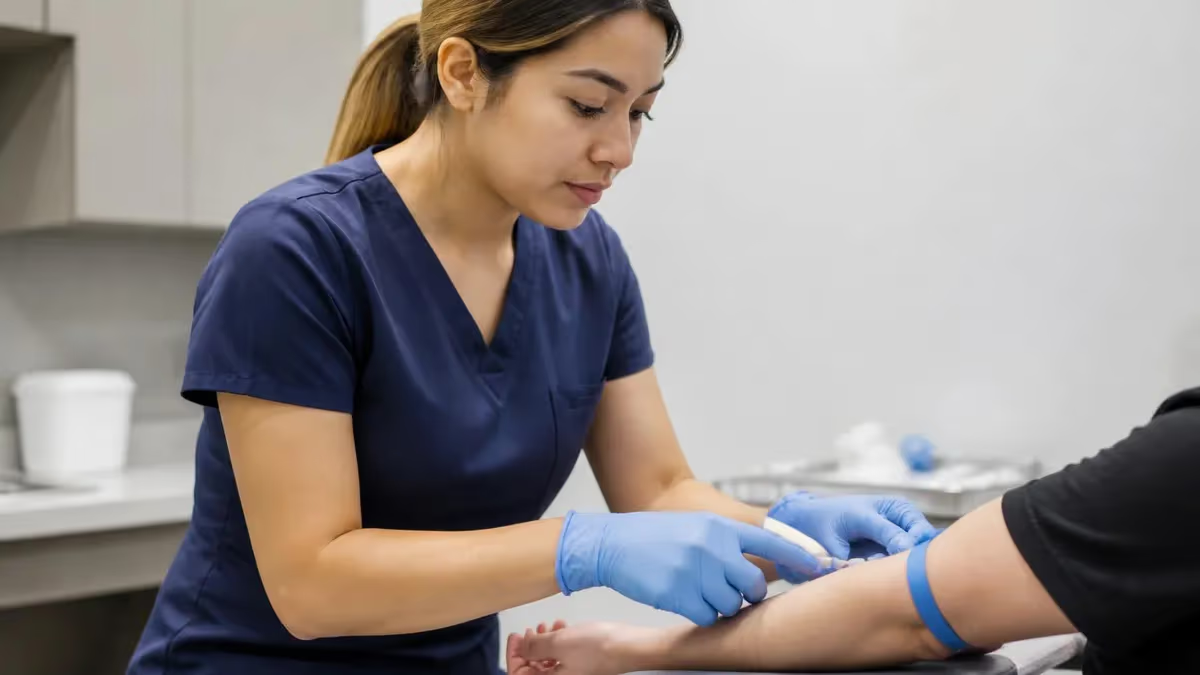
CCMA jobs are among the fastest-growing entry points into American healthcare, and 2026 is shaping up to be one of the strongest hiring years on record. The Bureau of Labor Statistics projects medical assistant employment to grow roughly 14% through 2032, far outpacing the average for all occupations. For credentialed professionals carrying the NHA ccma credential, that translates into more interviews, higher starting offers, and faster promotions inside primary care offices, specialty clinics, urgent care centers, and large hospital systems searching for clinically capable support staff.
Understanding the ccma meaning is the first step toward navigating this market. CCMA stands for Certified Clinical Medical Assistant, a credential issued by the National Healthworkforce Association (NHA) that verifies competence in both clinical tasks like phlebotomy, EKGs, injections, and vitals, and administrative work such as scheduling, electronic health records, and insurance verification. Employers prize the certification because it signals a candidate has passed a rigorous standardized exam and is ready to contribute on day one.
What makes ccma jobs especially attractive is the breadth of practice settings. A new graduate might work in a family medicine clinic one year, transition to a cardiology practice the next, and eventually move into a hospital float pool or surgical center. Each environment teaches different skills, exposes you to different patient populations, and pays differently based on acuity, location, and shift differentials. This flexibility is rare in healthcare careers that traditionally require multi-year degrees before any clinical practice begins.
Salary is another reason demand keeps climbing. The national average ccma salary in 2026 sits between $42,000 and $48,000 for early-career professionals, with metropolitan areas like Seattle, Boston, and the San Francisco Bay Area pushing top earners above $58,000. Add evening differentials, bilingual pay bumps, and certification stipends, and many CCMAs comfortably clear $50,000 within their first three years of employment.
Beyond compensation, the role offers something many healthcare jobs do not: a clear, fast pathway to higher credentials. CCMAs frequently bridge into LPN programs, surgical technologist certificates, registered nursing, ultrasound technology, or physician assistant pre-requisites. Employers often subsidize tuition because retaining a known performer is cheaper than training a stranger. That means a CCMA role can serve either as a stable long-term career or as a strategic stepping stone.
This guide walks you through the full landscape of ccma jobs in 2026: where the roles live, what they pay, who is hiring, what your day looks like, and exactly how to land your first offer. Whether you are still studying for the exam, recently certified, or two years in and ready for a promotion, you will find concrete numbers, hiring patterns, and tactical advice you can apply immediately to move your career forward in a field that increasingly cannot find enough qualified people.
We will also cover red flags to avoid when comparing offers, how to read between the lines of job descriptions, and which specialties tend to burn out new CCMAs versus which ones nurture growth. By the end you will know how to position your certification, your clinical hours, and your soft skills to win the role that fits your life plan, not just the first one that responds to your application.
CCMA Jobs by the Numbers

Where CCMAs Actually Work
The largest single employer of CCMAs. Family medicine, internal medicine, and pediatrics offices need certified staff to room patients, take vitals, administer vaccines, and manage EHR workflows for 18-30 patients a day.
Cardiology, orthopedics, dermatology, and OB-GYN offices pay 8-15% more than primary care. Expect specialized procedures like EKGs, casting assistance, skin biopsies, and prenatal vitals as part of your daily routine.
Large systems hire CCMAs for outpatient clinics, pre-admission testing, and float pools. Benefits packages are stronger, shift differentials exist, and internal transfer opportunities multiply your long-term options.
Fast-paced environments with 12-hour shifts and higher hourly rates. CCMAs handle triage, point-of-care testing, splinting, and laceration setup, gaining acute-care exposure that strengthens future job applications.
A growing category. Remote CCMAs handle pre-visit intake, medication reconciliation, and chronic care management calls. Roles favor candidates with strong typing speed, EHR fluency, and empathetic phone presence.
Salary expectations for ccma jobs vary widely based on geography, employer size, and clinical specialty, so understanding the full picture before accepting an offer is essential. According to 2026 compensation data aggregated from Indeed, Glassdoor, and the NHA's own employer surveys, the national median total compensation for a certified clinical medical assistant sits at $45,200, with the middle 50% earning between $39,800 and $51,400. Outliers on the high end, typically senior CCMAs in specialty surgical practices, can exceed $62,000 annually.
Earning a formal ccma certification from NHA is the single biggest lever you can pull as a new entrant. Multiple employer surveys show certified candidates receive offers that are 9-12% higher than non-certified applicants with similar experience. The credential reduces an employer's training risk, signals exam-validated competence, and frequently unlocks tuition reimbursement, sign-on bonuses, and accelerated review cycles. In tight labor markets, hiring managers often filter resumes to credentialed applicants first.
Geography compounds the certification premium dramatically. A CCMA in rural Mississippi may start at $33,000 while the same credential in Boston commands $52,000 to start. The five highest-paying metro areas in 2026 are San Francisco, Seattle, New York, Boston, and Washington D.C., where cost-of-living adjustments push median pay above $55,000. The five lowest-paying tend to be rural counties in Alabama, Mississippi, Arkansas, Louisiana, and West Virginia, where pay can dip below $34,000 despite identical job duties.
Setting matters almost as much as zip code. Hospital outpatient clinics and large academic medical centers consistently pay 7-11% more than independent physician practices because they operate on union or system-wide pay scales with predictable step increases. Specialty practices, especially orthopedics, cardiology, and dermatology, also pay above primary care because the procedural revenue per patient is higher and physicians want experienced support staff who require less direction.
Shift differentials, on-call pay, and bilingual stipends can quietly add $3,000-$7,000 to your annual income without changing your base rate. Spanish-speaking CCMAs are particularly valuable in California, Texas, Florida, and Arizona, where many practices offer a flat $1-$2 per hour bilingual bonus that compounds across thousands of hours per year. Evening clinics and Saturday urgent care shifts commonly add 10-15% on top of base wages, which is significant for early-career professionals trying to accelerate savings.
Benefits often matter more than the headline wage, especially for newer CCMAs comparing offers. Hospital systems typically offer 18-25 days of paid time off, fully paid CCMAs continuing education, free or subsidized scrubs, tuition reimbursement of $3,000-$5,250 per year, and 401(k) matches of 3-6%. A $42,000 hospital job with a 5% match and $5,000 in tuition assistance can financially outperform a $46,000 small-clinic offer with no retirement plan and bare-minimum PTO.
Finally, never accept the first number an employer quotes without comparable research. Pull salary data from the BLS Occupational Employment and Wage Statistics tables, cross-check with state-specific reports from your local workforce commission, and search Glassdoor for the exact employer name. Coming into a negotiation armed with three data points raises your starting offer an average of 4-7%, which compounds significantly across raises and future job changes throughout your career.

CCMA Practice Test Questions
Prepare for the CCMA - Certified Clinical Medical Assistant exam with our free practice test modules. Each quiz covers key topics to help you pass on your first try.
CCMA Administrative Duties
CCMA Exam Questions covering Administrative Duties. Master CCMA Test concepts for certification prep.
CCMA Anatomy and Physiology Basics
Free CCMA Practice Test featuring Anatomy and Physiology Basics. Improve your CCMA Exam score with mock test prep.
CCMA - Certified Clinical Medical Assistan...
CCMA Mock Exam on - Certified Clinical Medical Assistant Patient Intake and Vitals. CCMA Study Guide questions to pass on your first try.
CCMA - Certified Clinical Medical Assistan...
CCMA Test Prep for - Certified Clinical Medical Assistant Pharmacology and Injections. Practice CCMA Quiz questions and boost your score.
CCMA - Certified Clinical Medical Assistan...
CCMA Questions and Answers on - Certified Clinical Medical Assistant Phlebotomy and Specimen Collection. Free CCMA practice for exam readiness.
CCMA Clinical Duties
CCMA Mock Test covering Clinical Duties. Online CCMA Test practice with instant feedback.
CCMA EKG Administration
Free CCMA Quiz on EKG Administration. CCMA Exam prep questions with detailed explanations.
CCMA Infection Control and Sterilization
CCMA Practice Questions for Infection Control and Sterilization. Build confidence for your CCMA certification exam.
CCMA Medical Billing and Coding Basics
CCMA Test Online for Medical Billing and Coding Basics. Free practice with instant results and feedback.
CCMA Medical Law and Ethics
CCMA Study Material on Medical Law and Ethics. Prepare effectively with real exam-style questions.
CCMA Medical Terminology
Free CCMA Test covering Medical Terminology. Practice and track your CCMA exam readiness.
CCMA Patient Care
CCMA Exam Questions covering Patient Care. Master CCMA Test concepts for certification prep.
CCMA Patient Intake and Vitals
Free CCMA Practice Test featuring Patient Intake and Vitals. Improve your CCMA Exam score with mock test prep.
CCMA Pharmacology and Injections
CCMA Mock Exam on Pharmacology and Injections. CCMA Study Guide questions to pass on your first try.
CCMA Pharmacology and Medications
CCMA Test Prep for Pharmacology and Medications. Practice CCMA Quiz questions and boost your score.
Specialty Career Tracks for the Certified Clinical Medical Assistant
Primary care is where most certified clinical medical assistant careers begin. You'll room patients, document chief complaints, take vitals, administer vaccines, draw labs, and queue prescription refills. The pace is steady, typically 18-25 patients per provider per day, and the work tends to follow a predictable schedule with weekends and major holidays off.
The trade-off is moderate pay growth compared to specialty roles. Expect a starting wage between $17 and $20 per hour with annual raises of 2-4%. The upside is broad clinical exposure: you'll see pediatrics, geriatrics, women's health, mental health screenings, and chronic disease management, which builds an extraordinarily versatile resume for future specialty moves or nursing school.
Is a CCMA Career Right for You?
- +Strong job security with 14% projected growth through 2032
- +Short training timeline — most programs finish in 8-12 months
- +Wide variety of work settings from clinics to hospitals to telehealth
- +Credential portability across all 50 states with NHA certification
- +Clear career ladder into LPN, RN, surgical tech, and PA programs
- +Bilingual and specialty premiums add meaningful income beyond base pay
- +Tuition reimbursement is common at hospitals and large systems
- −Entry-level pay in rural markets can start below $16/hour
- −Physical demands including long standing hours and lifting patients
- −Exposure to infectious disease, bodily fluids, and needlestick risk
- −Emotional weight of difficult patient interactions and family stress
- −Documentation burden — EHR work can absorb 30-40% of your shift
- −Some practices treat MAs as overflow help rather than clinical partners

Your CCMA Job Application Checklist
- ✓Pass the NHA CCMA exam and receive your official certification number
- ✓Update LinkedIn with your CCMA credential, externship hours, and key clinical skills
- ✓Build a one-page resume highlighting procedural skills like phlebotomy, EKG, and injections
- ✓Collect three references — clinical instructor, externship preceptor, and a peer
- ✓Register on Indeed, Glassdoor, and LinkedIn job alerts for CCMA and MA roles within 30 miles
- ✓Apply directly through hospital career portals, not just aggregators
- ✓Tailor your cover letter to the specialty mentioned in each job posting
- ✓Prepare 5-7 STAR-format stories about patient interactions and clinical challenges
- ✓Practice answering common interview questions about HIPAA, sterile technique, and EHR systems
- ✓Research salary benchmarks for your zip code before any phone screen
Apply within 30 days of passing your exam
Employers heavily favor candidates whose certification is freshly earned because their clinical knowledge is sharpest and they require minimal retraining. Applicants who wait six months or more often face renewed scrutiny about clinical currency. Strike while your skills, references, and externship contacts are still warm.
Building a CCMA resume that wins interviews requires more than listing your certification number. Hiring managers scan resumes in roughly six seconds, so the top third must clearly communicate your credential, your clinical skill inventory, and any specialty exposure. Lead with a two-line summary like: "NHA-certified CCMA with 320 externship hours in family medicine; proficient in venipuncture, EKG acquisition, EHR documentation, and bilingual patient education (English/Spanish)." That single line answers the three questions every hiring manager asks first.
Quantify everything you can. Instead of writing "performed vitals," write "obtained vitals on 25-30 patients per shift across pediatric, adult, and geriatric populations." Instead of "assisted with procedures," write "assisted with 50+ EKGs, 30+ phlebotomy draws, and 40+ injections during externship." Numbers convert vague experience into evidence. Studying the ccma meaning behind each task helps you describe duties using terminology hiring managers recognize.
Your skills section should be a focused inventory, not a kitchen sink. Cluster skills into three buckets: clinical (phlebotomy, EKG, injections, vitals, sterile technique), administrative (Epic, Cerner, athenahealth, scheduling, prior authorizations, CPT/ICD-10 basics), and soft skills (bilingual fluency, patient education, conflict de-escalation). Eight to twelve concrete, employer-recognized skills outperform a list of twenty buzzwords every single time on automated resume screening tools.
For the interview itself, prepare STAR stories. STAR stands for Situation, Task, Action, Result, and it is the framework behavioral interviews are designed around. Develop six stories before your first interview: a patient communication challenge, a HIPAA scenario, a clinical mistake you caught and corrected, a time you handled an angry patient, an example of teamwork, and a time you exceeded expectations. Rehearse each until you can deliver it in under 90 seconds with concrete numbers and a clear outcome.
Expect technical questions about HIPAA, OSHA, infection control, common medications, and basic anatomy. A hiring manager may ask: "What is the maximum number of times you can attempt venipuncture before escalating?" or "What's the difference between sterile and aseptic technique?" These questions filter for credential validity. If you struggle with these, recruiters quietly downgrade your candidacy regardless of how well your soft skills present.
Always send a thank-you email within 24 hours of every interview. Reference one specific topic discussed and reiterate your interest in the practice's patient population or workflow. This single habit is consistently cited by hiring managers as a tiebreaker between two equally qualified candidates. It costs you ten minutes and signals professionalism, follow-through, and emotional intelligence, three traits that matter enormously in clinical environments.
Finally, never accept the first offer on the spot. Ask for 24-48 hours to review, then return with one or two specific counter-points: matching another offer, requesting a higher PTO bank, or asking for a sign-on bonus equal to your certification renewal cost over the next four years. Even a $1,500 sign-on bonus is meaningful, and employers expect negotiation from credentialed candidates. Walking away with the first number quoted leaves real money on the table.
Be cautious of postings that promise "flexible duties," demand five-plus years of experience for an "entry-level" role, or refuse to disclose pay range. These signal scope creep, understaffing, or below-market compensation. Reputable employers list specific duties, transparent salary bands, and named supervisors during interviews.
Career growth for CCMAs is one of the most underestimated benefits of the credential. Within 12-18 months of starting, most certified clinical medical assistants face their first promotion decision: become a lead MA, specialize further, or use the role as a launchpad to a higher credential. Each path has trade-offs in pay, schedule flexibility, and long-term ceiling, and the right choice depends entirely on whether you want to stay in support roles or move into licensed clinical practice. Many practitioners use a ccma practice test to refresh fundamentals before chasing the next promotion.
The lead CCMA path is the fastest internal promotion. Lead MAs supervise scheduling, training, and clinical workflow oversight for a team of three to ten medical assistants. Pay bumps are typically $2-$4 per hour above staff CCMA wages, and the role looks excellent on resumes for future management roles. Downsides include more administrative work, less direct patient contact, and the awkward transition from peer to supervisor that some find emotionally taxing in the first 90 days.
Specialty deepening is another strong track. A CCMA who spends three years in cardiology, accumulating advanced EKG, stress test, and Holter monitor experience, becomes highly hireable across any cardiology practice nationally. Similar dynamics exist in dermatology, orthopedics, OB-GYN, and ophthalmology. Specialty-deep CCMAs often command $4-$8 above generalist pay and are recruited by practice owners looking to skip the six-month training ramp for new hires.
The bridge-to-nursing path is the most common growth route nationally. Roughly 30% of CCMAs enroll in LPN or RN programs within four years of certification, using employer tuition reimbursement and clinical hour credits. Hospitals are particularly aggressive sponsors, offering paid education time, guaranteed post-graduation placement, and sign-on retention bonuses. The trade-off is two to four years of part-time school on top of full-time work, which is demanding but financially significant.
Some CCMAs move laterally into adjacent credentialed roles such as phlebotomist, EKG technician, surgical technologist, or medical scribe. These transitions are usually quick, often requiring only a short certificate program, and they let you specialize in a single high-value clinical task. The downside is narrower long-term ceiling — a phlebotomist's career topline is lower than a CCMA who eventually becomes an RN — but the early income jump can be meaningful.
Telehealth and remote care coordination is the newest frontier. Companies like Included Health, Teladoc, and large insurance carriers hire CCMAs for chronic care management, medication adherence calls, and pre-visit intake. Roles are typically 100% remote, pay $20-$25 per hour, and offer schedule flexibility that traditional clinical settings cannot match. The trade-off is reduced hands-on clinical skill maintenance, which can complicate future returns to bedside roles.
Whichever path you choose, document your wins. Keep a running log of patient volumes, specialty procedures performed, EHR systems mastered, languages spoken with patients, and any quality improvement projects you contributed to. This becomes the foundation of every future resume, raise negotiation, and credential bridge program application. The CCMAs who track their progress quantitatively advance roughly twice as fast as those who rely on memory and good intentions when promotion conversations come up.
Practical preparation in the final 30 days before applying makes an outsized difference in outcomes. Start with a 60-minute audit of your online presence. Search your own name on Google, review your LinkedIn, scrub questionable social media, and remove anything that could undermine a background or reference check. Hospitals routinely Google candidates, and one careless post can quietly remove you from a shortlist without any feedback ever reaching you. This single hour of cleanup can mean the difference between two offers and zero.
Next, sharpen your clinical knowledge with deliberate practice questions. Spend two weeks completing 25-30 NHA-style questions per day, focused on weak areas identified by your exam score report. Topics like medication dosage calculations, EKG lead placement, infection control protocols, and HIPAA privacy rule scenarios appear repeatedly on both certification exams and competency interviews. Treat this prep as if you were retaking the exam, because hiring managers often quiz you on these in person during practical evaluations.
Build a target list of 15-20 employers within your geographic range, prioritizing those with strong benefits, transparent pay scales, and good reviews on Glassdoor and Indeed. Apply systematically: five applications per week with custom cover letters, follow-up emails after seven days, and a LinkedIn connection request to the hiring manager when their name is visible. This volume strikes the balance between thoroughness and burnout while keeping your pipeline full of active opportunities through the typical 21-day hiring cycle.
Schedule informational interviews with current CCMAs at your target employers. A 20-minute coffee chat or video call uncovers culture, workload, supervisor reputation, and unwritten compensation norms that no job posting will ever reveal. Most healthcare professionals are remarkably willing to share insights with newer entrants to the field, and these conversations frequently turn into internal referrals, which boost your hire probability by an estimated three to five times relative to cold applications.
Prepare your wardrobe and documents the day before every interview. Bring three printed copies of your resume, your NHA certification card, two government IDs, a notepad with prepared questions, and a pen. Wear simple, clean professional attire — scrubs only if explicitly told to. Arriving fully prepared signals seriousness, reduces your interview-day cognitive load, and lets you focus your mental energy entirely on relationship-building with the hiring team rather than logistics.
After the interview, evaluate the offer holistically. Look beyond base wage to PTO, sick leave, health insurance premium splits, dental and vision coverage, retirement matching, tuition reimbursement, continuing education stipends, malpractice coverage, scrub allowances, parking, and commute distance. A spreadsheet comparing two offers across 12-15 line items reveals the true value gap, which often differs sharply from the headline wage that recruiters lead with during initial conversations.
Finally, give yourself grace during the search. Even strong candidates face rejection, ghosting, and slow processes in healthcare hiring. The average CCMA submits 15-25 applications before landing their first offer, and the process can take 30-90 days from credential issuance. Stay disciplined, track applications in a simple spreadsheet, follow up consistently, and protect your mental health by limiting application work to defined hours each day so the search does not consume the rest of your life.
CCMA Questions and Answers
CCMA Salary in 2026: How Much Certified Clinical Medical Assistants Really Earn
CCMA Test: Complete CCMA Practice & Certification Exam Guide

CCMA Certified Clinical Medical Assistant Practice Test PDF (Free Printable 2026)
CCMA Practice Test: Prep, Domains, Pass Score and Strategy

Certified Clinical Medical Assistant: Complete Training Guide
About the Author

Educational Psychologist & Academic Test Preparation Expert
Columbia University Teachers CollegeDr. Lisa Patel holds a Doctorate in Education from Columbia University Teachers College and has spent 17 years researching standardized test design and academic assessment. She has developed preparation programs for SAT, ACT, GRE, LSAT, UCAT, and numerous professional licensing exams, helping students of all backgrounds achieve their target scores.
Join the Discussion
Connect with other students preparing for this exam. Share tips, ask questions, and get advice from people who have been there.
View discussion (9 replies)