
Competency & Credentialing Institute CCI: Complete Certification Guide for Cardiovascular Professionals
Master the Competency & Credentialing Institute CCI exams with our complete 2026 October guide covering eligibility, format, study plans, and pass rates. 🗨️
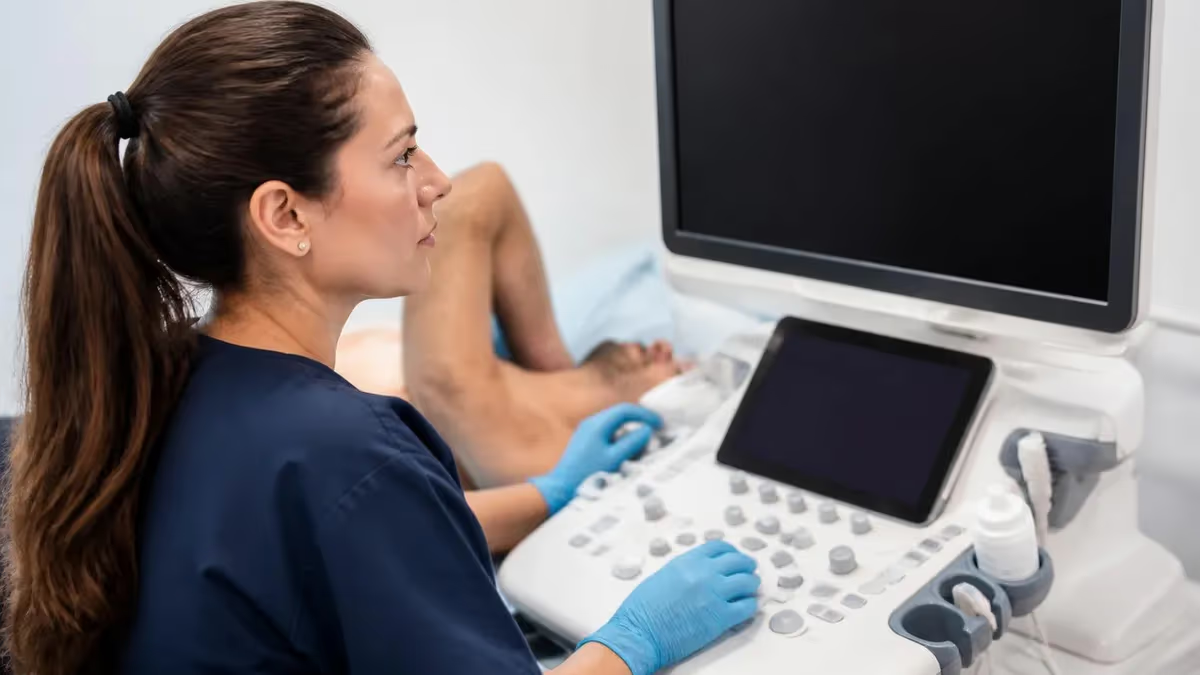
The competency & credentialing institute cci is the nationally recognized authority responsible for credentialing cardiovascular professionals across the United States, including registered cardiac sonographers, vascular technologists, electrophysiology specialists, and invasive cardiovascular professionals. For more than fifty years, CCI has served as the gold-standard certifying body, validating that allied health workers possess the clinical knowledge, technical skill, and ethical grounding required to deliver safe diagnostic and interventional cardiovascular care in hospitals, outpatient clinics, and specialty laboratories nationwide.
If you are reading this guide, you are likely preparing for one of CCI's flagship credentialing exams: the RCS (Registered Cardiac Sonographer), RVS (Registered Vascular Specialist), RCIS (Registered Cardiovascular Invasive Specialist), RCES (Registered Cardiac Electrophysiology Specialist), or CCT (Certified Cardiographic Technician). Each pathway has unique eligibility prerequisites, exam blueprints, and continuing education obligations. Knowing these details before you apply prevents wasted application fees and study hours.
This comprehensive resource walks through every element candidates need to know in 2026, from the application portal and eligibility documentation to the latest blueprint percentages, scoring methodology, and renewal cycle. We pair the official policy guidance with practical advice gathered from technologists who recently sat for these exams, including how they balanced clinical rotations, family obligations, and a structured study schedule that produced first-attempt passes.
You will also find direct links to focused practice tests on cardiac pharmacology, hemodynamic monitoring, cardiac anatomy, stress testing protocols, and cerebrovascular duplex examinations. These topic-specific quizzes target the exact domains weighted most heavily on CCI examinations, so every minute you spend reviewing translates into measurable score improvement when you finally sit at the Pearson VUE testing center.
Before diving in, it helps to understand who CCI serves. Approximately 25,000 active credential holders rely on CCI for their professional license, and roughly 4,500 new candidates test each year. Pass rates vary by examination and by candidate preparation, ranging from 54% on the RCIS to 71% on the CCT. Your goal is to land comfortably above the cut score, and the strategies below will help you do exactly that.
For a deeper look at exam format and sample items, our Pass Your CCI Test 2026 with Confidence - Tips & Guide walks through the structure question by question. Use it alongside this overview to build a complete preparation roadmap, then return here to drill specific domains using the practice quizzes embedded throughout the article.
Whether you are a new graduate from a CAAHEP-accredited program, an experienced sonographer pursuing a second credential, or a career-changer entering invasive cardiology through the clinical pathway, this guide gives you the actionable knowledge you need to navigate CCI's process with confidence and earn the credential that defines your specialty.
CCI by the Numbers in 2026

CCI Exam Format Overview
| Section | Questions | Time | Weight | Notes |
|---|---|---|---|---|
| Patient Care & Assessment | 35 | 37 min | 20% | Pre-procedure preparation |
| Anatomy & Physiology | 30 | 32 min | 18% | Cardiovascular structures |
| Pharmacology | 25 | 26 min | 15% | Cardiac medications |
| Procedural Technique | 50 | 53 min | 30% | Clinical performance |
| Post-Procedure Care | 20 | 22 min | 12% | Recovery monitoring |
| Pretest Unscored Items | 10 | — | 0% | Future blueprint items |
| Total | 170 | 3 hours | 100% |
Understanding which CCI pathway you qualify for is the first strategic decision in your credentialing journey. CCI offers multiple eligibility routes depending on your educational background, clinical hours logged, and prior credentials. Each pathway has documentation requirements that must be uploaded through the candidate portal before your application moves into the review queue, which typically takes 10 to 15 business days to clear.
The most direct route is graduation from a CAAHEP or CoARC accredited program in cardiovascular technology, diagnostic medical sonography, or a related allied health specialty. Graduates of these programs automatically qualify for the corresponding CCI exam without needing additional clinical hours, because the accrediting body has already verified that the curriculum and supervised practicum hours meet CCI's competency standards.
Candidates who completed non-accredited programs or who entered the field through on-the-job training must follow the clinical experience pathway. This route generally requires between 800 and 1,800 verified clinical hours documented by a supervising physician, registered technologist, or department director. The exact threshold depends on which credential you are pursuing, so review CCI's published prerequisite chart carefully before submitting your application.
A third option exists for credential holders from related certifying organizations, such as ARDMS or ARRT registrants who want to add a CCI credential to their portfolio. These professionals may qualify under the prerequisite 8 pathway, which recognizes equivalent training and reduces redundant documentation. If you already hold an active credential in a related specialty, this is often the fastest route to your second registry.
International candidates trained outside the United States must submit their educational transcripts for evaluation by an approved credential evaluation service such as ECE, WES, or IERF. The evaluation determines whether foreign coursework meets the equivalent of a US-based associate degree program. Allow an extra 30 to 45 days for this step, and budget for the evaluation fee, which ranges from $150 to $300 depending on the service you choose.
Once your eligibility is confirmed, CCI issues an authorization to test letter via email. This document is your golden ticket: it contains your candidate ID number, the testing window (usually 90 days), and instructions for scheduling your exam at a Pearson VUE testing center. Many candidates lose precious weeks by waiting to schedule until they feel ready, only to find their preferred date and location fully booked. Schedule immediately, then prepare backward from that date.
For printable resources you can use offline during the application process, our practice test provides downloadable materials covering each eligibility pathway and a worksheet for tracking your documentation submissions. Keep it on your desk as you assemble transcripts and clinical verifications.
CCI Practice Test Questions
Prepare for the CCI - Cardiovascular Credentialing International exam with our free practice test modules. Each quiz covers key topics to help you pass on your first try.
CCI Cardiac Pharmacology and Hemodynamic M...
CCI Exam Questions covering Cardiac Pharmacology and Hemodynamic Monitoring. Master CCI Test concepts for certification prep.
CCI - Cardiovascular Credentialing Interna...
Free CCI Practice Test featuring - Cardiovascular Credentialing International Cardiac Anatomy and Physiology. Improve your CCI Exam score with mock test prep.
CCI - Cardiovascular Credentialing Interna...
CCI Mock Exam on - Cardiovascular Credentialing International Cardiac Stress Testing Protocols. CCI Study Guide questions to pass on your first try.
CCI - Cardiovascular Credentialing Interna...
CCI Test Prep for - Cardiovascular Credentialing International Cerebrovascular Duplex Examinations. Practice CCI Quiz questions and boost your score.
CCI - Cardiovascular Credentialing Interna...
CCI Questions and Answers on - Cardiovascular Credentialing International ECG Rhythm Interpretation. Free CCI practice for exam readiness.
CCI - Cardiovascular Credentialing Interna...
CCI Mock Test covering - Cardiovascular Credentialing International Invasive Catheterization Procedures. Online CCI Test practice with instant feedback.
CCI - Cardiovascular Credentialing Interna...
Free CCI Quiz on - Cardiovascular Credentialing International Peripheral Arterial Evaluation. CCI Exam prep questions with detailed explanations.
CCI - Cardiovascular Credentialing Interna...
CCI Practice Questions for - Cardiovascular Credentialing International Peripheral Venous Evaluation. Build confidence for your CCI certification exam.
CCI - Cardiovascular Credentialing Interna...
CCI Test Online for - Cardiovascular Credentialing International Ultrasound Physics and Instrumentation. Free practice with instant results and feedback.
CCI - Cardiovascular Credentialing Interna...
CCI Study Material on - Cardiovascular Credentialing International Valvular Pathology Assessment. Prepare effectively with real exam-style questions.
CCI - Cardiovascular Credentialing Interna...
Free CCI Test covering - Cardiovascular Credentialing International Vascular Hemodynamics Principles. Practice and track your CCI exam readiness.
CCI Credentials, Domains & Scoring Methodology
The Registered Cardiovascular Invasive Specialist (RCIS) credential validates competence in cardiac catheterization, coronary interventions, and electrophysiology procedures. The exam contains 170 multiple-choice items delivered over three hours and emphasizes hemodynamic interpretation, fluoroscopy safety, and emergency response. Candidates must understand both diagnostic and interventional catheterization workflows, including stent deployment, balloon angioplasty, and intra-aortic balloon pump management used in cardiogenic shock and high-risk PCI cases.
Pass rates for first-time RCIS candidates hover around 54%, making it CCI's most challenging examination. Successful candidates typically log 200 or more hours of dedicated review, complete two to three full-length practice exams, and rotate through high-volume catheterization labs. Expect heavy emphasis on coronary anatomy, contrast media protocols, and recognition of life-threatening arrhythmias such as ventricular tachycardia and complete heart block requiring urgent intervention.

Should You Pursue a CCI Credential?
- +Salary increases of 8-15% typically follow credential attainment
- +Nationally recognized by all major US healthcare employers and insurance networks
- +Opens doors to specialty positions in EP labs and structural heart programs
- +Demonstrates commitment to professional excellence to hiring managers
- +Required by many state licensure boards and Medicare reimbursement rules
- +Provides pathway to instructor and clinical coordinator roles in education
- +Builds credibility with referring physicians and interdisciplinary care teams
- −Application and exam fees exceed $400 when combined with study materials
- −Renewal requires 36 CME credits every three years plus annual fees
- −First-attempt failure means waiting 90 days before retesting at full cost
- −Study commitment of 200+ hours displaces family and personal time
- −Clinical hour documentation can be difficult to retroactively verify
- −Test anxiety affects performance even among highly experienced technologists
CCI Exam Pre-Test Preparation Checklist
- ✓Verify eligibility pathway and gather all required transcripts and clinical verification forms
- ✓Create your candidate profile on the CCI portal and upload supporting documentation
- ✓Pay the application fee using a credit card and save the confirmation receipt
- ✓Wait for eligibility approval and download your Authorization to Test letter immediately
- ✓Schedule your Pearson VUE exam date within the first week of receiving authorization
- ✓Order or download the current CCI Examination Content Outline for your specific credential
- ✓Complete a diagnostic practice exam to identify weak content domains for focused study
- ✓Build a 10 to 12 week study schedule allocating two hours per weekday and four on weekends
- ✓Take a full-length timed practice exam two weeks before your scheduled test date
- ✓Confirm testing center location, photo ID requirements, and arrival time 24 hours before exam

Schedule your exam date first, then prepare backward
Top-scoring candidates consistently report one common habit: they schedule their Pearson VUE appointment within 48 hours of receiving authorization to test. A firm date creates accountability, eliminates procrastination, and ensures access to preferred testing centers before they book out. Working backward from a fixed deadline produces stronger study habits than open-ended preparation, which often expands indefinitely without measurable progress milestones.
Effective preparation for any CCI examination requires more than reading textbooks and memorizing facts. The exam tests applied clinical judgment, and high-scoring candidates consistently use a layered study approach that combines content review, active recall through practice questions, and simulated test conditions to build the stamina required for a three-hour computer-based exam administered under strict proctoring rules.
Begin with a diagnostic assessment to identify your baseline. Take a full-length practice exam without any preparation, score yourself by domain, and use the results to allocate study time proportionally. If pharmacology represents 15% of the blueprint but you scored 40% on those items, that domain deserves more attention than anatomy where you may already perform well. Data-driven preparation always outperforms generic textbook reading from chapter one through the final page.
Next, build a study calendar with concrete weekly targets. Most successful candidates dedicate 10 to 14 weeks of consistent preparation, averaging 12 to 15 hours per week. Front-load content review during weeks one through six, transition to mixed practice questions during weeks seven through ten, and reserve the final two to four weeks for full-length simulated exams under timed conditions that replicate the actual testing environment as closely as possible.
Active recall is the single most powerful study technique supported by cognitive science research. Rather than passively re-reading notes, force yourself to retrieve information from memory by answering practice questions, explaining concepts aloud, or writing out pathophysiology mechanisms without reference material. Each retrieval strengthens neural pathways and dramatically improves long-term retention compared to highlighting textbook passages or watching review videos passively.
Use spaced repetition for high-yield facts that require memorization, such as drug dosing ranges, hemodynamic normal values, ECG intervals, and ASE chamber quantification cutoffs. Flashcard apps like Anki schedule reviews at expanding intervals based on how well you recall each item. This approach consistently produces better retention than cramming, and it integrates seamlessly with a busy clinical schedule because each session can be completed in 15-minute blocks during lunch breaks.
Form a study group of two to four peers also preparing for CCI exams. Teaching content to others is the highest level of mastery, and explaining a concept exposes gaps in your own understanding that solo study would never reveal. Schedule weekly 90-minute video sessions where each member presents a domain, walks through challenging practice questions, and shares mnemonics or memory aids that proved useful during individual preparation.
Finally, simulate test-day conditions during your final two weeks. Wake up at the same time you will on exam day, eat the same breakfast, drive to a quiet location, and complete a full 170-question practice exam without breaks longer than CCI permits. This conditioning reduces day-of anxiety, identifies stamina problems, and ensures that your body and mind are calibrated for peak performance during the actual three-hour assessment.
CCI and Pearson VUE charge a rescheduling fee of $50 to $75 if you change your exam date within 30 days of the appointment, and rescheduling within 24 hours forfeits the entire exam fee. If life circumstances threaten your readiness, document the situation early and contact CCI's candidate services line to discuss extension options before incurring penalties that could delay your credential by months.
Earning your CCI credential is a milestone, but maintaining it requires ongoing commitment. CCI operates on a triennial renewal cycle, meaning every active credential holder must complete 36 hours of approved continuing medical education within each three-year period, pay annual maintenance fees, and attest to ethical practice standards before their certificate is renewed and their name remains on the public registry searchable by employers.
The 36 CME hours can come from multiple sources, including journal-based self-assessment programs, professional conference attendance, vendor-sponsored training, and CCI-approved online modules. At least half of the credits must be directly related to your credential's specialty, ensuring that an RCIS focuses on invasive cardiology topics rather than accumulating hours in unrelated subjects. Maintain a digital folder with certificates, attendance records, and detailed transcripts in case CCI selects your renewal for audit verification.
Annual maintenance fees range from $40 to $75 per credential depending on whether you hold a single registry or multiple. Most active credential holders find these costs negligible compared to the salary premium their credential provides. Failing to pay the maintenance fee or complete renewal documentation results in lapsed status, which requires a reinstatement application, additional fees, and potentially retesting if the lapse exceeds 12 months from the renewal deadline currently published in CCI bylaws.
If you hold multiple CCI credentials, you may apply a portion of your CME hours toward both, as long as the content directly relates to each specialty. For example, a candidate holding both RCIS and RCES credentials can apply electrophysiology-focused CME to both registries simultaneously, reducing the total hours needed compared to maintaining each credential independently. This efficiency makes pursuing multiple credentials more attractive over the long term for career advancement.
Beyond regulatory compliance, the most valuable benefit of ongoing CME is staying current with rapidly evolving cardiovascular technology. New ablation catheters, drug-eluting stents, transcatheter valve systems, and AI-assisted echocardiography platforms enter US practice every year. Technologists who actively pursue education on these innovations position themselves for leadership roles, structural heart program assignments, and clinical research opportunities that offer both intellectual stimulation and meaningful salary growth.
To organize your renewal documentation efficiently, consider using a spreadsheet or dedicated CME tracking app that logs each activity, the credit hours earned, the date of completion, and a link to the supporting certificate. Several free apps designed for healthcare professionals integrate directly with CCI's portal, automatically syncing approved activities and flagging gaps before your renewal deadline approaches and creates last-minute stress.
For video-based renewal content and walkthrough explanations of recent blueprint updates, our practice test resource provides expert-led discussions covering the rationale behind challenging exam items. These videos qualify for self-reported CME in many cases and double as targeted review for technologists preparing to take a second CCI credential to expand their professional opportunities.
The final week before your CCI exam is critical, and the strategies you employ during these last seven days often determine whether you pass on the first attempt or face a 90-day retest waiting period. Successful candidates shift from intensive content review to targeted weak-area reinforcement, mental conditioning, and logistical preparation that eliminates avoidable test-day stress. This section provides a day-by-day blueprint for maximizing your performance.
Seven days before the exam, take your final full-length practice test under strict timed conditions in a location free from interruptions. Review every missed question in detail, not just to learn the correct answer but to understand why the distractor choices seemed plausible. CCI question writers craft distractors to test specific misconceptions, so understanding the reasoning behind each wrong answer reveals knowledge gaps that flashcards alone cannot address effectively before exam day.
Five days before the exam, focus exclusively on your three weakest content domains identified during diagnostic testing. Avoid the temptation to review topics where you already score well, because the marginal benefit of additional review on strong domains is minimal compared to targeted improvement in weak areas. Allocate two hours daily to focused practice questions on these specific topics, taking detailed notes on patterns of error that emerge during your review sessions.
Three days before the exam, taper your study intensity to prevent burnout. Limit study to one or two hours of light review focusing on high-yield memorization items such as drug dosing ranges, normal hemodynamic values, ECG intervals, and ASE measurement cutoffs. Avoid learning new material at this stage, because trying to absorb unfamiliar concepts so close to the exam often creates confusion that displaces previously well-consolidated knowledge from your working memory.
The day before the exam, completely stop studying by noon and engage in restorative activities such as light exercise, time with family, or your favorite hobby. Confirm your testing center route, gather two forms of valid photo identification, lay out comfortable clothing for the next morning, and prepare a light breakfast that you can eat without digestive distress. Go to bed at your normal time, because trying to force extra sleep often produces insomnia and anxiety.
On exam day, arrive at the Pearson VUE testing center 30 minutes before your scheduled appointment. Bring your authorization letter, identification, and any approved accommodations documentation. Eat a balanced breakfast with protein and complex carbohydrates to maintain stable blood sugar throughout the three-hour exam. Avoid excessive caffeine, which can amplify anxiety and trigger frequent bathroom breaks that consume valuable testing time during your scheduled appointment window.
During the exam, pace yourself by checking the time after every 40 questions. If you average less than 60 seconds per item, you will finish with time to review flagged questions. Use the mark-for-review feature for items where you narrowed answers to two choices, then return after completing the full exam. First-pass instinct is often correct, so change answers only when you find clear evidence justifying the change rather than reacting to lingering uncertainty about your original choice.
Sample CCI - Cardiovascular Credentialing International Practice Questions
Try these questions from our free CCI - Cardiovascular Credentialing International practice tests. The correct answer and an explanation follow each question.
A patient with complete ICA occlusion would most likely show which waveform pattern in the ipsilateral CCA?
- A. Normal low-resistance biphasic waveform
- B. High-resistance pattern with reduced or absent diastolic flow
- C. Markedly elevated PSV with spectral broadening
- D. Retrograde flow throughout the cardiac cycle
Answer: B. High-resistance pattern with reduced or absent diastolic flow
ICA occlusion eliminates the low-resistance contribution from the ICA, leaving only the high-resistance ECA component in the CCA, reducing diastolic flow.
A sonographer notices the Thermal Index (TI) reading is elevated during a lengthy fetal ultrasound. Which of the following principles should guide their actions?
- A. The Mechanical Index (MI) is more important for fetal imaging.
- B. TI values are only relevant for adult cardiac studies.
- C. The ALARA (As Low As Reasonably Achievable) principle.
- D. Increase the acoustic output to shorten the scan time.
Answer: C. The ALARA (As Low As Reasonably Achievable) principle.
The Thermal Index (TI) indicates the potential for tissue heating. The ALARA principle is a fundamental safety guideline in medical imaging, stating that exposure should be kept as low as reasonably achievable. When the TI is elevated, the sonographer should take steps to reduce it, such as decreasing the output power, not dwelling in one spot for too long, and minimizing the overall scan time, without compromising diagnostic accuracy.
During coronary angiography, a 'damping' of the pressure waveform in the guide catheter most likely indicates:
- A. Vasospasm distal to the tip
- B. Catheter tip occlusion of the coronary ostium
- C. Ventricular fibrillation
- D. Air in the manifold system
Answer: B. Catheter tip occlusion of the coronary ostium
Damping occurs when the catheter tip obstructs coronary flow, reducing the pulsatile pressure signal and risking ischemia or dissection.
During a vasodilator pharmacological stress test, a patient develops complete heart block. What is the correct immediate intervention?
- A. Increase the adenosine infusion rate to override the block
- B. Administer aminophylline IV and place the patient supine
- C. Administer atropine 1 mg IV and prepare for temporary pacing
- D. Continue monitoring — complete heart block with adenosine is transient and self-limited
Answer: B. Administer aminophylline IV and place the patient supine
Aminophylline reverses adenosine receptor-mediated complete heart block; the agent's short half-life also means the block typically resolves rapidly with antagonism.
Take the full CCI - Cardiovascular Credentialing International practice test
CCI Questions and Answers



About the Author

Educational Psychologist & Academic Test Preparation Expert
Columbia University Teachers CollegeDr. Lisa Patel holds a Doctorate in Education from Columbia University Teachers College and has spent 17 years researching standardized test design and academic assessment. She has developed preparation programs for SAT, ACT, GRE, LSAT, UCAT, and numerous professional licensing exams, helping students of all backgrounds achieve their target scores.