
CAEC Math Practice Test: Format, Free Practice Questions and Prep Plan 2026
🎯 A CAEC math practice test mirrors the real exam: 42 questions, 120 minutes, 55% to pass. See the format, calculator rules and free prep tips.

A CAEC math practice test mirrors the real Mathematics test: 42 questions in 120 minutes, split into Part I without a calculator (12 questions, 30 minutes) and Part II with a calculator (30 questions, 90 minutes). You need 55% to meet the minimum standard. Practicing under those exact limits is the fastest way to prepare.
Caec Math Practice Test: Key Facts (Updated October 2026)
| Fact | Details | Source |
|---|---|---|
| Math test format | 42 questions in 120 minutes. Part I (no calculator): 12 questions, 30 minutes. Part II (calculator): 30 questions, 90 minutes. | Government of Alberta |
| Passing score | 55% on each test (Meets Minimum Standard). Bands: ES 80-100%, MS 55-79%, AS 40-54%, DMS 0-39%. | Government of Alberta |
| Delivery | Written in person at a testing centre on a scheduled date. Computer-based, with a paper option. No at-home online proctoring. | Government of Alberta |
| Calculator | Part II only. Approved: TI-30XIIS, TI-30Xa, TI-30XS, Casio fx-260, Casio fx-300MS Plus 2nd Ed. Graphing, programmable and wireless models are banned. | CAEC Test Administration Guide (Alberta) |
| Fees (Canadian dollars) | Set per province. Ontario: $100 for all five tests and $100 per re-write. Manitoba: $15 per subject. Newfoundland and Labrador: $6 per test. Saskatchewan, Northwest Territories and Nova Scotia residents: no fee. | Independent Learning Centre |
| Retakes | One attempt per subject per calendar month, maximum three per calendar year. Passed tests never expire. | CAEC Test Administration Guide (Alberta) |
| Results | Math results post to your account within about 2 business days. | Government of Newfoundland and Labrador |
| ID at testing | Two forms of valid, unexpired ID are required. | CAEC Test Administration Guide (Alberta) |
If you are comparing every option, our hub on caec practice tests shows how the math test fits with the other four CAEC subjects: Reading, Writing, Science and Social Studies. This page zooms in on Mathematics only, because it is the test adult learners most often postpone. Below you will find the format, the calculator rules, a realistic study approach, and a free practice routine that matches real exam conditions.
What Is on the CAEC Math Practice Test?
The CAEC Mathematics test checks everyday numeracy rather than advanced theory. Expect whole numbers, fractions, decimals, percents, ratios and rates, measurement and unit conversion, basic geometry such as perimeter, area and volume, introductory algebra with equations and patterns, and reading data from tables and graphs. Questions are usually set in real situations such as pricing, recipes, wages or floor plans, so good practice asks you to choose the operation before you calculate.
The test is split by calculator access. Part I has 12 questions in 30 minutes and no calculator, which rewards quick mental arithmetic, fraction fluency and estimation. Part II has 30 questions in 90 minutes and allows an approved scientific calculator. That works out to roughly two and a half minutes per Part I question and three minutes per Part II question. A useful practice test should enforce both clocks so you learn exactly where your pace slips.
How Do You Use a CAEC Math Free Practice Test Well?
Start with a diagnostic. Take one full mock under timed conditions, mark every miss, and sort errors into three buckets: concept gaps, careless slips, and time pressure. A learner who scores 48% with mostly careless slips needs a different plan than one who scores 48% because fractions and percents are shaky. Record your score by topic, not just overall, because the 55% pass mark applies to the whole test and weak areas drag the total down.
Free practice is useful, but only if it resembles the real thing. Look for multiple-choice questions, a clear separation between no-calculator and calculator sets, and explanations that show the steps rather than only the answer letter. Our free CAEC math questions follow that pattern. Pair them with the official outcomes and evaluation plan published by Alberta, since that document defines what each test is allowed to measure and therefore what is worth your limited study hours.
Plan on three to six weeks if you studied math recently and eight to twelve if it has been years. Four sessions of 45 to 60 minutes each week beats one long weekend cram, because arithmetic fluency fades quickly without repetition. End each week with a mixed set of 15 to 20 questions, then retake a full timed mock every second week to confirm your trend line is climbing toward 55% and beyond, rather than guessing how ready you feel.
CAEC Math Practice Test by the Numbers
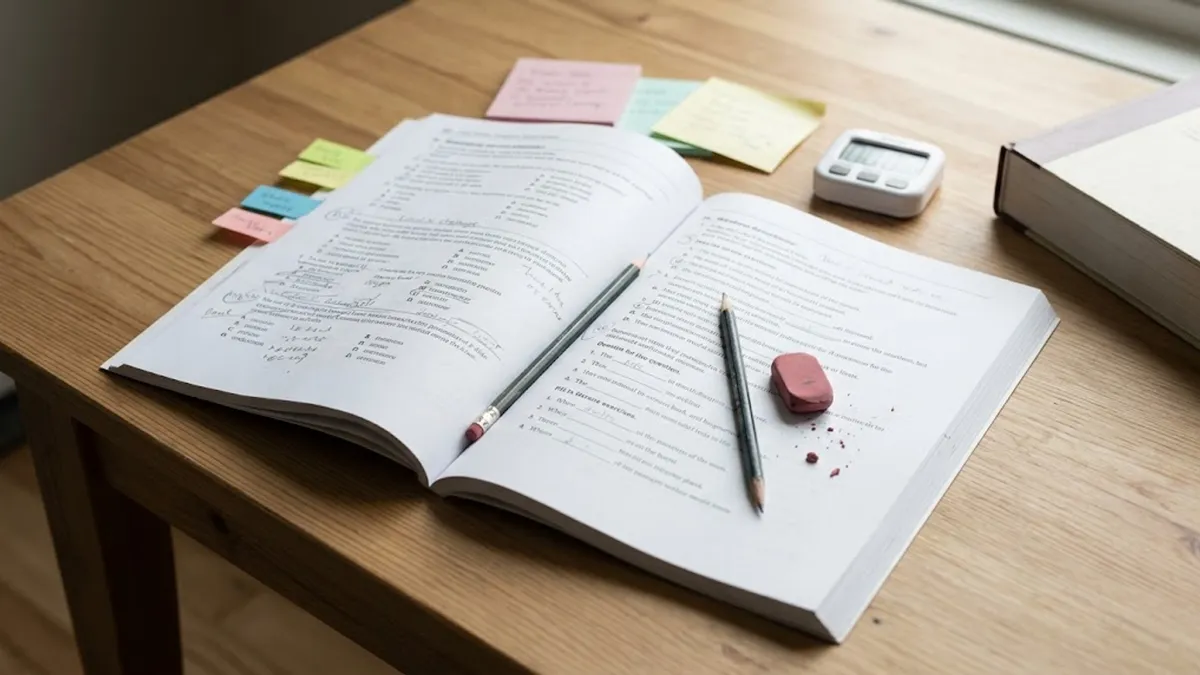
CAEC Practice Test Math: What Is the Exam Format?
| Section | Questions | Time | Weight | Notes |
|---|---|---|---|---|
| Part I: Mathematics without a calculator | 12 | 30 min | about 29% of questions | Mental math, fractions, estimation |
| Part II: Mathematics with a calculator | 30 | 90 min | about 71% of questions | Approved scientific calculator only |
| Total | 42 | 120 minutes | 100% |
CAEC Math Practice Questions: How Is the Test Scored?
You pass the Mathematics test by earning 55% or higher, which the program calls Meets Minimum Standard. Results fall into four bands: Exceeds Standard at 80 to 100%, Meets Standard at 55 to 79%, Approaching Standard at 40 to 54%, and Does Not Meet Standard at 0 to 39%. If scoring tracks raw correct answers, 55% of 42 questions is about 24 correct, so that is a sensible target for every mock you take.
Many adults arrive expecting a GED-style scale and worry about a 450 or 800 score. There is no such scale on the CAEC, because that belonged to the GED, which stopped testing in Canada on May 3, 2024. Your goal here is simpler: 55% on each of the five tests. Passed tests never expire, and there is no deadline for finishing all five, so you can focus on math alone first.
Notice how the points are distributed. Part II holds 30 of the 42 questions, about 71% of the test, so calculator-based word problems deserve most of your study hours. Yet Part I should not be neglected, because 12 questions without a calculator is nearly 29% of your result. Missing six of them to simple arithmetic slips can cost you the entire margin you built on the harder section, so treat both parts seriously.
A realistic mock routine helps you see this balance. Do Part I with a 30-minute timer and your calculator physically out of reach, then take a short break, then do Part II for 90 minutes. Score each part separately and note the percentage for both. If Part I sits at 50% while Part II sits at 70%, you know the weakness is mental math and fractions, not the algebra that you might have feared.
Our companion caec practice test study guide explains how to combine math with the other four subjects so you do not burn out. Most learners sit tests one at a time, and math is often a good middle choice: it is more mechanical than Writing, and gains from practice show up faster than in Reading or Social Studies, where background knowledge matters a great deal.
Keep an error log in a simple notebook. For each missed question write the topic, the reason you missed it, and the correct method in one line. After two weeks you will see patterns, for example misplacing decimals in percent problems or forgetting to convert minutes to hours in rate questions. Reviewing that log for ten minutes before each session produces larger gains than doing twenty extra random problems from a question bank.
For the big picture on timing, registration and retakes, read how to pass the caec exam in 2026 — complete study guide. It covers all five subjects and gives week-by-week pacing. Then return here to sharpen math with timed sets. Think of math as the one subject where your score is almost entirely a product of repetition, which makes it the most predictable test to pass.
CAEC Math Practice Tests Free: Which Study Method Fits You?
Self-study suits learners who are disciplined and only need a refresher. Begin with a free CAEC practice test to find weak topics, then spend each session on one area, such as fractions or percent, before returning to mixed questions. Work problems on paper, show every step, and check against the explanation, not just the answer letter, so that errors in method become visible.
The danger of self-study is skipping what feels uncomfortable. If you avoid algebra or geometry because they were hard in school, they will still appear on test day. Schedule your weakest topic first in each session, when you are freshest, and cap sessions at 60 minutes. Track weekly scores in a notebook so progress, or the lack of it, is obvious and honest.
Are CAEC Math Practice Tests Free Online Worth Using?
- +No cost, so you can repeat sets as often as you need
- +Instant feedback shows weak topics within minutes
- +Timed sets build the pace you need for 42 questions
- +Explanations teach the method behind each answer
- +You can study anywhere on a phone or computer
- +Low pressure helps reduce math anxiety before test day
- −Free banks may not match the official wording exactly
- −Quality varies, and some sites include outdated content
- −Practice alone cannot replace learning missing concepts
- −You must supply your own discipline and schedule
- −Online questions cannot test paper-booklet handling
- −A scientific calculator still has to be bought and learned
CAEC Math Prep: What Should You Do Before Test Day?
- ✓Take one full timed diagnostic before studying anything.
- ✓Log every missed question with its topic and the reason.
- ✓Practice Part I with a 30-minute timer and no calculator.
- ✓Practice Part II with a 90-minute timer and your calculator.
- ✓Buy an approved scientific calculator and learn its keys.
- ✓Memorize common fraction, decimal and percent equivalents.
- ✓Review area, perimeter and volume formulas until automatic.
- ✓Do 15 to 20 mixed questions at the end of every week.
- ✓Gather two forms of valid, unexpired ID for check-in.
- ✓Confirm your date, time and centre in your CAEC account.

Only Part II allows a calculator, and only approved models
Approved handheld models include the TI-30XIIS, TI-30Xa, TI-30XS, Casio fx-260 and Casio fx-300MS Plus 2nd Edition. Graphing, programmable and wireless calculators are banned. Practice with your exact model for at least two weeks so that fractions, percent and memory keys feel automatic when the clock is running.
CAEC Alberta: How Does Math Testing Work?
The CAEC is a national high-school equivalency credential, and Alberta publishes much of the core information, including the program overview, the how-to-earn guidance, the outcomes and evaluation plan by subject, and the test administration guide. Searches such as alberta caec usually point to those government pages. The same five tests are used across participating provinces and territories, so the math test you practice for is essentially the same wherever you register.
Tests are written in person at a testing centre on a scheduled date. Delivery is computer-based, with a paper option, and there is no at-home online proctoring. You register through the CAEC digital platform at caec.vretta.com, choose a subject and a date, and receive confirmation. Because seats are scheduled, book early enough to allow three to four weeks of focused practice after your date is fixed, but not so far ahead that you lose motivation.
Fees depend on your province, so check before you book. Ontario charges $100 for all five tests and $100 per re-write of unsuccessful tests. Manitoba charges $15 per subject and $15 per retest, non-refundable. Newfoundland and Labrador charges $6 per test, while Saskatchewan, the Northwest Territories and Nova Scotia residents pay nothing. All amounts are in Canadian dollars, which matters for readers outside Canada who are converting the cost.
Age and residency rules are provincial as well. Ontario sets a minimum age of 18 plus six months of residency. Saskatchewan and the Northwest Territories ask candidates to be over 18 and out of school for one year. Manitoba and Newfoundland and Labrador use 19 as the minimum age, though age exemptions are available. If you are close to a cutoff, contact the provincial office before spending time on preparation or paying any fee.
On test day you must bring two forms of valid, unexpired identification. Arrive early, because late arrival can forfeit your seat. For Mathematics, bring only an approved scientific calculator for Part II, and expect the testing staff to check it. Phones, smart watches and any wireless device are not allowed at your desk. Knowing these rules ahead of time removes stress that otherwise eats into your concentration for the first few questions.
Results for Mathematics post to your account within about two business days, which is fast compared with Writing, where scoring can take up to 20 business days. If you do not reach 55%, you can retake. The national rule allows one attempt per subject per calendar month and a maximum of three per calendar year. After a third unsuccessful attempt you must wait until the next calendar year, so use each attempt wisely and review your errors between tries.
If you have passed GED subjects from the 2002 series, some may be credited toward the matching CAEC test until May 2027, and December 2027 in Newfoundland and Labrador. That could mean you never need to sit the math test at all. Check with your provincial office before you start studying, because a previously passed GED Mathematics result may already count, and you could redirect that effort to a different subject.
Cost, minimum age and residency rules are set provincially, and GED credit for the 2002 series ends in May 2027 (December 2027 in Newfoundland and Labrador). Confirm current details with your provincial CAEC office before you pay or book a seat.
CAEC Practice Test: What Topics Should You Review First?
Begin with number sense, because every other topic depends on it. Make sure you can add, subtract, multiply and divide whole numbers, decimals and fractions without a calculator, and convert between fractions, decimals and percents. Part I rewards this skill directly, and Part II word problems often hide a simple fraction step inside a longer story. Ten minutes of daily drills, such as 3/8 as a decimal or 15% of 240, builds speed quickly.
Next, study ratios, rates and percent, which appear in many real-life contexts. Practice unit prices, speed and distance, discounts, sales tax and tips. A typical question might ask for the final cost after a 20% discount and 5% tax, and many learners lose points by applying both to the original price. Writing each step on paper, in order, prevents that mistake and makes your reasoning easy to check afterward.
Measurement and geometry come third. Learn the formulas for perimeter, area of rectangles, triangles and circles, and volume of boxes and cylinders, along with common unit conversions between metric units and between hours and minutes. Many questions combine these skills, for example finding how many square metres of flooring cover an irregular room. Sketch every figure, label each side, and check that your units match before you multiply anything together.
Introductory algebra is the topic most adults fear, but it is usually gentler than expected. Expect solving one-step and two-step equations, evaluating expressions, and recognizing number patterns. Treat an equation as a balance: whatever you do to one side, you do to the other. Practice translating sentences into equations, such as three more than twice a number equals 17, since this translation step is where most errors occur, not the solving itself.
Data and graphs round out the list. You should be able to read tables, bar graphs, line graphs and simple circle graphs, and calculate mean, median, mode and range. Questions often ask which statement the data supports, so practice reading axes and units carefully. These items are among the quickest points on the test because the answer is already on the page, and they reward careful reading far more than advanced calculation.
Word problems cut across all of these topics, so build a routine for them. Read the question twice, underline what is being asked, list the given numbers with units, choose the operation, estimate the answer, then calculate. The estimate catches many errors, because an answer of 4,500 for a bill that should be around 45 is obviously wrong. This five-step habit costs thirty seconds and saves far more points than it spends in time.
If you want printable material for these topics, our caec alberta practice test PDF gives you paper questions you can mark up with a pen, which is useful if you plan to take the paper version. Many learners find handwriting each step improves accuracy compared with working on a screen, and printing also makes it easy to practice in places without reliable internet access.
What Are the Best Tips for CAEC Math Test Day?
Sleep matters more than a last-minute review. A tired brain makes arithmetic slips that no amount of cramming can prevent, and Part I depends on mental math. The night before, do a light 20-minute review of formulas and conversions, lay out your ID and calculator, and stop studying early. Eat a normal breakfast, and aim to reach the testing centre with at least 30 minutes to spare for check-in.
Manage the two time blocks separately. In Part I you have 30 minutes for 12 questions, so aim for about two minutes each and leave a few minutes to review. In Part II you have 90 minutes for 30 questions, about three minutes each. Mark any question that takes more than four minutes, move on, and return later. Unanswered questions score zero, so never leave a blank when time is nearly up.
Use estimation as a safety net on every question. Before you press a calculator key, round the numbers and predict a rough answer. If your result differs sharply from the estimate, recheck your keystrokes. A common error is entering a percent as a whole number, or dividing in the wrong order. Estimation takes seconds and also helps you eliminate multiple-choice options that are clearly too large or too small.
Read each question completely, including units. Many wrong answers come from solving for the wrong quantity, such as giving total cost when the question asked for the change, or answering in centimetres when metres were requested. Circle the unit in the question and check it against your final answer. When a diagram is provided, trust the labeled numbers over your visual impression, because figures in tests are often not drawn to scale.
Know your calculator before the day. Learn how your approved model handles fractions, order of operations, the percent key and memory. Replace the battery if it is weak, and remember that the calculator is only for Part II. Using a graphing or programmable model, or one with wireless features, is banned, so a last-minute substitute from a friend could leave you without any calculator, which makes Part II much harder.
If you do not pass, treat the result as data. Your account will show your band, and a score in the Approaching Standard range of 40 to 54% means you are closer than it feels. Review the error log, fix two or three topics, and book a retake after a few weeks. Remember the limit of one attempt per subject per month and three per calendar year, and pay any provincial re-write fee only when ready.
Finally, keep perspective: Mathematics is one of five tests, and passed tests never expire. You can pass math first, then take Reading, Science, Social Studies and Writing at your own pace with no deadline. Many adults find that clearing the test they fear most gives a big confidence boost. Stay consistent, practice under real time limits, and let your scores, not your nerves, tell you when you are ready.
CAEC Questions and Answers



About the Author

Educational Psychologist & Academic Test Preparation Expert
Columbia University Teachers CollegeDr. Lisa Patel holds a Doctorate in Education from Columbia University Teachers College and has spent 17 years researching standardized test design and academic assessment. She has developed preparation programs for SAT, ACT, GRE, LSAT, UCAT, and numerous professional licensing exams, helping students of all backgrounds achieve their target scores.