

C-SORT Practice Test
Updated for September 2026Modern special operations forces (SOF) require more than just physical strength and tactical prowess. To endure the psychological and emotional demands of high-risk, high-stakes missions, candidates must possess extraordinary mental resilience, adaptability, and stress tolerance. Recognizing the critical importance of these traits, the U.S. military developed the Computerized-Special Operations Resiliency Test (C-SORT) to evaluate candidates beyond traditional physical and academic criteria. The C-SORT is a computer-based psychological assessment used during the screening and selection process for elite military roles, including Navy SEALs, Special Warfare Combatant-Craft Crewmen (SWCC), and other special operations units. This test helps identify individuals who are best suited for the mental rigors of special operations environments. Unlike standard aptitude tests, the C-SORT emphasizes emotional regulation, impulse control, and cognitive flexibility under pressure.
C-SORT Practice Test Questions
Prepare for the C-SORT - Computerized-Special Operations Resiliency Test exam with our free practice test modules. Each quiz covers key topics to help you pass on your first try.
C-SORT Cognitive Processing & Decision-Mak...
C-SORT Exam Questions covering Cognitive Processing & Decision-Making Skills. Master C-SORT Test concepts for certification prep.
C-SORT Computerized-Special Operations Res...
Free C-SORT Practice Test featuring Computerized-Special Operations Resiliency Biographical and Behavioral History. Improve your C-SORT Exam score with mock test prep.
C-SORT - Computerized-Special Operations R...
C-SORT Mock Exam on - Computerized-Special Operations Resiliency Biographical and Behavioral History. C-SORT Study Guide questions to pass on your first try.
C-SORT Computerized-Special Operations Res...
C-SORT Test Prep for Computerized-Special Operations Resiliency Cognitive Flexibility and Decision-Making. Practice C-SORT Quiz questions and boost your score.
C-SORT - Computerized-Special Operations R...
C-SORT Questions and Answers on - Computerized-Special Operations Resiliency Cognitive Flexibility and Decision-Making. Free C-SORT practice for exam readiness.
C-SORT Computerized-Special Operations Res...
C-SORT Mock Test covering Computerized-Special Operations Resiliency Core Personality Trait Assessment. Online C-SORT Test practice with instant feedback.
C-SORT - Computerized-Special Operations R...
Free C-SORT Quiz on - Computerized-Special Operations Resiliency Core Personality Trait Assessment. C-SORT Exam prep questions with detailed explanations.
C-SORT Computerized-Special Operations Res...
C-SORT Practice Questions for Computerized-Special Operations Resiliency Emotional Regulation and Control. Build confidence for your C-SORT certification exam.
C-SORT - Computerized-Special Operations R...
C-SORT Test Online for - Computerized-Special Operations Resiliency Emotional Regulation and Control. Free practice with instant results and feedback.
C-SORT Computerized-Special Operations Res...
C-SORT Study Material on Computerized-Special Operations Resiliency Performance Strategies and Goal-Setting. Prepare effectively with real exam-style questions.
C-SORT - Computerized-Special Operations R...
Free C-SORT Test covering - Computerized-Special Operations Resiliency Performance Strategies and Goal-Setting. Practice and track your C-SORT exam readiness.
C-SORT Computerized-Special Operations Res...
C-SORT Exam Questions covering Computerized-Special Operations Resiliency Psychological Resilience Under Stress. Master C-SORT Test concepts for certification prep.
C-SORT - Computerized-Special Operations R...
Free C-SORT Practice Test featuring - Computerized-Special Operations Resiliency Psychological Resilience Under Stress. Improve your C-SORT Exam score with mock test prep.
C-SORT Computerized-Special Operations Res...
C-SORT Mock Exam on Computerized-Special Operations Resiliency Situational Judgment and Adaptability. C-SORT Study Guide questions to pass on your first try.
C-SORT - Computerized-Special Operations R...
C-SORT Test Prep for - Computerized-Special Operations Resiliency Situational Judgment and Adaptability. Practice C-SORT Quiz questions and boost your score.
C-SORT Computerized-Special Operations Res...
C-SORT Questions and Answers on Computerized-Special Operations Resiliency Stress Tolerance and Coping. Free C-SORT practice for exam readiness.
C-SORT - Computerized-Special Operations R...
C-SORT Mock Test covering - Computerized-Special Operations Resiliency Stress Tolerance and Coping. Online C-SORT Test practice with instant feedback.
C-SORT Interpersonal Effectiveness and Com...
Free C-SORT Quiz on C-SORT Interpersonal Effectiveness and Communication Under Pressure. C-SORT Exam prep questions with detailed explanations.
C-SORT Risk Assessment and Threat Evaluation
C-SORT Practice Questions for C-SORT Risk Assessment and Threat Evaluation. Build confidence for your C-SORT certification exam.
C-SORT Team Cohesion and Leadership Under ...
C-SORT Test Online for C-SORT Team Cohesion and Leadership Under Pressure. Free practice with instant results and feedback.
C-SORT Emotional Regulation & Stress Toler...
C-SORT Study Material on Emotional Regulation & Stress Tolerance. Prepare effectively with real exam-style questions.
Key Takeaways
Free C-SORT Practice Test Online
C-SORT is a psychological screening tool used by U.S. military special operations forces to measure emotional and mental resiliency.
It is not a pass/fail test, but part of a holistic candidate assessment for elite training pipelines like Navy SEAL and SWCC programs.
The test evaluates traits such as adaptability, stress tolerance, and decision-making under pressure.
C-SORT scores are combined with ASVAB and other physical assessments to determine overall candidate ranking.
The test includes situational judgment questions, cognitive reaction tasks, and personality-based items.
Purpose and Origin of C-SORT
The Computerized-Special Operations Resiliency Test was introduced as part of the U.S. military's effort to reduce attrition in its toughest training pipelines. Programs like Basic Underwater Demolition/SEAL (BUD/S) and Special Warfare Combatant-Craft Crewman School have historically high dropout rates, often due to the psychological strain of training rather than physical limitations.
Developed in coordination with military psychologists and behavioral scientists, the C-SORT aims to:
Predict long-term success in high-stress environments
Identify individuals with the emotional intelligence and resilience to handle the demands of special operations
Supplement physical and academic metrics to create a complete candidate profile
By using modern behavioral science, the military can better allocate resources and select those most likely to succeed—and survive—in the operational field.
- ✓Review the official C-SORT exam content outline
- ✓Take a diagnostic practice test to identify weak areas
- ✓Create a study schedule (4-8 weeks recommended)
- ✓Focus on your weakest domains first
- ✓Complete at least 3 full-length practice exams
- ✓Review all incorrect answers with detailed explanations
- ✓Take a final practice test 1 week before exam day
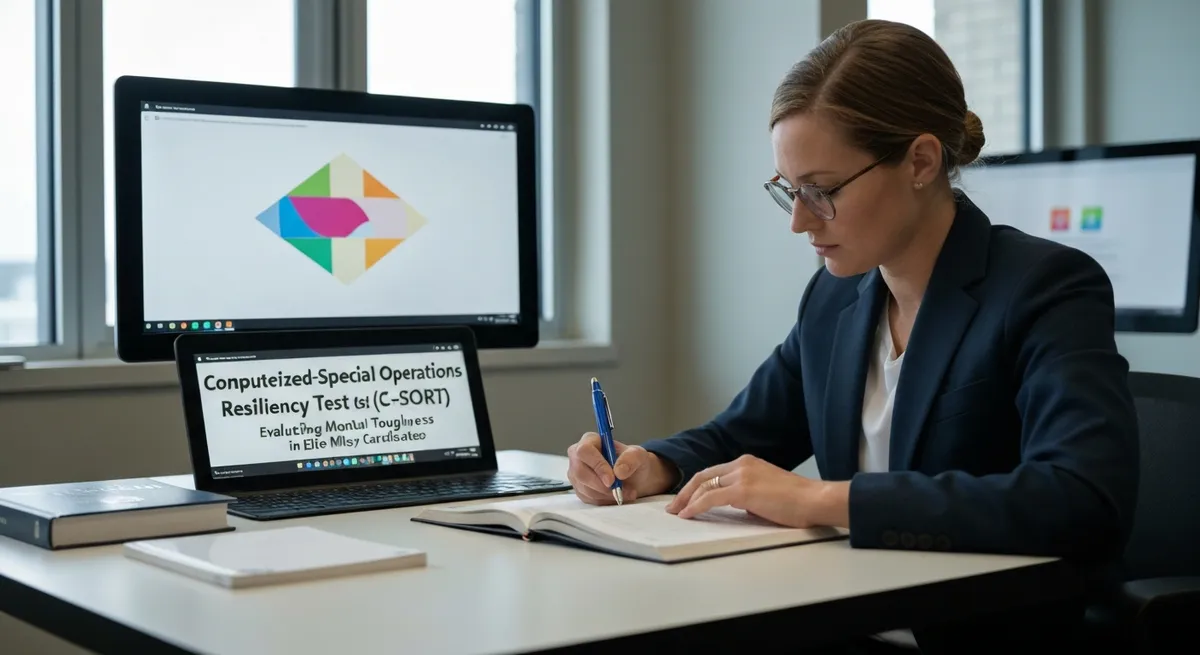
Test Structure and Components
The C-SORT is a computer-delivered assessment that typically takes 30 to 45 minutes to complete. It consists of three main sections, each targeting specific psychological and behavioral traits.
This section includes questions related to personal history, past behaviors, and decision-making experiences. These are designed to reveal patterns of behavior, leadership potential, risk tolerance, and perseverance.
Example question types:
"How often have you taken a leadership role in high-stress situations?"
"Describe how you respond when facing personal failure."
In this portion, candidates are presented with hypothetical operational scenarios and asked to choose how they would respond. These questions measure moral judgment, self-regulation, adaptability, and critical thinking.
Example scenario:
“Your team is in a hostile environment, and a teammate is panicking. What do you do?”
Candidates must select from multiple responses, each revealing different aspects of emotional intelligence and team orientation.
This section includes rapid-fire, reaction-based tasks that assess cognitive flexibility, impulse control, and the ability to maintain performance under time pressure.
Tasks may include:
Matching patterns quickly
Reacting to changes in visual stimuli
Making split-second decisions while tracking multiple variables
PBM activities are critical for identifying candidates who can think clearly under pressure—an essential skill in combat operations.
Scoring and Results Interpretation
The C-SORT does not produce a traditional “pass/fail” result. Instead, it provides a composite resiliency score, typically ranked into three tiers:
Tier 1 (High Resilience): Indicates superior emotional regulation and adaptability.
Tier 2 (Average Resilience): Suitable for SOF training, but may require more mental conditioning.
Tier 3 (Below Average): Suggests difficulty in managing stress or pressure; candidates may be encouraged to build mental fitness before reapplying.
These scores are combined with other data points such as:
Physical Screening Test (PST) scores
Interview assessments and service records
The final composite score is used to determine a candidate’s selection viability and training pipeline readiness.
Why Mental Resilience Matters in Special Operations
Special operations personnel face extreme physical and psychological environments: combat zones, underwater missions, remote insertions, and high-pressure tactical decisions. Resilience is not just helpful—it’s a survival skill.
Traits assessed by the C-SORT—like grit, mental endurance, stress regulation, and decision-making speed—are directly linked to:
Mission effectiveness
Unit cohesion
Mental health outcomes post-deployment
Reduced dropout and injury rates in training
C-SORT helps ensure that candidates are not only physically elite but also psychologically equipped to thrive in high-stakes missions.
How Candidates Can Prepare
While the C-SORT is designed to be difficult to game or “study for,” candidates can take steps to improve their performance:
Practice identifying emotional triggers and developing positive coping mechanisms.
Simulate high-pressure scenarios through physical challenges, cold exposure, and time-sensitive problem-solving.
Evaluate dilemmas and practice rational decision-making under emotional stress or ambiguity.
Play strategy-based games, reaction apps, or memory puzzles to sharpen focus and decision-making speed.
Techniques such as mindfulness, box breathing, visualization, and positive self-talk are used by elite military units to enhance mental performance.

Conclusion
The Computerized-Special Operations Resiliency Test (C-SORT) is a cutting-edge tool that enables the U.S. military to evaluate the psychological resilience and cognitive capabilities of candidates entering the most demanding environments. Unlike physical endurance or academic intelligence, mental resilience is harder to quantify—but no less vital. By integrating behavioral science with military readiness, C-SORT ensures that those selected for elite operations possess the emotional and psychological fortitude to excel under fire.
Whether you're aspiring to join special operations or seeking to improve your mental game, understanding the value of resilience—and how it’s tested—can guide your preparation and long-term success.
C-SORT: Pros and Cons
- +C-SORT exam preparation strengthens your knowledge across all domains
- +Passing the exam proves competency to employers and clients
- +Study materials and practice tests are widely available
- +Exam-based credentials are portable across states and employers
- +Clear exam objectives help focus your study plan effectively
- −Exam anxiety can affect performance — practice tests help reduce it
- −Registration fees are non-refundable if you miss your test date
- −Limited retake opportunities may apply with waiting periods
- −Exam content updates periodically — use current study materials
- −Testing center availability may require advance scheduling
C-SORT Questions and Answers
About the Author

Certified Professional Development Expert & Niche Certification Advisor
University of Pennsylvania Graduate School of EducationDr. Alexandra Kim holds a PhD in Professional Studies from the University of Pennsylvania and is a Certified Professional in Learning and Performance (CPLP) and Certified Professional in Talent Development (CPTD). With 17 years of corporate training and professional certification advisory experience, she helps professionals navigate specialized, emerging, and cross-industry certification programs.
Join the Discussion
Connect with other students preparing for this exam. Share tips, ask questions, and get advice from people who have been there.
View discussion (8 replies)