
BSN Second Degree Programs: Complete Guide to Requirements, Costs, and Career Outcomes
BSN second degree programs explained: admission requirements, costs, timelines, and career outcomes. Your complete 2026 September guide. 🎓
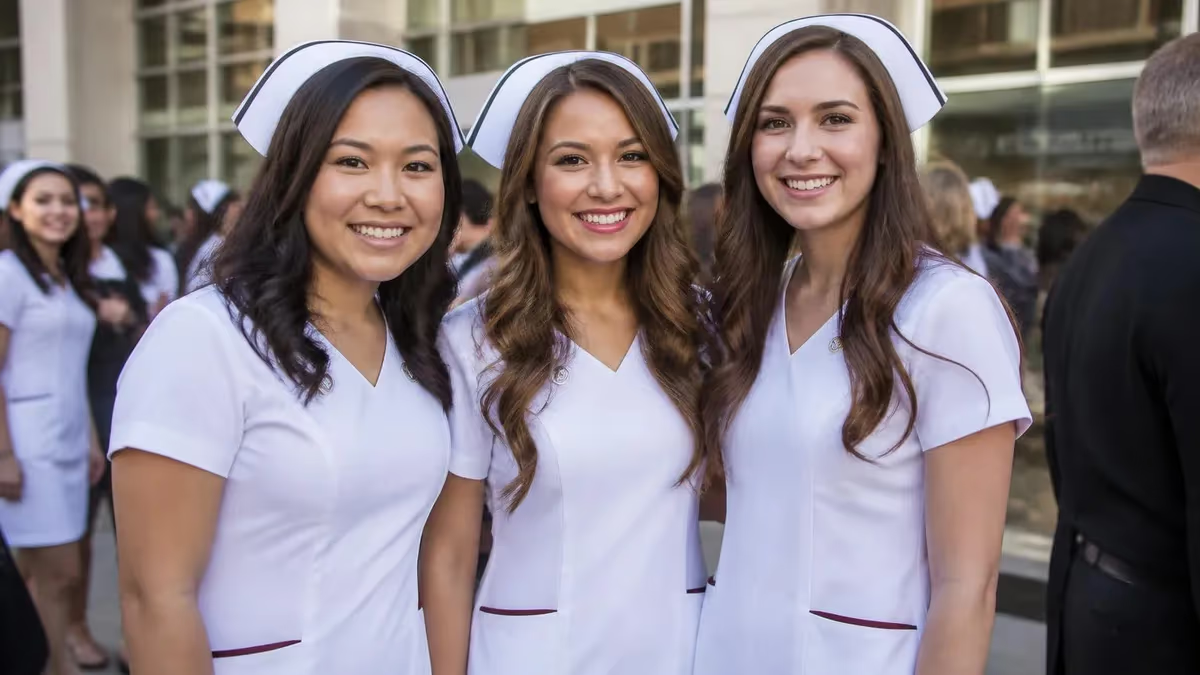
BSN second degree programs — formally called Accelerated Bachelor of Science in Nursing (ABSN) or Second-Degree BSN programs — offer college graduates from any non-nursing field a streamlined path into professional nursing. If you hold a bachelor's or higher degree in biology, psychology, business, or any other discipline, these intensive programs let you leverage your existing academic credentials to earn a nursing license in as little as 12 to 18 months, significantly faster than a traditional four-year BSN route.
The demand for second-degree BSN graduates has surged in recent years, driven by a nationwide nursing shortage that the American Association of Colleges of Nursing (AACN) projects will leave more than 200,000 registered nurse vacancies open annually through 2030. Hospitals and health systems now actively recruit career-changers because they bring professional maturity, subject-matter expertise — think former respiratory therapists, accountants, or educators — and strong interpersonal skills that pure nursing graduates sometimes lack at graduation.
Admission to these programs is competitive. Most require a minimum undergraduate GPA of 3.0 on a 4.0 scale, completion of prerequisite science courses such as Anatomy, Physiology, Microbiology, and Chemistry, and — depending on the school — documented healthcare experience ranging from 40 to 200 hours of direct patient contact. Understanding exactly what each program requires before you apply can save months of preparation and thousands of dollars in application fees.
Tuition for second-degree BSN programs varies considerably. Public university programs can cost between $15,000 and $35,000 total, while private accelerated programs at institutions like Johns Hopkins, Georgetown, or Vanderbilt may run $60,000 to $90,000 for the full curriculum. Financial aid, scholarships specific to nursing students, and loan forgiveness programs through the Health Resources and Services Administration (HRSA) can substantially offset these costs for qualified applicants.
One of the most frequently asked questions from prospective students is whether online second-degree BSN programs exist. The answer is nuanced: no program can complete clinical rotations entirely online, but many schools now offer hybrid formats where didactic coursework is delivered asynchronously, allowing students to complete 50–70% of their classes remotely while attending local clinical placement sites for hands-on training hours.
Exploring bsn second degree programs alongside ADN bridge pathways gives career-changers a full picture of how academic credentials stack up against time-to-practice and total cost considerations. Each route has real tradeoffs that depend on your prior degree, location, financial situation, and long-term nursing specialty goals — all of which this guide addresses in depth.
Throughout this article you will find program structure breakdowns, side-by-side comparisons of accelerated versus traditional BSN timelines, a detailed admissions checklist, honest pros and cons, and expert preparation strategies backed by NCLEX pass-rate data. Whether you are just beginning to explore nursing as a second career or you have already started gathering transcripts, the information here will help you make a confident, well-informed decision about your next step.
BSN Second Degree Programs by the Numbers

Types of BSN Second Degree Programs
The most common format: a compressed 12–18 month full-time curriculum covering the same credit hours as a traditional BSN. Courses run back-to-back with minimal breaks, demanding 50–60 hours of academic commitment per week. Most require students to relocate or stop working entirely.
Didactic coursework is delivered asynchronously online, while clinical rotations are completed at approved local sites. This format suits career-changers who cannot relocate but still need to fulfill 600–800 mandatory clinical hours. Program length typically extends to 18–24 months.
Designed for non-nurses with a bachelor's degree who want graduate-level nursing credentials. The first phase earns RN licensure (equivalent to a BSN), then students continue into a Master of Science in Nursing specialty. Total commitment is 3–4 years but ends with an MSN.
If you already hold an ADN or diploma RN license, this bridge pathway awards a BSN by building on existing clinical experience. Credits for prior nursing courses are often accepted, reducing remaining coursework to 30–60 credit hours completed in 12–24 months.
Admission requirements for second-degree BSN programs are more rigorous than those for traditional undergraduate nursing admissions, partly because programs must ensure career-changers can handle a compressed curriculum without the buffer of spread-out prerequisite courses. Virtually every accredited ABSN program in the United States requires a completed bachelor's degree from a regionally accredited institution, a cumulative GPA of at least 3.0 (though many competitive programs prefer 3.3 or higher), and official transcripts showing completion of specific science prerequisites.
The prerequisite science courses most commonly required include Human Anatomy, Human Physiology (often both required separately rather than combined), Microbiology with lab, General Chemistry or Chemistry for Health Sciences, and Statistics or Biostatistics. Some programs also require Developmental Psychology, Nutrition, and Pathophysiology. These courses must typically have been completed within the last five to ten years with a grade of C or better — though programs at flagship state universities often require a B or above in each science course to remain competitive.
Healthcare experience requirements vary more widely. Programs like those at Johns Hopkins and Duke require at least 100–200 hours of documented direct patient care experience — volunteering in an emergency department, working as a medical scribe, or serving as a Certified Nursing Assistant (CNA). Other programs, particularly newer online-hybrid formats, accept shadowing experiences or community health volunteer hours. Either way, this experience strengthens your personal statement and demonstrates genuine understanding of what nursing practice actually involves on a daily basis.
Letters of recommendation are another critical component. Most programs require two to three letters, with at least one from a science faculty member and one from a healthcare professional who can speak to your clinical or patient-service aptitude. Generic letters written by professors who barely know the applicant are a known red flag for admissions committees. Invest time cultivating relationships with professors in your prerequisite courses and with supervisors in any clinical volunteer roles you undertake.
Personal statements and essays are required by nearly all second-degree BSN programs, and they are taken seriously. Admissions committees want to understand why you are leaving your previous career field, what specifically draws you to nursing rather than other healthcare roles, and how your first-degree background will make you a better nurse. Applicants who demonstrate self-awareness — acknowledging the emotional and physical demands of nursing alongside their enthusiasm — consistently receive stronger evaluation scores than those who present idealized or vague motivations.
Some programs also require GRE or TEAS (Test of Essential Academic Skills) scores as part of the application package. The ATI TEAS is particularly common for ABSN applicants; it tests reading, math, science, and English language usage at the college level. Scoring above the 70th percentile is generally considered competitive. Preparation resources, including full-length practice tests, are widely available and should be treated as a serious component of your application timeline rather than an afterthought.
International applicants or those with degrees from non-US institutions face additional steps: credential evaluation by a recognized body such as World Education Services (WES), English proficiency testing (TOEFL or IELTS for non-native speakers), and — in some states — prior review by the state board of nursing before an international graduate can enroll. Beginning this credential review process at least six months before your target application deadline is strongly advised to avoid delays.
Costs, Financial Aid, and Program Timelines
Tuition for accelerated second-degree BSN programs spans a wide range depending on institution type and state residency status. Public university ABSN programs — such as those at University of Texas at Arlington, University of Cincinnati, or California State Universities — typically charge between $15,000 and $40,000 in total tuition for the full accelerated sequence. In-state students benefit from substantially lower per-credit-hour rates, often saving $8,000 to $15,000 compared to out-of-state or private alternatives. Additional costs to budget include clinical uniform fees, nursing kit equipment ($300–$600), NCLEX-RN examination fees ($200), ATI or HESI standardized testing fees built into the curriculum, and liability insurance often required during clinical rotations.
Private ABSN programs at prestigious institutions charge significantly more. Georgetown University's ABSN runs approximately $72,000 in tuition; Johns Hopkins and Vanderbilt programs fall in the $65,000–$85,000 range. These costs do not include living expenses, which for full-time students who must stop working can add another $20,000–$40,000 depending on cost of living in the program's city. Before choosing a private program solely for name recognition, research average starting salaries in your target specialty and geographic market to calculate realistic return on investment timelines.
Accelerated Second-Degree BSN: Pros and Cons
- +Fastest route to RN licensure for degree-holding career-changers — just 12–18 months of nursing school
- +Previous degree and life experience command higher respect from employers and peers on clinical units
- +Higher starting salaries than ADN graduates in most markets, with BSN often required for hospital employment
- +Access to direct-entry MSN programs after graduation for faster specialty or NP progression
- +Strong sense of community with cohort peers who share similar career-change backgrounds and motivations
- +Eligible for the same federal student aid, scholarships, and hospital tuition reimbursement as traditional BSN students
- −Extremely demanding pace — 50 to 60 hours of coursework and clinical commitment per week leaves little time for employment
- −High cost, particularly at private institutions where tuition alone can exceed $80,000 for the full program
- −Prerequisites can add 12–24 months before enrollment for applicants whose first degree lacked science coursework
- −Competitive admissions means rejection risk is real, especially at programs with fewer than 20 seats per cohort
- −No part-time options in most traditional ABSN formats — full-time enrollment is mandatory by program design
- −Burnout risk is documented and significant; the intensity that accelerates graduation also increases withdrawal rates by 5–10% compared to traditional programs
BSN Second Degree Application Checklist
- ✓Request official transcripts from every college or university you have attended, including community colleges where prerequisites were completed.
- ✓Verify that all required prerequisite courses (Anatomy, Physiology, Microbiology, Chemistry, Statistics) are completed with grades of B or better.
- ✓Document and log all healthcare experience hours with supervisor contact information for verification purposes.
- ✓Secure two to three strong letters of recommendation — at least one from a science professor and one from a healthcare professional who knows your work.
- ✓Draft and revise your personal statement to clearly explain your career-change motivation, prior degree relevance, and realistic understanding of nursing demands.
- ✓Register and prepare for the ATI TEAS or GRE if required by your target programs — aim for above the 70th percentile on TEAS.
- ✓Complete the FAFSA as early as October 1 to maximize eligibility for federal loans, grants, and institutional aid packages.
- ✓Research employer tuition reimbursement programs at target hospitals before finalizing your list of programs.
- ✓Confirm your target programs are accredited by CCNE or ACEN — unaccredited programs may not qualify for federal aid or state licensure.
- ✓Build a timeline working backward from your desired start date to ensure prerequisites, applications, and financial aid deadlines are met.
NCLEX Pass Rates Should Drive Your Program Choice
The most important metric to compare across programs is not tuition cost or prestige — it is the program's first-time NCLEX-RN pass rate. The national average hovers around 88%, but individual program rates range from 65% to 99%. Programs with consistently low pass rates signal curriculum weaknesses or poor preparation that will cost you time and money in retakes. Request five years of NCLEX pass-rate data directly from each program's nursing department before you apply.
Career outcomes for BSN second-degree graduates are consistently strong across nearly every U.S. nursing market. According to the Bureau of Labor Statistics (BLS), registered nurses earned a median annual wage of $81,220 in 2023, with the top 10% earning more than $120,000. However, BSN-prepared nurses — especially those hired into hospital settings — frequently start at salaries $3,000 to $8,000 higher than their ADN counterparts in the same facility, and they advance to charge nurse, nurse manager, and clinical educator roles more quickly due to the academic foundation the BSN provides.
Geographic variation in starting RN salaries is substantial. California leads the nation with median RN wages exceeding $124,000 annually, driven by strong union protections and mandatory nurse-to-patient ratios. Washington, Massachusetts, Oregon, and Hawaii also rank among the highest-paying states. By contrast, Alabama, Mississippi, South Dakota, and Iowa report median RN wages closer to $58,000–$65,000 — though lower cost of living in those states partially offsets the compensation gap. ABSN graduates who are geographically flexible can optimize starting salary by targeting high-wage states during their first two to three years of practice before returning to preferred locations.
Hospital employment remains the dominant first job for new ABSN graduates, with approximately 61% of new RNs entering acute care settings. Critical care, emergency nursing, and labor-and-delivery units are popular choices for career-changers because these specialties tend to value the maturity, critical thinking, and communication skills that second-degree nurses bring from their previous professions. Former teachers often excel in patient education roles; former engineers find strong footing in critical care environments that demand systematic problem-solving under pressure.
Specialty certifications accelerate salary growth substantially after licensure. The Certified Medical-Surgical Registered Nurse (CMSRN), Certified Emergency Nurse (CEN), and Critical Care Registered Nurse (CCRN) credentials each correlate with salary premiums of $5,000 to $15,000 annually according to various nursing salary surveys. Most specialty certification bodies require 1,500 to 2,000 hours of practice in the relevant specialty before you can sit for the exam, making your first two years post-graduation a foundational investment period.
Graduate degree progression is another significant outcome advantage for second-degree BSN nurses. Because they already hold one bachelor's degree, many ABSN graduates find transitioning to NP, CRNA, or nurse educator graduate programs psychologically and academically natural.
The Doctor of Nursing Practice (DNP) pathway — which leads to Nurse Practitioner, Certified Nurse-Midwife, or Clinical Nurse Specialist roles — is accessible after the BSN with two to four additional years of graduate study. CRNAs (Certified Registered Nurse Anesthetists) report the highest average nursing compensation at $203,090 annually per BLS data, making that pathway particularly attractive to ABSN graduates from STEM or healthcare backgrounds.
Employer sign-on bonuses have become a widespread feature of RN recruitment in markets experiencing persistent shortages. New BSN graduates in shortage states like Texas, Florida, and Arizona regularly receive sign-on bonuses of $10,000 to $25,000, particularly for commitments to work in intensive care, emergency, or operating room settings. These bonuses are typically structured with one- to two-year repayment agreements if the nurse leaves employment early, so reading contract terms carefully before accepting is essential.
Long-term earnings potential for ABSN graduates who advance into leadership or advanced practice roles is significant. Nurse managers in hospital settings earn a median of $104,000 annually; Directors of Nursing at acute care hospitals average $115,000–$135,000 depending on facility size. Advanced practice registered nurses (APRNs) — including NPs, CRNAs, CNMs, and CNSs — collectively earn a median of $123,780 according to BLS, with top earners in anesthesia and specialty NP practice exceeding $250,000. The BSN is not the ceiling; it is the foundation upon which a decades-long high-earning healthcare career is built.

Enrolling in an unaccredited second-degree BSN program can disqualify you from federal financial aid, prevent you from obtaining RN licensure in certain states, and block entry into virtually all graduate nursing programs. Before applying to any program, verify accreditation through the CCNE (Commission on Collegiate Nursing Education) at aacnnursing.org or ACEN (Accreditation Commission for Education in Nursing) at acenursing.org. Do not rely on program marketing materials alone — search the accreditor's official directory directly.
Choosing the right second-degree BSN program requires balancing multiple factors simultaneously: accreditation status, NCLEX pass rates, cost, location, clinical placement quality, faculty-to-student ratio, and fit with your personal learning style and life situation. There is no single best program for everyone — the right program is the one that maximizes your probability of graduating, passing the NCLEX on the first attempt, and securing employment in your preferred specialty and location. Working through that decision systematically rather than chasing prestige or proximity alone will serve you far better in the long run.
Start your program evaluation by establishing non-negotiables. If you cannot relocate, programs outside commuting distance are immediately eliminated regardless of ranking. If you have financial constraints, programs above a certain total cost threshold — including living expenses for the months you cannot work — are similarly removed from consideration. If you have a family, programs that require 60-hour weeks without any flexibility for emergencies deserve extra scrutiny before commitment. Setting these boundaries first narrows your list to programs where you can genuinely succeed rather than survive.
Within your constrained list, evaluate programs on objective outcomes data. Request five years of first-time NCLEX pass rates — not cumulative pass rates, which inflate numbers by including retakers — and compare them to the national average of approximately 88%. Ask programs about their graduation rates; ABSN programs can have withdrawal rates of 5–15%, and understanding why students leave helps you assess whether those risks apply to your situation. Also ask about typical employment rates within six months of graduation; programs with strong hospital partnerships often report 90–95% employment rates, while programs in saturated nursing markets may report lower figures.
Clinical placement quality is frequently overlooked but critically important. Hospitals that serve as clinical sites for strong programs offer students exposure to higher patient acuity, broader technology platforms, and more experienced preceptor mentorship than community or rural facilities alone. Ask admissions staff specifically which hospitals serve as primary clinical partners and whether students have any input in specialty rotation preferences. Programs that place all students in a single health system versus those with diverse clinical partnerships offer very different learning breadth during the accelerated training period.
Faculty credentials and accessibility matter more in accelerated programs than in traditional four-year programs because there is no time to recover from poor instruction. Look for programs where full-time faculty hold doctoral preparation (DNP or PhD) and have current clinical experience in their teaching specialty. High adjunct faculty ratios — common at newer or for-profit programs — can signal inconsistent instruction quality. During campus visits or virtual information sessions, ask specifically about the ratio of full-time to adjunct faculty and whether the program director is accessible for student concerns during the curriculum.
Student support services deserve attention beyond the curriculum itself. ABSN programs are intense enough that students who hit personal or academic crises without adequate support frequently withdraw. Strong programs offer academic counseling, tutoring or peer-support networks, mental health resources, and — critically — structured NCLEX preparation integrated throughout the curriculum rather than bolted on at the end. Programs that use standardized testing tools like ATI or HESI throughout the program to identify at-risk students early have measurably better NCLEX outcomes than those that rely on faculty observation alone.
Finally, consider the program's relationships with the local healthcare employment market. Programs affiliated with major health systems often have formal or informal hiring pipelines that give graduates a significant employment advantage. If a local hospital system co-funds a second-degree nursing program at a nearby university, their graduates frequently receive priority screening during hiring. Understanding these relationships — which are rarely advertised but easy to uncover by asking current students or alumni — can make a geographically average program the strategically superior choice for your career launch.
Preparing effectively for the academic demands of a second-degree BSN program begins well before orientation week. Students who hit the ground running in accelerated programs are almost universally those who completed a systematic pre-program review of foundational science content, practiced clinical reasoning through case studies and practice questions, and established sustainable study habits during the prerequisite phase rather than waiting until the program's pressure was already maximum. Treating the months between acceptance and orientation as a preparation runway rather than a vacation period is one of the highest-leverage decisions you can make.
NCLEX preparation should begin on day one of your ABSN program, not during a frantic final-month cram after graduation. The most successful accelerated nursing students integrate practice questions into their weekly study routine throughout the entire program — even when content feels basic or early in the curriculum. This approach serves two purposes: it reinforces retention of material across a compressed curriculum where early content is quickly replaced by new material, and it builds the test-taking stamina and clinical reasoning skills the Next Generation NCLEX (NGN) explicitly requires through its new case study and extended multiple-response question formats.
Time management in ABSN programs is qualitatively different from anything most career-changers have experienced in their previous academic or professional lives. A common mistake is applying the study strategies from an undergraduate degree — reading chapters passively, highlighting text, reviewing lecture slides — to ABSN content that requires active recall, application to clinical scenarios, and synthesis across multiple body systems simultaneously. Evidence-based study techniques including spaced repetition, active retrieval practice, interleaving content across subjects, and practice question analysis significantly outperform passive review in terms of NCLEX outcomes and retention during clinical rotations.
Building a peer study group within your cohort during the first week of the program pays dividends throughout the entire curriculum. Second-degree nursing cohorts are unusually rich in diverse expertise — your study group may include a former pharmacist, a retired military medic, and a previous EMT. Leveraging each person's subject-matter strengths during group study sessions accelerates mastery of difficult topics and provides a natural support network during the emotional lows that inevitably accompany high-stakes, high-intensity educational programs.
Clinical rotation performance is weighted heavily in ABSN programs, and impressing clinical preceptors during rotations creates real career opportunities. Hospital units that host nursing students frequently extend employment offers to top performers before graduation — sometimes even before NCLEX results arrive. Approaching every clinical shift with a prepared clinical patient report, asking thoughtful questions about pathophysiology and pharmacology rationale, and demonstrating professional reliability and communication competency positions you as someone the unit wants to hire. These preceptor relationships also become a source of professional references that carry more weight with hiring managers than faculty letters alone.
Self-care is not optional in an accelerated nursing program — it is a clinical necessity for your own performance. Research on nursing student burnout consistently shows that students who sacrifice sleep, exercise, and social connection entirely during intense programs perform worse academically and clinically than those who maintain basic wellness routines. Establishing non-negotiable sleep minimums, brief daily physical activity, and at least one meaningful social interaction per week creates the cognitive and emotional reserve that prevents the compounding fatigue that derails otherwise capable students in months three through six of a 15-month program.
Upon graduation and NCLEX passage, your first nursing position deserves as much strategic thought as your program selection. Accepting a hospital new-graduate residency program — typically a 12-week structured transition supported by experienced preceptors — significantly improves first-year nurse retention and clinical competency development compared to entering positions without formal orientation support.
New graduate residency programs are offered by most major health systems and are specifically designed for nurses who completed accelerated or direct-entry programs without the extended clinical immersion of traditional BSN curricula. Seeking out these structured first positions rather than accepting any available offer demonstrates the same strategic thinking that distinguished your career-change decision from the start.
BSN Questions and Answers
ADN to BSN Online: Bridge Programs and Costs Complete Guide

Accelerated BSN Programs by Location: Complete US Guide With Canada Comparison for 2026

Accredited BSN Programs: Complete Guide to CCNE and ACEN Nursing Degrees in 2026

BSN RN: What It Is, Salary, and Why It Matters in 2026

Inexpensive Online RN to BSN Programs: Affordable Paths to Your Bachelor's Degree in 2026
About the Author

Registered Nurse & Healthcare Educator
Johns Hopkins University School of NursingDr. Sarah Mitchell is a board-certified registered nurse with over 15 years of clinical and academic experience. She completed her PhD in Nursing Science at Johns Hopkins University and has taught NCLEX preparation and clinical skills courses for nursing students across the United States. Her research focuses on evidence-based exam preparation strategies for healthcare certification candidates.