
BSN Schools: Complete Guide to Top Nursing Programs in 2026 October
🎯 Compare BSN schools, admission requirements, costs, and accreditation. Complete 2026 October guide to choosing the right Bachelor of Science in Nursing program.
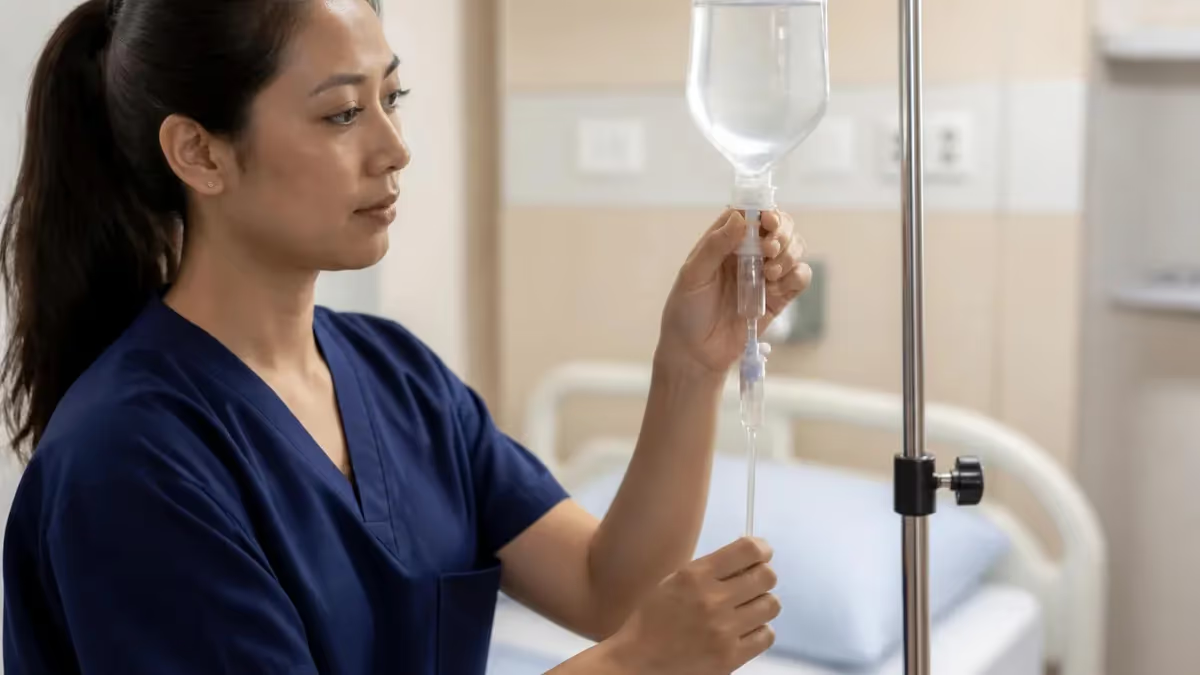
Choosing among the hundreds of BSN schools across the United States is one of the most consequential decisions a future nurse will make. The right Bachelor of Science in Nursing program shapes your clinical confidence, NCLEX-RN pass rate, starting salary, and even where you can practice after graduation. With more than 700 accredited four-year nursing programs operating today, prospective students must weigh accreditation, cost, clinical placements, faculty credentials, and outcomes data before committing to a school that will define the next four years of their life.
The landscape of nursing education has shifted dramatically since the Institute of Medicine's 2010 report urging that 80 percent of registered nurses hold a baccalaureate degree by 2020. Although that target was missed nationally, hospitals seeking Magnet recognition still push aggressively for BSN-prepared nurses, and many health systems now hire only baccalaureate graduates for staff RN positions. This shift has made the choice of school more strategic than ever before.
BSN programs typically span four academic years and include roughly 120 to 130 credit hours of coursework. The first two years emphasize prerequisites such as anatomy, physiology, microbiology, chemistry, statistics, and developmental psychology. The final two years deliver nursing-specific theory and supervised clinical rotations in medical-surgical, pediatric, obstetric, psychiatric, and community health settings. Students must also pass standardized exams like the HESI or ATI to progress through the curriculum.
Tuition at BSN schools varies wildly, from roughly $10,000 per year at in-state public universities to more than $60,000 annually at private institutions. Add room, board, books, uniforms, malpractice insurance, background checks, and clinical lab fees, and the total four-year investment can range from $50,000 to over $250,000. Understanding this financial picture early helps families plan loans, scholarships, and work-study arrangements without surprises.
Beyond cost, accreditation by either the Commission on Collegiate Nursing Education (CCNE) or the Accreditation Commission for Education in Nursing (ACEN) is non-negotiable. State boards of nursing will not allow graduates of unaccredited programs to sit for the NCLEX-RN, and graduate schools refuse credits from unaccredited institutions. Verifying current accreditation status on the agency websites should be the first filter applied to any school list.
This guide walks you through every dimension of evaluating BSN schools: program formats, admissions criteria, costs, clinical experiences, NCLEX outcomes, online options, and post-graduation career paths. Whether you are a high school senior beginning college applications, a working adult considering a second career, or a paramedic or LPN looking to advance, the framework below will help you build a short list of programs that match your goals, learning style, and budget without falling for marketing claims that obscure the actual quality of education delivered.
By the end, you will understand what separates a strong nursing school from a mediocre one, how to interpret NCLEX-RN first-time pass rates, why simulation labs matter, and how to evaluate clinical placement agreements. You will also see how online and hybrid pathways have evolved into legitimate options for many students, and how to spot programs that overpromise and underdeliver before signing enrollment paperwork.
BSN Schools by the Numbers
Types of BSN Programs Offered by Nursing Schools
The classic baccalaureate pathway for high school graduates, combining two years of prerequisites with two years of nursing coursework and 800–1,000 hours of supervised clinical rotations across multiple specialty areas.
Intense 12–18 month programs designed for adults who already hold a bachelor's degree in another field. Coursework runs year-round with no summer break and demands roughly 60–70 study hours weekly.
Online bridge programs for licensed registered nurses with associate degrees or diplomas. Typically 12–24 months and focused on leadership, research, community health, and evidence-based practice topics.
Bridge tracks granting credit for prior practical nursing education. Students complete advanced clinical, theory, and general education coursework over 2–3 years, depending on transferable credits.
Hybrid option for non-nurses with bachelor's degrees who want to skip straight to a master's, earning BSN-level licensure within 12–18 months before continuing to advanced practice or leadership tracks.
Admission to competitive BSN schools has become significantly more selective over the past decade. Many flagship state universities now report acceptance rates below 30 percent for their nursing majors, with some elite programs admitting fewer than one in ten applicants. Understanding what admissions committees actually weigh will help you build an application that stands out beyond a simple list of grades and test scores submitted through the common application portal.
Cumulative GPA remains the single most important academic metric. Most BSN programs require a minimum 3.0 on a 4.0 scale, but competitive admits typically present 3.5 or higher, with science prerequisite GPAs often weighted even more heavily. Anatomy and physiology, microbiology, and chemistry grades signal whether a student can handle the volume and rigor of nursing pharmacology, pathophysiology, and biochemistry coursework that begins immediately upon matriculation into the nursing major.
Standardized testing requirements have grown more complex. The TEAS (Test of Essential Academic Skills) is required at the majority of BSN schools, evaluating reading, math, science, and English usage. A score of 75 or higher generally meets minimums, but competitive programs expect scores in the 85th percentile and above. Some schools also require the SAT or ACT for traditional freshman applicants, while others have moved to test-optional admissions since the pandemic disruptions of 2020 and 2021.
Prerequisite coursework must be completed with grades of C or better, though many schools require B or better in science courses. Common prerequisites include anatomy and physiology I and II, microbiology with lab, general chemistry, statistics, nutrition, human growth and development, English composition, and introductory psychology. Schools may also expect medical terminology, ethics, or sociology, depending on their curriculum design and state board requirements.
Healthcare experience is not always mandatory, but it strengthens applications significantly. Volunteer hours in a hospital, employment as a certified nursing assistant, EMT certification, hospice volunteering, or work as a medical scribe all demonstrate genuine commitment to the profession. Admissions committees use these experiences to gauge whether applicants understand the physical and emotional demands of bedside nursing before investing institutional resources in their education.
Personal essays and letters of recommendation round out the application package. Strong essays articulate specific reasons for pursuing nursing rather than generic statements about helping people. Recommendations from science professors, healthcare supervisors, or volunteer coordinators carry more weight than generic letters from family friends. Many programs also conduct in-person or virtual interviews to assess communication skills, professionalism, and emotional intelligence before extending final admission offers to the entering cohort.
Finally, applicants must clear background checks, drug screens, immunization requirements, CPR certification, and health insurance verification before clinical rotations begin. Felony convictions, even old ones, may disqualify candidates because state boards of nursing review character and fitness as part of licensure. Addressing potential issues proactively with admissions counselors before applying saves wasted application fees and protects you from rejections that surface only after acceptance and tuition deposits have already been paid.
BSN Practice Test Questions
Prepare for the BSN - Degree Bachelor of Science in Nursing exam with our free practice test modules. Each quiz covers key topics to help you pass on your first try.
BSN Community and Public Health Nursing
BSN Exam Questions covering Community and Public Health Nursing. Master BSN Test concepts for certification prep.
BSN Maternal-Newborn and Women's Health Nu...
Free BSN Practice Test featuring Maternal-Newborn and Women's Health Nursing. Improve your BSN Exam score with mock test prep.
BSN Medical-Surgical Nursing
BSN Mock Exam on Medical-Surgical Nursing. BSN Study Guide questions to pass on your first try.
BSN Mental Health and Psychiatric Nursing
BSN Test Prep for Mental Health and Psychiatric Nursing. Practice BSN Quiz questions and boost your score.
BSN Pharmacology and Medication Administra...
BSN Questions and Answers on Pharmacology and Medication Administration. Free BSN practice for exam readiness.
BSN BS-Nursing General
BSN Mock Test covering BS-Nursing General. Online BSN Test practice with instant feedback.
Top BSN School Categories Compared
Public state universities educate the largest share of BSN students nationwide. Flagship schools like the University of Washington, UCLA, University of Michigan, University of North Carolina at Chapel Hill, and University of Texas at Austin combine research-intensive faculty with extensive academic medical center partnerships, offering students exposure to high-acuity clinical environments rarely available at smaller institutions.
In-state tuition at public BSN schools typically ranges from $8,000 to $15,000 per year, making them the most affordable option for residents. Out-of-state students often pay two to three times more, but some regional reciprocity agreements like WUE and SREB provide reduced rates. Class sizes can be large, with cohorts of 80 to 120 students per year, requiring proactive engagement to access faculty mentorship.

Is a Traditional BSN Program Right for You?
- +Eligible for staff RN positions at Magnet-designated hospitals nationwide
- +Higher starting salaries than ADN graduates in most metropolitan markets
- +Direct pathway into MSN, DNP, and CRNA programs without bridge requirements
- +Comprehensive clinical exposure across multiple specialties before graduation
- +Strong alumni networks and university recruiting partnerships with major health systems
- +Federal financial aid eligibility through FAFSA and institutional scholarships
- +Leadership, research, and public health content not covered in associate programs
- −Significantly higher tuition than community college ADN programs
- −Four-year commitment delays entry into the nursing workforce
- −Highly competitive admissions at top public and private universities
- −Heavy prerequisite load before nursing coursework even begins
- −Limited flexibility for working adults compared to part-time online options
- −Substantial student loan debt for graduates of private institutions
- −Mandatory full-time clinical hours during junior and senior years
BSN Schools Application Checklist
- ✓Verify CCNE or ACEN accreditation status on the official agency website
- ✓Confirm in-state vs. out-of-state tuition rates and residency requirements
- ✓Complete all science prerequisites with grades of B or higher
- ✓Register for and complete the TEAS exam at least three months early
- ✓Request official transcripts from every postsecondary institution attended
- ✓Secure two to three strong letters of recommendation from science or healthcare contacts
- ✓Draft and revise a personal statement explaining your nursing motivation
- ✓Document volunteer or paid healthcare experience hours with verifiable contacts
- ✓Submit FAFSA by the priority deadline, typically January or February
- ✓Schedule background check, drug screen, and immunization updates before orientation
- ✓Obtain CPR for Healthcare Providers certification from the American Heart Association
- ✓Review and accept admission offer before the national May 1 deposit deadline
First-Time Pass Rates Reveal Program Quality
The most reliable single indicator of a BSN school's teaching quality is its first-time NCLEX-RN pass rate. Programs consistently above 90 percent typically combine rigorous curriculum, dedicated NCLEX preparation courses, and high-fidelity simulation. Avoid schools below 75 percent or those that hide their numbers — most state boards of nursing publish these statistics publicly and can be searched online by school.
The cost of attending BSN schools has risen faster than overall inflation for two decades, leaving many graduates with $30,000 to $80,000 in student loan debt. Understanding the full price tag, distinguishing between sticker price and net price, and building a realistic financial aid strategy can mean the difference between a manageable monthly loan payment and a decade of financial strain that delays homeownership, family planning, and retirement savings well into your thirties.
Sticker price includes published tuition, mandatory fees, room and board, books and supplies, transportation, and personal expenses. The total annual cost of attendance at a public in-state BSN school typically ranges from $25,000 to $35,000 once housing and meals are included. Private universities frequently exceed $75,000 annually, and the highest-priced programs at elite institutions surpass $90,000 when all expenses are tallied accurately for budgeting purposes.
Net price subtracts grants, scholarships, and tuition discounts from sticker price, revealing what families actually pay. The federal Net Price Calculator, available on every accredited school's website, generates personalized estimates based on income, assets, and household size. Use this tool early in your search to avoid eliminating schools that appear unaffordable on paper but offer substantial aid to applicants who meet specific academic or demographic criteria during admissions review.
Federal aid begins with the FAFSA, which determines eligibility for Pell Grants of up to $7,395 annually, subsidized and unsubsidized Stafford Loans, and federal work-study positions. Pell Grants are reserved for students with significant financial need, while Stafford Loans are widely available with capped annual borrowing limits. Filing the FAFSA by each school's priority deadline maximizes aid; late filers often miss out on institutional grants distributed first-come, first-served until funds are exhausted.
Institutional scholarships and grants are the largest source of aid at most private nursing schools. These funds may be merit-based, need-based, or tied to specific criteria such as first-generation college status, military affiliation, or rural background. Many schools also offer endowed scholarships funded by alumni for students pursuing specific specialties like geriatrics, pediatrics, or behavioral health, requiring separate applications beyond the general admissions process.
External scholarships from organizations such as the American Nurses Foundation, Hurst Review, NURSE Corps Scholarship Program, and state nurses associations can add thousands of dollars annually. Some hospitals offer tuition forgiveness in exchange for two- to four-year work commitments after graduation, particularly in critical care, emergency, and underserved rural settings facing severe staffing shortages that limit operational capacity in their inpatient units and emergency departments.
Finally, consider opportunity cost. A four-year traditional BSN delays full-time RN income by two years compared to an associate degree pathway. For some students, completing an ADN first and then pursuing an RN-to-BSN bridge while working as a registered nurse offers superior financial mathematics, even though the total educational journey lasts longer. Run the numbers carefully using a spreadsheet that accounts for tuition, lost wages, interest accrual, and projected starting salaries in your geographic area.

Several high-profile for-profit nursing schools have lost accreditation in recent years, leaving graduates unable to sit for the NCLEX-RN or transfer credits. Always verify current accreditation directly on the CCNE (ccneaccreditation.org) or ACEN (acenursing.org) websites before paying any deposits. State board approval alone is not sufficient — true accreditation comes only from these two recognized agencies.
Online and hybrid BSN schools have evolved from skeptical experiments into legitimate, accredited pathways trusted by employers and graduate schools alike. The COVID-19 pandemic accelerated this transformation, normalizing virtual lectures, telehealth simulations, and remote proctoring while pushing nursing faculty to develop more sophisticated digital learning experiences. Today, fully online didactic coursework combined with in-person clinical rotations is mainstream at many of the country's most respected nursing schools across multiple geographic regions.
Fully online BSN programs are rare for first-time nursing students because state boards still require hands-on clinical hours that cannot be replicated entirely through virtual simulation. However, RN-to-BSN bridges thrive in online formats because licensed nurses already meet clinical hour requirements through their work experience. These programs allow working RNs to complete BSN coursework in 12 to 24 months without leaving their current jobs, which preserves income and benefits.
Hybrid traditional BSN programs combine online lectures with in-person labs, simulations, and clinical rotations scheduled in geographic clusters. Schools like Western Governors University, Chamberlain University, and Purdue Global have built reputations for hybrid delivery, while traditional brick-and-mortar institutions increasingly offer evening and weekend cohorts to accommodate adults transitioning into nursing from other careers without uprooting their families or relocating to a new city.
If you are exploring online formats, our rn to bsn online programs walks through accreditation verification, clinical placement logistics, and what to expect in virtual classrooms. Look for schools that arrange clinical sites for you rather than expecting students to find preceptors independently, which can become a major obstacle in markets with limited hospital partnerships or oversaturated nursing student populations competing for available rotation slots.
Technology requirements for wgu rn to bsn program students include reliable high-speed internet, a webcam, a quiet study space, and a computer capable of running medical simulation software. Some programs require specific operating systems or hardware specifications, so confirm requirements before enrollment. Budget for textbooks, online proctoring fees, lab kits shipped to your home, and travel expenses to in-person residencies if your chosen program requires periodic on-campus intensives lasting several days at a time.
Time management discipline is the single greatest predictor of success in online BSN schools. Without classroom structure, students must self-pace through recorded lectures, asynchronous discussion boards, and unit exams while balancing work, family, and clinical hours. Successful online students typically dedicate 25 to 35 hours per week to coursework, treat their studies like a part-time job, and proactively communicate with faculty when life events disrupt their carefully constructed academic schedule.
Finally, verify that your state's board of nursing approves the online program for licensure. Some states restrict online nursing education or require additional clinical hours for out-of-state graduates seeking endorsement. The Nurse Licensure Compact simplifies multi-state practice, but it does not override individual state education requirements. Confirming licensure eligibility before enrolling prevents the heartbreaking scenario of completing a program that does not qualify you to practice in your home state.
Once you have narrowed your list to three to five BSN schools that match your priorities, the final selection requires thoughtful comparison beyond rankings and admission rates. Visit each campus in person if possible, sit in on a nursing class, tour the simulation lab, and talk to current students outside the official tour. Marketing materials are designed to impress, but candid conversations with juniors and seniors reveal what daily life actually looks like inside the program walls.
Ask specific questions during your visits. What is the student-to-faculty ratio in clinical rotations? How are clinical sites assigned, and can students request specific specialties or hospitals? What is the NCLEX-RN pass rate for the past three cohorts, broken down by first-time and total pass rates? What percentage of graduates secure RN positions within six months, and at which health systems? Vague answers signal weak programs hiding embarrassing data.
Evaluate the simulation center carefully. Modern BSN programs invest in high-fidelity manikins capable of simulating cardiac arrests, deteriorating sepsis, postpartum hemorrhages, and pediatric respiratory distress. Standardized patient programs hire actors to simulate difficult therapeutic communication scenarios with grieving families or angry patients. Strong simulation curricula prepare graduates for situations they may not encounter in clinical rotations due to scheduling, patient census, or institutional policies that restrict student involvement.
Consider geographic placement. The hospitals you train in during clinical rotations often become your first employers after graduation. Schools located near major academic medical centers expose students to high-acuity, complex patients, while rural programs may emphasize community health and primary care. Neither is inherently better — what matters is alignment with your post-graduation career goals, family obligations, and long-term geographic preferences for where you want to live and practice as a nurse.
Faculty matter enormously. Look for programs where most clinical instructors are practicing nurses with recent bedside experience rather than career academics disconnected from current practice. Research-active faculty bring evidence-based content into the classroom, while doctorally prepared educators understand pedagogy and curriculum design. The best programs balance both, hiring clinically current preceptors alongside PhD-prepared researchers who collaborate with hospital systems on quality improvement projects.
Finally, factor in your own learning style and life circumstances. Some students thrive in large, anonymous lecture halls with hundreds of peers; others need the close mentorship of a small cohort of thirty. Working parents may require evening cohorts and proximity to childcare. First-generation students benefit from schools with strong academic support services, tutoring centers, and faculty mentors who understand the unique challenges of navigating higher education without family roadmaps to follow during difficult semesters.
Before signing enrollment paperwork, explore alternative pathways one more time. Our rn vs bsn helps you decide whether to pursue an associate degree first and bridge later, while reviewing accelerated and bridge options ensures you have not overlooked a faster or cheaper route to the same destination. The right BSN school is the one that fits your specific circumstances — not the one with the most impressive marketing budget or highest national ranking in glossy magazines.
BSN Questions and Answers



About the Author

Registered Nurse & Healthcare Educator
Johns Hopkins University School of NursingDr. Sarah Mitchell is a board-certified registered nurse with over 15 years of clinical and academic experience. She completed her PhD in Nursing Science at Johns Hopkins University and has taught NCLEX preparation and clinical skills courses for nursing students across the United States. Her research focuses on evidence-based exam preparation strategies for healthcare certification candidates.