
Alabama Boating License Test Answers: Complete Study Guide 2026 October
Master Alabama boating license answers with our complete study guide. Practice tests, real exam tips & state-by-state requirements. 🎓 Pass on your first try!
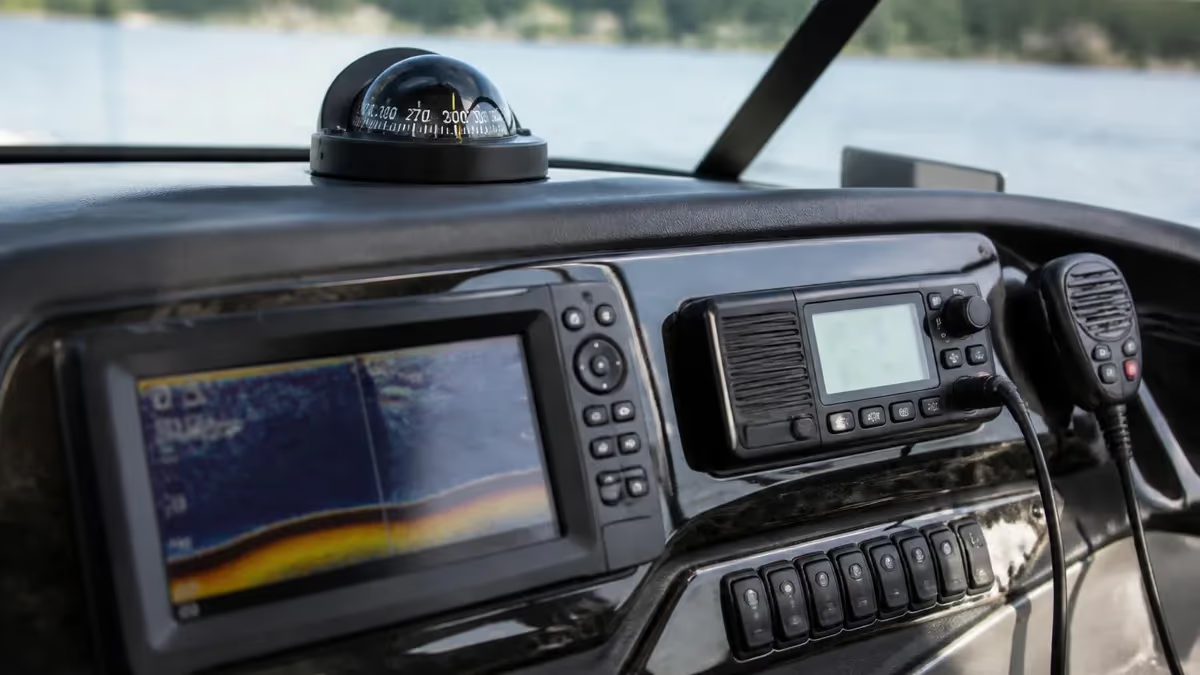
If you're searching for alabama boating license answers to help you pass your state boating safety exam, you've come to the right place. Alabama requires all motorboat operators born on or after January 1, 1982, to carry a Boater Safety Certificate — and earning that certificate means passing a state-approved exam that covers navigation rules, safety equipment, emergency procedures, and Alabama-specific waterway regulations. Understanding exactly what to study, which topics carry the most weight, and how the test is structured can make the difference between walking away with your certification on the first attempt and having to retake the exam.
The Alabama boating safety course and exam are administered through NASBLA-approved providers, including online platforms recognized by the Alabama Law Enforcement Agency (ALEA). The exam typically contains 60 questions drawn from a standardized question bank, and you must score at least 70% — answering 42 or more questions correctly — to pass. Topics include rules of the road, proper lookout requirements, speed regulations, vessel lighting, fire extinguisher classifications, life jacket requirements, and proper anchoring techniques. Knowing the exact categories tested gives you a road map for focused, efficient preparation.
One of the most common questions new boaters ask is whether a license earned in one state transfers to another. If you already hold a florida boating license, a california boating license, or a tennessee boating license, you may be wondering if Alabama will recognize your existing certification. The good news is that most NASBLA-approved boater education cards are accepted reciprocally across all 50 states, meaning your out-of-state card is generally valid on Alabama waters — though you should always verify current reciprocity rules with ALEA before heading out.
Many first-time test-takers underestimate how scenario-based modern boating exams have become. Rather than asking you to define terms outright, questions often present a real-world situation — for example, two vessels approaching head-on, a PWC crossing a sailboat's path, or a boater discovering a fuel leak while underway. Answering these correctly requires not just memorization of rules but a genuine understanding of how those rules apply when conditions get complicated. This is why working through realistic practice questions is far more effective than simply reading the textbook once.
This study guide covers everything you need to know to earn your Alabama Boater Safety Certificate: the full exam format, the heaviest-tested topics, state-specific rules that differ from federal standards, a week-by-week study schedule, and hundreds of practice questions aligned with the actual exam blueprint. Whether you're preparing for the in-person proctored exam or the online version offered by providers like Boat-Ed or BoatUS Foundation, the material in this guide applies directly to what you'll encounter on test day.
Understanding whether do you need license to operate a boat varies significantly by state, age, and vessel type. In Alabama, the certificate requirement applies to motorized vessels, but paddlecraft, kayaks, and canoes are generally exempt from the boater education requirement — though operators are still expected to follow all navigation rules and carry required safety equipment. Jet ski and PWC operators face additional restrictions in Alabama, including a minimum age requirement and rules about how close they can operate to swimmers, docks, and other vessels.
Throughout this guide you'll find detailed explanations of every major topic area, study strategies that experienced boaters recommend, and clear breakdowns of the answer logic behind the most frequently missed questions. Alabama boating license answers are not about trick questions — they're about building real knowledge of safe boating practices. Stick with this material, complete the practice sets embedded throughout, and you'll be fully prepared to pass your exam, get on the water legally, and enjoy Alabama's incredible lakes, rivers, and coastal waterways with confidence.
Alabama Boating License by the Numbers
Key Facts at a Glance
| Item | Value | Details |
|---|---|---|
| Exam Questions | 60 | Standard Alabama boating safety exam length |
| Minimum Passing Score | 70% | 42 correct answers required to pass |
| Minimum Course Hours | 8 hrs | Required study time for approved online courses |
| Typical Course Fee | $34–$45 | Varies by approved provider |
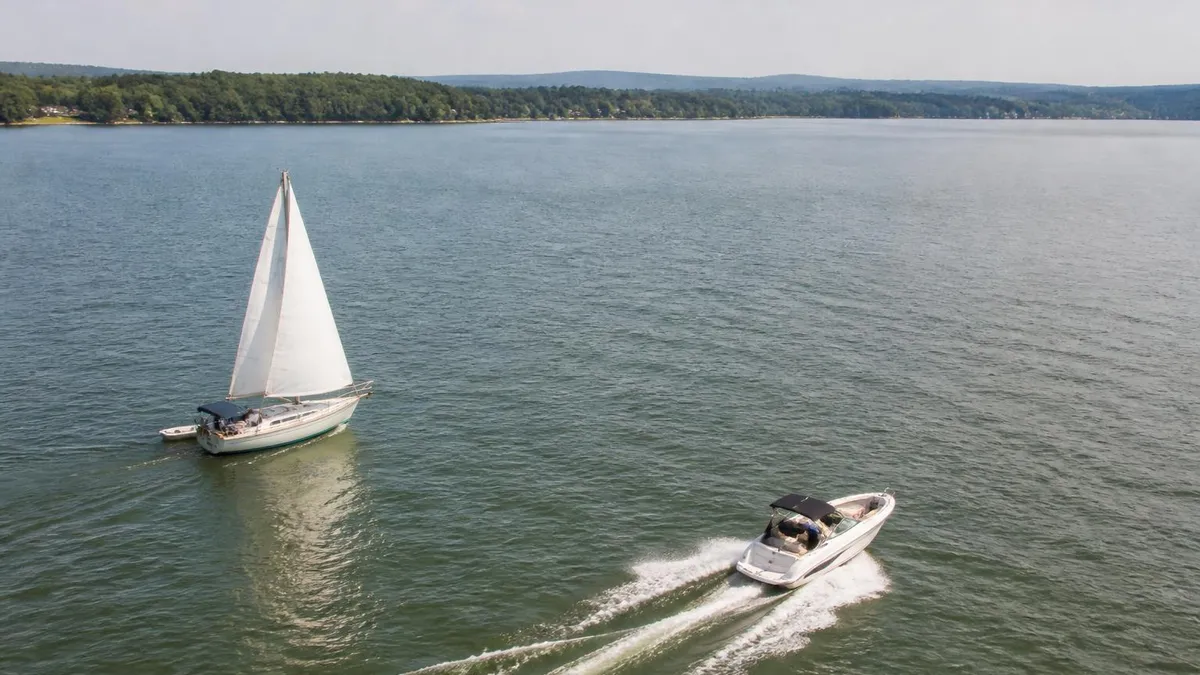
Alabama Boating License Study Schedule
- ▸Read the USCG Navigation Rules for inland and coastal waters
- ▸Memorize vessel hierarchy: sail over power, less maneuverable over more maneuverable
- ▸Practice 20 right-of-way scenario questions
- ▸Learn whistle signal meanings (1 blast, 2 blasts, 5 blasts)
- ▸Memorize PFD types (I–V) and when each is required
- ▸Learn fire extinguisher classes (B-I vs B-II) by vessel length
- ▸Study visual distress signal requirements for day vs night
- ▸Review sound signaling device requirements by vessel size
- ▸Study Alabama no-wake zone rules and restricted areas
- ▸Learn PWC-specific Alabama regulations and age requirements
- ▸Review Alabama alcohol-related boating laws and BUI penalties
- ▸Memorize state speed limits in congested waterways
- ▸Practice man-overboard response procedures step by step
- ▸Study distress signal protocols and when to call the Coast Guard
- ▸Complete 3 full-length 60-question practice exams
- ▸Review all missed questions and re-read source material for weak areas
The Alabama boating safety exam tests knowledge across six major content domains, and understanding how much weight each domain carries is essential for allocating your study time efficiently. Navigation rules and right-of-way situations consistently account for the largest share of questions — typically 20 to 25 percent of the exam. These questions cover when to yield, what sound signals to use in different situations, and how to navigate crossing, meeting, and overtaking scenarios correctly. Mastering this domain alone puts you well above the 70% passing threshold if you're solid on everything else.
Required safety equipment is the second-heaviest topic, usually representing 18 to 22 percent of questions. Alabama law requires specific types and numbers of personal flotation devices (PFDs), fire extinguishers, visual distress signals, and sound-producing devices depending on vessel length and the type of water you're navigating. A common exam trap involves fire extinguisher classifications — test-takers often confuse B-I and B-II extinguishers, or forget that vessels with enclosed engine compartments have stricter requirements than open-hull boats of the same length.
Understanding vessel lighting is another frequently tested area that trips up many first-time exam-takers. Alabama follows USCG inland rules for lighting, which means you need to know the difference between colored running lights for power vessels, sailboats, and rowboats, as well as anchor lights and the specific arcs each light must cover. Questions often describe a lighting configuration and ask you to identify what type of vessel you're looking at, or ask from which direction you're approaching another vessel based on the lights visible to you.
Environmental regulations and boater responsibility form a growing portion of modern boating exams. Alabama has strict rules about fuel spills, waste discharge, and invasive species prevention — particularly important given the state's enormous freshwater lake system, which includes Lake Guntersville, Lake Martin, Weiss Lake, and the Tennessee River chain. Exam questions in this category often involve choosing the correct response when a fuel spill occurs, or identifying which types of waste can legally be discharged in Alabama waterways (virtually none).
Alcohol and drug impairment rules are tested directly on the Alabama exam. Alabama's BUI (Boating Under the Influence) law mirrors its DUI statute — a BAC of 0.08% or higher is illegal for vessel operators, and law enforcement officers can stop any vessel on Alabama waters for a safety check or if there is reasonable suspicion of impairment. Refusing a sobriety test carries automatic penalties. The exam may ask about penalties, the legal BAC limit, or how impairment affects reaction time and judgment on the water.
Many boaters preparing for their Alabama exam benefit enormously from studying questions about anchoring, docking, and trailering — topics that appear in smaller but consistent numbers across every exam version. Proper anchoring requires understanding scope ratios (typically 7:1 for rope anchors in calm conditions), how to set an anchor effectively, and how to recognize when an anchor is dragging. Trailering questions often cover proper trailer lighting, safety chain attachment, and launching ramp etiquette. If you know a nys boating license has similar trailering requirements, you'll notice that federal standards underpin most of these rules across all states.
Emergency procedures round out the exam's content domains. You should know the correct response to a man-overboard situation (throw a flotation device immediately, keep eyes on the victim, approach from downwind), how to signal distress (three blasts of a horn, orange distress flags by day, flares by night), and what to do if your vessel begins taking on water. Fire aboard a vessel is another high-frequency emergency topic — knowing to first cut the fuel supply, then use the fire extinguisher from a downwind position, is the kind of specific procedural knowledge the exam rewards.
Boating License Requirements: Alabama, Florida & Beyond
Alabama requires all motorboat operators born on or after January 1, 1982, to complete a NASBLA-approved boater safety course and carry the resulting certificate while on the water. The exam is 60 questions with a 70% passing threshold, and courses can be completed online through providers like Boat-Ed.com or in a classroom setting. PWC operators face additional restrictions, including a minimum age of 14 years old, and operators between 14 and 17 must be supervised by an adult who holds a valid Boater Safety Certificate.
Alabama's certification is permanent once earned — there is no renewal requirement. Boaters must carry their physical or digital Boater Safety Certificate while operating, and law enforcement officers can request it during any on-water stop. Visitors operating a vessel on Alabama waters must comply with their home state's boater education requirements, but most NASBLA-approved cards from other states are accepted as valid reciprocal documentation. Always verify current reciprocity rules with ALEA before your trip.
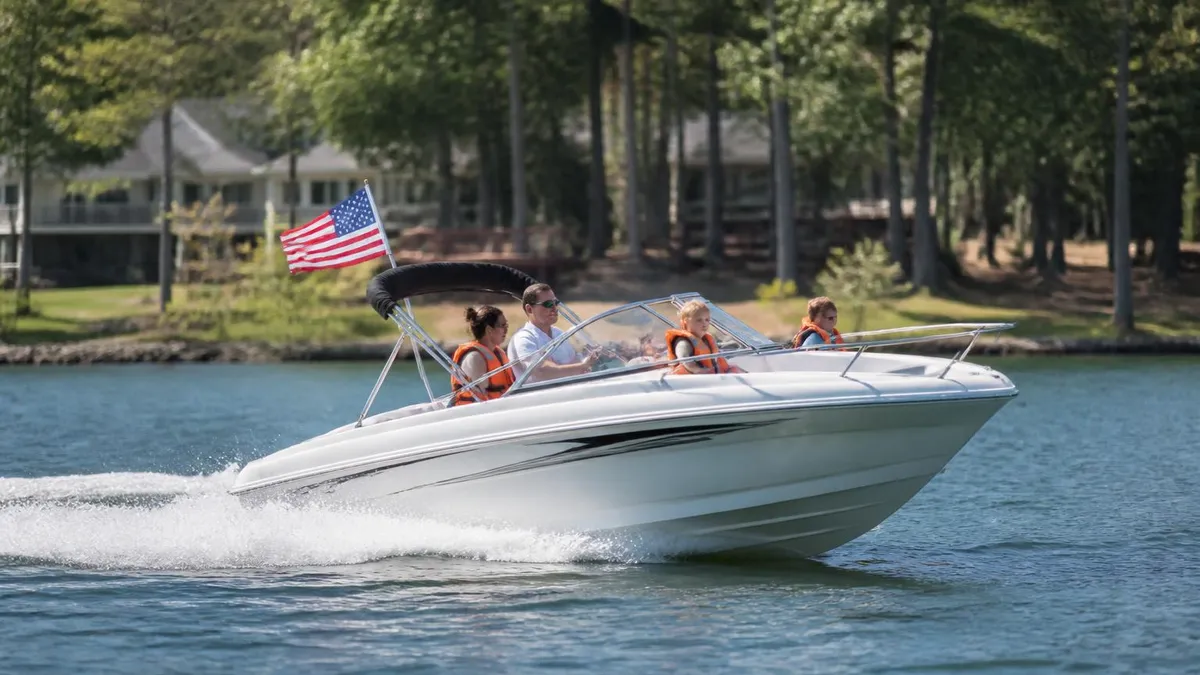
Online vs. In-Person Alabama Boating Safety Course
- +Complete the online course at your own pace, any time of day or night
- +Online providers like Boat-Ed include interactive animations and video lessons
- +Instant access to your certificate PDF upon passing the online final exam
- +Online courses often cost the same or less than in-person classroom sessions
- +Review and replay any section as many times as needed before the exam
- +Pause and resume your coursework across multiple study sessions without losing progress
- −No hands-on practice component in online-only courses — purely theoretical
- −Some learners find self-paced online study harder to stay motivated without a set schedule
- −Online exams require a reliable internet connection and compatible device throughout
- −Cannot ask an instructor real-time questions during difficult topic sections
- −In-person courses sometimes include on-water demonstrations not available online
- −Technical issues or website downtime can interrupt progress at critical moments
Alabama Boating Exam Day Checklist
- ✓Complete all required course modules and confirm your course is NASBLA-approved before registering for the exam
- ✓Score 80% or higher on at least three full-length practice exams before attempting the real test
- ✓Review all navigation right-of-way rules the night before and memorize the vessel hierarchy
- ✓Double-check the PFD type requirements for your vessel's length and operating waters
- ✓Memorize fire extinguisher classifications: B-I for vessels under 26 feet, B-II for vessels 26–40 feet
- ✓Review vessel lighting configurations and the arcs each color light must cover
- ✓Know Alabama's specific BUI law: 0.08% BAC limit, same as DUI, with mandatory penalties
- ✓Prepare a valid government-issued photo ID to present when registering for your proctored exam
- ✓If taking an online exam, test your internet connection and browser compatibility in advance
- ✓After passing, download and save your digital certificate — carry it every time you operate a vessel
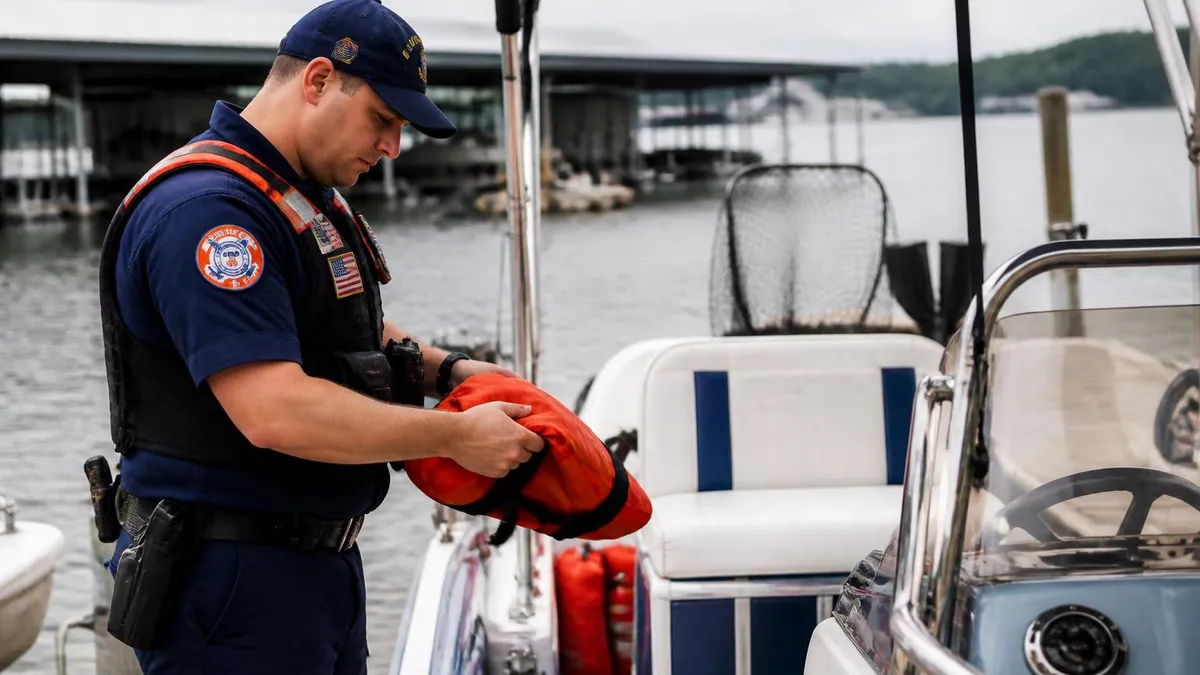
Most Missed Topic: Right-of-Way in Crossing Situations
The single most frequently missed question category on the Alabama boating exam involves crossing situations between two power-driven vessels. When two motorboats approach on crossing courses, the vessel that has the other on its starboard (right) side is the stand-on vessel and must maintain course and speed. The give-way vessel — the one that has the other on its port (left) side — must alter course, slow down, or stop. Memorizing this rule with a simple mnemonic like "starboard means stand on" can save critical exam points.
Understanding exactly why certain answers are correct on the Alabama boating exam requires more than surface-level memorization — it demands knowing the reasoning behind each rule. Consider the navigation lights section, which consistently produces wrong answers for test-takers who try to memorize color and position without understanding purpose.
Red and green running lights communicate your direction of travel to other boaters at night: if you see a vessel's green light, it is on your port side moving away from you or crossing; if you see red, the vessel may be on a collision course with you. This logic — not rote memorization — is what the exam tests.
Fire extinguisher questions follow a similar pattern. The exam doesn't just ask what type of extinguisher you need — it asks why certain vessels need two extinguishers instead of one, why built-in fire suppression systems in engine compartments count toward requirements, and what to do if your extinguisher's pressure gauge shows it is partially discharged. Alabama law requires you to service or replace extinguishers that are not fully charged, and using a partially-discharged extinguisher in an actual fire is both dangerous and potentially inadequate to suppress the blaze.
Alcohol on the water is a topic that many boaters think they already understand, only to discover nuance on the exam. Alabama's BUI statute applies to all vessels — including non-motorized boats, sailboats, and PWCs.
The physical effects of alcohol are intensified on the water due to sun, wind, wave motion, and engine vibration — a phenomenon the USCG refers to as "boater's fatigue." Exam questions may ask about this amplification effect, why the risk is higher on water than on land for the same BAC, or what a vessel operator should do if they believe a passenger is dangerously intoxicated.
Speed regulations are another area of nuance. Alabama does not post specific numeric speed limits on most open waterways — instead, the law requires a "reasonable and prudent" speed that takes into account visibility, vessel traffic, weather conditions, sea state, and proximity to hazards. No-wake zones, however, do post specific restrictions, and violating them carries significant penalties. The exam may describe a scenario and ask whether a given speed is legal or prudent, requiring you to apply the reasonableness standard rather than look up a posted number.
Anchoring questions frequently test whether you understand scope — the ratio of anchor line length to water depth. A 7:1 scope (for example, 70 feet of rode in 10 feet of water) provides adequate holding power under normal conditions, while a 5:1 scope may be acceptable in calm conditions with good bottom composition.
The exam may ask about minimum scope, what to do if your anchor drags, or how to set an anchor correctly. Understanding that an anchor should be set by backing down slowly against the current or wind — not simply dropped and hoped — is the kind of applied knowledge these questions reward.
Trailering questions appear less frequently but consistently on the Alabama exam. Key knowledge includes proper tie-down techniques to secure the vessel to the trailer, the requirement for working trailer lights at all times when towing on public roads, and appropriate launching ramp etiquette (preparing your vessel in a staging area, not at the ramp itself, to avoid congestion). Questions about trailer safety chains — which must cross under the trailer tongue to catch the tongue if it separates from the hitch — are particularly common and frequently missed by unprepared test-takers.
For anyone curious about whether they legally need a certification before getting on the water, knowing the answer depends on your state, age, and vessel type. The question of new york state boating license rules illustrates how dramatically requirements vary — New York's Progressive Boater Education Law phases in requirements by birth year much like California's system. No matter which state you're in, completing a NASBLA-approved course is the fastest path to legal, confident boating on any waterway in the country.
Alabama boaters required to hold a Boater Safety Certificate must carry it — physically or digitally — every time they operate a motorized vessel. Being caught without it can result in a citation even if you passed your exam years ago. Law enforcement officers conduct routine safety checks on Alabama waterways and have the authority to cite operators who cannot produce valid documentation. Keep a copy on your phone and a laminated backup on your vessel at all times.
The most effective strategy for mastering alabama boating license answers is interleaved practice — rather than studying one topic until you've exhausted it, mixing questions from different domains forces your brain to retrieve and apply knowledge in the same random order the real exam presents it. When you study navigation rules for an hour straight, your brain gets into a rhythm and pattern-matches correctly. When those same questions are interspersed with fire extinguisher, lighting, and emergency procedure questions, retrieval becomes harder — and that productive difficulty is exactly what cements long-term memory.
Spaced repetition is the second major study strategy that research consistently shows outperforms rereading. This means reviewing material at increasing intervals — once on day one, again on day three, again on day seven, and so on. Free flashcard apps like Anki support this method perfectly, and creating your own cards based on the specific topics tested on the Alabama exam is far more effective than using generic boating flashcard decks. Focus especially on cards for the topics you got wrong on your first practice exam attempt, as those represent your highest-use study opportunities.
Many test-takers make the mistake of treating practice questions as a test of what they already know rather than a learning tool. When you get a practice question wrong, the single most important next step is not moving on — it's understanding exactly why the correct answer is correct and why your chosen answer is wrong. Read the explanation, trace it back to the relevant rule in the course material, and mentally replay the scenario until you can explain the reasoning out loud. This active processing approach is dramatically more effective than passive review of the same material.
Time management during the actual Alabama boating exam deserves specific preparation. With 60 questions and typically 90 minutes to complete the exam, you have an average of 90 seconds per question — far more than you'll need for most straightforward questions, but not as much as it seems when you encounter a complex scenario question that requires careful reading. Practice taking full-length timed exams to calibrate your pace, and develop a flagging strategy: answer all questions you're confident about first, flag uncertain ones, and return to flagged questions with remaining time.
Physical preparation on exam day matters more than many people realize. Arriving well-rested, having eaten a balanced meal, and avoiding caffeine overload can meaningfully improve cognitive performance — particularly on scenario-based questions that require reading comprehension and analytical reasoning. If you're taking an online exam from home, eliminate distractions, test your technology setup in advance, and take the exam in a quiet environment where you won't be interrupted mid-session.
After you pass your Alabama exam, your next priority is understanding the practical on-water rules that aren't always fully conveyed in course materials. Joining a local boating club, taking a hands-on seamanship course through US Power Squadrons, or simply going out on the water with an experienced boater to practice docking, anchoring, and navigation in real conditions will rapidly accelerate your skill development beyond what any exam can measure. The certification is the starting point, not the finish line.
Whether you're pursuing a missouri boating license, an ohio boating license, or your Alabama Boater Safety Certificate, the underlying federal navigation rules are the same across all states — meaning the investment you make in mastering these rules pays dividends on every body of water you visit, not just Alabama's. Use this guide, complete the practice exams embedded throughout, and approach your certification as the foundation of a lifetime of safe, enjoyable boating.
In the final days before your Alabama boating exam, shift your focus from learning new material to consolidating and reinforcing what you already know. Attempting to cram unfamiliar topics in the 48 hours before your exam typically increases anxiety without meaningfully improving performance. Instead, run through two or three full-length practice exams under timed, test-like conditions, review any questions you missed, and spend the final evening on a light review of your weakest topic areas — no more than 30 to 45 minutes of active study.
Creating a personal quick-reference sheet of the most commonly tested facts is a powerful last-day study tool. Include the minimum passing score (70%), PFD type definitions and when each is required, fire extinguisher classifications by vessel length, the legal BAC limit for Alabama BUI (0.08%), the vessel hierarchy for right-of-way, and the basic lighting rules for running lights. Reading through this sheet several times builds retrieval fluency — the ability to rapidly recall key facts under exam pressure without having to reason through them from scratch.
One of the most overlooked aspects of boating license preparation is understanding what the examiners are specifically NOT testing. The Alabama exam is not a navigation chart plotting exercise, a knot-tying test, or a meteorology course — it focuses strictly on the legal and safety knowledge defined by NASBLA's national boating education standards. This focus means you should resist the temptation to deep-dive into marine electronics, weather forecasting, or advanced seamanship unless those topics genuinely interest you as supplementary learning after you've earned your certificate.
For parents helping young boaters prepare, Alabama allows operators as young as 12 to operate a personal watercraft with a Boater Safety Certificate, supervised by an adult. Operators 14 and older may operate a PWC with a certificate without direct adult supervision, though they must still comply with all operational rules. Children under 8 must wear a USCG-approved PFD at all times while on a vessel, regardless of vessel type or water conditions — and this rule applies to all Alabama waterways including private lakes and rivers.
Understanding how to register a vessel in Alabama is directly related to your boating certification journey, and the exam sometimes includes questions about registration requirements. All motorized vessels and sailboats over 12 feet must be registered with ALEA. Registration numbers must be displayed on the bow of the vessel in specific block letters, and the registration decal must be affixed near the number. Exceptions include vessels already registered in another state that are temporarily visiting Alabama waterways for 90 days or fewer.
Environmental stewardship is increasingly emphasized on modern boating exams, and the Alabama exam is no exception. The state's waterways are home to numerous protected species, including various freshwater mussel species listed under the Endangered Species Act. Alabama boaters are responsible for avoiding sensitive habitat areas, following all no-anchor zones in protected areas, and following invasive species prevention protocols — particularly cleaning, draining, and drying boats and trailers when moving between water bodies to prevent the spread of organisms like zebra mussels and hydrilla.
Finally, remember that earning your Alabama Boater Safety Certificate is the beginning of your education as a safe and responsible boater, not the end. The USCG Auxiliary and US Power Squadrons both offer free or low-cost advanced boating safety courses, on-water training, and vessel safety checks — services that can significantly enhance your skills and confidence on the water. Taking advantage of these resources, staying current with any changes to Alabama boating laws, and modeling safe boating behavior for everyone on your vessel will make every trip safer and more enjoyable for you, your passengers, and everyone sharing the waterway.
Sample Boating License Test Practice Questions
Try these questions from our free Boating License Test practice tests. The correct answer and an explanation follow each question.
Two power-driven vessels are approaching each other head-on. What should each vessel do?
- A. Alter course to starboard and pass port-to-port
- B. Alter course to port and pass starboard-to-starboard
- C. Maintain course and speed
- D. Stop engines and drift
Answer: A. Alter course to starboard and pass port-to-port
In a head-on meeting, both power-driven vessels turn to starboard (right) and pass port-to-port.
If you see only a green light from another vessel at night, what does this indicate?
- A. The vessel is anchored
- B. You are seeing the vessel's starboard side — it is crossing your path from right to left
- C. The vessel is operating in reverse
- D. The vessel is a sailing vessel under sail only
Answer: B. You are seeing the vessel's starboard side — it is crossing your path from right to left
A green light alone means you are looking at the starboard side of the vessel, which is moving from your right to your left.
A red buoy marks which side of a channel when returning from open water toward a harbor?
- A. The right (starboard) side
- B. The left (port) side
- C. The center of the channel
- D. A submerged wreck
Answer: A. The right (starboard) side
Under 'red right returning,' keep red buoys on your starboard side when returning from sea.
When two power-driven vessels are approaching head-on, what is the correct action?
- A. Both alter course to starboard
- B. Both alter course to port
- C. The larger vessel holds course
- D. Both maintain speed and course
Answer: A. Both alter course to starboard
In a head-on meeting, each vessel turns to starboard so they pass port-to-port.
Boating License Questions and Answers
Tennessee Boating License 2026 — Requirements, Age & How to Get One

Age Requirements for a Boating License: What Every State Demands in 2026
MN Boat License: Who Needs One & How to Get Certified
Do You Need a License to Drive a Boat? State-by-State Guide 2026

Boating License Cost: What You'll Pay in Every State (2026 Guide)
About the Author

Master Mariner & Maritime Certification Specialist
Massachusetts Maritime AcademyCaptain David Harrington is a US Coast Guard licensed Master Mariner with a Bachelor of Science in Marine Transportation from Massachusetts Maritime Academy. He has 22 years of deep-sea and coastal navigation experience aboard commercial vessels and specializes in preparing maritime candidates for USCG licensing exams, STCW certification, dynamic positioning (DPO), and officer-of-the-watch qualifications.
Join the Discussion
Connect with other students preparing for this exam. Share tips, ask questions, and get advice from people who have been there.
View discussion (6 replies)