
Medical Testing for Drivers: DOT Exams, Drug Tests & BMV
Learn about medical testing for drivers — DOT physical exams, point-of-care drug testing for CDL holders, vision requirements, and BMV medical review rules.

Medical testing for drivers isn't just bureaucratic red tape — it's a system built around one core idea: keeping impaired or medically unfit drivers off the road. Whether you're applying for a commercial driver's license or renewing your standard license after a health scare, you'll encounter some form of medical review. The rules vary depending on the type of license you hold, the state you're in, and your specific health history.
For commercial drivers, the requirements are federal — set by the Federal Motor Carrier Safety Administration (FMCSA) and enforced through the Department of Transportation (DOT). For standard license holders, it's the Bureau of Motor Vehicles (BMV) that steps in — usually when a doctor, law enforcement officer, or court flags a concern. Either way, understanding what's tested and why gives you a real advantage. You can prepare properly, avoid surprises, and know your rights if something goes wrong.
This guide covers the full landscape: DOT physical exams, point-of-care drug and alcohol testing, vision standards, conditions that affect eligibility, and how to navigate the BMV's medical review process. If you're studying for your license and want to shore up your knowledge of traffic law basics, a driving theory test is a great place to start.
The stakes for commercial drivers are especially high. A fully loaded semi-truck can weigh 80,000 pounds — the physics of a medical episode at highway speed are catastrophic. That's why the FMCSA mandates regular medical clearance for every CDL holder, no exceptions. You can't work around it, defer it, or substitute a personal doctor's note unless that doctor is a certified Medical Examiner listed on the FMCSA's National Registry.
For non-commercial drivers, the bar is lower but not nonexistent. Most states require a vision test during license renewal. Beyond that, your license can be reviewed — or even suspended — if a physician reports that a medical condition makes driving unsafe. Some states also require medical disclosure when you apply for a first license, particularly if you have a history of seizures, blackouts, or cardiovascular events.
States like Indiana BMV and the Ohio BMV have their own medical review boards that assess fitness to drive on a case-by-case basis. These aren't rubber-stamp processes — they review doctor's reports, driving records, and sometimes conduct their own evaluations before reinstating a license. Knowing how your state's BMV handles these reviews can save you weeks of uncertainty.
Medical Testing by the Numbers

You must hold a valid DOT medical certificate (FMCSA medical card) if you operate any of the following:
- A vehicle with a Gross Vehicle Weight Rating (GVWR) over 10,001 lbs in interstate commerce
- A vehicle designed to transport 9 or more passengers (including the driver) for compensation
- A vehicle transporting hazardous materials requiring placards
- Any vehicle requiring a Commercial Driver's License (CDL)
Intrastate-only drivers may follow state-specific rules, but most states mirror federal standards. When in doubt, assume federal rules apply.
The DOT Physical Exam for Commercial Drivers
The DOT physical exam is conducted by a licensed Medical Examiner (ME) — a doctor, nurse practitioner, physician assistant, or chiropractor — who is registered with the FMCSA. You can't just walk into any clinic. The ME must appear on the FMCSA National Registry of Certified Medical Examiners. Using an uncertified examiner means your certificate won't be recognized, and you'll need to repeat the exam.
During the exam, the ME evaluates several health domains. Vision is checked in each eye, with and without corrective lenses. Hearing is tested using a forced whisper test or audiometric device. Blood pressure is measured — if yours is between 140/90 and 159/99, you'll get a one-year certificate instead of the full two-year term. Anything above 180/110 means disqualification until it's controlled. The ME also reviews your urinalysis for protein and glucose (not for drugs — that's a separate test), and assesses your cardiovascular and neurological health.
If you take prescription medication, bring a complete list. Some medications are disqualifying — certain anticonvulsants, methadone, and some psychiatric drugs can prevent certification. Others are acceptable with documentation. Being upfront is always better than having the ME discover omissions. A thorough Medical Examiner will ask follow-up questions — give honest, specific answers and let them make the clinical call.
DOT Physical Exam: Step-by-Step
Complete Medical History Form
Vision Testing
Hearing Test
Blood Pressure & Cardiovascular Review
Urinalysis
Certificate Issued or Deferred
Point-of-Care Drug and Alcohol Testing
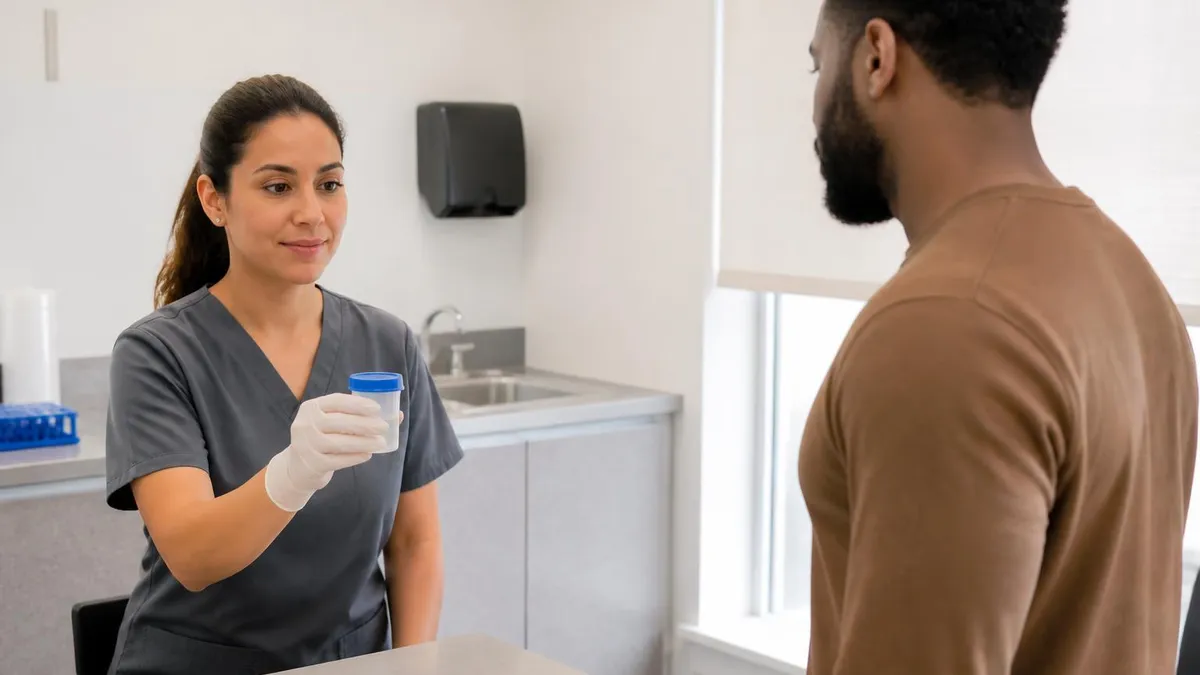
Point-of-care (POC) drug and alcohol testing is a different beast from the DOT physical. It's not about your general health — it's specifically about whether you're impaired right now or have recently used controlled substances. All commercial drivers subject to DOT regulations must participate in a drug and alcohol testing program administered under 49 CFR Part 40.
The testing happens at multiple points in your employment: pre-employment (before you can drive a commercial vehicle), randomly throughout the year, post-accident (when there's a fatality or certain injury thresholds are met), when there's reasonable suspicion based on observable behavior, and when returning to duty after a violation. You don't get advance notice for random tests — that's the whole point. Employers must test a minimum percentage of their driver workforce each year (50% for drugs, 10% for alcohol under current FMCSA rules).
The standard DOT urine drug test screens for five substance categories: marijuana (THC metabolites), cocaine, amphetamines (including methamphetamine and MDMA), opioids (codeine, morphine, hydrocodone, hydromorphone, oxycodone, oxymorphone), and phencyclidine (PCP). A positive result — or a refusal to test — is treated the same as a confirmed positive. You're immediately removed from safety-sensitive duties, which means no driving until you've completed the return-to-duty process with a Substance Abuse Professional (SAP).
Alcohol testing for commercial drivers uses breath alcohol testing (BAT) equipment — specifically Evidential Breath Testing (EBT) devices approved by the DOT. The thresholds matter: a Blood Alcohol Content (BAC) of 0.02–0.039 results in removal from duty for 24 hours. A BAC of 0.04 or above triggers a full DOT violation with the same consequences as a positive drug test. Note that the commercial driver threshold (0.04) is half the standard legal limit (0.08). This reflects the stricter safety standard applied to people operating large vehicles.
Many drivers ask about CBD products and whether they can cause a positive drug test. The short answer: yes, they can. Hemp-derived CBD products are not regulated for THC content, and some contain enough THC to trigger a positive test. The DOT doesn't recognize CBD as a valid medical explanation for a positive marijuana test. If you're a commercial driver, avoid all CBD products — the risk isn't worth it.

DOT Drug Testing: What Works For and Against Drivers
- +Standardized federal process — same rules apply nationwide
- +Protects drivers from working alongside impaired colleagues
- +Positive result doesn't automatically end your career — SAP process exists
- +Pre-employment testing gives employers and drivers a clean starting point
- +Confidential — results only shared with employer and relevant DOT agencies
- −Random testing means no advance notice — can happen any day
- −CBD and legal hemp products can still trigger positive THC results
- −Refusal to test treated same as a confirmed positive
- −Return-to-duty process after a violation is lengthy and costly
- −Some medications must be disclosed or may cause false positives
Drug Testing Types: When Each One Applies
Every CDL driver must pass a pre-employment drug test before operating a commercial vehicle for a new employer — even if you passed one at your last job. This is a urine drug test following DOT protocols. You must test negative before driving. No exceptions, no waivers.
Employers are also required to check the FMCSA Drug and Alcohol Clearinghouse for any prior violations before hiring a driver. If a violation appears and the return-to-duty process isn't complete, you can't be hired into a safety-sensitive position.
Vision Requirements for Drivers
Vision is one of the most commonly evaluated — and most commonly disqualifying — factors in both commercial and standard driver medical reviews. For CDL holders, the FMCSA sets a clear minimum: 20/40 visual acuity in each eye, with or without corrective lenses, and at least 70 degrees of peripheral vision in the horizontal plane. Color vision doesn't have a specific standard, but you must be able to recognize traffic signal colors.
Monocular drivers — those with vision in only one eye — are generally disqualified from commercial driving unless they hold a federal vision exemption. These exemptions exist but require a documented three-year safe driving history and a medical evaluation. They're not easy to get, and they're not guaranteed.
For standard license holders, most states require a vision test during initial licensing and may require one at renewal (frequency varies by state and age). If your vision drops below the state's minimum — typically 20/40 or 20/50 with or without correction — you'll need to wear corrective lenses while driving, which will appear as a restriction on your license. If your vision can't be corrected to the minimum standard, your license may be restricted to daylight driving only, or revoked entirely.
The BMV medical review process kicks in when something flags your ability to drive safely. This can happen several ways: a physician submits a medical report (in states with mandatory reporting laws), law enforcement observes erratic driving linked to a medical event, or you're involved in an at-fault accident and the circumstances suggest a medical cause. Some states also require self-reporting of certain conditions when you apply for or renew a license.
Once a review is triggered, the BMV typically sends you a letter requesting a medical examination and a report from your treating physician. The report must address whether your condition affects your ability to drive safely and — if so — what restrictions or treatment plan is in place. There's usually a deadline to respond (often 30–60 days), and missing it can result in automatic suspension.
The review timeline varies by state and complexity. A straightforward case with a clean doctor's report might be resolved in 2–4 weeks. Complex cases involving neurological conditions, recent hospitalizations, or conflicting medical opinions can take months. During this time, your driving privileges may be temporarily suspended or placed under a conditional restriction. Knowing how to prepare and respond quickly — with complete documentation — dramatically shortens this process.
If you need to visit a BMV office to submit documents or follow up on a medical review, check BMV office hours before heading out — hours vary by location, and some offices require appointments for medical-related services.
Medical Conditions That Can Affect Driving Eligibility
- CDL impact: Disqualifying unless seizure-free for ≥8 years off medication (federal standard)
- Standard license: Most states require a seizure-free period (typically 6–12 months) before reinstatement
- BMV process: Requires neurologist report confirming stable condition and risk assessment
- CDL impact: Previously disqualifying; federal exemption program allows ITDM drivers with strong glucose management
- Standard license: Generally permitted with physician attestation of controlled glucose levels
- BMV process: May require periodic endocrinologist reports confirming stable control
- CDL impact: Certain cardiac diagnoses (uncontrolled arrhythmia, recent MI, certain pacemakers) are disqualifying
- Standard license: Post-cardiac event, most states require a waiting period and cardiologist clearance
- BMV process: Cardiologist report required; some states mandate stress test results
- CDL impact: Not automatically disqualifying, but moderate-severe OSA requires documented CPAP compliance
- Standard license: Rarely affects standard license unless severity is extreme
- BMV process: CPAP compliance data (usage reports) typically required at renewal
Most standard license holders will never face a formal BMV medical review — unless one of the following triggers occurs:
- A licensed physician submits a medical report to the BMV under mandatory reporting laws (varies by state)
- Law enforcement reports a medical episode observed during a traffic stop or accident
- You're involved in an at-fault accident and a medical cause is suspected
- A court orders a medical evaluation as part of DUI/DWI sentencing
- You voluntarily disclose a new medical condition during license renewal
If none of these apply, your standard license renewal typically involves only a vision check — not a full medical review.
The BMV Medical Review Process
Preparing for a DOT physical isn't complicated, but going in unprepared can cost you your certification — at least temporarily. Here's what experienced commercial drivers recommend. First, get your blood pressure under control before the exam. If it's been running high, talk to your doctor weeks in advance, not the night before. Showing up with a BP of 185/115 means you're going home without a certificate.
Bring a complete medication list — including over-the-counter drugs, supplements, and herbal remedies. The Medical Examiner needs this to assess whether anything you're taking is disqualifying or requires additional documentation. If you use a CPAP machine for sleep apnea, bring your CPAP compliance data — most modern machines track usage digitally, and the ME will want to see at least 4 hours per night on 70% of nights over the past 90 days. Missing this data can result in a deferred decision.
Wear your corrective lenses or bring them to the exam. If you have hearing aids, wear them. Bring your glasses prescription if you have one — some MEs ask for it. Avoid alcohol for at least 24 hours before the exam, and don't smoke heavily on exam day (it can affect blood pressure readings). Get a full night's sleep. These sound obvious, but a lot of drivers fail or get deferred because of easily avoidable issues.
If you're a new CDL applicant still working toward your license, studying with a learner's permit practice test can help you understand the broader rules before you add the medical requirements on top.
Failing a DOT physical or receiving a positive drug test result doesn't necessarily mean your driving career is over — but it does mean you're facing a structured process before you can get back behind the wheel of a commercial vehicle. The path forward depends on why you failed.
If you failed the DOT physical due to a medical condition, the ME may defer certification pending additional records — a specialist evaluation, lab results, or a treatment plan. Once you provide the documentation and the ME is satisfied, certification can proceed. In some cases, you may receive a conditional certification with a shortened validity period (e.g., 3 months or 1 year instead of 2) requiring more frequent monitoring.
If your CDL is downgraded due to a medical disqualification, you have the right to appeal. The FMCSA has an exemption program for certain disqualifying conditions — vision, epilepsy, insulin-dependent diabetes, and others. Exemptions require a formal application, medical documentation, and a demonstrated safe driving history. They're not quick, but they are real options for qualified drivers.
For positive drug or alcohol test results, the return-to-duty process requires evaluation and treatment through a qualified Substance Abuse Professional (SAP), followed by a return-to-duty test, and then a period of unannounced follow-up testing. The SAP process can take weeks to months depending on the treatment recommended. Some employers will hold your position during this time; others won't. Either way, the process is federal — it applies regardless of which state you're in or which employer you work for.
DOT Physical Exam Preparation Checklist
- ✓Bring government-issued photo ID
- ✓Complete FMCSA Form MCSA-5875 medical history form (available online)
- ✓List all medications (prescription, OTC, supplements) with dosages
- ✓Bring corrective lenses (glasses and/or contacts) and any hearing aids
- ✓Bring CPAP compliance report if you have diagnosed sleep apnea
- ✓Get blood pressure below 140/90 before appointment if possible
- ✓Avoid alcohol for at least 24 hours before the exam
- ✓Bring records of any recent surgeries, hospitalizations, or specialist visits
- ✓Verify your examiner is listed on the FMCSA National Registry
- ✓Bring your current medical certificate if you're renewing
Medical Testing for Drivers: Questions and Answers
What Happens If You Fail
Medical testing requirements for drivers are more layered than most people expect — but they're not impossible to navigate once you understand the framework. Commercial drivers face the most rigorous standards: annual or biennial DOT physicals, mandatory drug and alcohol testing at multiple career touchpoints, and strict vision and cardiovascular thresholds. Standard license holders face a lighter touch, but the BMV's medical review process is real and can affect your driving privileges if a medical condition is flagged.
The most important thing you can do — whether you're a CDL driver prepping for a DOT physical or a standard license holder dealing with a new diagnosis — is to get ahead of it. Know the standards, talk to your doctor before any exam, bring complete documentation, and respond to BMV requests quickly. Delays and omissions are what turn manageable situations into drawn-out license suspensions.
Don't treat a failed DOT physical as the end of the road. Many conditions are manageable with the right treatment plan, and the FMCSA exemption program exists precisely for situations where a driver can demonstrate they're safe to operate a vehicle despite a disqualifying diagnosis. Document everything, stay proactive with your healthcare providers, and work with an experienced ME who understands the commercial driver landscape.
If you're also working on your licensing knowledge, a BMV office hours lookup and a learner's permit practice test can round out your preparation alongside the medical requirements. Ready to check your knowledge on licensing rules? Try the BMV licensing requirements practice test and see where you stand.
About the Author
Attorney & Bar Exam Preparation Specialist
Yale Law SchoolJames R. Hargrove is a practicing attorney and legal educator with a Juris Doctor from Yale Law School and an LLM in Constitutional Law. With over a decade of experience coaching bar exam candidates across multiple jurisdictions, he specializes in MBE strategy, state-specific essay preparation, and multistate performance test techniques.