
BME Internships: Biomedical & Mechanical Engineering Opportunities 2026 October
BME internships guide: top biomedical and mechanical engineering programs, pay rates, application timelines, and networking through ASME, BMES, and IEEE. 💡
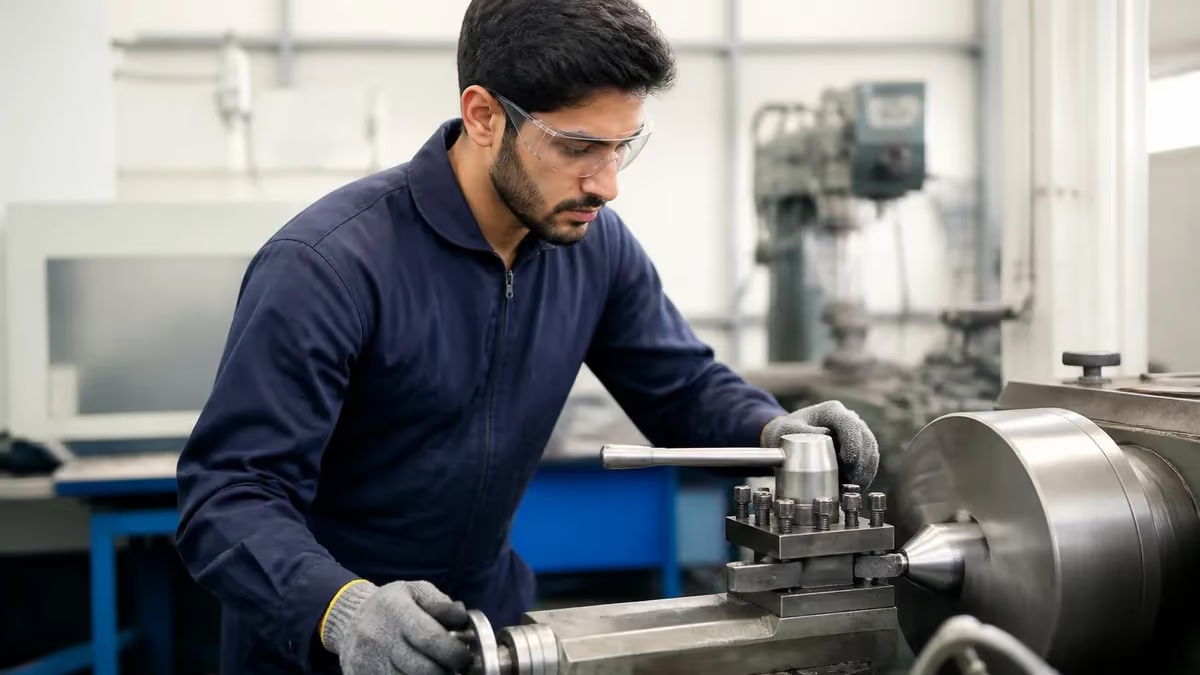
BME internships open two very different doors, depending on which BME you mean. For some students, BME stands for Biomedical Engineering — a field where summer placements happen inside pacemaker labs, prosthetics workshops, and tissue-engineering startups. For others, BME is short for Bachelor of Mechanical Engineering, the undergraduate degree that funnels students into automotive plants, aerospace hangars, and energy plants every June. Both paths are competitive. Both pay well. And both reward students who treat the application process like a second course load.
Here's the thing — most juniors wait until February to start hunting, and by then the best programs at Medtronic, Boston Scientific, GM, and Boeing have already closed their pipelines. The students who land the strongest offers tend to start in September of their sophomore year, build relationships through ASME, BMES, IEEE, or SWE chapters, and hit Handshake daily once postings open. They also keep a spreadsheet — application date, recruiter name, follow-up status — because juggling 30 to 40 active applications in your head doesn't work.
This guide walks through where the internships live, who's hiring, what recruiters scan for on a resume, how much you should expect to earn, and the specific networking moves that turn a cold application into a callback. Whether you're chasing a robotic-surgery role at Intuitive Surgical or a powertrain co-op at Ford, the playbook is the same: start early, talk to humans, and let your projects do the heavy lifting. The rest of this guide breaks each step down — from clarifying which BME you actually are, to negotiating the housing stipend on your offer letter.
BME Internships by the Numbers

Which BME Are You? Biomedical vs. Bachelor of Mechanical
The acronym trips up recruiters and ATS systems alike, so spell it out on every application. Biomedical Engineering (BME) students typically work at companies building medical devices, diagnostic equipment, drug-delivery systems, or surgical robots. Think Medtronic, Boston Scientific, Stryker, Edwards Lifesciences, Johnson & Johnson, Abbott, GE Healthcare, Philips, and a swarm of Series A startups in Boston, San Diego, and Minneapolis.
Bachelor of Mechanical Engineering (BME) grads cast a wider net. You'll see them at GM, Ford, Stellantis, Tesla, Rivian, and Lucid on the automotive side; Boeing, Lockheed Martin, Northrop Grumman, Raytheon, and GE Aviation on the aerospace side; and ExxonMobil, Chevron, Shell, and Schlumberger on the energy side. Even Apple, Amazon, and Google hire mechanical engineering interns for hardware teams.
A few employers want both. SpaceX, Tesla, and Apple all run programs that take biomedical and mechanical applicants for biomechanics, wearables, and human-factors work. The Mayo Clinic and Cleveland Clinic also blend the two — their device-development teams need mechanical fluency on top of biology.
Practically: if your resume lands at a recruiter who only knows the abbreviation BME as biomedical, a mechanical CV looks confusing. Same goes the other way. So write out the full degree name in your education section, and tailor the headline summary to the role you're chasing. Then let the projects, coursework, and lab experience do the rest. Vague never wins a callback.
Quick Reality Check
Big-name internships at Medtronic, Boston Scientific, Boeing, and GM open applications between September and November for the following summer. By January, the strongest candidates have already been pre-selected through career fairs, referrals, and on-campus events. If you apply in March, you're competing for leftover slots.
Medical Device Internships: Where Biomedical BME Students Go
If you're a biomedical engineering major, the medical device industry is the gravitational center of your summer search. Medtronic runs one of the largest programs in the country — over 1,500 interns each summer across Minneapolis, Boulder, Memphis, and Galway. Their Engineering & Operations Rotational Program (EORP) is the holy grail: a two-year post-grad track that almost always pulls from the intern class.
Boston Scientific hires heavily in Marlborough, MA, Maple Grove, MN, and Arden Hills, MN. Stryker's flagship program in Kalamazoo and Mahwah focuses on orthopedic and surgical instruments — they sponsor a residential internship experience and the conversion rate to full-time is one of the highest in the industry. Johnson & Johnson MedTech runs structured placements through their MedTech Engineering Internship, with stints in Cincinnati, Raynham, and Irvine.
Smaller, faster-growing players sometimes offer more meaningful project work. Intuitive Surgical (the da Vinci robot makers in Sunnyvale), Edwards Lifesciences in Irvine, Abbott in Abbott Park, and Penumbra in Alameda regularly post intern roles for biomedical, mechanical, and electrical undergrads. Then there's a long tail of startups — anywhere a Series A company is FDA-tracked, they need extra hands in regulatory, quality, and R&D over the summer.
One underrated route: academic medical centers. Mayo Clinic, Cleveland Clinic, Johns Hopkins, and the NIH all run summer research programs that count as real engineering experience. Pay is lower (sometimes stipend-only), but the project depth and publication credit can outweigh that for grad-school-bound students. Don't dismiss them just because they're not in a glass corporate tower.
Top BME Internship Employers
Medtronic, Boston Scientific, Stryker, Edwards Lifesciences, Abbott, J&J MedTech, GE Healthcare, Philips, Intuitive Surgical, Penumbra. Strong programs in MN, MA, CA, IN.
GM, Ford, Stellantis, Tesla, Rivian, Lucid, Toyota North America, Honda. Heavy hiring in Detroit, Austin, and Fremont. Powertrain, chassis, manufacturing, and ADAS teams.
Boeing, Lockheed Martin, Northrop Grumman, Raytheon, GE Aviation, SpaceX, Blue Origin, Pratt & Whitney. Clearance-eligible US citizens get priority on defense roles.
ExxonMobil, Chevron, Shell, Schlumberger, GE, Siemens, Caterpillar, John Deere, Honeywell. Field rotations are common — expect site visits to refineries and plants.
Apple (hardware), Amazon (robotics, Lab126), Google (Pixel, Nest), Microsoft (Surface), Dyson, iRobot. Hardware-product mechanical engineering with consumer polish.
Mayo Clinic, Cleveland Clinic, Johns Hopkins APL, NIH, Sandia, Oak Ridge, Lawrence Livermore. Lower pay, deeper projects, great for grad-school applicants.
Mechanical Engineering Internships: Automotive, Aerospace, and Beyond
For Bachelor of Mechanical Engineering students, the search looks different. Automotive OEMs dominate Midwest hiring — GM's Student Co-op Program in Warren and Milford rotates students through powertrain, body, and chassis; Ford's College Graduate Program runs out of Dearborn with hubs in Allen Park and Romeo. Stellantis (Chrysler, Jeep, Dodge, Ram) hires through their Detroit and Auburn Hills campuses. Tesla and Rivian take heavy mechanical loads in Fremont, Austin, Normal, and Palo Alto, and they're notoriously fast-moving — expect to ship work that ends up in production cars.
On the aerospace side, Boeing's Boeing Business Career Foundation Program spans Seattle, Charleston, St. Louis, and Mesa. Lockheed Martin's College Internship Program covers Fort Worth, Marietta, Sunnyvale, and Bethesda. Northrop Grumman and Raytheon hire similarly across the Sun Belt and Mid-Atlantic. GE Aviation places interns in Cincinnati, Lynn (Boston), and Madisonville. SpaceX in Hawthorne and McGregor is the dream for many — be ready to work 60-hour weeks.
Don't overlook the energy and industrial sector. Caterpillar in Peoria, John Deere in Moline, Honeywell across multiple US sites, GE Power, and Siemens Energy all run substantial mechanical engineering programs. Oil and gas (ExxonMobil, Chevron, Shell) pay among the highest hourly rates — often $30+ per hour — and frequently include housing stipends because field locations are remote.
Finally, consumer hardware has become a huge mechanical employer. Apple's hardware org in Cupertino hires hundreds of ME interns each summer for product design, thermal, and reliability. Amazon Robotics in North Reading, Google Pixel in Mountain View, and Microsoft Surface in Redmond all take mechanical undergrads who can prototype quickly.

Your university's Handshake portal is the single most important tool. Set up daily job alerts for keywords like mechanical engineering intern, biomedical engineering intern, R&D intern, and product design intern. Upload a polished resume in PDF, write a one-paragraph profile summary, and check in every weekday at 9 a.m. Postings get hundreds of applicants within 48 hours — speed matters. Filter by employers visiting your campus first, because on-campus interviewers convert at 3-5x the rate of cold applicants.
How to Apply: Timeline, Resume, and Cover Letter
Treat the application calendar like a course syllabus. September: finalize your resume, update LinkedIn, attend the engineering career fair, and submit early applications to Lockheed, Boeing, GE, and Medtronic — they all open before October. October-November: apply broadly. Most Fortune 500 medical device and aerospace companies post during this window. December-January: first-round interviews start. February-March: final-round on-sites and offers. April: sign by mid-April or risk losing your slot to a backup candidate.
Your resume should be one page, ATS-friendly (no columns, no graphics), and project-led. Recruiters scan in 8 seconds. Lead with the strongest project — a senior design prototype, a research lab role, a Formula SAE car, a robotics competition — and quantify everything. Designed and 3D-printed knee orthosis fixture; reduced assembly time from 22 to 7 minutes beats worked on knee orthosis project every time. Include software (SolidWorks, ANSYS, MATLAB, Python, LabVIEW, AutoCAD), languages, and certifications. Drop the GPA if it's below 3.2 unless asked.
For the cover letter, skip the boilerplate. One paragraph on why this company, one paragraph on a specific project that maps to their work, one paragraph on what you'll do in the role. Mention a product by name. Reference an engineer you've talked to on LinkedIn or at a career fair. Hiring managers can spot a generic letter in 10 seconds, and generic letters get tossed.
Behavioral interviews use the STAR method: Situation, Task, Action, Result. Prepare 6-8 stories you can pivot to fit any question.
Many students hold off applying because they don't think they're qualified yet. Recruiters consistently say they'd rather see 12 applications from a sophomore than 2 from a senior. Apply when interested, even if you only meet 70% of the listed requirements. The job posting is a wish list, not a hard filter.
Networking Through ASME, BMES, IEEE, and SWE
Engineering societies are the most underused recruiting channel on most campuses. ASME (American Society of Mechanical Engineers) hosts the IMECE conference each November, plus regional student conferences with industry-judged design competitions. Your local chapter likely runs plant tours, resume reviews, and mock interviews — show up to all of them.
BMES (Biomedical Engineering Society) holds its annual meeting in October, drawing recruiters from Medtronic, Boston Scientific, Stryker, J&J, and most major academic medical centers. The student career fair is structured specifically for internships — you'll have 5-10 minutes with each booth. IEEE matters if you're touching electronics, controls, or biomedical signal processing. SWE (Society of Women Engineers) runs the largest annual engineering career fair in the country — over 250 employers and 18,000 attendees. SHPE and NSBE host similar national conferences with strong recruitment.
The actual networking move is simple: introduce yourself, ask one substantive question about the company's recent work, and ask for the recruiter's business card or LinkedIn. Follow up the same evening with a short email referencing what you discussed. Two weeks later, send a polite "checking in" message. Three follow-ups beats one perfect first impression.
Don't underestimate professors. Faculty who consult for industry — particularly in biomechanics, biomaterials, fluid dynamics, and controls — get cold-call requests from recruiters all the time. A professor's referral often skips your resume past the first ATS filter. Office hours are free intelligence: ask about their industry contacts and whether they know of summer research positions in their network. Many do.
BME Internship Application Checklist
- ✓Update LinkedIn headline, summary, and photo by September 1
- ✓One-page resume reviewed by career services and a working engineer
- ✓Daily Handshake check at 9 a.m. with saved search alerts
- ✓Join BMES, ASME, IEEE, or SWE student chapter and attend monthly meetings
- ✓Attend campus engineering career fair with 20 printed resumes
- ✓Apply to 5+ companies per week September through January
- ✓Track every application in a Google Sheet with date, recruiter, and follow-up status
- ✓Prep 6-8 STAR-method behavioral stories
- ✓Mock interview with a peer or career services twice before first real interview
- ✓Send thank-you email within 24 hours of every interview

What to Highlight on a BME Resume
Recruiters pattern-match. They scan for technical software, hands-on projects, and any signal that you can ship work without constant hand-holding. For biomedical engineering candidates, lead with anything device-adjacent: tissue mechanics labs, biosignal processing, regulatory coursework (FDA, ISO 13485), C++/Python for medical instrumentation, MATLAB simulations, or experience with cell culture. List specific equipment — Instron, BD Accuri, Biacore, anything you've actually touched. Include any wet-lab safety training (BSL-2, IRB, IACUC).
For mechanical engineering candidates, the must-haves are SolidWorks, ANSYS or Abaqus (FEA), MATLAB, and ideally one CAM or PLM tool like Mastercam, NX, or Creo. Manufacturing courses, hands-on fabrication, CNC machining experience, and welding certifications all push you above peers. Formula SAE, Baja SAE, IEEE Robotics teams, NASA HASP, RockSat-C, AIAA DBF, and university CubeSat programs are recruiter magnets — these show you can work in a real engineering team and ship hardware on a deadline.
Three details that consistently surprise students by how much they matter: 1) A clear two-line description of your senior design or capstone project, even if you're a junior previewing the topic. 2) Any prior internship or part-time engineering work, even unpaid — a research lab over the summer between freshman and sophomore year is huge. 3) Leadership in a technical context. Section lead on the FSAE team beats president of the dorm council. Recruiters want to see that you've made technical decisions under pressure.
Skip the irrelevant. No high school awards, no "proficient in Microsoft Word," no objective statement. Use the space for one more project bullet instead.
Big Company vs. Startup Internship
- +Big companies: structured program, professional development, strong return-offer pipeline
- +Big companies: housing stipend, relocation paid, predictable 40-hour weeks
- +Big companies: brand name on resume opens doors for years
- +Startups: real ownership, ship products end-to-end, work directly with founders
- +Startups: faster learning curve, exposure to multiple disciplines
- +Startups: stronger network into Series B+ companies and VC ecosystem
- −Big companies: narrow scope, paperwork-heavy, slower decisions
- −Big companies: harder to stand out among hundreds of interns
- −Big companies: bureaucracy can mute project ownership
- −Startups: longer hours, less mentorship, occasionally chaotic
- −Startups: lower pay, no housing stipend, sometimes equity over cash
- −Startups: less name recognition for future applications outside the network
Pros and Cons at a Glance
| Pros | Cons |
|---|---|
| Big companies: structured program, professional development, strong return-offer pipeline | Big companies: narrow scope, paperwork-heavy, slower decisions |
| Big companies: brand name on resume opens doors for years | Big companies: harder to stand out among hundreds of interns |
| Startups: real ownership, ship products end-to-end, work directly with founders | Big companies: bureaucracy can mute project ownership |
| Startups: faster learning curve, exposure to multiple disciplines | Startups: longer hours, less mentorship, occasionally chaotic |
| Startups: stronger network into Series B+ companies and VC ecosystem | Startups: lower pay, no housing stipend, sometimes equity over cash |
Pay, Housing, and Benefits: What to Expect
BME internship pay varies more than students assume. The current floor for engineering interns at a Fortune 500 medical device or aerospace company is $20-25 per hour. Top-tier programs at Apple, Google, SpaceX, Tesla, and a few oil-and-gas giants push $30-45 per hour. Some big tech mechanical roles for upperclassmen now exceed $50/hour with bonuses. Most programs are 10-14 weeks at 40 hours per week, which works out to a summer paycheck between $9,000 and $25,000 before taxes.
Housing is the bigger swing. Top medical device, automotive, and aerospace employers either provide a housing stipend ($1,500-$4,000/month), partner with a local apartment complex for subsidized rent, or offer corporate housing outright. If a posting doesn't mention housing, ask in the interview — recruiters expect it, and the answer can mean a $5,000+ difference in take-home.
Relocation is usually a flat one-time bump: $500-$2,000. Some companies cover flights to the job site, some don't. Health insurance during a summer internship is rare for short programs but increasingly common for 6-month co-ops. Many internships now include access to the company gym, free meals (at Apple, Google, and most aerospace giants), and free shuttle service.
One last note: conversion to full-time is the biggest financial outcome. Roughly 60% of medical device and automotive interns receive return offers, often with $5,000-$15,000 signing bonuses. The summer internship is essentially a 12-week interview for a job that starts at $75,000-$95,000. That math makes the application grind worth it many times over.
Final Moves That Land Offers
The students who consistently win BME internships do four things differently. First, they apply early and often — 30+ applications across a season, not 3. Second, they treat each conversation as a relationship, not a transaction. A coffee chat with an engineer in March can produce a referral in October. Third, they invest in one or two technical sidesketches outside of coursework: a personal project on GitHub, a Formula SAE leadership role, a research paper draft, a portfolio of CAD models. These artifacts give recruiters something to react to.
Fourth, and this is the most overlooked move — they practice technical interviews. For mechanical, expect questions on statics, dynamics, thermodynamics, and machine design. For biomedical, expect physiology, transport phenomena, biomaterials, and signal processing fundamentals. Pull out your old textbooks. Walk through the highest-yield chapters. Do practice problems. Recruiters will ask you to derive simple things on the spot, and a confident answer to "how would you size a beam for this load?" or "why does action potential propagation slow with demyelination?" beats a fancy resume.
The internship market rewards persistence. Most successful applicants got rejected from their top 3 choices before landing offer 4 or 5. Keep going. The right summer experience can shape the next decade of your career — pick programs where the work, the team, and the location all match what you actually want, not just the company name on the offer letter.
Sample BME - Bachelor of Mechanical Engineering Practice Questions
Try these questions from our free BME - Bachelor of Mechanical Engineering practice tests. The correct answer and an explanation follow each question.
Which of the following determines the engine's mechanical efficiency?
- A. BP/IP
- B. IP/BP
- C. 1/(BP*IP)
- D. (BP*IP)
Answer: A. BP/IP
Mechanical efficiency quantifies how effectively the power generated inside an engine's cylinders (indicated power, IP) is converted into useful power delivered at the crankshaft (brake power, BP). It is calculated as the ratio of brake power to indicated power (BP/IP). This ratio indicates the fraction of power available for external work after accounting for internal frictional losses within the engine.
A hidden line in engineering drawing is represented by:
- A. Continuous thick line
- B. Thin dashed line
- C. Chain dotted line
- D. Wavy line
Answer: B. Thin dashed line
Hidden lines represent edges or outlines not visible from the current view and are drawn as thin dashed lines per standard drafting conventions.
The scale '1:2' on an engineering drawing means the drawing is:
- A. Twice the actual size
- B. Half the actual size
- C. Full size
- D. 10 times the actual size
Answer: B. Half the actual size
A scale of 1:2 means one unit on the drawing equals 2 units on the actual object, so the drawing is half the true size.
The title block of an engineering drawing typically does NOT include:
- A. Part name and number
- B. Material specification
- C. Scale and drawing number
- D. Customer's bank account
Answer: D. Customer's bank account
Title blocks contain part name, number, material, scale, drawing number, revision, company name, and drafter information — not financial data.
Take the full BME - Bachelor of Mechanical Engineering practice test
BME Questions and Answers
About the Author

Educational Psychologist & Academic Test Preparation Expert
Columbia University Teachers CollegeDr. Lisa Patel holds a Doctorate in Education from Columbia University Teachers College and has spent 17 years researching standardized test design and academic assessment. She has developed preparation programs for SAT, ACT, GRE, LSAT, UCAT, and numerous professional licensing exams, helping students of all backgrounds achieve their target scores.
Join the Discussion
Connect with other students preparing for this exam. Share tips, ask questions, and get advice from people who have been there.
View discussion (8 replies)