
BLS for Healthcare Providers: AHA Certification Course Guide 2026 September
BLS for healthcare providers course explained: 🆕 AHA cert, blended vs classroom format, cost, who needs it, and how to pass the skills check first try.
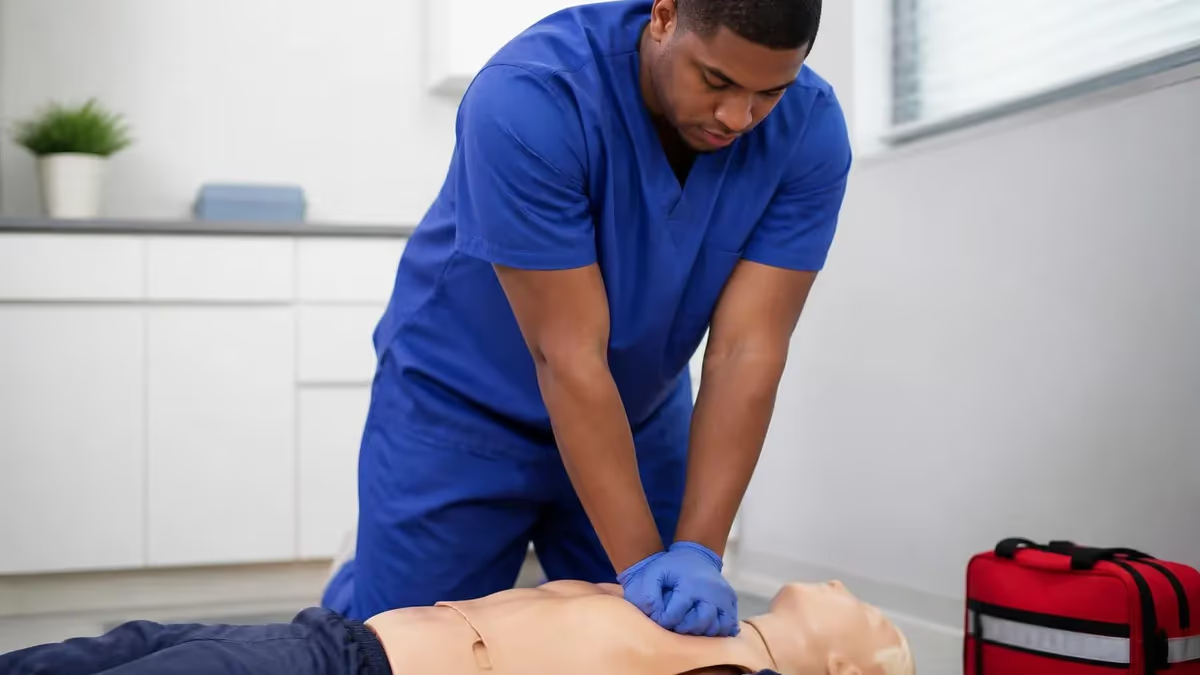
You just finished orientation, and your nurse manager hands you a checklist. Halfway down, three letters jump out: BLS. The basic life support BLS for healthcare providers card is one of those credentials nobody really explains to you — they just assume you have it, or that you'll figure it out before your start date. So here's the plain version.
The BLS for healthcare providers course (officially renamed by the American Heart Association to "BLS Provider" back in 2016, though the older name is still used everywhere) trains clinical staff in the resuscitation skills you actually need on a hospital floor, in an ambulance, in a dental chair, or at a pharmacy counter when somebody collapses. It's the certification an RN, MD, EMT, dental hygienist, paramedic, or pharmacy tech is expected to hold — not the simpler Heartsaver CPR card that gets handed out at corporate wellness days.
The big differences? Two-rescuer CPR, infant and child algorithms, AED integration into a team workflow, bag-mask ventilation, and the team dynamics that separate a chaotic code from a competent one. None of that shows up in a layperson class. All of it shows up in a real arrest.
This guide walks through exactly what the course covers, how the blended versus instructor-led formats differ, what the cpr aha bls for healthcare providers certification actually costs, who needs it, and — importantly — how to pass the skills check the first time. If you're renewing, scroll to the renewal section. If you're certifying for the first time, start at the top.
BLS Provider Course at a Glance
What "BLS for Healthcare Providers" Actually Means
The phrase gets thrown around loosely, so let's nail the terminology down. The American Heart Association used to offer a course literally titled BLS for Healthcare Providers. In 2016, after the ECC guideline refresh, they collapsed that into a single course called BLS Provider. Same audience, slightly updated algorithm. Hospitals, job postings, and onboarding checklists still use the old phrase, which is why you'll see both — they're talking about the same card.
The American Red Cross runs an equivalent: american red cross basic life support BLS for healthcare providers. Most US hospitals accept either AHA or Red Cross BLS, but a handful of academic medical centers and credentialing bodies will only honor AHA. Check your employer's policy before you book — switching providers mid-renewal is the most common reason people end up paying twice.
One nuance worth flagging: outside the US, you'll occasionally see basic cardiac life support healthcare provider as the local name. The content maps cleanly to AHA BLS in most countries, but the card itself isn't automatically transferable. If you're moving jurisdictions, ask your new licensing board first.
Bottom line: "BLS", "BLS Provider", bls cpr hcp, provider bls, healthcare provider bls — all of these point to the same credential. The course content is standardized. What varies is who teaches it, where, and at what price.
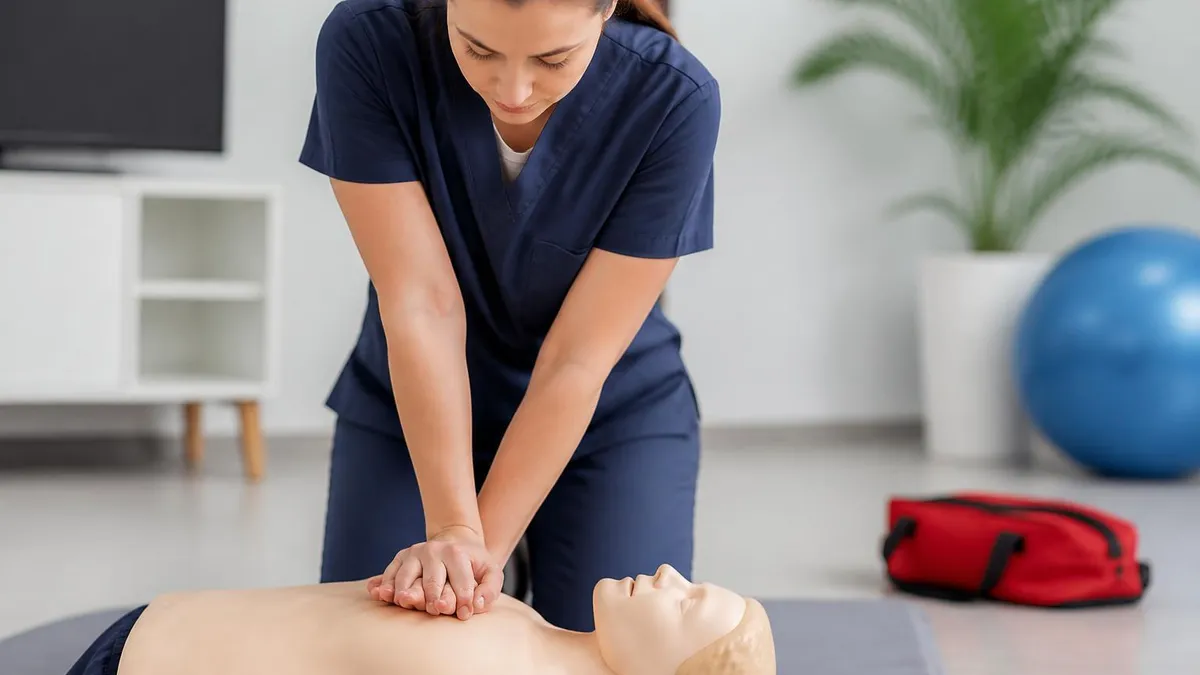
BLS Provider is for healthcare professionals. It covers two-rescuer CPR, pediatric arrest, bag-mask ventilation, and team-based AED use. The card is what your employer requires.
Heartsaver CPR AED is for laypeople — teachers, coaches, daycare staff. It covers single-rescuer CPR only and skips the airway adjuncts, infant 2-rescuer technique, and team dynamics. Heartsaver will not satisfy a hospital, clinic, or EMS hiring requirement, even though it's cheaper and shorter.
Who Needs the BLS for Healthcare Providers Card
Pretty much anyone in scrubs, plus a lot of people in lab coats and uniforms. The standard list looks like this:
- Registered nurses, LPNs, and nursing students — usually mandated before clinicals start, then renewed every two years.
- Physicians, residents, and physician assistants — required for hospital privileges and most outpatient practice.
- EMTs and paramedics — a baseline for state EMS certification; many services bundle it with their hire-on package.
- Dental staff — dentists, hygienists, and dental assistants in most US states must hold current BLS for license renewal.
- Pharmacists and pharmacy technicians — required for immunization certification and ACPE-accredited residency programs.
- Respiratory therapists, surgical techs, sonographers, radiologic techs — almost universal.
- Medical, nursing, dental, and PA students — schools typically require a current card on file before patient contact.
- Athletic trainers, physical therapists, occupational therapists, chiropractors — state-dependent, but increasingly the norm.
If you're not sure, the test is simple: does your job or training site put you within arm's reach of a patient? If yes, you almost certainly need it. The basic life support cpr for healthcare providers card is also a hiring prerequisite, not just a maintenance one — you'll need it before your first shift, not after.
What the BLS HCP Course Actually Covers
Compression depth (2-2.4 in adult, ~1.5 in infant), rate 100-120/min, full chest recoil, minimal interruptions. Switching compressors every 2 minutes.
Compression-to-ventilation ratio shifts to 30:2 for single rescuer, 15:2 for two-rescuer pediatric. Clear role assignment, closed-loop communication, time-keeper.
Turn it on, expose chest, place pads, clear, shock — without breaking compression flow. Special cases: hairy chest, water, pacemakers, transdermal patches.
E-C clamp technique, two-person bag-mask, OPA/NPA sizing. Avoiding hyperventilation. Ventilation rates with and without an advanced airway.
Conscious vs unconscious choking — adult, child, infant. Abdominal thrusts, chest thrusts in pregnancy/obesity, back slaps for infants.
Opioid-associated emergencies and naloxone, drowning, pregnancy, and patients with continuous-flow LVADs that complicate BLS assessment.
Course Formats: Blended Online vs Instructor-Led
There are really only two ways to earn the card, and they take almost the same total time. The difference is where you spend the hours.
Instructor-Led (Classroom) BLS
The traditional route. You show up, sit through video segments and discussion, practice skills on adult and infant manikins under instructor supervision, then take the 25-question written exam and a skills test. Total time: roughly 4 hours for an initial course, 3-3.5 hours for renewal. It's the format most employers prefer for first-timers because the instructor catches bad technique in real time.
Blended (HeartCode BLS Online + Skills Check)
This is what people mean by online bls for healthcare providers. You complete the cognitive portion online — about 2 hours of video, scenario simulations, and a 25-item written exam — then book a separate in-person skills session (about 30-45 minutes one-on-one with an instructor) to demonstrate compressions, ventilations, and AED use. Total time: about 2.5 hours plus travel. The card you receive is identical to the classroom version — same eCard, same expiration, same employer acceptance.
One catch: a few employers, especially academic medical centers, require the in-person initial course and only allow blended for renewal. Read your HR policy before you pay.
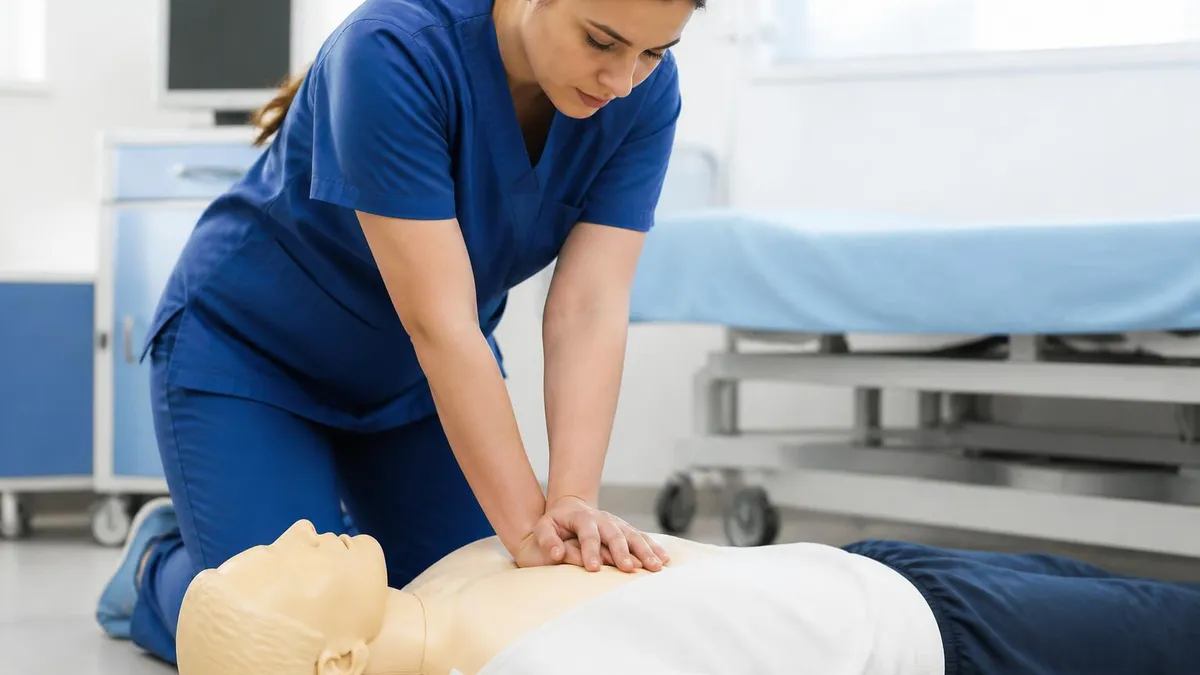
Compare BLS Course Options
AHA BLS Provider — Instructor-Led
- Total time: ~4 hours initial, ~3 hours renewal
- Cost: $70-$110 typical
- Format: Group classroom with manikins, video, written exam
- Card: AHA eCard, 2-year validity
- Best for: First-time learners, employers requiring in-person initial
What to Expect on the Day of the Course
Whether you picked classroom or blended, the in-person component looks roughly the same. Wear clothes you can kneel in — you'll be on the floor doing compressions on an adult manikin for several minutes at a stretch. Bring your photo ID, your online completion certificate if you did blended, and arrive 10 minutes early so the instructor can check you in.
The instructor will run you through a short warm-up, then ask you to demonstrate each skill in sequence. You'll be scored on:
- Adult one-rescuer CPR with AED — five cycles, then deploy and follow AED prompts.
- Adult two-rescuer CPR with bag-mask — coordinated compressions and ventilations, switching every two minutes.
- Infant CPR (one and two rescuer) — two-finger technique solo, two-thumb encircling hands for two-rescuer.
- Child CPR with AED — including pediatric pad placement or pediatric attenuator.
- Relief of choking — conscious and unconscious, adult and infant.
The 25-question written exam is closed-book and runs about 30 minutes. The pass mark is 84% — that's four wrong answers, no more. If you miss the cutoff, instructors typically offer a single retake the same day; beyond that, you may need to repurchase.
Don't memorize the algorithm in panic the night before. Watch the AHA pre-course video, work through the simulator scenarios, and practice the rate (think "Stayin' Alive" or "Baby Shark" — 100-120 bpm). The exam tests judgment more than recall.
- Compression depth too shallow. Adult depth is 2 to 2.4 inches. Hovering at 1.5 is the number-one fail point.
- Leaning on the chest between compressions. Full recoil matters as much as depth — let the chest spring back.
- Skipping the pulse check. No more than 10 seconds, then commit. Hesitation reads as confusion to the examiner.
- Hyperventilation. One breath every six seconds with an advanced airway. Squeezing the bag like a stress ball is an instant deduction.
- Forgetting to call for help and the AED early. The first sentence out of your mouth should be a clear assignment to a bystander.
What It Costs and Where to Book
Prices have crept up over the last few years, but the range is still tight. Initial certification through a community AHA training center typically runs $70-$110 all-in. Renewal (sometimes called a "challenge" or "refresher") is a little cheaper, usually $55-$85. The HeartCode online portion alone is $35-$50, with the skills check booked separately — total often comes out the same as classroom once you add both.
Where you book matters more than the brand on the manikin:
- AHA training center locator (heart.org) — find AHA-credentialed instructors near you. Highest acceptance rate at hospitals.
- Red Cross local chapter — wide availability, sometimes faster scheduling than AHA. Verify employer acceptance.
- Hospital education department — if you already work in healthcare, ask. Free or subsidized is common.
- Community college or university EMS programs — affordable, but sessions fill quickly each semester.
- Independent training sites — many run weekend classes. Stick to AHA-aligned providers; avoid sites that promise 100% online with no skills check (those aren't valid for clinical employment).
The two warning signs of a fake card: no in-person skills component, and no employer verification path (an AHA or Red Cross card has a unique ID or QR your HR can verify). If a course offers online bls for healthcare providers with no skills session attached, walk away — that's a layperson refresher, not a provider-level card, and it will not satisfy a credentialing review.
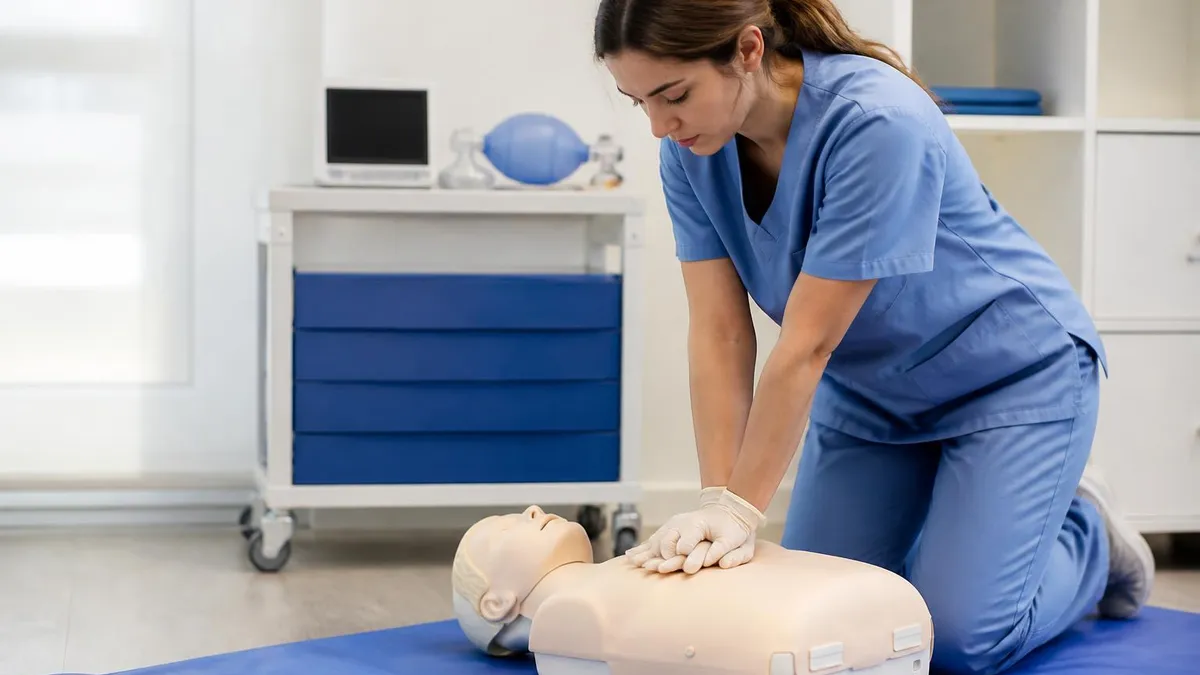
Pre-Class Prep Checklist
- ✓Verify your employer accepts AHA, Red Cross, or both before booking
- ✓Confirm whether your initial certification can be blended or must be classroom
- ✓Complete the online HeartCode portion if you chose blended (bring the completion certificate)
- ✓Watch the AHA pre-course self-assessment video (free on heart.org)
- ✓Review the 2020 AHA guidelines summary — algorithms haven't changed in 2025
- ✓Practice compression rate to the beat of Stayin' Alive or Baby Shark
- ✓Wear comfortable, kneel-friendly clothing and closed-toe shoes
- ✓Bring photo ID and any prerequisite certificates the training center requires
- ✓Arrive 10 minutes early; latecomers may be turned away for liability reasons
- ✓Eat beforehand — low blood sugar during compressions is a real problem
Renewing Your BLS Card
BLS certification is valid for exactly two years from the issue date — not the test date, the issue date — and the AHA gives a 30-day grace window where the card is still technically current. Past that, you have to recertify, and most employers will pull you off the schedule until the new card is on file.
Renewal courses are shorter than initial: usually around 3 hours classroom or about 2.5 hours total for blended. The skills are the same; the difference is the assumption you've done them before. Instructors move faster, the discussion is leaner, and the exam is identical — 25 questions, 84% to pass. If you let your card expire by more than the grace period, you don't strictly need to retake the initial course (the AHA technically allows the renewal even after expiration), but many training centers will only book you into the full initial class to be safe.
The smart move is to put a calendar reminder 60 days before expiration. That gives you time to book, complete blended online portions at your own pace, and find a skills session that fits your shift schedule. Waiting until week 23 is the most common reason people end up scrambling and paying premium prices for a Saturday session at a hospital-adjacent training site.
One question that comes up constantly: do your continuing education credits from BLS count toward state license renewal? It varies. Most state nursing boards count BLS for 1 to 2 contact hours; most dental boards count it for 2 to 4 CE hours. EMS recertification typically credits BLS as a refresher module. Always check your specific licensing board's rules — and save the completion certificate, not just the wallet card, because some boards want the longer document for their audits.
Blended (Online + Skills) Format: Pros and Cons
- + —
- + —
- + —
- + —
- + —
- − —
- − —
- − —
- − —
- − —
Using BLS on the Job — Beyond the Card
Holding the card and being good at it are two different things. The course teaches algorithms; what makes resuscitation actually work is repetition, team familiarity, and post-event review. If your unit doesn't run regular mock codes, ask for them. The best ICUs and EDs in the country drill BLS sequences quarterly because skill decay is real — research consistently shows compression quality drops measurably within three to six months of certification.
A few habits that separate confident responders from frozen ones:
- Know where your AED is. Not approximately — exactly. Time-to-shock is the single largest survival predictor.
- Practice the first 60 seconds. Pulse check, call for help, start compressions, get the AED. Everything after that flows; the opening is where people freeze.
- Use closed-loop communication. "Give epi 1 milligram" — "Epi 1 milligram given, time noted." Speak orders out loud, confirm execution out loud.
- Switch compressors before you're tired. Every two minutes, on schedule. The person doing compressions is always the worst judge of their own depth.
- Debrief every code, win or lose. Two minutes. What worked, what didn't. This is how units improve.
One more thing worth noting: BLS doesn't stand alone for many roles. Nurses in critical care, ED, and procedural areas will also need ACLS (Advanced Cardiovascular Life Support); pediatric and NICU staff need PALS. BLS is the floor — the foundation everything else builds on. Get it solid, then layer.
A quick word on documentation, too. Your BLS eCard, whether AHA or Red Cross, has a unique verification number printed on it. Your hospital's HR or credentialing office will scan or look that number up — they're not just trusting the PDF you upload. Keep a screenshot saved somewhere accessible (phone, email, cloud drive) because credentialing audits happen at random and "I'll get it to you next week" is the wrong answer. If you ever switch employers or move states, the eCard travels with you; the verification path is the same regardless of where you trained.
Final Thoughts: Make the Card Count
The cpr aha bls for healthcare providers certification is one of those credentials that's easy to treat as a checkbox. Sign up, sit through it, get the card, forget the details until 23 months later. That's a missed opportunity — both for you and for the next patient who codes in front of you.
Treat the four hours like the real thing. Push hard on the manikin. Speak your orders out loud even when the instructor isn't listening. Ask about the weird edge cases (yes, you can shock a patient with a continuous-flow LVAD, but you assess differently — and that scenario shows up on more exams than you'd guess). Read the algorithm card on your badge reel once a month for the first six months. The card on your scrubs lasts two years; the muscle memory should last a career.
If you're studying for the exam right now, run through the practice questions linked above. They mirror the AHA written test format closely — same length, same depth of judgment calls. Whether you're a first-time learner, a renewing nurse, or somebody whose card expired three months ago and is starting to sweat about their next clinical rotation, the path is the same: book the right format, prep the algorithms, show up rested, and treat the manikin like a person. The card is the receipt. The skill is the point.
And one practical scheduling note before you click away: if your card is within 90 days of expiring and you work clinical hours, book the renewal now. Skills sessions at popular training centers fill weeks out, especially in spring (when nursing students are finishing rotations) and late summer (when residents and new hires come on). Paying $20 more for a weekday afternoon slot is almost always cheaper than burning a vacation day chasing a Saturday class because you waited.
BLS Questions and Answers
About the Author

Registered Nurse & Healthcare Educator
Johns Hopkins University School of NursingDr. Sarah Mitchell is a board-certified registered nurse with over 15 years of clinical and academic experience. She completed her PhD in Nursing Science at Johns Hopkins University and has taught NCLEX preparation and clinical skills courses for nursing students across the United States. Her research focuses on evidence-based exam preparation strategies for healthcare certification candidates.
Join the Discussion
Connect with other students preparing for this exam. Share tips, ask questions, and get advice from people who have been there.
View discussion (8 replies)