
BLS Class: Course Overview, Where to Take It, Online vs In-Person, Curriculum, and Certification
BLS class guide: ⏳ course content, where to take it (AHA, Red Cross, hospital), online vs in-person, cost, certification process, and renewal requirements.
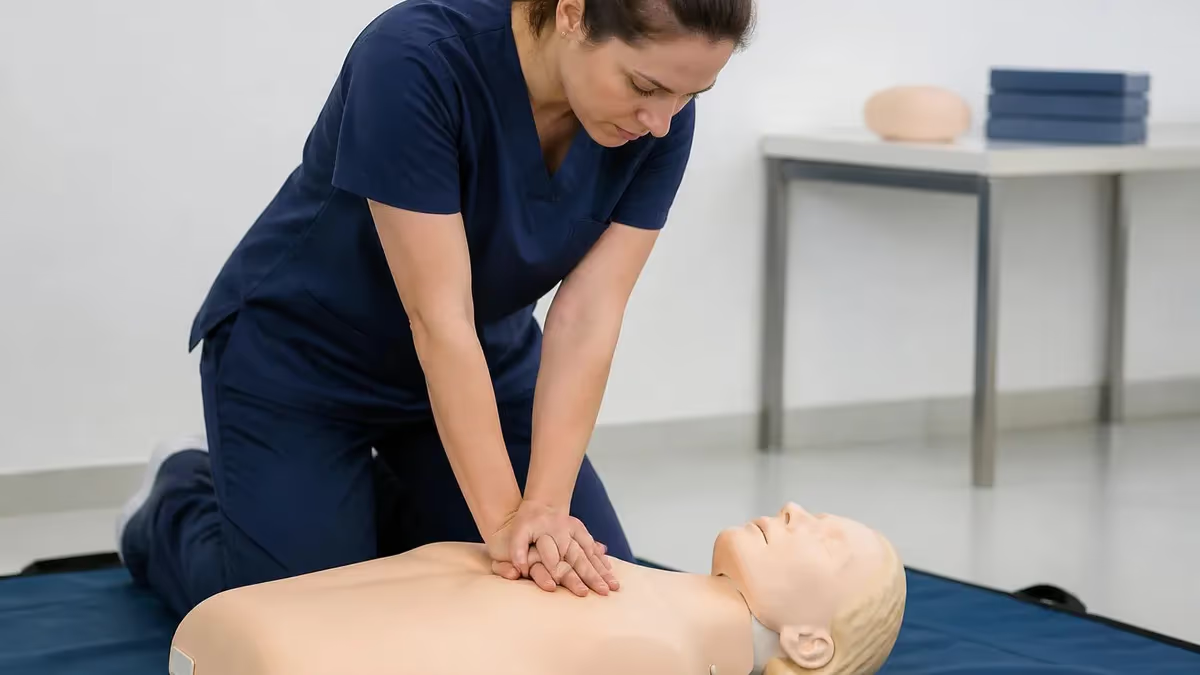
A BLS class teaches basic life support skills required for healthcare workers and many emergency responders. BLS (Basic Life Support) certification covers high-quality CPR for adults, children, and infants; use of AEDs (automated external defibrillators); team-based resuscitation; and managing choking emergencies. The American Heart Association (AHA) is the primary BLS provider, but Red Cross and others offer similar training accepted by many employers.
Who needs BLS. Healthcare workers: nurses, doctors, EMTs, paramedics, pharmacists, dentists, dental hygienists, medical assistants, lab technicians. Many healthcare-adjacent roles: respiratory therapists, physical therapists, occupational therapists, social workers in clinical settings. Emergency responders: police, firefighters. Workplace safety: lifeguards, daycare workers, school nurses. Required for nursing school, medical school, EMT certification.
BLS vs CPR vs ACLS. BLS: comprehensive resuscitation skills, ~4-hour course, healthcare-focused. CPR: basic compression-only or with breaths, ~2-hour course, layperson-focused. ACLS (Advanced Cardiac Life Support): advanced rhythm interpretation, drug administration; ~2-day course; for ICU, ED, advanced practice clinicians. BLS is foundation for all higher-level training.
Common BLS scenarios. Hospital code blue. ICU patient cardiac arrest. ER stroke patient. Outpatient clinic emergency. Pre-hospital cardiac arrest (EMTs). Childcare emergency (drowning, choking). Workplace incident.
Why it matters. Cardiac arrest survival depends on rapid CPR and defibrillation. Properly trained workers respond effectively. AHA estimates BLS-trained responders save thousands of lives annually. Hospital cardiac arrest survival rates have improved with widespread BLS training.
This guide covers BLS class content, options for training, costs, online vs in-person, certification process, renewal, and what to expect on the day of class. It's for anyone needing or considering BLS certification.

What to Expect
- Duration: 4-5 hours typical (in-person)
- Online + in-person: 1.5-2 hours online + 30-60 min skills
- Cost: $50-90 typical
- Providers: AHA (most common), Red Cross, others
- Format: Classroom + hands-on skills + written test
- Passing score: 84% on written test
- Validity: 2 years
- Renewal: 1-2 hour renewal course every 2 years
- Required for: Nursing, medical school, EMT, healthcare
- Card format: Digital (eCard) or physical certificate
What you'll learn in a BLS class.
Adult CPR. Recognize sudden cardiac arrest. Activate emergency response system. Perform high-quality chest compressions: depth 2-2.4 inches (5-6 cm), rate 100-120 per minute, allow full chest recoil between compressions, minimize interruptions. Provide effective ventilations (mouth-to-mask or bag-mask): 1 second each, visible chest rise.
Pediatric CPR (1 year to puberty). Adjustments from adult: depth about 1/3 chest diameter (~2 inches), compression-to-ventilation ratio 30:2 (single rescuer) or 15:2 (two rescuer), use AED with pediatric pads if available (under 8 years), can use adult pads if pediatric not available.
Infant CPR (under 1 year). Two-finger technique (single rescuer) or two-thumb-encircling-hands technique (two rescuer). Compress with about 1.5 inches depth. 30:2 ratio (single rescuer) or 15:2 (two rescuer). Mouth-to-nose-and-mouth ventilations. Smaller breaths than adult.
AED use. Turn on AED. Apply pads (specific placement varies by patient size). Follow audio prompts. Ensure no one touches victim during analysis. Deliver shock when prompted (clearly say 'clear' before shocking). Resume compressions immediately after shock.
Team resuscitation. Roles in team: compressor, ventilator, defibrillation specialist, team leader, recorder, IV access (when applicable). Closed-loop communication ('Epinephrine 1 mg given' acknowledged with 'Epi 1 mg received'). Coordinated minute-by-minute rotations during long arrests.
Choking management. Adult: Heimlich maneuver (abdominal thrusts) for conscious adult; back blows alternating with abdominal thrusts for unconscious. Infant: 5 back blows alternating with 5 chest thrusts. Switch to CPR if patient becomes unresponsive.
High-quality CPR principles. Push hard. Push fast. Full chest recoil. Minimize interruptions. Avoid excessive ventilation. Switch compressors every 2 minutes (or earlier if fatigued).
2020 AHA guidelines updates. Compression rate 100-120/min (no longer 'at least 100'). 'CAB' approach (Compressions-Airway-Breathing). Hands-only CPR emphasis for bystanders. Reduced emphasis on pulse check (don't waste time).
BLS Skills Covered
Compressions 2-2.4 inches deep, 100-120/min. Ventilations 30:2 ratio.
Smaller depth, 30:2 or 15:2 ratio. AED with pediatric pads if available.
Two-finger or two-thumb technique. 1.5 inches depth. Smaller breaths.
Apply pads, follow prompts, clear before shock, resume compressions.
Defined roles. Closed-loop communication. Compressor rotation every 2 min.
Heimlich for adults; back blows + chest thrusts for infants.
Where to take a BLS class. Multiple options.
American Heart Association (AHA). Gold standard. Most widely accepted. Search at heart.org for local Training Centers and instructors. Three formats: in-person (4-5 hours), HeartCode BLS (online + in-person), HeartCode BLS Blended Learning (online + virtual skills). Cost: $50-90 typical.
American Red Cross. Widely available. Includes BLS for Healthcare Providers. Search at redcross.org for classes. Cost: $50-85 typical. Acceptance varies — verify with your employer/program.
National Safety Council. Industry-focused. Often workplace-based training. Search at nsc.org. Some employers prefer NSC certification.
Health and Safety Institute (HSI). MEDIC FIRST AID and ASHI BLS. Smaller market but accepted by many employers. May be alternative if AHA unavailable.
Hospital-based programs. Many hospitals offer free or discounted BLS classes to staff and students. Major teaching hospitals have continuous BLS class schedules. Often AHA-affiliated.
Community colleges. Often offer BLS classes through continuing education. May be open to public or restricted to enrolled students. Cost varies.
Nursing/medical schools. Programs often require BLS and may include in tuition or offer at discount. Verify with program.
EMT/paramedic programs. Often include BLS as prerequisite or first course component. Verify with program.
Local fire departments. Some offer BLS classes to public. Cheaper option. AHA-certified instructors.
Private CPR training companies. CPR Today, Save A Life Center, others. Often $50-100 range. Convenience focus.
What to verify before signing up. Provider accepted by your employer. Course meets your specific requirements (BLS Provider vs Heartsaver vs other). Class location and dates. Refund/transfer policies. Instructor qualifications. Materials included.
Training Providers
American Heart Association. Gold standard. heart.org for locations. In-person, HeartCode (online + skills), or Blended Learning. Cost $50-90. Most widely accepted by healthcare employers.
Online vs in-person BLS classes. Choose your format.
In-person BLS. Format: 4-5 hours classroom + skills practice. Pros: Direct hands-on instructor feedback. Group dynamics build team skills. No technical issues. Tactile learning. Cons: Time commitment (must attend full class). Less flexibility. Travel required.
HeartCode BLS (Blended Learning). Format: 1.5-2 hours online + 30-60 min in-person skills session. Pros: Self-paced online portion. Faster than full in-person. Test-out option for experienced rescuers. Cons: Requires technology and internet. Still need in-person skills check. May feel rushed.
HeartCode BLS Online + Virtual Skills. Format: 1.5-2 hours online + virtual skills evaluation via video. Pros: Fully remote. Most convenient. Cons: Limited interaction. Technical issues possible. Not accepted by all employers.
Skills-only renewal (HeartCode BLS Renewal). For currently-certified providers. Online refresher + 30-min skills check. Faster renewal option. Cost similar to full BLS.
Choosing format. New to BLS: in-person preferred for learning. Experienced: blended/online faster and convenient. Renewal: HeartCode online + virtual skills typically sufficient. Strict employer requirements: verify which format is acceptable before paying.
Common formats by provider. AHA: HeartCode BLS (most common online + skills), HeartCode BLS for Healthcare Providers Blended Learning, in-person classroom. Red Cross: BLS for Healthcare Providers (in-person + skills). HSI/ASHI: BLS Provider (in-person typical, some online options).
What's actually online. Anatomy and physiology review. Cardiac arrest recognition. CPR technique theory. AED operation. Team resuscitation principles. Choking management. Quizzes throughout. Final written assessment.
What's in-person/practical. Adult, child, infant CPR on manikins. Two-rescuer CPR. AED use on manikins. Choking management on manikins. Skills checkoff by instructor. Sometimes practical scenarios with team members.
BLS Format Stats
Key Facts at a Glance
| Item | Value | Details |
|---|---|---|
| Skills-only renewal | 1-2 hr | |
| AHA BLS cost typical | $50-90 | |
| Written test passing score | 84% | |
| Certification validity | 2 years |
What happens during a BLS class. Hour by hour.
Hour 1: Introduction. Course overview. AHA BLS Provider Manual review (provided). High-quality CPR principles. Adult cardiac arrest recognition. EMS activation. Many programs start with video demonstrations.
Hour 2: Adult CPR skills. Manikin practice. Chest compression depth (2-2.4 inches), rate (100-120/min), recoil. Two-rescuer CPR coordination. Switching compressors. Ventilations with bag-mask. Skills checks with instructor.
Hour 3: AED and child/infant CPR. AED operation walkthrough. Pads placement. Clear and shock protocol. Pediatric considerations: smaller depth, different ratio. Infant techniques (two-finger or two-thumb). Manikin practice for each.
Hour 4: Choking and team dynamics. Adult Heimlich/back blows. Infant management. Conscious vs unconscious choking. Team-based resuscitation: roles, communication, leadership. Practical scenarios with team coordination.
Hour 5: Skills check and written test. Final skills evaluation: adult/child/infant CPR, AED use, choking management. Written test (25 multiple-choice questions, 84% passing). Group debrief. Certificate distribution.
What to bring. Photo ID. Comfortable clothing (you'll be on the floor doing compressions). Notebook for notes. Snack and water (long day). Some programs provide manuals; others require you bring or buy own.
Skills check expectations. Demonstrate adult CPR with bag-mask ventilation. Demonstrate child CPR. Demonstrate infant CPR. Demonstrate AED use. Manage adult and infant choking. Show team coordination. Instructor may correct technique throughout — pass/fail.
Written test. 25 multiple-choice questions. Covers material from class. 84% (21/25) to pass. If failing, can usually retake same day or another day. Most students pass first time with attention during class.
What if you fail. Practical: usually allowed retake with instructor. Written: usually retake same day. Multiple failure attempts may require re-enrollment. Most students don't fail.
Class Day Schedule
Introduction. Course overview. Manual review. Recognition skills.
Adult CPR. Manikin practice. Two-rescuer coordination.
AED. Pediatric CPR. Infant CPR. Practice each.
Choking. Team dynamics. Practical scenarios.
Skills check. Written test (25 questions, 84% pass). Certificate.
ID, comfortable clothes, notebook, snack. Manual usually provided.
Studying for BLS class. Preparation makes it easier.
Pre-class study materials. AHA BLS Provider Manual: comprehensive 100+ page guide. Available in print or digital. Read 2-4 weeks before class.
Online practice tests. PracticeTestGeeks offers free BLS practice tests. AHA and Red Cross have official practice exams. ProMed offers practice tests. Take multiple to identify weak areas.
Key concepts to master. Compression depth and rate (memorize numbers). CPR ratios (30:2 single, 15:2 two-rescuer infant/child). AED steps (turn on, pads, clear, shock, resume). Recognition of cardiac arrest. EMS activation.
Memorize key numbers. Adult CPR: 30:2 ratio, 2-2.4 inches deep, 100-120/min. Child CPR: 30:2 (single), 15:2 (two-rescuer), about 2 inches deep. Infant CPR: 30:2 (single), 15:2 (two-rescuer), 1.5 inches deep. AED: 200 J biphasic (adult), 50-75 J pediatric. Compression rate: 100-120 per minute.
Practice mental skills. Mentally rehearse: 'Adult cardiac arrest. Activate EMS. Begin compressions: 30. Open airway. Give 2 breaths. Continue cycles.' Mental practice helps actual performance.
Skills practice options. AHA Hands-Only CPR videos online. CPR practice kits with manikins ($30-100). Practice with classmate, family member (use a pillow or stuffed animal — never on actual person).
Watch the class manual. Often includes video links. Watch all demonstrations. Pause to practice along.
Day-of preparation. Get good sleep. Eat light breakfast. Bring water. Wear comfortable clothes. Arrive early. Be ready to participate actively.
What instructors look for. Confidence and quality, not just doing the steps. Verbalize what you're doing ('I'm checking responsiveness'). Be safety-conscious ('Make sure scene is safe'). Communicate with team. Show enthusiasm and engagement.
Common mistakes new students make. Too shallow compressions. Too slow rate. Incomplete chest recoil. Excessive ventilation. Hesitation in AED use. Practice corrects these.
1. Arrive 15 minutes early. Register, find seat, mentally prepare. Late arrivals may be denied entry.
2. Bring photo ID. Required for registration and certificate issuance.
3. Wear comfortable clothing. You'll be on the floor doing CPR. No skirts, dresses, tight clothing.
4. Bring snacks and water. 4-5 hour class is long. Light snacks help maintain energy.
5. Pay attention to instructors. They're providing critical safety information. Don't be on phone during class.
6. Ask questions. Better to ask during class than after. Instructors expect questions.
7. Practice during break. Use breaks to practice technique if time allows.
8. Stay engaged. Active participation makes the class go faster and helps you learn.
9. Don't be afraid to make mistakes. Class is the place to learn. Instructors expect mistakes and correct them.
10. After class, practice immediately. Within 24-48 hours, reinforce what you learned. Use AHA-recommended retention strategies.
BLS certification and renewal.
Initial certification. Pass written test (84%) and skills check. Receive: AHA BLS Provider eCard (digital) and/or printed certificate. Card includes: name, course completion date, expiration date (2 years), instructor name, signature.
How to verify your eCard. AHA: heart.org/cpr to login and access eCards. Red Cross: certificates available through redcross.org account. Most employers accept digital cards.
Validity period. AHA and Red Cross BLS: 2 years from completion date. Watch expiration carefully — many employers don't allow grace period.
Renewal process. Renewal courses available 60-90 days before expiration. Renewal courses faster than initial (typically 1-2 hours). Cost similar ($50-90). Skills check + written test. Updated to latest guidelines.
If certification lapses. Generally cannot renew expired card. Must take full BLS course again (4-5 hours). Don't let it expire — set calendar reminders 90 days before.
HeartCode BLS Renewal. Online review + virtual skills evaluation. Convenient for currently certified providers. Same renewal price typically.
What's included in renewal. Review of high-quality CPR. Updates to AHA guidelines. AED protocol updates. Team resuscitation refresher. Final skills check. Final written test (typically 10-15 questions for renewal vs 25 for initial).
Employer-specific requirements. Some employers (hospitals especially) require AHA BLS Provider specifically. Verify which course they accept. Some require renewal at exactly 24 months, not 23 or 25.
State-specific. EMT-related: state may require specific BLS course or have state-approved providers. Check your state's EMS regulations. Some healthcare licenses (nursing, advanced practice) have specific BLS requirements.
Multiple cards. Some healthcare workers carry multiple BLS cards (AHA + Red Cross) to satisfy different employer requirements. Inconvenient but sometimes necessary.

Certification Process
Written test 84%+ (typically 25 questions, 21 correct). Skills check on adult/child/infant CPR, AED, choking. Instructor evaluates competency. Most students pass first time.
BLS for different professions.
Nurses. AHA BLS Provider required for most nursing positions. Often required during nursing school. RN license renewal usually requires current BLS. Some specialties (ICU, ED) require ACLS in addition.
Physicians. BLS required throughout medical training. Most attendings maintain current BLS. ACLS or PALS often required by specialty.
EMTs. BLS or equivalent required. Often included in EMT training. Renewal aligned with state EMS certification.
Paramedics. ACLS required (which includes BLS). Plus advanced skills like rhythm interpretation, IV access, medication administration.
Dentists and Dental Hygienists. State-mandated. Different from medical BLS (basic CPR with focus on dental setting). Some states require AHA BLS Provider; others accept Dental-specific BLS.
Pharmacists. BLS required in many states. Some hospitals require for staff pharmacists. Community pharmacists less commonly.
Respiratory Therapists. BLS required. Often ACLS for hospital settings.
Physical Therapists. BLS required for license. Clinical setting work requires current BLS.
Medical Assistants and CMAs. BLS often required by employer. Required for many MA programs.
Lab Technicians. BLS required by some employers, especially hospital labs.
Law enforcement. BLS or similar through department. May be specific course (Law Enforcement BLS).
Firefighters. BLS through department. Aligns with EMT requirements.
Lifeguards. BLS (or Lifeguard CPR with First Aid) typically required by employer. May be included in lifeguard certification.
Daycare workers. BLS or Pediatric First Aid + CPR typically required. State requirements vary.
School nurses. BLS required for licensure in most states.
Coaches and trainers. CPR/AED typically required (BLS recommended). Specific to sport.
BLS by Profession
Nurses, doctors, EMTs, pharmacists. AHA BLS Provider typical.
Dentists, hygienists. State-mandated. Dental-specific or AHA.
EMTs, firefighters, police. Through department. BLS or equivalent.
School nurses, daycare workers. State-required typically.
Sports settings. CPR/AED + BLS often required.
Medical assistants, lab techs. Often required by employer.
Cost considerations for BLS class.
Typical pricing. AHA BLS Provider: $50-90. Red Cross BLS for Healthcare Providers: $50-85. HSI/ASHI BLS: $40-80. Hospital-sponsored (for employees): often free.
Variations. In-person: $60-90 typical. HeartCode (online + skills): $60-90 typical. Skills-only renewal: $40-70. Group rates (5+ students): discount possible.
What's included. Course materials (sometimes). Manual (sometimes). Certificate. Practice manikins. Instructor time.
What's sometimes extra. AHA BLS Provider Manual: $30-40 if not included. Pocket reference guide: $5-10. Digital course access: usually included. Skills practice at home: optional purchase.
Employer reimbursement. Many employers reimburse for BLS if required for job. Submit receipt and certificate. Get pre-approval if uncertain.
Group discounts. Many providers offer group rates. Helpful for healthcare organizations training multiple staff. Negotiate if possible.
Free options. Local fire department sometimes offers free public BLS. American Red Cross occasionally offers free classes for healthcare workers. Hospitals provide free training to staff.
Cost comparison vs other options. CPR/First Aid (non-healthcare): $30-50. Heartsaver CPR: $50-70. BLS: $50-90. ACLS: $200-400. PALS: $200-400. BLS is mid-range cost.
Hidden costs. Manual ($30-40 if not included). Travel and parking. Time off work for in-person classes. Renewal every 2 years.
Annual cost projection. Initial certification: $50-90. Every 2 years: $50-90 renewal. Average annual cost: $25-45 amortized.
For students. Often included in tuition for nursing/medical/EMT programs. Check before paying separately.
1. Verify employer accepts. Don't pay for class your employer won't accept. Confirm provider name (AHA, Red Cross, HSI) is acceptable.
2. Check course type. 'BLS Provider' is healthcare-focused. 'Heartsaver CPR' is for laypeople. Don't confuse them.
3. Format fits your style. In-person for learners, online + skills for experienced renewers. Choose what works.
4. Schedule fits your life. Class times vary. Find one that works without missing other commitments.
5. Location convenient. 4-5 hour class — don't travel hours each way.
6. Instructor qualified. Look for current AHA or Red Cross instructor. Read reviews if possible.
7. Refund policy. Some classes have strict no-refund policies. Understand before booking.
8. Renewal timing. Schedule renewal 30-60 days before expiration. Don't wait until last minute.
Common BLS class questions and concerns.
I'm nervous about CPR on manikins. Normal. Everyone feels awkward initially. Instructors expect it. Practice quickly normalizes the experience. By end of class, you'll feel confident.
I have a physical limitation. Some accommodations available. Discuss with instructor in advance. Some skills (especially compressions) may be modified. Confirm acceptability of modified completion with instructor.
I've never done CPR before. That's fine. BLS classes designed for beginners. Instructors will teach from scratch. Hands-on practice cements the skills.
What if I make a mistake in real life. CPR done imperfectly is better than no CPR. Good Samaritan laws protect you in most jurisdictions when acting in good faith. Don't hesitate.
How do I find a class near me. Search heart.org or redcross.org. Check local hospitals. Community colleges and universities. Local fire department.
What's the difference between AHA and Red Cross BLS. Both teach same essential skills. AHA more widely required by healthcare employers. Red Cross more common in general workplace settings. Both accepted by most employers.
Will I forget what I learned. Yes, gradually. That's why renewal every 2 years exists. Many healthcare workers practice mentally and review periodically.
Can I do BLS at home. Studying yes; certifying no. AHA and Red Cross require in-person skills verification. Online-only courses generally not accepted by healthcare employers.
What if I'm pregnant. BLS classes safe for pregnant participants. Modify compressions if needed (different angle). Discuss with instructor.
What if I have a heart condition. Discuss with instructor before class. Avoid prolonged stress. Most can attend with appropriate breaks.
BLS Pros and Cons
- +BLS certification is recognized by employers as verified competency
- +Provides a structured knowledge framework beyond just the credential
- +Certified professionals report 10–20% salary increases on average
- +Maintenance requirements create ongoing professional development
- +Differentiates candidates in competitive hiring and promotion decisions
- −Certification fees, materials, and renewal costs add up over a career
- −Requirements change — delaying may mean facing updated content
- −Salary ROI varies significantly by geography and industry
- −Preparation requires significant time alongside existing responsibilities
- −Validates knowledge at a point in time, not ongoing real-world performance
Sample BLS - Basic Life Support Practice Questions
Try these questions from our free BLS - Basic Life Support practice tests. The correct answer and an explanation follow each question.
You release the baby's airway after 30 chest compressions, then search the child's mouth for the obstruction. You are able to take out a small toy that you see. (True or False) You'll perform a brachial pulse check as your next course of action.
- A. False
- B. True
Answer: A. False
False. After successfully removing an obstruction and providing rescue breaths, if the child is still unresponsive and not breathing normally, you should continue CPR. A pulse check is only performed if the child shows signs of life (e.g., starts breathing normally, moving, or responding). If the child remains unresponsive, CPR should continue until EMS arrives or the child recovers.
A person is found unconscious and you suspect choking as the cause. Before starting CPR, what unique step should you perform?
- A. Deliver 5 abdominal thrusts in the supine position first
- B. Open the airway and look in the mouth for a visible foreign object before attempting breaths
- C. Skip rescue breaths and begin compressions only
- D. Perform 5 back blows before compressions
Answer: B. Open the airway and look in the mouth for a visible foreign object before attempting breaths
Open the airway with a head-tilt chin-lift and look for a visible object in the mouth; only remove it if clearly visible before beginning CPR.
A person is found slumped in a chair, unresponsive, with no visible breathing. An AED is 2 minutes away. What should the first responder do FIRST?
- A. Wait for the AED before starting any interventions
- B. Begin chest compressions immediately
- C. Move the victim to a flat surface, then call for the AED
- D. Attempt rescue breathing first
Answer: C. Move the victim to a flat surface, then call for the AED
The victim should be placed on a firm, flat surface (which also confirms position for effective compressions) while the AED is retrieved, and CPR should begin immediately.
Which document specifically authorizes a designated person to make medical decisions on behalf of an incapacitated patient?
- A. Living will
- B. Do-Not-Resuscitate order
- C. Durable power of attorney for healthcare
- D. POLST form
Answer: C. Durable power of attorney for healthcare
A durable power of attorney for healthcare (healthcare proxy) legally designates someone to make medical decisions when the patient cannot.
BLS Questions and Answers
Final thoughts. A BLS class is a 4-5 hour investment that prepares you to save lives. Whether you're a nurse, EMT, physician, or any healthcare worker requiring certification, the skills you learn are immediately applicable and lifelong useful.
Choose your provider carefully. AHA is the gold standard for healthcare. Red Cross is widely accepted. Hospital-sponsored programs are often free for staff. Verify your employer accepts the course you're taking before paying.
Format depends on your situation. In-person works best for first-time learners. HeartCode (online + skills) is convenient for renewing or experienced providers. Both result in the same valid certification.
Prepare for class. Review the AHA BLS Provider Manual. Take practice tests. Memorize key numbers (depth, rate, ratios). Mental practice helps actual performance.
Participate actively in class. Engage with instructors. Practice with all manikins. Ask questions. Make mistakes and learn from them. The classroom is the safe place to develop competency.
Maintain your certification. Set calendar reminders 60-90 days before expiration. Don't let it lapse. Renewal courses are faster and cheaper than starting over.
Use it in real life. BLS-trained responders save thousands of lives annually. When you witness cardiac arrest at work or in community, your training prepares you to act. Confidence comes from preparation and practice.
The BLS class is a small investment with enormous return. Time spent learning these skills could be the difference between life and death for someone someday. Take it seriously, prepare well, and become the person who knows what to do when seconds matter.
About the Author

Registered Nurse & Healthcare Educator
Johns Hopkins University School of NursingDr. Sarah Mitchell is a board-certified registered nurse with over 15 years of clinical and academic experience. She completed her PhD in Nursing Science at Johns Hopkins University and has taught NCLEX preparation and clinical skills courses for nursing students across the United States. Her research focuses on evidence-based exam preparation strategies for healthcare certification candidates.
Join the Discussion
Connect with other students preparing for this exam. Share tips, ask questions, and get advice from people who have been there.
View discussion (8 replies)