
BART Careers: Jobs, Hiring Process & How to Get Started 2026 September
✅ Pass the BART Careers: Jobs, Hiring Process & exam with confidence. Practice questions with detailed explanations and instant feedback on every answer.
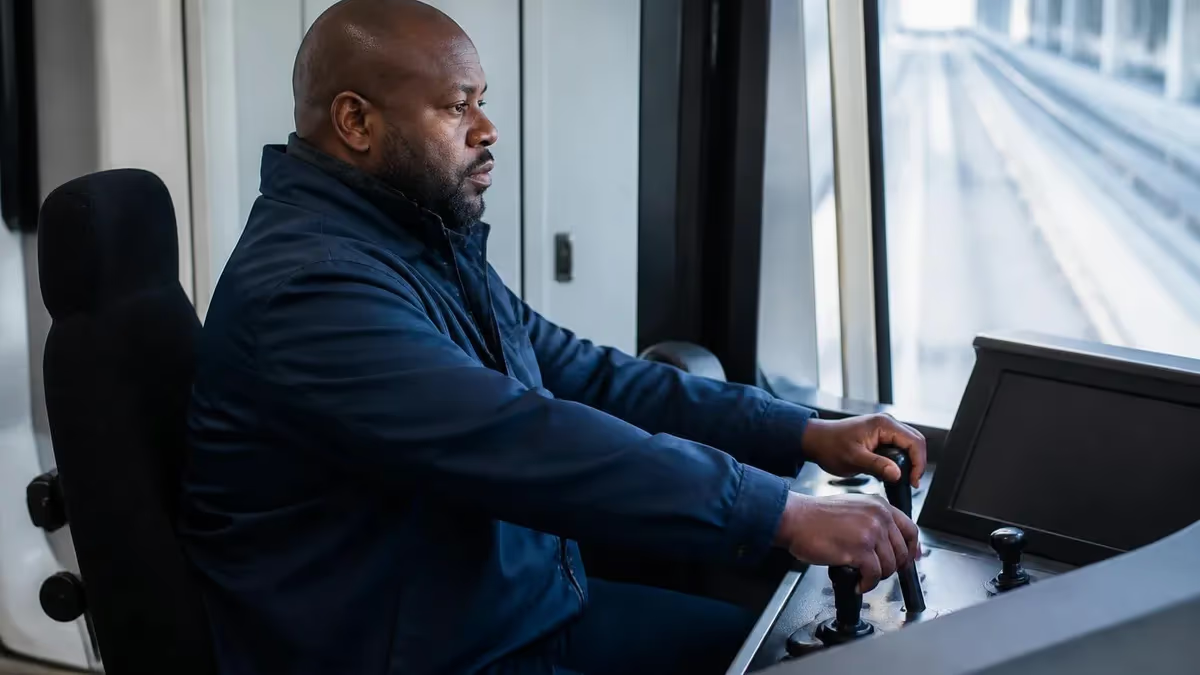
Bay Area Rapid Transit — better known as BART — operates one of the most-used rail systems in the western United States. It connects San Francisco, Oakland, Berkeley, San Jose, and dozens of communities across the Bay Area, moving hundreds of thousands of riders on a typical weekday.
For people looking for stable, well-paying careers in the Bay Area, BART is one of the better public employers in the region. Jobs range from train operators and station agents to police officers, engineers, and skilled trades. The pay is competitive, benefits are strong, and positions come with civil service job security.
This guide covers the main career categories at BART, what each role involves, hiring requirements, and how to navigate the application process.
BART Transit Operator
Transit Operator is one of the most visible and frequently hired positions at BART. Operators are responsible for operating BART trains, communicating with passengers and control centers, and responding to incidents and delays.
BART trains run on a computerized Automatic Train Control (ATC) system, which means the train accelerates and decelerates automatically between stations. The operator's role involves monitoring the system, handling door operations, communicating with central control, and managing any situations that require manual intervention or passenger assistance.
Don't let the automated system fool you into thinking this is a low-skill job. Operators are responsible for public safety on a vehicle carrying hundreds of passengers. Situational awareness, communication under pressure, and reliability are the core competencies the hiring process screens for.
Transit Operator Requirements
- High school diploma or GED equivalent
- Valid California driver's license
- No felony convictions
- Pass a pre-employment drug test and physical
- Complete BART's in-house operator training program (paid training)
Starting pay for new transit operators runs approximately $30–$35/hour, with significant increases after completing probation and with seniority under the SEIU Local 1021 contract.

BART Station Agent
Station agents are the customer-facing employees at BART stations. They manage fare gates, assist passengers with tickets and clipper cards, handle cash, respond to emergencies on the platform, and communicate with the operations center about incidents.
The role requires good communication skills, composure in crowded and occasionally stressful environments, and the ability to handle cash accurately. The job is often a stepping stone to other BART positions — many experienced BART employees started as station agents.
Station agents are represented by SEIU Local 1021. Pay is roughly comparable to transit operators, though the specific classification and step rates differ.
- ✓Review the official BART exam content outline
- ✓Take a diagnostic practice test to identify weak areas
- ✓Create a study schedule (4-8 weeks recommended)
- ✓Focus on your weakest domains first
- ✓Complete at least 3 full-length practice exams
- ✓Review all incorrect answers with detailed explanations
- ✓Take a final practice test 1 week before exam day
BART Police Department
The BART Police Department (BPD) is a full-service law enforcement agency with arrest authority throughout the BART service area — which spans multiple counties. BART officers patrol trains, stations, and parking facilities, respond to calls for service, and handle everything from fare evasion to serious crimes.
BART Police careers are highly sought after. The department's jurisdiction across the entire BART system creates diverse patrol experiences rarely available at a single municipal department. Officers work with a range of agencies and handle the specific challenges of transit policing — crowds, enclosed environments, and a transient population with complex social needs.
BART Police Officer Requirements
- Must meet California POST minimum standards for peace officer employment
- 21 years of age minimum
- US citizen or permanent resident who has applied for citizenship
- No felony convictions
- Valid California driver's license
- Vision correctable to 20/20
- Pass a written exam, physical agility test, oral interview, background investigation, and psychological evaluation
BART Police officers are represented by the BART Police Officers Association. Base pay for new officers typically starts around $100,000+, and total compensation including overtime commonly exceeds $130,000–$150,000. The pension benefit (CalPERS) is substantial.

BART Maintenance and Skilled Trades
A large portion of BART's workforce works in maintenance — keeping 669 cars, 131 miles of track, and dozens of stations and facilities in operating condition. These roles are in constant demand and offer excellent pay for skilled tradespeople.
Maintenance Positions at BART
- Car Maintenance Technician: Inspects, maintains, and repairs BART rail cars. Electrical, mechanical, and hydraulic systems knowledge required. Union: ATU Local 1555.
- Track and Structures: Inspects and maintains track, tunnels, bridges, and structural elements. Much of this work happens overnight during revenue service gaps.
- Systems and Technology: Maintains the Automatic Train Control system, communications infrastructure, and signaling. Highly technical roles requiring electronics or systems engineering background.
- Facilities Maintenance: Building systems — HVAC, electrical, plumbing — at stations and support facilities.
Skilled trades positions at BART often require specific journeyman certifications or apprenticeship completion. Pay for journey-level maintenance workers runs $40–$55/hour under union contracts.
BART Administrative and Professional Positions
Beyond operations and maintenance, BART employs hundreds of professionals in planning, engineering, finance, IT, human resources, legal, and communications.
BART is a public agency undergoing significant capital expansion — the extension to San Jose (BART Silicon Valley Phase 2) represents billions of dollars in infrastructure investment. This creates ongoing demand for civil engineers, project managers, environmental planners, and construction management professionals.
Professional and administrative positions are generally not union positions and are hired through a competitive application and interview process. Salaries for professional positions are in the $90,000–$140,000+ range depending on the classification level.

How to Apply for BART Jobs
All BART positions are posted on the BART Careers website (bart.gov/jobs). The process for most positions follows these stages:
1. Online application: Submit through the BART careers portal. Applications are typically open for 1–2 weeks. Make sure your application addresses the specific minimum qualifications listed — BART HR screens for these literally. Missing a required qualification in your application often results in disqualification even if you're otherwise a strong candidate.
2. Written exam or assessment: Many positions require a written exam. For transit operator, this typically includes reading comprehension, math, and situational judgment questions. For police, it's the California POST Entry Level Law Enforcement Test Battery. Study for this specifically — it matters.
3. Oral interview or board: A structured interview with a panel of BART staff. Questions are typically behavioral ("tell me about a time you handled a difficult situation with a customer/coworker/public"). Prepare STAR-format answers in advance.
4. Background investigation: Particularly thorough for police positions, but all BART positions involve some level of background check. Be truthful on your application — discrepancies found during investigation are automatic disqualification.
5. Medical and drug screening: Pre-employment physical and drug test. Safety-sensitive positions (operators, police) have zero-tolerance drug policies.
6. Training: Most BART positions include paid on-the-job training. Transit operator training is approximately 3–4 months of combined classroom and supervised operation.
BART Employee Benefits
BART offers a comprehensive benefits package that's one of the main draws for long-term employment with the agency:
- Health insurance: Medical, dental, and vision coverage for employees and dependents. BART covers a significant portion of the premium.
- Pension: CalPERS defined benefit pension. For most safety positions, this is a 3% @ 50 or 3% @ 55 formula — meaning very strong retirement benefits for those who stay long-term.
- Free BART rides: Employees and eligible dependents receive free BART service.
- Paid time off: Vacation, sick leave, and holidays in line with California public sector standards.
- Tuition reimbursement: Available for many positions to support continuing education.
BART: Pros and Cons
- +Growing demand for BART professionals in the job market
- +Diverse career opportunities across multiple industries
- +Competitive compensation packages including benefits
- +Clear advancement path from entry-level to senior positions
- +Transferable skills applicable to related fields
- −Entry-level positions may offer lower starting compensation
- −Field can be competitive — relevant certifications help stand out
- −Work-life balance varies by employer and specialty
- −Keeping skills current requires ongoing professional development
- −Some positions require specific licenses or background checks
About the Author

Attorney & Bar Exam Preparation Specialist
Yale Law SchoolJames R. Hargrove is a practicing attorney and legal educator with a Juris Doctor from Yale Law School and an LLM in Constitutional Law. With over a decade of experience coaching bar exam candidates across multiple jurisdictions, he specializes in MBE strategy, state-specific essay preparation, and multistate performance test techniques.
Join the Discussion
Connect with other students preparing for this exam. Share tips, ask questions, and get advice from people who have been there.
View discussion (8 replies)