
What Does an Air Traffic Controller Do? Full Career Overview 2026 October
📚 What does an air traffic controller do? Learn daily duties, work environment, required skills, salary, and how to start this high-demand aviation career.

Understanding what does an air traffic controller do is the first step for anyone considering this demanding, high-stakes aviation career. At its core, an air traffic controller (ATC) is responsible for the safe, orderly, and efficient movement of aircraft through the national airspace system. Controllers issue instructions to pilots, coordinate flight paths, manage runway usage, and ensure that aircraft maintain safe distances from one another at all times — a responsibility measured not in minutes, but in seconds.
Air traffic controllers work across several distinct specialties within the Federal Aviation Administration (FAA) and the military. Terminal controllers manage aircraft approaching and departing from airports, typically handling traffic within a 30- to 50-mile radius. En route controllers, stationed in Air Route Traffic Control Centers (ARTCCs), guide aircraft during the cruise phase of flight across vast stretches of airspace. Ground controllers direct aircraft and vehicles on the airport surface, keeping taxiways and runways free of conflicts before aircraft ever leave the pavement.
The job demands extraordinary mental agility. A busy approach controller at a major hub like Chicago O'Hare or Atlanta Hartsfield may manage 15 to 20 aircraft simultaneously, tracking each one's altitude, speed, heading, and destination while anticipating conflicts that could arise three or four minutes into the future. Controllers must mentally process a constantly shifting three-dimensional picture and translate that picture into clear, concise radio transmissions that pilots can act on immediately.
Beyond the moment-to-moment communication with pilots, controllers coordinate continuously with adjacent sectors and facilities. When an aircraft transitions from terminal airspace into en route airspace, for example, controllers at both facilities must agree on the aircraft's altitude, route, and any restrictions before the handoff takes place. This behind-the-scenes coordination is invisible to most passengers but is essential to maintaining the seamless flow of air traffic across the country every single day.
The role carries significant legal and regulatory weight. Every controller action is governed by FAA Order 7110.65, the Air Traffic Control handbook that specifies separation standards, phraseology, and procedures for virtually every conceivable scenario. Controllers must apply these rules correctly even under stress, fatigue, or during equipment outages. Deviations from procedure — even minor ones — are investigated, documented, and used to improve training and system safety across the entire national airspace system.
Physical and mental fitness requirements are equally strict. Controllers undergo medical evaluations, must pass the FAA Academy training program, and are subject to ongoing performance evaluations throughout their careers. Unlike many federal jobs, ATC positions carry a mandatory retirement age of 56, reflecting the cognitive demands of the work. The career path from trainee to fully certified controller typically takes two to five years depending on the complexity of the facility to which a controller is assigned.
For those who meet the challenge, the rewards are substantial. Median salaries exceed $130,000 annually, and the career offers strong federal benefits, job stability, and the rare satisfaction of performing work that directly protects human lives every single day. To understand exactly what does an air traffic controller do in high-pressure situations, it helps to study the history of the profession — including the pivotal moments that shaped modern ATC policy and workforce conditions.
Air Traffic Control by the Numbers

Core Duties of an Air Traffic Controller
Controllers apply legally mandated separation standards — typically 3 nautical miles laterally or 1,000 feet vertically in radar-controlled airspace — to prevent conflicts between aircraft operating in the same sector at the same time.
During peak periods, controllers sequence arrivals and departures to maximize runway throughput. This involves speed adjustments, radar vectors, and altitude assignments that keep aircraft evenly spaced while minimizing delays for passengers.
Every clearance, instruction, and advisory must be delivered using standardized ICAO phraseology on specific radio frequencies. Clear, unambiguous communication prevents misunderstandings that could place aircraft in dangerous proximity.
When a pilot declares an emergency, the controller immediately clears the frequency, coordinates with emergency services, and provides the flight crew with every resource available — priority handling, vectors to the nearest suitable airport, and crash-rescue notification.
Controllers review and amend flight plans, strip data, and coordinate with adjacent sectors and centers to ensure that aircraft handoffs are smooth, accurate, and compliant with any altitude or route restrictions along the flight's path.
The path to becoming a certified air traffic controller is rigorous, highly structured, and longer than most candidates anticipate. The FAA requires applicants to be U.S. citizens, pass a medical examination, hold either a degree from an FAA-approved Collegiate Training Initiative (CTI) school or three years of progressively responsible work experience (or a combination of both), and score competitively on the Air Traffic Skills Assessment (ATSA). Age limits apply: applicants must be hired before their 31st birthday, with exceptions for veterans and current FAA employees.
Candidates who pass initial screening are sent to the FAA Academy in Oklahoma City, Oklahoma, for facility-specific training. The Academy program can last from five weeks for lower-complexity facilities up to several months for candidates bound for high-altitude en route centers. Academy training combines computer-based instruction, simulator exercises, and written exams. Failure at any stage results in separation from the program, and wash-out rates at the Academy have historically been significant — particularly for en route candidates who must master complex radar skills quickly.
After graduating from the Academy, new controllers are assigned to a facility as developmental controllers. This is where the real learning begins. Developmental controllers work under the direct supervision of certified professional controllers (CPCs) and must certify on each operational position at their facility in sequence, from the simplest to the most complex. At a large TRACON — a Terminal Radar Approach Control facility — that process can take three to four years and requires passing both performance evaluations and written knowledge checks at each position.
On-the-job training (OJT) at the facility is intense. A developmental controller will plug in next to a CPC, listen and observe, then gradually take over communications while the trainer monitors every action and stands ready to intervene. The trainer evaluates the developmental's situational awareness, decision-making speed, ability to prioritize tasks, and proficiency with facility-specific procedures. Any serious error can result in remedial training or, in cases of repeated poor performance, decertification and removal from the developmental program.
Controllers who successfully certify on all positions at their facility earn the title of Certified Professional Controller. CPCs then begin accruing seniority, which governs scheduling preferences, transfer opportunities, and overtime assignments. Many CPCs eventually pursue management positions, training roles, or lateral moves to higher-complexity facilities that come with higher pay grades under the FAA's Core Compensation Plan, which links pay directly to facility complexity level.
Military-trained controllers represent a significant pipeline into the civilian FAA workforce. Veterans who served as military air traffic controllers can receive credit toward the FAA's experience requirement and, in many cases, qualify for hiring preference under veterans' preference rules. The military trains controllers for tower, radar approach, and en route functions in environments that are comparable to — and sometimes more demanding than — their civilian FAA equivalents, particularly at overseas and combat-support installations.
Continuing education never stops for controllers. The FAA mandates recurrent training on emergency procedures, new equipment, revised procedures, and human factors topics throughout a controller's career. Annual proficiency checks ensure that CPCs maintain their skills on every position they are certified to work. Facilities that handle instrument approaches under low-visibility conditions conduct additional training simulations to keep controllers sharp for scenarios they may encounter only a few times each year in actual operations.
Types of Air Traffic Control Positions
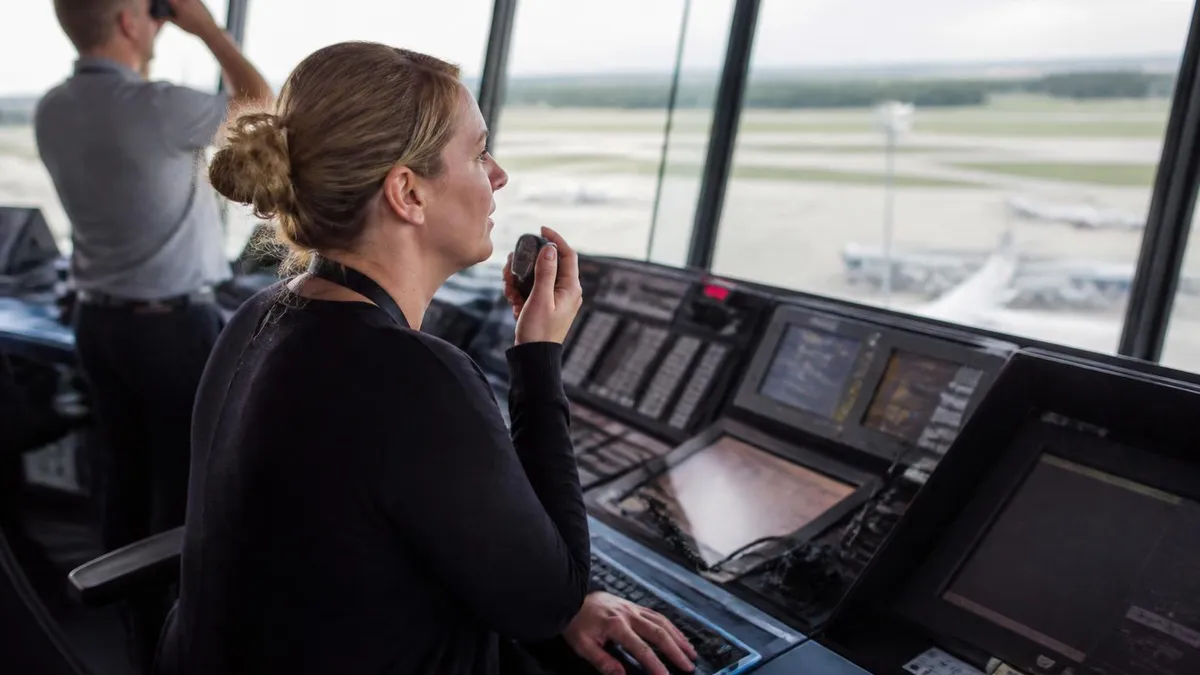
Tower controllers work in the glass cab atop the airport terminal or control tower building, maintaining visual contact with aircraft and vehicles on the airport surface. They issue takeoff and landing clearances, sequence traffic in the traffic pattern, and coordinate with ground control to keep the movement area safe. At busy airports, separate local control and ground control positions may each be staffed by a different controller working simultaneously.
Tower positions are often the first assignment for developmental controllers, especially at smaller airports, because visual traffic management provides a concrete foundation for understanding aircraft movement before transitioning to radar-only environments. Controllers at towered airports are also responsible for issuing IFR clearances, activating and canceling flight plans, and coordinating with the TRACON or ARTCC that handles arriving and departing instrument traffic outside the immediate airport environment.

Pros and Cons of an Air Traffic Control Career
- +Median salary above $132,000 with federal benefits including pension, health insurance, and Thrift Savings Plan matching
- +High job security — air traffic control is a critical infrastructure role with consistent federal government demand
- +Mandatory retirement at 56 with eligibility for full pension after 20 years of service, enabling an early and financially comfortable retirement
- +Intellectually stimulating work that demands and rewards rapid problem-solving, spatial reasoning, and multitasking abilities
- +Clear career progression from developmental controller to CPC, with opportunities to advance into management, training, or staff positions
- +Strong sense of purpose — controllers directly protect the lives of millions of passengers flying the national airspace every year
- −Extremely high-stress environment where errors can have catastrophic, irreversible consequences for aircraft and passengers
- −Mandatory retirement age of 56 cuts careers short, which can feel limiting for controllers who remain highly capable well past that age
- −Shift work is unavoidable — ATC facilities operate 24 hours a day, 365 days a year, requiring nights, weekends, and holidays on a rotating basis
- −Long training pipeline of two to five years before full certification, with a risk of washing out at any stage from Academy through facility OJT
- −Age-31 hiring cutoff eliminates late-career changers who discover the profession after that threshold, regardless of aptitude or background
- −Geographic inflexibility — the FAA assigns controllers to facilities based on staffing needs, not personal preference, and transfer requests are not always approved
Essential Skills Every Air Traffic Controller Must Master
- ✓Develop strong spatial reasoning to mentally picture three-dimensional aircraft positions from two-dimensional radar data.
- ✓Practice multitasking drills that require simultaneously tracking multiple moving objects while issuing verbal instructions.
- ✓Memorize standard ATC phraseology from FAA Order 7110.65 to ensure clear, unambiguous communications with all flight crews.
- ✓Study separation standards for each class of airspace — radar, non-radar, vertical, and lateral — until they become instinctive.
- ✓Build situational awareness habits: always know the status of every aircraft in your sector before accepting new traffic.
- ✓Learn to prioritize tasks under load — aircraft in conflict take precedence over routine coordination and data entry.
- ✓Practice time management using mental countdown timers to anticipate when aircraft will reach sector boundaries or conflict points.
- ✓Understand emergency procedures for every scenario including loss of communications, fuel emergencies, and unlawful interference.
- ✓Develop stress resilience through scenario-based simulator training that replicates high-traffic, equipment-failure conditions.
- ✓Cultivate clear verbal communication skills — transmission speed, tone, and precision directly affect pilot compliance and safety.
Situational Awareness Is the Core Skill
Every veteran controller and FAA trainer identifies situational awareness — the ability to know exactly where every aircraft in your sector is, where it is going, and what conflicts it may encounter — as the single most important skill in ATC. Technical knowledge, radar proficiency, and phraseology can all be taught, but the ability to maintain a complete mental picture of a dynamic, three-dimensional traffic environment under pressure is what separates controllers who succeed from those who wash out during training.
Air traffic control is among the most financially rewarding federal careers available in the United States, and the compensation structure rewards both longevity and facility complexity. Under the FAA's Core Compensation Plan, controllers are assigned a pay band based on the operational complexity level of their facility — Level 5 through Level 12, with 12 representing the most demanding large TRACONs and ARTCCs. As of 2024, fully certified controllers at large facilities can earn total compensation exceeding $180,000 annually when overtime, locality pay, and night differential are included.
The federal benefits package adds substantial value on top of base salary. Controllers participate in the Federal Employees Retirement System (FERS), which combines a defined-benefit pension, Social Security contributions, and employer matching in the Thrift Savings Plan — the federal government's equivalent of a 401(k). With 20 years of ATC service, a controller can retire at 50 with an immediate pension; with 25 years, retirement is available regardless of age. This early retirement eligibility is unique among federal employees and reflects the physically and cognitively demanding nature of the work.
Health, dental, and vision insurance through the Federal Employees Health Benefits (FEHB) program is available to controllers and their families, with the government covering a significant share of the premium. Life insurance, flexible spending accounts, and generous paid leave — including 13 to 26 days of annual leave per year depending on tenure — round out a benefits package that is difficult to match in the private sector. The total compensation value of the federal package is often 30 to 40 percent above the base salary number alone.
The career outlook for air traffic controllers is shaped by a structural workforce challenge: the FAA has been dealing with a staffing shortage for over a decade. As experienced controllers hired in the post-1981 rebuild era reached mandatory retirement age, the pipeline of new controllers struggled to keep pace. The FAA has responded with increased hiring targets, Academy class expansions, and streamlined onboarding for military-trained controllers, but many facilities remain understaffed, driving significant overtime opportunities for controllers currently on the rolls.
Advancement opportunities exist both within and adjacent to the operational ATC role. Certified controllers can move into front-line manager (FLM) positions, overseeing the operational floor and making real-time decisions about traffic management strategies. Above FLMs, area managers, facility managers, and regional operations positions carry increasing levels of responsibility and pay. Many experienced controllers also transition into FAA staff roles in training, procedure design, airspace planning, or safety analysis, leveraging their operational expertise in a non-shift-work environment.
Private sector and international opportunities also exist for credentialed controllers. Defense contractors frequently hire experienced FAA controllers to staff military range control facilities, test range operations, and contract tower programs at smaller airports. Some controllers pursue careers with the International Civil Aviation Organization (ICAO), foreign civil aviation authorities, or international carriers. The knowledge, skills, and federally recognized credentials earned through an FAA career are highly portable and respected throughout the global aviation community.
Job satisfaction surveys consistently rank air traffic control among the most meaningful federal careers, despite its stress. Controllers frequently cite the combination of intellectual challenge, financial security, camaraderie among colleagues, and the knowledge that their work directly protects lives as factors that make the career deeply rewarding. For candidates who are willing to invest the years required to reach full certification, the long-term career trajectory — financial, professional, and personal — is exceptionally strong by any measure.
The FAA requires that new-hire air traffic controllers be placed on the eligibility list before reaching age 31. This cutoff is strictly enforced and applies regardless of qualifications, experience, or aptitude scores. Veterans with prior military ATC service may qualify for exceptions or preference, but civilian applicants without prior FAA or military ATC experience must apply during an open announcement before their 31st birthday or forfeit eligibility permanently.
The journey to becoming an air traffic controller begins long before the FAA Academy. Serious candidates should start by researching FAA-approved Collegiate Training Initiative (CTI) programs, which are offered at colleges and universities across the United States. CTI programs provide aviation-specific coursework in meteorology, aircraft performance, airspace, and ATC procedures, and CTI graduates receive priority consideration during FAA hiring announcements. Completing a CTI degree before age 31 is one of the most strategic moves an aspiring controller can make.
The Air Traffic Skills Assessment (ATSA) is the primary aptitude screening tool used by the FAA during the hiring process. The ATSA measures spatial reasoning, multitasking, mathematical processing speed, and several other cognitive abilities that are directly relevant to ATC work. Preparation matters — while the test cannot be memorized, candidates who practice spatial visualization, dual-task exercises, and mental math under timed conditions consistently perform better than those who walk in cold. Several commercial and free preparation resources are available specifically targeting the ATSA format.
Once hired, candidates are placed in a structured pre-employment program and eventually assigned to an FAA Academy class in Oklahoma City. Academy performance directly influences facility assignment, and high performers may be offered assignments at their preferred location. Candidates who score at the top of their class are often assigned to higher-complexity (and higher-paying) facilities, so treating Academy training as an audition for a specific career trajectory — not just a box to check — is the mindset that separates top performers from the pack.
Physical health is a prerequisite that candidates sometimes overlook. FAA medical requirements for controllers include adequate vision (correctable to 20/20), hearing within specified thresholds, and freedom from a range of disqualifying medical conditions including certain cardiac, neurological, and psychiatric diagnoses. Candidates who have any doubt about their medical eligibility should request a pre-employment medical evaluation before investing heavily in the CTI or Academy process to avoid disappointment late in the pipeline.
Networking with current and retired controllers is an underutilized career strategy. Organizations like the National Air Traffic Controllers Association (NATCA), the Air Traffic Control Association (ATCA), and online communities of current developmentals and CPCs provide insight into facility cultures, training environments, and the realistic day-to-day experience of the job that no official FAA publication captures. Informational interviews with working controllers often reveal practical details — about specific TRACON environments, facility management cultures, and OJT quality — that can meaningfully inform a candidate's facility preference decisions.
Mental preparation is as important as academic preparation. Controllers who thrive in the developmental program consistently describe a specific psychological profile: they remain calm under pressure, tolerate ambiguity without freezing, accept criticism without becoming defensive, and derive genuine satisfaction from solving complex puzzles in real time. Candidates who recognize these traits in themselves — and who take concrete steps to stress-test them through simulations, air traffic control video games, and scenario-based exercises — arrive at the Academy and the facility OJT environment genuinely better prepared than their peers.
Finally, it is worth understanding the broader professional and historical context of the career. The 1981 PATCO strike and the subsequent mass firing of over 11,000 controllers by President Reagan reshaped the entire profession, establishing precedents about federal employees' right to strike and creating workforce dynamics that still influence the FAA-NATCA relationship today. Understanding this history — and the labor, policy, and safety reforms it produced — gives aspiring controllers a richer appreciation for the institutional environment they are entering and the protections and obligations that come with it.
Practical preparation for the ATC career requires more than textbook study — it demands deliberate practice of the specific cognitive skills the job uses. One of the most effective tools available to aspiring controllers is Microsoft Flight Simulator or X-Plane combined with VATSIM, a free online network that allows volunteer controllers to provide realistic ATC services to virtual pilots worldwide. VATSIM experience does not substitute for FAA training, but it develops exactly the multitasking, phraseology, and traffic-flow skills that make the Academy and facility OJT easier and faster to complete.
Reading FAA Order 7110.65 — available free on the FAA website — is non-negotiable for serious candidates. This document is the bible of air traffic control, governing every procedure a controller will ever use on the operational position. Candidates who arrive at the Academy with familiarity with this document — who understand what radar separation means, how to read a flight strip, and why specific phraseology is mandatory — compress their learning curve significantly compared to those encountering these concepts for the first time in a high-pressure classroom environment.
Time management and self-study discipline are predictors of Academy success. The Academy curriculum moves quickly, with new material introduced daily and tests scheduled throughout. Candidates who fall behind early rarely catch up. Building a daily study routine — even during the weeks before Academy attendance begins — establishes habits of disciplined, consistent learning that carry forward through the entire developmental process. Flashcard tools, practice quizzes, and study groups with fellow candidates all contribute to retention under the Academy's compressed timeline.
Understanding weather and its impact on ATC operations is a practical skill that accelerates facility training. Weather-related traffic management initiatives — ground stops, ground delay programs, and Miles-in-Trail restrictions — are among the most common disruptions controllers encounter on a daily basis. Candidates who arrive at their facility already knowing what a convective SIGMET is, how to read a METAR, and why thunderstorm deviations create compression problems in arrival flows will absorb facility procedures more rapidly and impress their trainers from day one.
Physical fitness and sleep hygiene are professional disciplines, not optional wellness choices. Research on shift work and cognitive performance consistently shows that sleep-deprived individuals perform significantly worse on the kinds of rapid-decision tasks that define ATC work. Controllers who develop structured sleep routines — including strategies for day sleeping on night-shift rotations — maintain higher performance levels and make fewer errors than those who treat rest as an afterthought. This is a career where the stakes of cognitive impairment are literally measured in human lives.
Mentorship from a working controller is the single most valuable resource available to a candidate who can access it. Mentors provide honest assessments of facility culture, coaching on OJT dynamics, and advocacy that can open doors to preferred facility assignments. NATCA chapters at local facilities sometimes offer mentorship programs for CTI students and new hires; reaching out proactively through these channels demonstrates the initiative and professional engagement that hiring managers and trainers look for in developmental candidates.
The most important practical advice for every aspiring controller is deceptively simple: apply early, apply multiple times if necessary, and treat every stage of the process as a performance. The FAA hiring pipeline can take twelve to eighteen months from application to Academy start date, and open announcements do not appear on a predictable schedule.
Candidates who monitor USAJobs.gov consistently, have their documentation ready to submit immediately when an announcement opens, and approach each ATSA and interview as a competitive event — not a formality — maximize their probability of making it through a process that eliminates most applicants before they ever set foot in Oklahoma City.
ATC Questions and Answers

Air Traffic Controllers Fired: Reagan 1981, Causes, Effects

Air Traffic Controller Requirements: Age, Education, and Process

Air Traffic Control Pay: Complete Salary Guide for Controllers in 2026

Navy Air Traffic Controller: Complete Career Guide, Duties, and How to Become One

Air Traffic Controller Pay: Complete 2026 Salary Guide
About the Author

Commercial Pilot & FAA Certification Specialist
Embry-Riddle Aeronautical UniversityCaptain Jennifer Walsh graduated with honors in Aerospace Engineering from Embry-Riddle Aeronautical University and holds FAA Airframe & Powerplant and Airline Transport Pilot certificates. With 11 years of commercial aviation experience and 6 years as a ground school instructor, she guides aviation mechanics and student pilots through FAA written exams and practical tests.
Join the Discussion
Connect with other students preparing for this exam. Share tips, ask questions, and get advice from people who have been there.
View discussion (8 replies)