
Air Traffic Controller Reddit: What Controllers Really Say About the Job, Training, and Daily Life
✅ Air traffic controller reddit threads reveal the real ATC job: pay, stress, training, schedules, and washout rates. A controller's-eye career guide for 2026 September.
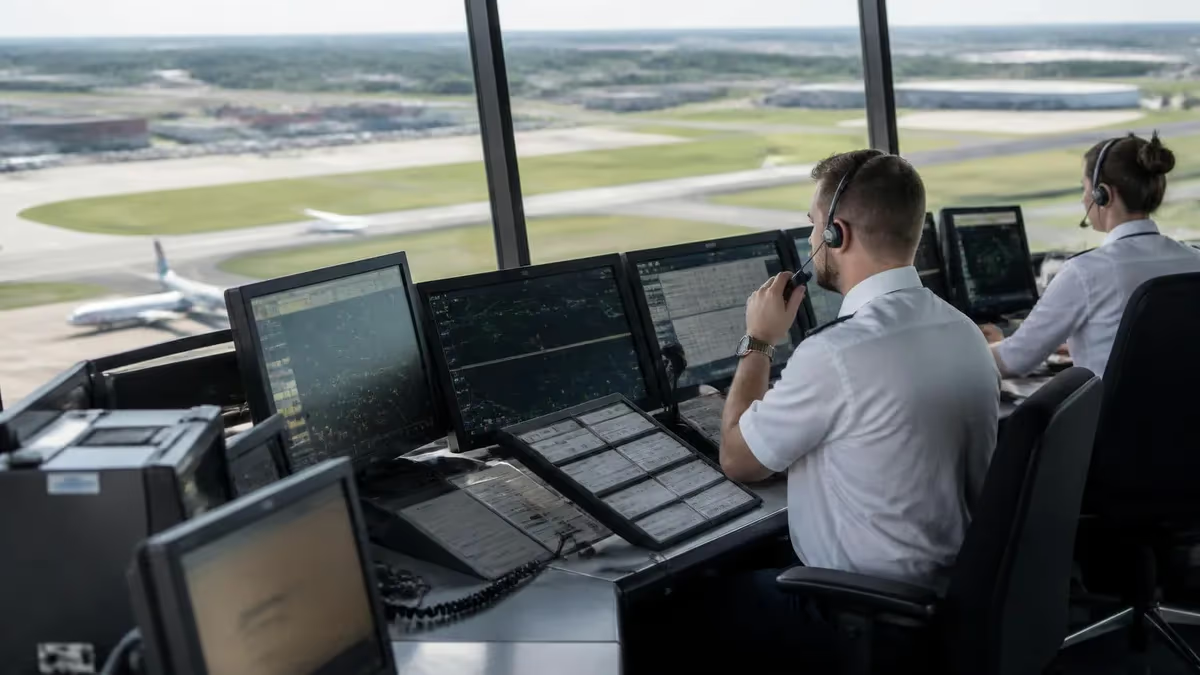
If you have ever typed "air traffic controller reddit" into a search bar at midnight, you already know why the platform pulls so many aspiring controllers. The forums are full of raw, unfiltered accounts from people who actually plug in and separate traffic for a living, and they answer the questions that glossy recruiting pages skip. How hard is the training? How brutal are the schedules? Is the money worth the stress? This guide pulls those recurring threads together into one honest, structured career overview built for serious applicants.
The appeal of the Reddit angle is simple: it is peer-to-peer truth. A trainee who just washed out of Oklahoma City will describe exactly what tripped them up, while a 15-year veteran will explain why they would still pick the job again despite the rotating shifts. You get the good, the bad, and the strange middle ground that official FAA literature rarely captures. That is the spirit this article keeps, while organizing the chaos into something you can actually act on.
Air traffic control is one of the highest-paid jobs in America that does not require a four-year degree, and it carries a federal pension on top of strong base pay. That combination is rare, and it is exactly why the field is competitive even as the agency battles a long-running staffing crisis. Controllers describe a job that is simultaneously high-pressure and oddly addictive, where a busy session feels like a video game you cannot pause and a slow night feels like watching paint dry from a glass tower.
Reddit threads also surface the parts nobody warns you about: the medical disqualifications that end careers early, the mandatory retirement age of 56, and the way training facility assignment can make or break your first two years. The community is candid about how the hiring "bid" works, how the Air Traffic Skills Assessment filters thousands of applicants, and how the ongoing air traffic controller reddit conversation about understaffing affects overtime, morale, and your odds of getting hired in the first place.
This article is a Tier 3 supporting overview, meaning it gives you the full landscape rather than a single narrow tutorial. We cover duties, daily life, pay realities, training stages, washout rates, the pros and cons people argue about most, and a long FAQ pulled from the questions that come up again and again in controller subreddits. By the end you should understand not just what the job pays, but what it actually costs you in sleep, stress, and lifestyle.
One word of caution before we dive in: Reddit is anonymous, and anonymous advice is a mix of gospel truth and exaggeration. Use the community as a directional compass, not a contract. Where this guide cites numbers, they are grounded in FAA data, Bureau of Labor Statistics figures, and union reporting, then cross-checked against what controllers consistently say. Treat the firsthand stories as flavor and the verified figures as the backbone of your decision.
Air Traffic Control by the Numbers

What Air Traffic Controllers Actually Do
Work the cab of an airport tower, sequencing departures and arrivals, clearing aircraft to land and take off, and managing ground movement on taxiways and runways using visual contact and radar feeds.
Handle approach and departure control in radar rooms, threading aircraft into and out of busy terminal airspace within roughly 30 to 50 miles of major airports while maintaining separation standards.
Staff Air Route Traffic Control Centers managing high-altitude en route traffic across huge swaths of airspace, handing aircraft off between sectors on long cross-country flights.
Provide pilot briefings, weather updates, and flight plan services. A smaller slice of the workforce, but a common entry topic in Reddit threads about non-radar paths.
The single most-asked question in controller subreddits is some version of "how do I actually become one?" The path is more rigid than most careers because it runs almost entirely through the FAA. You apply during a hiring bid, pass the Air Traffic Skills Assessment, clear a medical and security screening, complete the FAA Academy in Oklahoma City, and then survive on-the-job training at your assigned facility. Each stage is a filter, and Reddit is full of stories about people who cleared one only to stumble on the next.
The Air Traffic Skills Assessment, or ATSA, replaced the old AT-SAT and is the first hard gate. It tests spatial reasoning, memory, multitasking, and the ability to absorb rules under time pressure. Controllers consistently warn that you cannot cram for it the night before, because it measures aptitude more than knowledge. The funnel is unforgiving: tens of thousands apply, a fraction pass with a "well qualified" rating, and only a slice of those receive a tentative offer letter to attend the Academy.
The Academy itself is where many washout stories originate. Depending on whether you train for tower or en route, you spend roughly two to four months learning rules, phraseology, and running high-fidelity simulations graded by instructors. The pressure is real because failing the Academy generally ends your shot at the job. Reddit threads describe the program as drinking from a firehose, with map memorization, rapid-fire scenarios, and pass/fail evaluations that decide whether you continue or go home.
Passing the Academy is not the finish line. The longest, most stressful phase is on-the-job training at your assigned facility, where you work live traffic under the watch of a certified controller. This can take one to three years depending on facility complexity, and washouts still happen here. A trainee who breezed through Oklahoma City can still fail to certify on a busy sector, which is why veterans tell newcomers that facility assignment matters enormously.
Age is a hard constraint that surprises many applicants. You generally must be hired before turning 31 for most controller positions, because mandatory retirement is 56 and the FAA wants a full career out of each hire. The detailed air traffic controller requirements cover education, citizenship, medical standards, and the age window, and they are worth memorizing before you bid, because missing the cutoff by a single day disqualifies you with no appeal.
Beyond the formal gates, the medical and security clearance steps quietly eliminate strong candidates every cycle. Color vision deficiencies, certain heart or psychiatric conditions, and a history of substance issues can all be disqualifying. Reddit users frequently urge applicants to get an unofficial medical screening early so they do not invest months only to fail the FAA flight physical. The clearance process can also drag for months, testing the patience of anyone hoping to switch careers quickly.
The throughline across every stage is that ATC hiring rewards preparation and aptitude over credentials. You do not need a pilot's license or an aviation degree, though a Collegiate Training Initiative school can streamline parts of the path. What you need is the raw cognitive horsepower to track multiple aircraft, the discipline to memorize precise phraseology, and the temperament to stay calm when six planes need decisions at once.
Daily Life Across Facility Types
Tower controllers describe a sensory-rich job: you watch real aircraft through the glass, scan strips, and juggle ground, local, and clearance positions. Reddit veterans say small towers can feel slow while major towers like Atlanta or Chicago O'Hare run relentless pushes. The visual element is rewarding, but weather, runway changes, and surface congestion add complexity that radar rooms never see.
The lifestyle upside is that many towers operate fewer overnight shifts than centers, and the work is concrete and immediate. The downside is exposure to weather-driven chaos and the cognitive load of managing the airport surface, where ground stops and taxiway conflicts can snowball quickly during peak banks of arrivals and departures.

Is Being an Air Traffic Controller Worth It?
- +High pay with no four-year degree required
- +Federal pension and strong retirement benefits
- +Job security tied to a national staffing shortage
- +Intellectually engaging, fast-paced work
- +Strong union representation through NATCA
- +Clear advancement and facility-upgrade pay bumps
- +Pride in directly keeping aviation safe
- −Rotating shifts wreck sleep and social life
- −High washout rate at Academy and OJT
- −Strict medical standards end some careers early
- −Mandatory retirement at age 56
- −Chronic understaffing means heavy overtime
- −High stress with zero margin for error
- −Limited control over your first facility assignment
Air Traffic Controller Reddit Application Readiness Checklist
- ✓Confirm you can be hired before turning 31.
- ✓Verify U.S. citizenship and clean background.
- ✓Get an early unofficial FAA medical screening.
- ✓Check color vision and hearing standards now.
- ✓Watch USAJOBS for the next FAA hiring bid.
- ✓Prepare seriously for the ATSA aptitude test.
- ✓Practice spatial reasoning and short-term memory drills.
- ✓Consider a Collegiate Training Initiative school.
- ✓Save a financial cushion for relocation to Oklahoma City.
- ✓Research facility types before ranking preferences.
- ✓Build sleep habits that tolerate rotating shifts.
- ✓Read controller subreddits for honest expectations.
Roughly 1 in 3 trainees do not finish
Across Academy cohorts and on-the-job training combined, washout rates frequently land in the 30 to 40 percent range, and at complex facilities they climb higher. The lesson controllers repeat is blunt: getting hired is not the same as making it. Treat every stage as a real exam, prepare relentlessly, and never assume the offer letter guarantees a career.
Money is the magnet, and Reddit threads dissect it endlessly. The headline is that certified controllers earn a median well above six figures, with the Bureau of Labor Statistics reporting median pay around $144,000 in recent data and top earners at the busiest facilities pushing well past $200,000 once overtime is included. That earning power without a bachelor's degree is the central reason the job trends on career forums year after year, and it is largely accurate rather than hype.
The catch is that you do not start at the top. Trainees earn a modest Academy stipend, then a starting facility salary that ramps as you certify on positions. Pay is tied to facility level, so a controller at a small tower earns dramatically less than one at a major TRACON or center. Reddit veterans constantly remind newcomers that the path to big money runs through upgrading to higher-level, higher-stress facilities, which often means relocating away from where you trained.
Geography complicates the picture. A salary that feels enormous at a center in a low-cost rural area can feel ordinary at a facility near an expensive coastal metro. Smart applicants weigh locality pay adjustments and cost of living together rather than chasing the biggest raw number. The full breakdown of bands, locality pay, and overtime is covered in the dedicated air traffic control pay guide, which is the resource Reddit users link most when newcomers ask what they will really take home.
The pension is the quiet superpower of the career. As federal employees, controllers participate in the Federal Employees Retirement System, which combines a defined-benefit annuity, Social Security, and a Thrift Savings Plan with agency matching. Because the job has an early mandatory retirement age, controllers can retire relatively young with a real pension, a combination almost nonexistent in the private sector. This is why long-tenured controllers on Reddit so often say the benefits, not just the salary, are what kept them in the chair.
Overtime is a double-edged sword in the current staffing environment. With the system thousands of controllers short of targets, many facilities lean heavily on six-day weeks and mandatory overtime to keep sectors open. That inflates paychecks substantially, and some controllers bank serious extra income. But the same threads warn that the overtime is not optional, and chronic six-day weeks grind people down, turning a financial upside into a lifestyle liability over the long run.
Lifestyle is where the salary conversation gets honest. The pay is excellent, but it is shift pay, and the shifts rotate through mornings, evenings, and overnights, sometimes within a single week. The infamous "rattler" schedule compresses a week of varied shifts to create a long weekend, and controllers either love it or blame it for wrecking their sleep. Whatever you earn, you trade a conventional circadian rhythm and predictable family time to get it.
So is the money worth it? The community consensus is a qualified yes for the right person. If you value high income, a strong pension, and engaging work, and you can tolerate rotating shifts and high stress, few careers match the deal. If you need predictable hours, weekends off, and low pressure, the salary will not compensate for what the schedule takes. The numbers are real; whether they fit your life is the actual question.

You generally must be hired before your 31st birthday for entry-level controller positions, with limited exceptions for prior military experience. The FAA does not waive this for strong candidates, and missing the bid window can permanently close the door. If you are in your late twenties and serious, treat the next hiring announcement as urgent rather than optional.
Stress is the topic that gives controller subreddits their honest, sometimes dark, character. This is a job where a lapse in attention can have catastrophic consequences, and controllers carry that weight every shift. The pressure is not constant terror but sustained vigilance, the mental equivalent of holding a heavy object steady for hours. Veterans describe learning to compartmentalize, to make rapid decisions without second-guessing, and to leave the job in the building when they clock out, a skill that takes years to build.
Fatigue is the most discussed health hazard, and it is structural rather than personal. Rotating shifts fight human biology, and overnight work in a dim radar room is notoriously hard to stay sharp through. Studies and union reporting have repeatedly flagged controller fatigue as a safety issue, and Reddit threads are full of strategies for surviving the midnight shift, from strict caffeine timing to blackout curtains to napping on breaks where facilities permit it.
The chronic staffing shortage amplifies every stressor. Fewer controllers means more traffic per person, more overtime, and fewer chances to take leave when you need it. The long-running air traffic control shortage is not an abstract policy debate to working controllers; it is the reason their weeks stretch to six days and their vacations get denied. Understanding that context helps applicants set realistic expectations about workload before they ever plug in.
Mental health gets candid treatment on the forums, partly because FAA medical rules historically made controllers wary of seeking help. Disclosing certain conditions or treatments can trigger lengthy medical reviews or disqualification, which created a culture where some controllers hid struggles to protect their certification. Reddit discussions push hard for reform here, and they urge newcomers to understand the medical landscape so they can manage their health without unknowingly jeopardizing their careers.
Burnout is real but not universal, and the threads make a useful distinction. Many controllers love the actual work of separating traffic; what burns them out is the schedule, the overtime, and the management friction, not the controlling itself. That nuance matters for applicants, because it means the stress is largely manageable if the staffing and scheduling situation improves. The job's core is engaging; the surrounding conditions are what people most often complain about.
Coping strategies that surface again and again include guarding your sleep aggressively, building a life outside aviation, leaning on the camaraderie of your facility, and using the strong union for support and protection. Controllers describe their crews as tight-knit, forged by shared high-stakes work, and that solidarity is a genuine buffer against the stress. The people who thrive treat their off-hours and their physical health as non-negotiable parts of staying certified.
The honest summary from the community is that the job is demanding but survivable, and even rewarding, for people built for it. The stress is real, the schedule is punishing, and the stakes are high, yet thousands of controllers do it for full careers and retire proud of the work. The key is going in clear-eyed, which is exactly what the Reddit angle provides better than any brochure ever could.
If the honest picture has not scared you off, the practical question becomes how to maximize your odds of getting in and staying in. The first piece of advice controllers give is to take the ATSA seriously as the real gate it is. Build spatial reasoning, working memory, and multitasking through deliberate practice over weeks, not days. Treat it like the SAT of your career, because a marginal score can mean waiting another full hiring cycle for a second attempt.
Second, get ahead of the medical. Many strong candidates lose months chasing a path their physiology will not allow, then fail the FAA flight physical at the end. Schedule a private screening for color vision, hearing, cardiac, and vision standards before you invest emotionally in the dream. Knowing early lets you either proceed with confidence or pivot to a related aviation career without burning a year of your life on a foreseeable disqualification.
Third, prepare financially and logistically for Oklahoma City. The Academy stipend is modest, relocation is on you, and trainees often arrive underfunded and stressed. Controllers recommend a cash cushion so money worries do not compound the academic pressure. The people who struggle most at the Academy are frequently those distracted by survival logistics rather than focused entirely on passing the simulations and memorizing their maps and phraseology.
Fourth, study the airspace, radar, and separation fundamentals before you ever start, even though formal training will reteach them. Walking in with a working mental model of Class A through G airspace, basic separation minima, and how radar handoffs work gives you a head start when the firehose opens. Practice tests are a low-cost way to build that foundation and to confirm you genuinely enjoy this kind of rule-dense, spatial problem solving before you commit years to it.
Fifth, manage facility expectations. You will rank preferences, but assignment depends on agency needs, and you may land somewhere unexpected. Veterans urge flexibility, because complaining about your first facility helps nothing and a willing attitude can shape how instructors invest in you. Remember that your first facility is rarely your last; controllers transfer and upgrade throughout their careers, so an unglamorous start can lead anywhere with time and certification.
Sixth, build sleep discipline now. The rotating shifts are the single biggest lifestyle shock, and controllers who arrive with good sleep hygiene adapt faster. Practice falling asleep at irregular hours, invest in blackout curtains and white noise, and learn to nap. The trainees who certify smoothly tend to be the ones who protected their rest, because a tired brain cannot absorb the volume of material the job throws at you in those first critical months.
Finally, use the community wisely. Read the controller subreddits for morale, tactics, and reality checks, but verify the consequential claims against official FAA sources and this site's detailed guides. Reddit is the best free source of lived experience in the industry, and also a place where outdated rumors and venting circulate freely. Combine its candor with verified data, prepare deliberately for each gate, and you will walk into the process with eyes wide open and a real shot at the headset.
ATC Questions and Answers

Air Traffic Control Shortage: What It Means for Your Career in 2026

ATC Tower: How It Works, Positions, and What Controllers Actually Do

Air Traffic Controllers Fired: Reagan 1981, Causes, Effects

Air Traffic Controller Requirements: Age, Education, and Process

Air Traffic Control Pay: Complete Salary Guide for Controllers in 2026
About the Author

Commercial Pilot & FAA Certification Specialist
Embry-Riddle Aeronautical UniversityCaptain Jennifer Walsh graduated with honors in Aerospace Engineering from Embry-Riddle Aeronautical University and holds FAA Airframe & Powerplant and Airline Transport Pilot certificates. With 11 years of commercial aviation experience and 6 years as a ground school instructor, she guides aviation mechanics and student pilots through FAA written exams and practical tests.
Join the Discussion
Connect with other students preparing for this exam. Share tips, ask questions, and get advice from people who have been there.
View discussion (8 replies)