
Air Traffic Control Shortage: What It Means for Your Career in 2026 October
Air traffic control shortage explained: FAA hiring waves, pay, training pipeline at the OKC Academy, and how to land a CPC role fast in 2026 October. 📗

The air traffic control shortage is the biggest workforce story in U.S. aviation right now, and it is the single best reason to take the ATC career path seriously this year. Towers from Newark to Burbank are running short-staffed, controllers are pulling six-day weeks, and the Federal Aviation Administration is hiring in waves it has not seen in a generation. If you have ever wondered whether the timing is right to apply, the honest answer is yes, and the window is unusually wide.
Roughly 11,800 fully certified controllers staff the National Airspace System, and the FAA's own target sits closer to 14,600. That gap of about 2,800 controllers drives the overtime, the staffing triggers at busy facilities, and the ground stops you may have already seen on the evening news. The shortage is not a rumor, it is a number, and the agency has finally moved from study to action.
For anyone weighing trade school, military reenlistment, a four-year degree, or a complete pivot from a stalled career, the math here matters. Controllers earn six figures inside a few years, retire with a pension at 56, and never carry student loans bigger than a used pickup. The catch has always been the bottleneck at the FAA Academy in Oklahoma City. That bottleneck is finally moving, and you should know exactly what changed before you fill out the application.
ATC Shortage By the Numbers
Why the shortage happened in the first place
Three forces collided. First, COVID. The Academy shut its doors in March 2020 and the FAA furloughed new-hire training for the better part of a year. Second, attrition. The big 1981 PATCO replacement class is now aging out, and a controller hired in 1989 must hang up the headset at 56. Third, washout rates. Even in a normal year, around one in three Academy trainees fails to graduate, and the facility certification grind that follows takes two to three years before a trainee becomes a Certified Professional Controller (CPC).
Stack those forces on top of a record-breaking 2024 travel year, and you get the situation pilots and passengers feel today. The FAA is not understaffed on paper, it is understaffed in the cab, and a tower with 24 certified slots that only fields 17 bodies is going to combine sectors, refuse training time, and burn out the people who stayed.
What the FAA is actually doing about it
Acting Administrator changes aside, the agency has rolled out the most aggressive hiring push since Reagan reopened the gates. The 2024 bid received more than 8,300 applications in nine days, and the agency closed it early. The 2025 and 2026 bids followed the same pattern, with off-the-street announcements running back-to-back instead of once every couple of years.

What changed in the 2025 hiring overhaul
- Academy class sizes raised from 1,500 to 1,800 per year, with a goal of 2,000 by 2027.
- The Air Traffic Skills Assessment (ATSA) is now offered year-round at Pearson VUE centers instead of in a single window.
- Tentative Offer Letters arrive 4-6 weeks after ATSA pass instead of 8-12 months.
- Direct hire from Collegiate Training Initiative (CTI) schools bypasses the Academy entirely for top graduates.
- $5,000 sign-on bonuses for hard-to-staff facilities like New York TRACON (N90) and Atlanta Center (ZTL).
The Collegiate Training Initiative is the part most candidates miss. If you graduate from a CTI school with a high score on the Tower Simulator assessment, you can skip the Oklahoma City Academy entirely and report straight to your assigned facility. That removes the single biggest washout risk in the pipeline and shaves four to seven months off your start date. There are 33 CTI partner schools, ranging from community colleges in Minnesota to four-year programs at Embry-Riddle. Picking the right one matters, and we covered the trade-offs in ATC degree vs Academy.
What the shortage means for pay
Pay is the part of the story that gets exaggerated on TikTok and undersold by the FAA. Here is the unvarnished version. Developmental controllers start at roughly $46,000 base while at the Academy. The day you arrive at your facility, you jump to AG (Academy Graduate) pay, which lands between $52,000 and $61,000 depending on locality. You then climb through D1, D2, D3, and CPC-IT pay bands as you certify on positions. At a Level 11 or Level 12 facility, a fully certified controller clears $160,000 to $210,000 with overtime, and the busiest Centers and TRACONs push higher still.
ATC Career Pipeline Stages
Submit a USAJobs application during a bid window. Pass the Air Traffic Skills Assessment within 30 days of invitation. Pass rate hovers around 30 to 40 percent, and the test rewards reps over cramming. Spread your prep across six weeks of short daily sessions.
12 to 16 weeks of full-time training in Oklahoma City. Tower track or En Route track. Pass-the-block washout sits near 30 percent for Tower and 45 percent for En Route. CTI direct-hires skip this stage entirely if their scores qualify.
1.5 to 3 years at your assigned facility. Certify on each position one at a time, starting with the easiest and building toward radar or local control. CPC status unlocks top pay, union seniority, and the right to bid transfers anywhere in the system.
Trade shifts, work overtime at premium rates, or transfer between facilities. Mandatory retirement is age 56, with a federal pension after 25 years of service. Most controllers can retire comfortably in their mid-50s, often a full decade before their non-federal peers.
Where the shortage hits hardest
Not every facility is short the same way. Low-level VFR towers in Florida and Texas are fully staffed because they are training grounds and weather is forgiving. The pain concentrates at Level 10, 11, and 12 facilities that handle the heaviest commercial traffic. New York TRACON (N90), Atlanta Center (ZTL), Jacksonville Center (ZJX), Chicago Center (ZAU), and Southern California TRACON (SCT) are the five sites the FAA has publicly described as critically short.
If you are willing to pick your facility based on staffing need, you can collect a hardship bonus, jump the bidding queue, and qualify for relocation incentives. Most new hires get a list of available facilities ranked by need, and choosing a top-of-list option is the cleanest way to lock in a fast career path. We break down the regional differences in best ATC facilities to work at for anyone weighing pay against quality of life.
Controller Position Types
Local control, ground control, and clearance delivery. You sit in the glass cab, watch real airplanes, and live by visual separation. Tower is the easiest entry point and the most common Academy track. Most VFR towers in the United States are Level 5 to Level 8 facilities, with smaller traffic counts and shorter certification timelines than radar facilities.
How long until the shortage is actually solved?
The honest projection sits in the late 2020s. Even with the new Academy class targets, the FAA loses around 800 controllers per year to retirement, medical disqualification, and resignation. Hiring 1,800 a year sounds like growth, but only about 1,000 of those will reach CPC status three years later. Net staffing gains, in other words, are roughly 200 controllers per year against a 2,800-seat deficit.
That means the shortage is a multi-year hiring environment. If you apply in 2026, the labor market for new controllers will still be hot when you certify in 2029, which is exactly the kind of timing that builds careers. Compare that to nursing, software engineering, or commercial trucking, where the hiring window opens and closes inside 18 months.
Should you take the test?
The ATSA is the gatekeeper. Around 60 to 70 percent of applicants do not pass on the first attempt, and a fail counts as one of your two career tries. That is why serious candidates prep before they sit. Pattern recognition, working memory, and situational awareness are scorable skills, not personality traits, and the right prep work moves the needle. Our full ATSA breakdown lives at ATSA practice tests, and the airspace knowledge subtest at ATC aviation knowledge test.

You must enter the FAA Academy before your 31st birthday, with very narrow exceptions for prior military controllers and active CPCs returning from another federal job. If you are 28 or older, do not stall on the ATSA, the timeline is unforgiving.
What the job actually looks like, day to day
Forget the movies. The job is not constant adrenaline, it is sustained focus. A typical shift runs 8 to 10 hours with two scheduled breaks, and you spend most of that time on position, talking to aircraft, updating data blocks, and coordinating with adjacent sectors. The hard part is not the busy days, it is the slow ones, because vigilance has to stay sharp even when nothing is happening.
Schedules rotate. The classic 2-2-1 (two swings, two days, one mid) is brutal at first and then becomes part of who you are. You will work weekends, holidays, and the occasional 10-hour overtime day. In return, you get every fourth day off in a normal block, a federal retirement after 25 years, and a paycheck that does not need a side hustle.
ATC Eligibility Checklist
- ✓Under age 31 by Academy start date
- ✓U.S. citizen with the ability to pass a Tier 4 security clearance
- ✓FAA Class II medical (no disqualifying conditions, vision correctable to 20/20)
- ✓Ability to relocate to Oklahoma City for 3-4 months
- ✓Willing to accept any facility assignment after Academy
- ✓Comfortable with shift work, holidays, and overnight rotations
The pay-versus-stress trade you actually face
Stress is the part of the job people argue about. The honest answer is that stress is real, but it is the controllable kind. You are not trading kids at home for hospital ICU adrenaline, and you are not carrying email home on your phone. When you walk off position, you are done. The trade is intensity for duration. You give two hours of total focus, you take a break, you give two more. Some weeks that is invigorating, other weeks it is exhausting, and most controllers find a rhythm by year three.
What the trade gives you is rare in 2026. You earn senior software engineer money without a degree, you retire decades before your friends, and you do meaningful work where mistakes matter. That is not an easy package to find in any other career, and the current shortage means the FAA is actively recruiting you instead of making you fight for a slot.
Pros and Cons of Applying Now
- +Aggressive hiring waves with year-round ATSA testing
- +$160K+ at full CPC certification with no degree required
- +Federal pension after 25 years and retirement at 56
- +Sign-on bonuses for hard-to-staff facilities
- +No student loans, the FAA pays for Academy training
- −Age cutoff of 31 with very limited exceptions
- −30-40% washout at the Academy and 30% facility washout
- −Mandatory shift work, weekends, holidays, and overtime
- −You may be assigned a facility you did not pick
- −2-3 year wait until CPC pay kicks in
Step-by-step plan if you want to apply this year
Open USAJobs.gov and create a profile today, not when the bid drops. The FAA opens off-the-street announcements with little warning and closes them in days. Have your resume cleared and your transcripts uploaded ahead of time. When the announcement goes live, you have a maximum of 72 hours to apply, and the agency does not extend deadlines.
Next, prep for the ATSA. Treat it like the LSAT or the AFOQT, not like a personality quiz. The applied math, listening, and working memory subtests reward practice, and the dial reading is a learnable skill. Plan on 30 to 60 hours of focused prep over six weeks. Spread your practice across short daily sessions, the test rewards reps over cramming.
If you pass the ATSA, the FAA invites you to a Tentative Offer Letter (TOL) interview and a medical exam. Pass those, and you wait. The wait used to be a year. Under the 2025 overhaul, the wait is now closer to four to eight weeks. Use that time to bank cash, talk to your family about Oklahoma City, and read every controller subreddit thread you can find. You will land at the Academy more ready than your classmates.

What recruiters wish you knew before you apply
Three quiet truths separate the candidates who breeze through the pipeline from the ones who stall out. First, the FAA medical is not a formality. If you take SSRIs, you need a HIMS waiver path, and that takes months. If you wear contacts, that is fine, but a prior LASIK chart has to be clean. If you have a single DUI within the last 10 years, you can still apply, but anything stacked beyond that becomes a hard barrier. Pull your records before you apply, not after the medical scheduler calls.
Second, your security clearance starts the day you submit the SF-86. Bad credit, foreign contacts, undisclosed marijuana use, all of it shows up. The fix is honesty. The FAA disqualifies more people for omissions than for the underlying issue, so write it down even if you think it will hurt you.
Third, picking the right Academy track matters. Tower track has a 30 percent washout. En Route track has closer to 45 percent washout because the radar scope is genuinely harder. Tower track also reports to facility faster. If you have any choice, take Tower unless you have a personal reason to chase a Center assignment. The pay difference is small, the lifestyle difference is real, and the certification timeline is shorter.
Recruiter Action Items
When the bid drops, you have under 72 hours. Pre-load your resume, transcripts, and references this week so applying takes 30 minutes.
Eye charts, prior LASIK reports, mental health notes, and any HIMS waiver paperwork take weeks to retrieve. Start before the AME appointment.
Foreign contacts, addresses, and employer history going back ten years. Honesty beats omission every time on the security clearance side.
Pearson VUE seats fill at busy centers. Book within a week of your invitation email so you do not lose your slot window.
Military controllers and the shortage
If you held a military ATC job (1C5X1 in the Air Force, AC rating in the Navy, 15Q in the Army, or 7257 in the Marines), the FAA wants you yesterday. The Veterans Recruitment Authority pathway lets prior military controllers skip the standard age cap up to 35 and, in some cases, bypass the Academy if you held current FAA-equivalent certifications. The MIL-to-FAA bridge has hired close to 1,200 prior-service controllers since 2023, and it is one of the cleanest fast tracks in federal hiring right now.
The catch is paperwork. You need a clean DD-214, your CTO or CCTO rating documentation, and ideally a letter from your most recent military supervisor. Those records can take 60-90 days to retrieve through eVetRecs, so request them the week you decide to apply. If you separated more than five years ago, your facility currency may have expired, and you will likely need to attend the standard Academy, but you still get age waiver consideration.
Downstream Cost of the Shortage
How the shortage affects passengers and the airline industry
The downstream effects are easier to see than the staffing rosters. When N90 is short, JetBlue and United build longer scheduled ground times into LGA and EWR turnarounds. When ZJX is short, Florida-bound flights from the Northeast get rerouted west around the busy sectors, adding 15 to 20 minutes of flight time and a hundred gallons of jet fuel. Those costs show up in your ticket price, and they show up in the FAA's quarterly performance reports.
Ground stops happen too. A tower that loses its sole certified position controller for the day cannot legally stay open, and the FAA's National Operations Center starts holding traffic miles away to keep arrivals from stacking. Those stops cost airlines an estimated $4,000 to $9,000 per minute at major hubs, which is why airline lobby groups have spent the last 18 months pressing Congress for FAA hiring funds. The shortage, in other words, has a constituency, and that constituency is finally paying for the fix.
The FAA closes off-the-street announcements within 72 hours of opening. Set up email alerts on USAJobs.gov today so you are notified the moment a 2026 announcement goes live. A few extra hours of lead time often decides who gets a Tentative Offer Letter and who waits another six months.
The bottom line on the shortage
The air traffic control shortage is not theoretical, it is not exaggerated, and it is not going away in the next year or two. The FAA is hiring harder than at any point since 1981, the Academy is throughput-limited rather than demand-limited, and the pay-versus-prep-cost ratio is the best in any non-degree career in the United States. If you are under 31, medically clean, and willing to move, this is the job to chase.
Start with the practice tests, lock in your ATSA score, and apply during the next bid window. The shortage is your opportunity, and it is the kind of opportunity that does not stay open forever. Most candidates spend more time scrolling controller Reddit than they spend prepping for the test that decides whether they get in. Flip that ratio, and your odds change overnight. For a deeper look at the broader career path, head to our ATC career hub and start with the ATSA practice section.
One last note. The FAA has historically struggled to retain controllers at high-cost-of-living facilities. Newark, JFK, San Francisco, and Boston all see early transfers because the locality pay does not stretch in those metros. If you are willing to spend three to five years at a hardship facility, you can negotiate a transfer to a Center or TRACON in a cheaper city later. That kind of geographic flexibility is the single biggest career lever in the system, and the shortage gives you the bargaining power to use it.
Readers who want more detail usually continue with air traffic control shortage.
Sample Air Traffic Controller Practice Questions
Try these questions from our free Air Traffic Controller practice tests. The correct answer and an explanation follow each question.
What is the role of a 'facility traffic management coordinator' during a ground delay program?
- A. To pilot relief aircraft during delays
- B. To communicate delay information to airlines and coordinate departure sequencing with the ATCSCC
- C. To refuel aircraft on the ramp
- D. To brief passengers on arrival procedures
Answer: B. To communicate delay information to airlines and coordinate departure sequencing with the ATCSCC
During ground delay programs, the TMC works with the Air Traffic Control System Command Center to assign departure slots and minimize airborne holding.
What does ATIS stand for and what is its primary purpose?
- A. Automated Terminal Information Service; to broadcast continuous airport weather and NOTAMs
- B. Air Traffic Identification System; to track aircraft identities
- C. Automated Tracking and Integration Service; to link radar systems
- D. Airport Traffic Information Signal; to sequence landing aircraft
Answer: A. Automated Terminal Information Service; to broadcast continuous airport weather and NOTAMs
ATIS (Automated Terminal Information Service) broadcasts continuous recorded messages with current airport conditions, weather, active runways, and NOTAMs so pilots can receive this information before contacting ATC.
What is RVSM and what vertical separation does it allow?
- A. Restricted VFR Separation Minima; 500 feet between aircraft
- B. Reduced Vertical Separation Minima; 1,000 feet between FL290 and FL410
- C. Required VHF Separation Monitoring; 2,000 feet above FL410
- D. Radar Verified Separation Method; 1,500 feet in all airspace
Answer: B. Reduced Vertical Separation Minima; 1,000 feet between FL290 and FL410
RVSM (Reduced Vertical Separation Minima) is the airspace between FL290 and FL410 where special equipment requirements allow vertical separation to be reduced from 2,000 feet to 1,000 feet, increasing airspace capacity.
What physical feature is standard in most ARTCC en route control rooms to help controllers manage radar displays?
- A. Standing desks only
- B. Darkened, low-light room environment with radar scopes as the primary light source
- C. Large floor-to-ceiling windows for natural light
- D. Open-plan offices with cubicles
Answer: B. Darkened, low-light room environment with radar scopes as the primary light source
En route center radar rooms are typically kept dim so that radar returns on scopes are easier to read without glare interference.
ATC Questions and Answers
About the Author
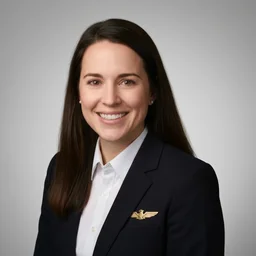
Commercial Pilot & FAA Certification Specialist
Embry-Riddle Aeronautical UniversityCaptain Jennifer Walsh graduated with honors in Aerospace Engineering from Embry-Riddle Aeronautical University and holds FAA Airframe & Powerplant and Airline Transport Pilot certificates. With 11 years of commercial aviation experience and 6 years as a ground school instructor, she guides aviation mechanics and student pilots through FAA written exams and practical tests.
Join the Discussion
Connect with other students preparing for this exam. Share tips, ask questions, and get advice from people who have been there.
View discussion (8 replies)