
Association of Social Work Boards ASWB Exam: Format, Fees, Passing Score and How to Prepare
🎯 The Association of Social Work Boards ASWB exam is a 122-question, 4-hour licensing test. See fees, passing score, registration and retakes.
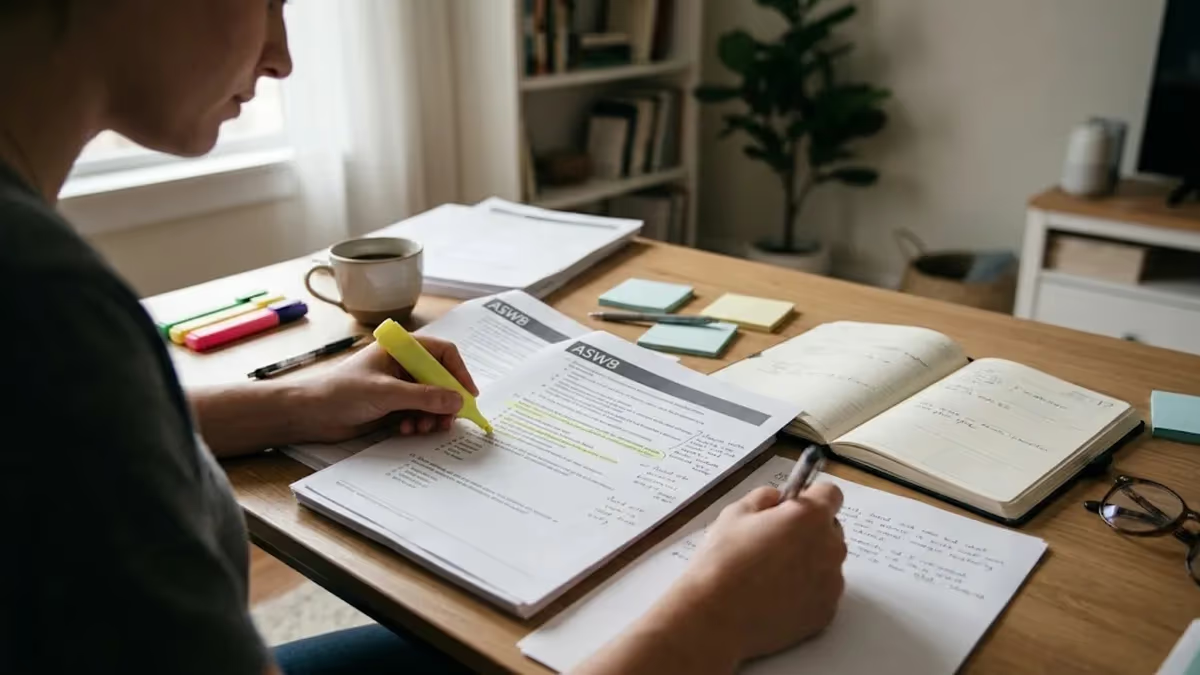
The Association of Social Work Boards (ASWB) exam is the computer-based licensing test most US state boards use to license social workers. Each ASWB exam has 122 multiple-choice questions, 110 scored, with a four-hour limit, and costs $230 for Associate, Bachelors, and Masters or $260 for Advanced Generalist and Clinical.
Association of Social Work Boards Aswb Exam: Key Facts (Updated October 2026)
| Fact | Details | Source |
|---|---|---|
| Delivery | Computer-based at Pearson test centers worldwide. The online proctoring pilot was suspended as of July 31, 2026. | ASWB |
| Format | 122 multiple-choice questions: 110 scored plus 12 unscored pretest, in two sections of 61, with a four-hour limit. | ASWB Exam Guidebook |
| Exam fee | $230 for Associate, Bachelors, and Masters; $260 for Advanced Generalist and Clinical. | ASWB |
| Eligibility | Apply for a license and be approved by your state or provincial board before registering with ASWB. | ASWB |
| Passing score | Pass/fail against one national standard; usually 66 to 78 correct out of 110 scored questions, depending on the form. | ASWB Exam Scoring |
| Results | Pass/fail shown on the testing computer; unofficial score report on ASWBCentral about 24 hours later. | ASWB Exam Scoring |
| Retakes | 90-day wait between attempts, waivable if your board allows it and your last score was within 10 correct answers of passing. Full fee applies again. | ASWB |
| 2026 update | New exams based on the 2026 blueprints launched August 3, 2026, with three content areas. Time limit, fees, and registration did not change. | ASWB |
If you are starting from zero, the quickest way to understand the test is to work through some aswb practice questions before paying for anything. The table above gives the official numbers, but numbers do not show how ASWB writes items. Most questions describe a short client scenario and ask for the best, first, or most appropriate response. Reading a few dozen early shows which vocabulary and decision rules you need to review.
The ASWB exam is the national licensing exam that state and provincial social work boards use to decide whether a candidate has the minimum knowledge to practice safely. ASWB does not issue licenses itself. Your board does that. ASWB writes the exam, scores it, and reports the result back to your board. That is why you apply to your state first, and why two people in different states can take the very same exam form.
There are five exam levels: Associate, Bachelors, Masters, Advanced Generalist, and Clinical. Which one you sit depends on your degree and on what your state board requires for the license you want. Many people searching for the aswb clinical examination are MSW graduates who need the Clinical exam for an LCSW-type license, while recent BSW graduates usually sit the Bachelors exam. Always confirm the level with your board before registering, because registering for the wrong level costs you time and money.
Preparation matters because the exam is scored pass or fail against one national standard, so you are not competing with other test takers. A focused aswb exam practice test routine, repeated across several weeks, is how most candidates find their weak content areas. Take a timed set, review every missed item, and write down why the right answer was best. Aim for steady practice rather than cramming. That habit teaches you the reasoning ASWB rewards, which matters more than memorizing definitions in isolation.
Cost and timing also deserve planning. The exam fee is paid to ASWB when you register, and your Authorization to Test (ATT) is valid for one exam and up to one year, unless your board sets an earlier date. You can request at most one extension of up to six months. Check your board's website for its own fee and deadline rules. Booking your seat at a Pearson center early also helps, since popular dates and locations near cities fill up before deadlines.
This guide walks through the exam format, the registration process, scoring and retakes, a realistic study approach, and the mistakes that cost candidates points. It reflects the 2026 blueprints that went live on August 3, 2026, so older advice about four content areas no longer applies. Use the sections below as a checklist, and treat the official ASWB guidebook as the final word whenever something here differs from your state board's rules.
How Many Questions, Hours, and Dollars Does the ASWB Exam Involve?
What Is the Format of the ASWB Exam?
| Section | Questions | Time | Weight | Notes |
|---|---|---|---|---|
| Section 1 | 61 | Shared 4-hour limit | 50% | Multiple-choice scenario questions, including some unscored pretest items |
| Section 2 | 61 | Shared 4-hour limit | 50% | Multiple-choice scenario questions, including some unscored pretest items |
| Total | 122 | 4 hours | 100% |
How Does ASWB Social Work Exam Registration Work?
ASWB social work exam registration starts with your state or provincial board, not with ASWB. You apply for a license, the board reviews your degree and any supervised experience it requires, and only then approves you to test. After approval, you create an account with ASWB, pay the exam fee, and receive an Authorization to Test. Skipping the board step is a frequent source of confusion for new graduates. Requirements differ by state, so read your board's application page first.
Once you hold an ATT, you schedule your seat at a Pearson test center through ASWB's scheduling system. The exam is taken on computer at Pearson centers worldwide. ASWB ran an online proctoring pilot that began March 23, 2026, for candidates living more than 100 miles from a center, but it suspended that pilot as of July 31, 2026, after a cheating attempt. For now, plan on a physical test center. Watch ASWB's announcement page for any change.
The biggest recent shift is the blueprint refresh. New exams based on the 2026 blueprints launched August 3, 2026. They use three content areas instead of four, carry fewer scored and pretest questions, and include more three-option questions. The four-hour limit, fees, and registration steps did not change. For a deeper look at what moved, read our breakdown of aswb exam changes before you pick study materials. Older prep books may still help, but check their topic lists against the current outline.
Fees are straightforward. The Associate, Bachelors, and Masters exams cost $230 each, while the Advanced Generalist and Clinical exams cost $260 each. Those amounts go to ASWB, separate from any application or licensing fees your state board charges. Budget for both, plus travel to the test center and any time off work. Preparation materials add to the total, so decide your study budget before you register.
Accommodations are available for candidates with documented needs, but the request goes through the process your board and ASWB describe, and it takes lead time. If you need an accommodation such as extra time, ask your board about it at the start of your application rather than the week before your exam date. Approval cannot be assumed, so build in a buffer of several weeks. Also make sure the name on your registration matches your government-issued ID exactly.
Because the exam is high stakes, many candidates add a trial run before test day. A free practice aswb exam shows pacing, question style, and fatigue points without costing you an exam fee. ASWB also sells an official online practice test for $85 to registered candidates, usable for 30 days, though there is no practice test for the Advanced Generalist exam. Use the paid official test late in your plan, as a final calibration. Free sets are still valuable for volume.
Finally, keep a simple registration timeline. Write down your application date, board approval date, ATT issue date, and the date your authorization expires. Set calendar reminders at 60 and 30 days before expiry. If life gets in the way, remember the one-time extension of up to six months per registration. Candidates who track these dates avoid paying for a second registration because an authorization quietly lapses.
How Should You Use an ASWB Exam Practice Test?
Timed sets are the closest rehearsal for the ASWB exam. Start with 30-question blocks in the first weeks, then move to 61-question halves that match the two sections of the real test, and finish with full 122-question runs. Set a timer at roughly two minutes per question and stop when it ends. Do this at the same time of day as your booked appointment. Learning to decide quickly, without checking notes, is a skill you build only by practicing it under pressure.
Review matters more than the score. After each set, spend at least as long reviewing as you spent answering. For every miss, and every lucky guess, write why the correct answer is best and why each wrong option fails. Sort the errors by cause: knowledge gap, misread stem, or rushed pace. After three sets, patterns appear, and those patterns tell you exactly where the next study session should go. Repeat missed topics a week later to check retention.
Are Free ASWB Practice Exams Enough to Pass?
- +They cost nothing, so you can take as many sets as you need
- +They build familiarity with scenario-style wording
- +Instant feedback and explanations show the reasoning behind answers
- +They fit easily into short study sessions
- +They let you rehearse timed pacing before test day
- +They reveal weak content areas early in your plan
- −They are not written or scored by ASWB
- −Question difficulty may differ from the real exam
- −Quality and accuracy vary from source to source
- −They cannot predict your actual pass or fail result
- −Some sets may still reflect the older blueprint
- −They do not replace content review or the official guidebook
What Should You Do Before the ASWB Clinical Examination?
- ✓Confirm with your state board which exam level you need.
- ✓Submit your license application and wait for board approval.
- ✓Register with ASWB and pay the exam fee ($230 or $260).
- ✓Note the expiration date on your Authorization to Test.
- ✓Schedule your seat at a Pearson test center early.
- ✓Download the current ASWB guidebook and content outline.
- ✓Take a diagnostic practice set in your first study week.
- ✓Complete at least three full-length timed practice sets.
- ✓Keep an error log and review it every week.
- ✓Confirm your ID matches your registration name before test day.
12 of the 122 questions do not count
Every ASWB exam mixes 12 unscored pretest questions in with the 110 scored ones, and they look identical. Treat every item seriously, but do not panic when one seems unfamiliar: it may be a tryout.
What Is ASWB and How Is the Exam Scored?
If you are asking what is ASWB, the short answer is that it is the organization that develops and maintains the licensing exams used by social work regulatory boards. Our guide on what is aswb covers its role in more depth. For test takers, the practical point is simple: ASWB owns the exam content and scoring, while your board owns the decision to grant a license. Keeping that split in mind explains most of the confusion about rules.
Scoring works on a pass or fail basis. Your result is pass or fail, not a percentage grade. ASWB sets the standard nationally, and each exam form is built to measure against it. Out of 110 scored questions, the number you need typically falls between 66 and 78 correct, depending on the form you receive. That range equals roughly 60 to 71 percent of scored items. Because forms differ slightly in difficulty, the required number shifts to keep the standard consistent.
The 12 unscored pretest questions are mixed in with the 110 scored ones, and you cannot tell which are which. ASWB uses them to try out new items for future exams. That has a practical consequence: if a question looks strange or covers something you have never seen, it may not count. Do not let one odd item drain your time or confidence. Choose your best answer and keep moving. Roughly one in ten items is a tryout.
Results come quickly. When you finish, the testing computer shows your pass or fail status on screen. About 24 hours later, an unofficial score report appears on your ASWBCentral dashboard. ASWB then reports the official result to your board, which handles the licensing steps that follow. Do not assume a pass on screen means you are licensed yet. You still need to complete any remaining board requirements, such as fees or supervision documentation. Ask your board how long its own processing takes.
Your study plan should mirror the exam. When you choose a practice test aswb candidates recommend, check that it uses scenario-based wording and a similar mix of content areas. Aim to finish several full-length sets under timed conditions in the final month. At 122 questions in four hours, you have just under two minutes per item. Track your score on each set, but study the pattern of errors more closely than the total.
Content knowledge still carries the exam. Expect questions on human development, assessment, diagnosis and treatment planning, intervention, ethics, professional values, and supervision, with the weighting depending on your exam level. Clinical and Advanced Generalist candidates see more complex case material than Bachelors candidates. Ethics runs through every level, so review the NASW Code of Ethics carefully. Rather than memorizing lists, practice linking each concept to an action: what a social worker should do first, next, or avoid in a given situation.
Finally, be honest about your starting point. Someone with strong field experience may need mostly test-taking practice, while someone who graduated several years ago may need a full content refresher. Take a diagnostic set in week one, sort every miss into knowledge gaps, reading errors, or time pressure, and spend your hours accordingly. That simple sort prevents the common trap of rereading familiar material while weak areas stay untouched.
ASWB suspended its online proctoring pilot as of July 31, 2026, after a cheating attempt. Plan to test at a Pearson center, and check ASWB's announcement page before booking in case the policy changes.
What Happens If You Fail the ASWB Examination?
If you do not pass, you can retake the exam, but not immediately. ASWB requires a 90-day wait between attempts. That wait can be waived if your board allows waivers and your most recent score was within 10 correct answers of passing. Some boards also cap the total number of attempts, so check your own board's rules before you register a second time. Treat the waiting period as study time, not as downtime.
To retake, you register again with ASWB and pay the full exam fee, which is $230 for the Bachelors exam and $260 for Advanced Generalist or Clinical. Your earlier fee does not carry over. Remember that your ATT covers one exam only. You may also need board approval to test again, depending on state rules, so contact your board as soon as you receive a failing result. Starting that conversation early keeps your timeline from slipping by weeks.
Passing standards confuse many candidates because the number of correct answers varies by form and licensing rules vary by state. Our reference on aswb passing score requirements by state explains how boards apply the national result. The key point is that ASWB's standard is national, while licensing conditions, such as supervised hours, remain local. If you plan to move, ask the new board about reciprocity before you test.
Understanding why attempts fail helps more than repeating the same routine. Common patterns include running short on time late in the exam, misreading what a question actually asks, and relying on workplace habits rather than the best-practice answer ASWB expects. Review your unofficial score report on ASWBCentral for the content areas where you scored lowest, then rebuild your plan around those areas, not around the whole syllabus. Be specific: write down three changes you will make before the next attempt.
Mindset matters after a failed attempt. A fail result says you were below the standard on one day, on one form, not that you cannot become a good social worker. Plenty of competent practitioners have needed a second attempt. Give yourself a short break, then return with a structured schedule. Burnout is a bigger threat to a retake than a lack of material, so protect sleep, exercise, and time with people you trust. Consider a study partner who can quiz you.
Passing the aswb examination is not the end of your professional learning. Most boards require continuing education to renew a license, and many approved courses are free. If you want to start building that habit early, our guide to free social work CEUs shows how to find approved courses that count toward renewal, and how to avoid providers your board will not accept. Keep certificates in one folder so renewal day takes minutes, not hours.
If you pass, celebrate, then act. Confirm that ASWB has sent your result to your board, pay any remaining licensing fees, and submit outstanding paperwork. Do not assume the board will chase missing items. Once your license is issued, save a copy of the certificate, update your resume, and notify your employer. If you passed the clinical aswb examination, also plan the next step in your supervision or specialty goals.
What Are the Best Tips to Pass the ASWB Exam?
The best single tip is to study in the same format you will be tested in. Do questions, not just reading. Every week, complete at least two sets of scenario-based items, review each answer choice, and write a one-line rule from each miss. Short, frequent sessions beat one long weekend cram. After a month you will have a personal list of rules that is far more useful than a generic outline, because it reflects the exact errors you make.
Learn the question stems. ASWB items often ask what to do first, what is the best next step, or which response is most appropriate. Those words signal a ranking task: more than one option may be acceptable, but only one fits the priority the stem sets. Underline the key word mentally, eliminate answers that skip assessment, and prefer options that are client-centered, ethical, and least restrictive. This approach converts uncertain items into educated choices.
Manage the clock deliberately. With 122 questions and four hours, you have about two minutes per item, but easy questions should take far less than that. Bank the saved minutes for scenarios that need careful reading. If you find yourself past three minutes on one item, choose your best answer and move on. A single stubborn question is rarely worth the risk of rushing ten others later. Remember, 12 items are unscored, and you do not need a perfect run.
Protect your energy in the final week. Do not start brand-new resources, and avoid late-night cramming. Review your personal rule list, skim your weakest content areas, and take one last timed set no later than three days before the exam. Visit the test center location in advance if you can, or at least confirm the route, parking, and arrival time. Reducing small stresses preserves mental energy for the questions.
On test day, bring what your Authorization to Test and Pearson confirmation require, including valid identification that matches your registration name. Arrive early, expect security procedures, and follow the center's rules about personal items. Eat a normal meal, hydrate, and use any break you're allowed wisely. Many candidates find that a brief stretch and a few slow breaths between sections resets focus for the second half of the exam.
Use trustworthy sources. The official ASWB guidebook, the content outline for your exam level, and the NASW Code of Ethics should anchor your study. Add reputable textbooks, a prep course if you learn well in groups, and plenty of free practice questions for volume. Be cautious with outdated materials, since the 2026 blueprints changed the content-area structure, and with any site that promises a guaranteed pass or claims to share real exam questions.
Finally, build a realistic timeline. A common plan is eight to twelve weeks of steady work: roughly ten hours a week, a diagnostic in week one, mixed practice in the middle weeks, and full timed sets near the end. If you work full time or have caregiving duties, stretch the plan rather than compressing it. Consistency beats intensity, and a calm, prepared candidate usually outperforms an exhausted one who studied twice as many hours.
ASWB Questions and Answers

ASWB Bachelors Test 2026

Aswb Exam Changes: What Is New in the Social Work Licensing Exam

What Is ASWB? Social Work Licensing Explained

ASWB Passing Score by State: Social Work License Requirements
ASWB Clinical Test
Free Social Work CEUs ASWB: How to Find Approved Courses That Count

ASWB Practice Exam: Free Social Work Licensing Test Prep

ASWB Practice Tests 2026: Free Exams for BSW, MSW, and Clinical
Sources & references
Prepared by the Practice Test Geeks editorial team using AI-assisted drafting; exam facts are checked against the official sources below. Editorial policy
- aswb.org — Exam information · verified Oct 2026
- aswb.org — Exam information · verified Oct 2026
- aswb.org — Fees · verified Oct 2026
- aswb.org — Test delivery, eligibility · verified Oct 2026
- aswb.org — Retake fee, retake policy · verified Oct 2026
- aswb.org — Passing score · verified Oct 2026
- aswb.org — Fees, exam format · verified Oct 2026
- aswb.org — Score release, score validity · verified Oct 2026