
ASVAB Mathematics Knowledge Practice Test: Complete Study Guide 2026 October
Master the ASVAB Mathematics Knowledge subtest with free practice tests, score breakdowns, and proven study strategies. 🎯 Boost your AFQT score today.
The ASVAB mathematics knowledge practice test is one of the most important tools you can use when preparing for military service. The Mathematics Knowledge (MK) subtest measures your grasp of high school algebra, geometry, and number theory — concepts that directly influence your Armed Forces Qualification Test (AFQT) score and determine which military occupational specialties are available to you.
Whether you are enlisting in the Army, Navy, Air Force, Marine Corps, or Coast Guard, a strong MK score opens doors to technical, intelligence, and engineering roles that come with better pay and career advancement. Starting your prep with a structured asvab for dummies approach will help you identify weak spots early and close them before test day.
Understanding the format of the Mathematics Knowledge subtest is the first step toward a high score. On the paper-and-pencil version of the ASVAB, you have 24 minutes to answer 25 questions. On the computerized CAT-ASVAB, the adaptive version gives you 18 minutes for 16 questions, adjusting difficulty based on your answers in real time. Both formats draw from the same topic pool: linear equations, quadratic expressions, exponent rules, geometric formulas for area and volume, probability basics, and properties of integers. Knowing exactly what the test covers lets you study smarter rather than harder, targeting the highest-yield concepts first.
Many recruits underestimate the Mathematics Knowledge subtest because they assume their everyday math skills are sufficient. In reality, MK questions are written to trip up test-takers who rely solely on intuition. Questions are carefully worded to test whether you genuinely understand the underlying mathematical principle, not just whether you can punch numbers into a calculator. For instance, a question may ask you to factor a quadratic expression rather than simply solve for a variable — a distinction that matters enormously on timed tests where choosing the wrong approach wastes precious seconds.
Your AFQT score is calculated from four ASVAB subtests: Arithmetic Reasoning, Mathematics Knowledge, Word Knowledge, and Paragraph Comprehension. The MK subtest contributes directly to this critical composite, which means every additional correct answer on the Math Knowledge section moves your AFQT percentile upward. For Army enlistment, the minimum AFQT is 31 for high school graduates. For the Air Force it is 36, and for officer programs the requirements climb significantly higher. The difference between a 50th-percentile and a 70th-percentile AFQT score can determine whether you qualify for a signing bonus, advanced training programs, or your preferred duty station.
Effective preparation requires consistent, deliberate practice over several weeks. Research on memory retention shows that spaced repetition — reviewing material at increasing intervals — dramatically outperforms cramming. A six-to-eight-week study plan that touches Mathematics Knowledge topics three to four times per week will produce far better results than two weeks of marathon sessions. Each study session should combine concept review, worked examples, and timed practice questions. Tracking which question types cause the most errors allows you to allocate future study time where it will have the greatest impact on your score.
One advantage that modern test-takers have is access to high-quality free resources online. PracticeTestGeeks offers full-length ASVAB practice tests that mirror the real exam's difficulty, pacing, and question style. Taking a full-length asvab practice test under realistic timed conditions before you begin your study plan establishes a baseline score and reveals your starting strengths and weaknesses. From that baseline, you can build a personalized prep roadmap that focuses your energy efficiently and tracks your improvement week over week. Consistent, measurement-driven preparation is the most reliable path to the score you need.
This guide walks you through every aspect of ASVAB Mathematics Knowledge preparation: the subtest format, the topics most heavily tested, proven study strategies, common mistakes to avoid, and a curated set of practice resources. Whether you are a first-time enlistee, retaking the ASVAB after a disappointing score, or preparing months in advance to maximize your options, the information ahead will give you a clear, actionable plan. Let's build the math foundation that unlocks your military career.
ASVAB Mathematics Knowledge by the Numbers
Key Facts at a Glance
| Item | Value | Details |
|---|---|---|
| MK Questions (P&P) | 25 | 24-minute time limit |
| MK Questions (CAT) | 16 | 18-minute time limit |
| Minimum AFQT Score | 31–36 | Varies by branch |

ASVAB Mathematics Knowledge Subtest Format
| Section | Questions | Time | Weight | Notes |
|---|---|---|---|---|
| Algebra & Equations | 8 | ~8 min | 32% | Linear, quadratic, systems of equations |
| Number Theory & Arithmetic Properties | 5 | ~5 min | 20% | Factors, multiples, exponents, roots |
| Geometry | 7 | ~7 min | 28% | Area, perimeter, volume, angle relationships |
| Probability & Word Problems | 5 | ~4 min | 20% | Ratios, percentages, basic probability |
| Total | 25 | 24 min (P&P) / 18 min (CAT) | 100% |
Algebra is the backbone of the ASVAB Mathematics Knowledge subtest, accounting for roughly a third of all questions. You need to be comfortable solving one-variable linear equations, simplifying expressions with like terms, and working with inequalities. Quadratic equations appear regularly in two forms: factoring expressions like x² + 5x + 6 = 0 and applying the quadratic formula.
Test-writers favor factoring because it is faster when the roots are integers — a pattern worth memorizing. Practice factoring at least ten quadratics per study session until the process feels automatic, because hesitation on these problems burns time you cannot afford under the clock.
Exponent rules are another high-frequency topic that many recruits get wrong because they memorize the rules without understanding them. The product rule (a^m × a^n = a^(m+n)), the quotient rule (a^m ÷ a^n = a^(m-n)), and the power rule ((a^m)^n = a^(m×n)) must be second nature. Negative exponents (a^-n = 1/a^n) and fractional exponents (a^(1/2) = √a) are also fair game. A common trap is confusing 2^3 × 2^3 with (2^3)^3 — the first equals 2^6 while the second equals 2^9. Working through a bank of exponent-focused problems before moving to geometry ensures these rules stay sharp throughout your prep.
Geometry questions on the MK subtest focus on practical formulas: area of triangles, rectangles, circles, and trapezoids; perimeter and circumference; volume of rectangular prisms, cylinders, and cones; and angle relationships in parallel lines cut by a transversal. You do not need to prove theorems — you need to select and apply the correct formula quickly.
The most common error is confusing area (square units) with perimeter (linear units), especially in multi-part questions that disguise which measure they are asking for. Building a one-page reference sheet of every formula and drilling it daily is one of the highest-return preparation moves available to you.
Number theory questions test divisibility rules, prime factorization, greatest common factors (GCF), and least common multiples (LCM). These concepts look simple but become tricky when embedded in word problems. For example, a question might describe two machines completing tasks at different rates and ask when they will align — a classic LCM application wrapped in unfamiliar context. Recognizing the underlying math structure beneath the story is the skill the test is actually measuring. To develop this skill, practice translating word problem descriptions into algebraic or arithmetic notation before solving, rather than jumping straight into computation.
Probability and percentage questions round out the Mathematics Knowledge subtest. Basic probability (favorable outcomes divided by total outcomes) appears in straightforward single-event scenarios. Percentage questions often involve finding a percentage of a number, calculating percentage change, or working backward from a final value to an original amount.
The army pt test parallels the ASVAB in one important way: both reward consistent, systematic preparation over last-minute cramming. For percentages, the key habit is converting between fraction, decimal, and percentage form fluidly — a skill that saves time on mixed-format problems where the answer choices appear in a different form than the question.
Rational numbers, absolute values, and integer operations also make appearances. Absolute value questions are particularly easy to miss because test-takers forget that |x| = 5 has two solutions: x = 5 and x = -5. Integer properties — odd vs. even, positive vs. negative — frequently appear as answer eliminator logic: if the question asks for the product of two odd numbers, any even answer choice is automatically wrong. Training yourself to use properties to eliminate impossible answers before solving the problem is a time-management technique that separates average scorers from high scorers on the Mathematics Knowledge subtest.
Scientific notation and unit conversion questions appear less frequently but should not be ignored. Converting 0.00045 into 4.5 × 10⁻⁴ or interpreting 3.2 × 10⁶ as 3,200,000 takes only seconds if you have practiced the conversion — but can take a frustrating minute if you have not. Similarly, basic unit conversions (feet to inches, pounds to ounces, quarts to gallons) are embedded in geometry and word problems. Keeping a brief unit conversion table in your study notes and reviewing it weekly ensures these conversions remain accessible on test day even under time pressure and test anxiety.
ASVAB Study Guide: Three Approaches to Mathematics Prep
A self-directed asvab study guide approach works best when you set a fixed daily study window — ideally 45 to 60 minutes — and protect it from interruptions. Start each session by reviewing one MK topic (for example, factoring quadratics), work through five to eight practice problems without notes to simulate test conditions, then grade your answers and study every mistake until you understand the correct reasoning. Rotating through all topic areas on a weekly cycle ensures that early concepts stay fresh while you continue building new skills.
Tracking your error rate by topic in a simple spreadsheet or notebook is the single most powerful self-study habit you can build. When you notice that geometry volume problems cause three times more errors than algebra questions, you know exactly where to invest your next study session. After four weeks of this tracked, topic-rotating approach, most students see their practice test scores climb 10 to 15 percentile points — a meaningful improvement that can unlock a significantly wider range of military job options and bonuses.
ASVAB Mathematics Knowledge: Practice Tests vs. Textbook Study
- +Practice tests reveal real exam pacing and time pressure you cannot simulate from a textbook
- +Immediate score feedback shows exactly which topics need more attention before test day
- +Repeated exposure to question phrasing trains pattern recognition that saves time on the real exam
- +Full-length simulations build the mental stamina needed to maintain focus across all subtests
- +Error-tracking from practice tests creates a personalized study agenda more efficient than generic review
- +Online practice platforms offer instant explanations that accelerate understanding of missed concepts
- −Practice tests without concept review do not fix fundamental knowledge gaps — you repeat mistakes
- −Low-quality free tests online may use inaccurate questions that teach incorrect approaches
- −Over-reliance on answer elimination can mask real understanding of the underlying math rules
- −Practice test fatigue sets in if you take full-length exams daily without recovery study days
- −Timed practice under pressure can reinforce bad habits if you are not also studying correct methods
- −Focusing only on practice tests may leave conceptual blind spots in geometry or number theory
ASVAB Mathematics Knowledge Test-Day Preparation Checklist
- ✓Memorize all standard geometry formulas for area, perimeter, and volume at least one week before test day.
- ✓Review exponent rules (product, quotient, power, negative, and fractional) until they are automatic.
- ✓Practice factoring quadratic expressions with integer roots without using the quadratic formula.
- ✓Complete at least three full-length timed ASVAB practice tests before your actual exam date.
- ✓Track your error rate by topic area after each practice test and adjust your study schedule accordingly.
- ✓Review divisibility rules (2, 3, 4, 5, 6, 9, 10) to speed up GCF and LCM calculations.
- ✓Practice converting between fractions, decimals, and percentages until the process is effortless.
- ✓Get at least eight hours of sleep the night before the exam to protect working memory and focus.
- ✓Arrive at the MEPS or test center at least 15 minutes early to reduce pre-test anxiety.
- ✓Read every question carefully and underline the key operation or unknown before solving.

Mathematics Knowledge Directly Moves Your AFQT Percentile
The AFQT score — the number that determines your eligibility to enlist — is calculated from just four subtests: Arithmetic Reasoning, Mathematics Knowledge, Word Knowledge, and Paragraph Comprehension. Mathematics Knowledge carries equal weight to Arithmetic Reasoning in this calculation, meaning every point you improve on MK produces a direct, proportional increase in your AFQT percentile. Recruits who invest an extra four to six hours specifically on Mathematics Knowledge prep routinely see their AFQT climb five to ten percentile points — often the difference between limited and unlimited job choices.
Understanding how ASVAB scores work is essential for setting meaningful preparation goals. Your AFQT score is a percentile ranking that compares your performance against a nationally representative sample of Americans who took the test in 1997. A score of 60 means you performed better than 60 percent of that reference group — not that you answered 60 percent of questions correctly. This distinction matters because a raw score improvement of just a few additional correct answers can move your percentile ranking significantly, especially in the middle of the distribution where scores are densely clustered.
Beyond the AFQT, the military calculates ten composite scores (called line scores or aptitude area scores, depending on the branch) from various combinations of ASVAB subtests. The Mathematics Knowledge subtest contributes to composites including Skilled Technical (ST), Electronics (EL), General Technical (GT), and Mechanical Maintenance (MM) for the Army. The GT score in particular gates entry to many officer programs, warrant officer pathways, and specialized technical schools. A strong Mathematics Knowledge score is not just about meeting the minimum AFQT threshold — it is about maximizing your composite scores to qualify for the highest-demand, highest-paying military jobs.
Regarding asvab scores, each military branch publishes its own minimum score requirements for specific jobs. The Army uses ASVAB line scores to determine MOS (Military Occupational Specialty) eligibility: an infantryman needs a Combat (CO) score of 87, while a signals intelligence analyst requires a Skilled Technical (ST) score of 101. Because MK feeds directly into the ST composite, recruits aiming for intelligence, cyber, or engineering MOSs should treat Mathematics Knowledge as a top priority rather than a secondary concern. Researching the line score requirements for your target MOS before you begin studying gives your preparation a concrete, motivating target.
The army combat fitness test has a parallel structure to the ASVAB scoring system: both use standardized benchmarks to determine readiness for specific roles rather than applying a universal pass-fail threshold. Just as different Army MOSs require different physical fitness standards, they require different composite score minimums. Understanding this structure helps you set precision goals for your ASVAB prep: instead of aiming for a generic high score, you can calculate exactly how many additional correct answers on Mathematics Knowledge you need to hit the composite score required for your target job, then work backward to build a focused study plan.
Retaking the ASVAB is possible if you are not satisfied with your initial scores. There is typically a one-month waiting period after the first attempt and a second one-month wait after the second attempt. After the third attempt and any subsequent tests, a six-month waiting period applies.
This policy means that preparation before your first attempt is always the highest-use investment — each retake costs you a month or more of time during which your enlistment is delayed. Treating the first attempt as your best shot, supported by eight weeks of structured preparation, is both strategically and practically the strongest approach.
Score reports from official ASVAB administrations are provided immediately after computerized CAT-ASVAB testing at Military Entrance Processing Stations (MEPS). Your recruiter receives the scores and reviews them with you to discuss MOS eligibility and next steps. Scores from student ASVAB administrations at high schools remain valid for two years.
If you take the ASVAB in school and later pursue enlistment, your recruiter can access those scores — but if they are more than two years old, you will need to retest. Planning your preparation timeline around these validity windows ensures your scores reflect your current, fully prepared ability rather than an earlier baseline.
One often overlooked aspect of ASVAB scoring is the confidence that comes from understanding your results. When you know your line scores, understand which composite each subtest feeds into, and see exactly how many points separate you from your target MOS, the path forward becomes clear and actionable. Recruits who understand their score reports make better preparation decisions, ask better questions of their recruiters, and approach retests with targeted focus rather than generic anxiety. Becoming fluent in ASVAB score interpretation is itself a meaningful preparation step that pays dividends throughout the enlistment process.
ASVAB scores are valid for two years from the date of testing. If your scores expire before you complete the enlistment process, you must retest from scratch — including the mandatory waiting periods between attempts. After your first attempt, you must wait one month before retesting; after the second attempt, another month; and after the third and any subsequent attempts, six months each. Plan your testing timeline carefully to avoid delays that could push back your enlistment date or limit your MOS options.
Building an effective study schedule for ASVAB Mathematics Knowledge requires honesty about your starting point and your timeline. If you have eight weeks before your test date, a structured six-day-per-week plan is ideal: dedicate four days to topic-specific math review and two days to full-section practice tests with error analysis. If your timeline is shorter — say, three to four weeks — compress the plan by front-loading the highest-frequency topics (algebra and geometry) and cutting the lower-frequency topics (scientific notation, advanced probability) to a single review session each. No study plan is perfect, but any consistent plan beats sporadic cramming.
One of the most effective supplementary resources for ASVAB Mathematics Knowledge prep is video instruction. Watching a 10-minute video explanation of quadratic factoring or the Pythagorean theorem before drilling practice problems activates prior knowledge and creates a mental model for solving unfamiliar question variations. Multiple free video resources exist specifically for ASVAB prep, and pairing them with the army fitness test resource on PracticeTestGeeks gives you both visual explanation and immediate application in the same study session. The combination of watching, then doing, then reviewing errors is the most time-efficient learning loop for mathematical material.
Group study is underrated for ASVAB preparation. Studying with one or two fellow recruits creates accountability, surfaces different error patterns (what confuses you may be easy for your study partner and vice versa), and makes the preparation process more sustainable over a multi-week timeline. Explaining a concept aloud to a study partner is one of the best ways to discover gaps in your own understanding — a phenomenon educational psychologists call the protégé effect. If your explanation breaks down or you cannot answer a follow-up question, you have just identified a concept that needs more review before test day.
Physical and mental health practices during your ASVAB prep period matter more than most recruits realize. Sleep is when the brain consolidates the day's learning into long-term memory — pulling an all-nighter before the exam actually reduces performance by impairing the memory retrieval you spent weeks building.
Aerobic exercise three to four times per week during your prep period has been shown in multiple studies to improve working memory and mathematical reasoning, the exact cognitive capacities that the Mathematics Knowledge subtest measures. Eating regular meals and staying hydrated on test day keeps blood glucose stable, which directly supports sustained concentration across multiple subtests.
Managing test anxiety on ASVAB day is a skill that deserves its own preparation. Anxiety is highest when the unknown is greatest — and the most effective antidote is familiarity. Every realistic practice test you take under timed conditions reduces the strangeness of the real exam environment.
By the time you sit for the official test, the format, pacing, and question style should feel deeply familiar. Deep-breathing techniques (four counts in, hold four, out four) activate the parasympathetic nervous system and have been shown to reduce cortisol levels within minutes — a practical, evidence-based tool for the moment you feel anxiety rising during a difficult question.
Guessing strategy deserves attention because the ASVAB does not penalize wrong answers on the paper-and-pencil version. If you reach a question you cannot solve, eliminate any answer choices you know are wrong, then guess from the remaining options. On the CAT-ASVAB, leaving questions unanswered is penalized more heavily than guessing, so never leave a question blank — always select the most plausible remaining answer. Knowing this policy in advance prevents the paralysis of sitting on a difficult question long enough to run out of time, which costs you the easy questions still waiting later in the section.
The final week before your exam should shift emphasis from learning new material to consolidating and reviewing what you already know. Attempting new, unfamiliar topics in the final seven days creates confusion rather than confidence.
Instead, review your formula sheet daily, work through 10 to 15 mixed practice questions per day at a relaxed pace, and revisit your error log one last time to confirm that previously missed question types no longer cause problems. Go into test day knowing you have prepared thoroughly, understanding your target scores, and trusting the preparation you have built over the preceding weeks. That confidence itself is a performance advantage.
On test day itself, the order in which you approach Mathematics Knowledge questions can meaningfully affect your score. Most experienced test-takers recommend a two-pass strategy: on the first pass, answer every question you can solve confidently within 30 to 40 seconds. Mark any question that requires more than a quick calculation and move on.
After completing the first pass, return to the marked questions with the remaining time. This approach ensures you collect all the easy points before spending time on harder problems, preventing the frustrating scenario of running out of time while a bank of solvable questions remains untouched at the end of the section.
Dimensional analysis — tracking units through every calculation step — is a habit that prevents one of the most common categories of errors on geometry and word problems. When a question gives dimensions in feet and asks for area in square feet, writing the units at every step (3 ft × 4 ft = 12 ft²) confirms you are performing the correct operation and catches errors like forgetting to square the unit.
This takes only a fraction of a second per step but catches the kind of careless unit error that accounts for a disproportionate share of wrong answers even among well-prepared test-takers who know the underlying math perfectly well.
For the CAT-ASVAB specifically, understanding how the adaptive algorithm works gives you a strategic advantage. The computer starts with a medium-difficulty question. If you answer correctly, it presents a harder question. If you answer incorrectly, it presents an easier one.
Your final score depends on both the number correct and the difficulty level of questions you answered correctly — meaning that getting harder questions right is worth more than getting easy questions right. This structure incentivizes attempting your hardest questions with genuine focus rather than rushing through them. Guessing on difficult questions when you have reasoning-based strategies available is never the best approach on the CAT-ASVAB.
Calculators are not permitted on any portion of the ASVAB, including the Mathematics Knowledge subtest. This is a critical fact that shapes your preparation strategy. Every calculation you perform during prep should be done by hand or mentally, not with a calculator. Specifically, you need to develop fluency with multiplying two-digit numbers mentally, simplifying fractions by hand, and estimating square roots without a calculator. These skills feel slow at first but become fast with consistent practice. Building calculator-free computation habits during prep ensures that the test environment feels natural rather than artificially constrained.
Estimation is a powerful tool on the Mathematics Knowledge subtest that many recruits overlook. When you have simplified an expression and your result seems much larger or smaller than all the answer choices, estimation can confirm whether you made an arithmetic error before you commit to an answer.
Conversely, if the answer choices are spread far apart — say, 4, 12, 48, and 144 — you often do not need an exact calculation. A rough estimate may eliminate three choices immediately, turning a complex calculation into a quick confirmation. Practicing estimation alongside exact computation is a dual investment that pays off in both speed and accuracy.
The relationship between Mathematics Knowledge and Arithmetic Reasoning deserves emphasis for test-takers who want to maximize their AFQT score. While MK tests mathematical concepts in a direct, abstract format, Arithmetic Reasoning tests those same concepts embedded in word-problem scenarios.
Studying both subtests together creates useful cross-reinforcement: a concept you encounter while studying for Arithmetic Reasoning (say, rate-time-distance relationships) may appear in a more abstract algebraic form on Mathematics Knowledge, and vice versa. Planning study sessions that alternate between MK concept review and AR word problem practice — rather than isolating the two completely — builds the flexible mathematical thinking that both subtests reward.
Consistency over the final stretch of your preparation is what separates test-takers who achieve their target score from those who fall just short. The recruits who score highest on Mathematics Knowledge are rarely the ones who are naturally gifted at math — they are the ones who showed up for their study sessions day after day, worked through difficult problems without giving up, and treated each practice test as a learning opportunity rather than a pass-fail verdict.
By the time you finish this guide and begin your structured prep, you will have a clearer roadmap than most recruits ever create. Follow it, track your progress, and trust the process. Your ASVAB Mathematics Knowledge score will reflect exactly the effort you put in.
Sample ASVAB - Armed Services Vocational Aptitude Battery Practice Questions
Try these questions from our free ASVAB - Armed Services Vocational Aptitude Battery practice tests. The correct answer and an explanation follow each question.
A platoon of 40 soldiers must complete a 10-mile march. If 25% fall out before finishing, how many soldiers complete the march?
- A. 25
- B. 28
- C. 30
- D. 32
Answer: C. 30
25% of 40 = 10 soldiers fall out; 40 − 10 = 30 soldiers finish.
A squad of 8 soldiers must complete 480 sandbags for a fortification. If 3 soldiers have already filled 120 sandbags, how many sandbags does each remaining soldier need to fill to complete the task equally?
- A. 45
- B. 60
- C. 72
- D. 52
Answer: C. 72
Remaining sandbags: 480 - 120 = 360. Remaining soldiers: 8 - 3 = 5. Each remaining soldier fills: 360 ÷ 5 = 72 sandbags.
Of 480 applicants, 5/8 pass the physical test. Of those who pass, 1/3 advance to the next stage. How many applicants advance?
- A. 100
- B. 90
- C. 120
- D. 160
Answer: A. 100
480 × 5/8 = 300 pass the physical; 300 × 1/3 = 100 advance to the next stage.
The hour hand of a watch rotates 30 degrees every hour. How many complete rotations does the hour hand make in 6 days?
- A. 8
- B. 10
- C. 12
- D. 14
Answer: C. 12
The hour hand completes one full 360-degree rotation every 12 hours. In 6 days, there are 6 * 24 = 144 hours in total. To find the number of complete rotations, divide the total hours by the hours it takes for one rotation: 144 hours / 12 hours/rotation = 12 rotations. So, the hour hand makes 12 complete rotations in 6 days.
Take the full ASVAB - Armed Services Vocational Aptitude Battery practice test
ASVAB Questions and Answers




About the Author
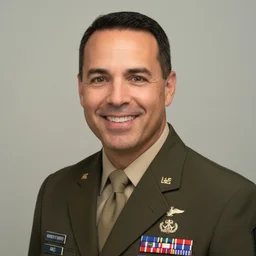
Retired Military Officer & Armed Forces Test Preparation Specialist
United States Army War CollegeColonel Steven Harris (Ret.) served 28 years in the US Army, earning a Master of Arts in Military Science from the Army War College and a Bachelor of Science in Criminal Justice. He has coached thousands of military enlistment and officer candidate program applicants through the ASVAB, AFQT, AFCT, OAR, and officer selection assessment processes across all military branches.
Join the Discussion
Connect with other students preparing for this exam. Share tips, ask questions, and get advice from people who have been there.
View discussion (5 replies)