
AP Physics 1 Equations & Study Materials Guide 2026 September
✏️ Pass your AP Physics 1 Equations & Study exam on the first attempt. Practice questions with detailed answer explanations, hints, and instant scoring.

If you're studying for Advanced Placement Physics 1, you've probably heard that the exam provides an equation sheet—and that having it doesn't mean knowing how to use it. That's the honest truth. The AP Physics 1 equation sheet lists the formulas, but the exam tests whether you understand when to apply them, why they work, and how to set up problems where the right equation isn't obvious. This guide covers the essential AP Physics 1 equations, what the College Board actually tests, and how to build the problem-solving skills the exam rewards.
AP Physics 1 is a calculus-free algebra-based physics course covering mechanics, simple harmonic motion, waves, and electric circuits. It's one of the most challenging AP exams in terms of conceptual depth—College Board data consistently shows it has one of the lowest passing rates among AP exams (typically 40–45% pass rate). That's not because the math is hard; it's because the exam demands genuine physics reasoning, not formula-plugging.
The AP Physics 1 Equation Sheet: What's on It
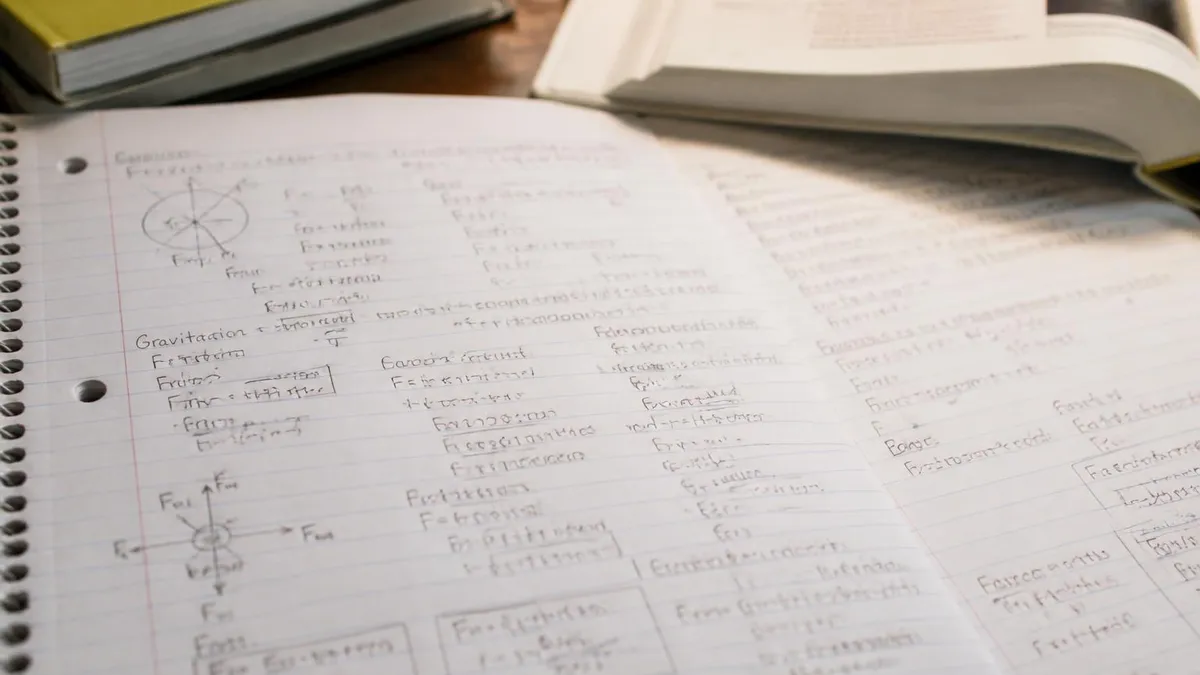
The official equation sheet provided on exam day includes equations in the following categories:
Kinematics
- v = v₀ + at
- x = x₀ + v₀t + ½at²
- v² = v₀² + 2a(x − x₀)
Know what each variable represents and the assumptions built into each equation (constant acceleration). Many exam questions will present a situation where acceleration isn't constant—recognizing when these equations don't apply is tested as heavily as knowing how to use them when they do.
Dynamics and Newton's Laws
- ΣF = ma (Newton's Second Law)
- F_g = mg (weight near Earth's surface)
- F_s ≤ μ_s N and F_k = μ_k N (static and kinetic friction)
The dynamics equations look simple. The exam makes them hard by putting you in scenarios with multiple forces, non-obvious force directions, or objects in contact where you need to apply Newton's Third Law carefully. The exam won't give you an equation for Newton's Third Law—you're expected to know it conceptually.
Circular Motion and Gravitation
- a_c = v²/r (centripetal acceleration)
- F_g = Gm₁m₂/r² (Newton's Law of Universal Gravitation)
Circular motion problems are often the ones that distinguish students who understand the physics from those who just memorize equations. The centripetal acceleration always points toward the center of the circle—this seems obvious but generates consistent errors on free-response questions when students don't draw proper free-body diagrams.
Energy and Work
- W = Fd cos θ
- K = ½mv²
- U_g = mgh
- Power: P = W/t = Fv
- Conservation of Energy: ΔK + ΔU + ΔE_thermal = W_external
Momentum and Impulse
- p = mv
- J = FΔt = Δp
- Conservation of Momentum: Σp_before = Σp_after
Simple Harmonic Motion
- T = 2π√(m/k) for a spring-mass system
- T = 2π√(L/g) for a simple pendulum
- x(t) = A cos(2πft)
Waves
- v = fλ
- f = 1/T
Electric Circuits
- I = ΔQ/Δt
- V = IR (Ohm's Law)
- P = IV = I²R = V²/R
- Series: R_series = ΣR_i; I same through all
- Parallel: 1/R_parallel = Σ(1/R_i); V same across all
Key Takeaway: AP certification demonstrates expertise in this field. Most candidates spend 4-8 weeks preparing with practice tests before taking the exam.
What the AP Physics 1 Exam Actually Tests
The AP Physics 1 exam has two sections: 50 multiple-choice questions (90 minutes) and 5 free-response questions (90 minutes). The free-response section accounts for roughly half the exam score and is where most students lose points.
The exam tests five science practices:
- Models and representations: Can you draw a free-body diagram, a motion graph, or a circuit diagram that accurately represents the physical situation?
- Mathematical routines: Can you apply the equations to calculate answers and use mathematical reasoning to make predictions?
- Scientific argumentation: Can you construct written explanations that use physics principles to justify conclusions?
- Experimental design: Can you identify variables, describe measurement procedures, and analyze experimental data?
- Quantitative and qualitative predictions: Can you predict how a change in one variable affects another without necessarily doing a full calculation?
Most students prepare only for practices 1 and 2. The exam heavily rewards practices 3 and 5—and that's where the score differential is. Writing clear physics justifications in free-response answers is a learnable skill, but it takes practice with actual AP-style prompts.
AP Physics 1 Study Materials That Work
Here's what actually helps versus what wastes time:
College Board Resources (Highest Priority)
The College Board publishes free released AP Physics 1 exams. These are the single most valuable study resource because they show exactly how the exam tests concepts. Work through every released free-response question under timed conditions, then compare your answers to the scoring guidelines. The scoring guidelines show how the exam rewards partial credit and what language earns points.
AP Classroom
Students enrolled in an AP Physics 1 course have access to AP Classroom, which includes topic questions, progress checks, and video lessons. The AP students guide covers how to make the most of the AP Classroom system, including the personal progress checks that give you formative feedback by topic.
Practice Tests by Topic
After reviewing the equation sheet and core concepts for each unit, do topic-specific practice before mixing everything in full practice tests. This lets you isolate weaknesses by unit rather than getting a mixed score that doesn't tell you where to focus. Physics 1 has seven units: kinematics, dynamics, circular motion and gravitation, energy, momentum, simple harmonic motion, and waves plus electric circuits.
AP Exam Dates and Planning
The AP exam schedule is published each year by College Board, typically with the schedule for May exams announced by September. AP Physics 1 is usually administered in May. Build your study plan backward from exam day—you need at least 6–8 weeks of structured practice to improve meaningfully on the free-response section.
Free-Response Question Strategy
AP Physics 1 free-response questions have a specific structure, and knowing the structure helps you earn partial credit even when you can't complete a problem fully. Most free-response questions include:
- A derivation or calculation component (apply equations to find a value)
- A representation component (draw a diagram, sketch a graph)
- A justification component (explain in writing using physics principles)
For each part, start by writing down what you know: list the given values, identify the relevant equation or principle, and show your setup before calculating. AP Physics 1 scores award method points even when the final numerical answer is wrong. A common mistake is skipping the setup and writing only a final answer—if that answer is wrong, you earn zero. If you show the correct setup with an arithmetic error, you earn partial credit.

The AP exam uses a multiple-choice format with questions covering all major domains. Most versions allow 2-3 hours for completion.
Questions test both knowledge recall and application skills. A score of 70-75% is typically required to pass.
- +Industry-recognized credential boosts your resume
- +Higher earning potential (10-20% salary increase on average)
- +Demonstrates commitment to professional development
- +Opens doors to advanced career opportunities
- −Exam preparation requires significant time investment (4-8 weeks)
- −Certification fees can be $100-$400+
- −May require continuing education to maintain
- −Some employers may not require certification

Building Conceptual Understanding: What Actually Works
The biggest mistake AP Physics 1 students make is treating physics like a math class where the goal is to find the right number. Physics is about building accurate models of how the world behaves—and the exam tests whether your model is right, not just whether your arithmetic is correct.
Build the habit of asking "why" for every equation and every relationship. Why does doubling the mass of a pendulum bob not change its period? (Because period depends on gravity and length, not mass.) Why does friction do negative work? (Because it acts opposite to displacement.) These conceptual questions are exactly what exam questions probe—often in scenarios you've never seen before.
The AP exam dates give you a fixed target to work toward. Build a 6–8 week study schedule that covers one unit per week in the first phase, then spends the final 2 weeks on full practice tests and free-response writing practice. That structure gives you both content depth and exam-format fluency before test day.
AP Physics 1 is hard—but it's learnable. The students who pass it aren't necessarily smarter than those who don't; they're the ones who built genuine physical intuition through consistent practice with challenging problems. Start with the equation sheet, understand what each equation means, then practice applying that understanding to problems that don't look like the ones you've already solved. That's the cycle that builds real physics skill.
About the Author

Educational Psychologist & Academic Test Preparation Expert
Columbia University Teachers CollegeDr. Lisa Patel holds a Doctorate in Education from Columbia University Teachers College and has spent 17 years researching standardized test design and academic assessment. She has developed preparation programs for SAT, ACT, GRE, LSAT, UCAT, and numerous professional licensing exams, helping students of all backgrounds achieve their target scores.
Join the Discussion
Connect with other students preparing for this exam. Share tips, ask questions, and get advice from people who have been there.
View discussion (3 replies)