
Advanced Placement Requirements: Complete Guide to AP Exam Eligibility
Advanced placement requirements explained — eligibility, registration, scores & prep tips. Everything you need for AP exam success. 🎯
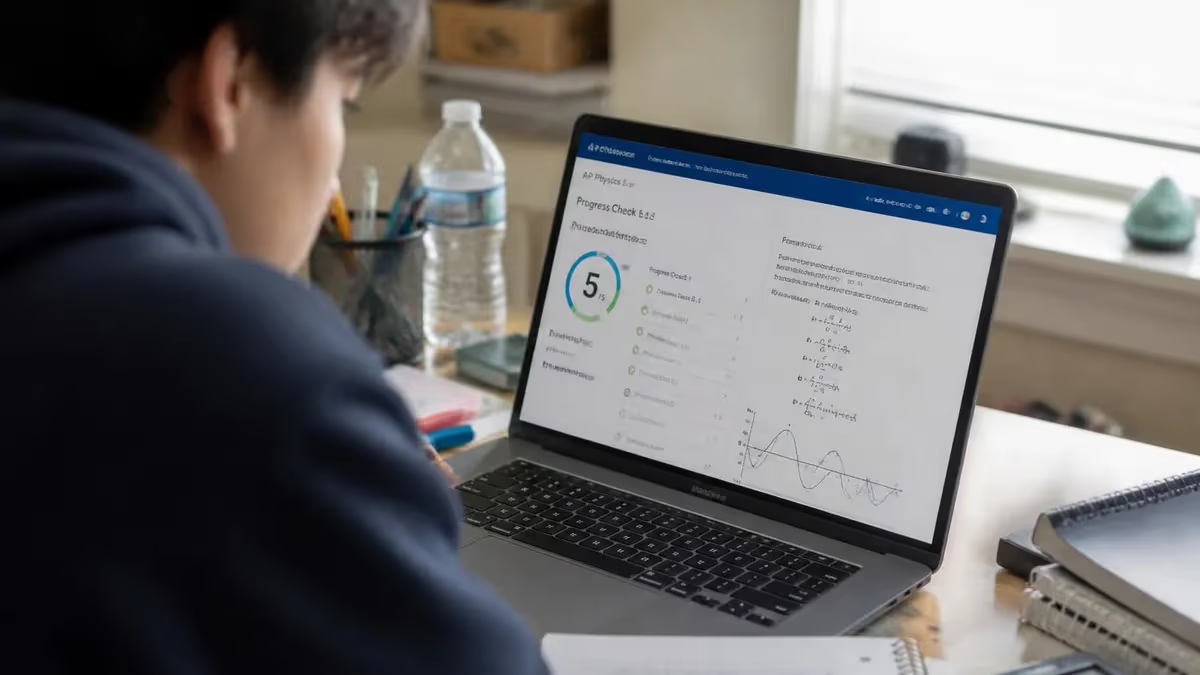
Understanding advanced placement requirements is the first step every student must take before signing up for one of the rigorous College Board examinations that can earn real college credit while still in high school. The AP program currently offers more than 38 courses across disciplines from calculus to art history, and knowing exactly who qualifies, when registration opens, and how the scoring system works gives serious test-takers a meaningful competitive edge. Whether you are scanning the ap top 25 most popular exams or exploring a niche subject, eligibility rules apply consistently across every course.
Each year, roughly 1.3 million students across the United States sit for AP exams, and the number continues to climb as more schools expand their advanced course offerings. The College Board does not impose a nationwide age cutoff or GPA threshold for exam participation, which surprises many families who assume only honor-roll students may register. Any student enrolled at a participating school — or even a homeschooled student who contacts their local AP coordinator — is technically eligible to attempt an exam, provided registration deadlines are met and the modest exam fee is paid on time.
The ap exam schedule is released by the College Board each fall, typically covering two full weeks in May. Exams are grouped so that popular subjects like Calculus AB, Biology, and U.S. History do not conflict with one another, though students taking multiple exams must plan carefully to avoid back-to-back marathon test days. The administration window is strict: if you miss your exam date without a documented late-testing accommodation, you forfeit your fee and receive no score for that sitting, so calendar management is a non-negotiable skill for AP candidates.
Scoring runs on a 1–5 scale, with a 3 historically considered the minimum passing threshold at most colleges, though competitive universities often require a 4 or 5 before awarding credit. Roughly 60 percent of all AP exams taken each year result in a score of 3 or higher, but individual exam pass rates vary dramatically. The ap poll top 25 hardest subjects, including AP Physics C: Mechanics and AP Chemistry, see pass rates closer to 50 percent, while AP Environmental Science and AP Psychology routinely post rates above 70 percent.
Preparation strategy differs significantly based on which exam you are targeting. A student preparing for a math-heavy exam such as AP Calculus should prioritize working through timed multiple-choice sets like the unit 2 progress check mcq part a ap calculus answers format to build both accuracy and pacing confidence. By contrast, a student focused on AP Biology benefits most from reviewing conceptual frameworks and then stress-testing them against lab-based free-response prompts before exam day arrives.
Beyond score requirements, many students wonder about the financial side of participation. The standard exam fee is $98 per exam for students at U.S. schools in 2025, with College Board subsidies reducing that cost to as low as $53 for students who qualify for the federal free or reduced-price lunch program. Some states, including Florida and Indiana, cover the entire exam cost for all public school students, so it pays to research your state's specific funding landscape before assuming you owe the full amount out of pocket.
This guide walks through every major eligibility dimension — who can take AP exams, when to register, how scores are calculated, what colleges accept, and how to structure a preparation timeline that gives you a realistic shot at earning that coveted 4 or 5. By the time you finish reading, you will have a clear, actionable roadmap for navigating the entire AP process from first enrollment to score reporting in July.
AP Exams by the Numbers

AP Exam Format Overview
| Section | Questions | Time | Weight | Notes |
|---|---|---|---|---|
| Section I – Multiple Choice | 60 | 90 min | 50% | Varies by subject; some exams use 40–70 MCQ |
| Section II – Free Response | 4 | 90 min | 50% | Essays, problems, or lab-based prompts |
| Late-Testing Window | 0 | Varies | N/A | Typically 2 weeks after standard exam window |
| Total | 100 | 3 hours | 100% |
One of the most common misconceptions about AP participation is that students must be enrolled in the corresponding AP course at their school to sit for the exam. While taking the class is strongly recommended — and most high schools require it as a condition of exam registration — the College Board itself imposes no such prerequisite at the national level.
A highly motivated self-studier can register for virtually any AP exam as a so-called "exam-only" candidate by working directly with their school's AP coordinator or, if they attend a school that offers no AP courses, by contacting a nearby school to serve as their testing site.
Homeschooled students represent a growing segment of AP test-takers and face slightly more logistical hurdles than their traditionally enrolled peers. By November 1st of each school year, homeschooled students must identify a local school willing to administer the exam on their behalf. That school's AP coordinator registers the student through College Board's online portal, and the student pays the exam fee plus any additional proctoring fee the host school charges. Most host schools are accommodating, but it is wise to begin this outreach process in September rather than waiting until the November deadline approaches.
International students studying in the United States on F-1 visas are fully eligible to take AP exams and may even have an incentive to do so: a strong AP score can substitute for language-proficiency requirements at some universities, and it demonstrates academic rigor to admissions committees evaluating transcripts from unfamiliar educational systems. International schools outside the United States that are authorized AP institutions also administer the exams, though those students follow a slightly different registration calendar and pay fees set in their local currency.
Students with documented disabilities may request accommodations through the College Board's Services for Students with Disabilities (SSD) program. Common accommodations include extended time (typically 50 or 100 percent additional time), large-print exam booklets, screen readers for computer-based sections, and permission to use a scribe. Accommodation requests must be submitted well in advance — the College Board recommends submitting by early November for May exams — and documentation from a licensed professional is required. Check the exam eligibility resource page for a complete list of qualifying conditions and approved accommodations.
The question of whether freshmen and sophomores can take AP exams is one that confuses many parents. Technically, there is no grade-level restriction. A ninth-grader who has mastered the material through independent study or an accelerated school program is welcome to register. In practice, most AP exam takers are juniors and seniors because the course sequencing at most high schools places prerequisite content in earlier grades. That said, high-achieving students occasionally take AP Computer Science Principles or AP Human Geography as early as eighth or ninth grade with excellent results.
Schools themselves have some latitude in setting internal eligibility rules. A principal may require a minimum grade in a prerequisite course, a teacher recommendation, or an aptitude test before allowing a student to enroll in an AP class. These school-level policies do not affect College Board registration — you can still register and pay for an exam even if your school has not formally enrolled you in the course — but navigating your school's internal policies early in the year prevents last-minute surprises and ensures you receive classroom preparation for the material you will be tested on.
Finally, there is no limit on the number of AP exams a single student can take in one year, and students may retake an exam in a subsequent year if they are dissatisfied with their initial score. The College Board records all scores unless a student submits a score-cancellation request, and many colleges ask applicants to self-report all AP scores on their application. Retaking an exam can demonstrate growth, but it can also draw attention to an initial low score, so weigh this decision carefully with your school counselor before registering for a second sitting.
AP Exam Schedule: Registration, Dates & Deadlines
AP exam registration opens in the fall, and most schools set an internal deadline in October or November. Students must register through their school's AP coordinator, who submits orders to the College Board via the AP Registration and Ordering system. The College Board's own ordering deadline for full-price registration typically falls in early November, after which late orders incur a $40 surcharge per exam — a meaningful penalty that rewards early planning.
After the ordering deadline, a brief late-registration window remains open through approximately mid-March for students who join a course late or decide last-minute to add an exam. During this window, coordinators can still place orders, but availability may be limited for certain exam sittings. Students should confirm their registration status with their coordinator by March 1st to ensure their exam order appears in the system before the final late window closes.

Is Taking AP Exams Worth It? Benefits and Drawbacks
- +Earn college credit and potentially skip introductory courses, saving tuition money
- +Demonstrates academic rigor to college admissions committees evaluating your transcript
- +Builds time-management and critical-thinking skills that transfer to college coursework
- +AP course grades can boost weighted GPA calculations at most high schools
- +A score of 3 or higher is accepted for credit at more than 4,000 U.S. colleges
- +Exposure to college-level material reduces the adjustment shock of freshman year
- −Exam fee of $98 per test adds up quickly for students taking five or more exams
- −Heavy workload from multiple AP courses can increase stress and burnout risk
- −Some elite universities require a 4 or 5 and may not accept a 3 for credit
- −Not all AP credits transfer to every major; engineering programs often disallow them
- −A low AP score that appears on self-reported applications can hurt admissions odds
- −Exam-only students without classroom preparation face a steep independent study curve
AP Exam Eligibility Checklist: Everything You Need to Register
- ✓Confirm your school offers AP exams or identify a nearby host school if you are homeschooled.
- ✓Create a free College Board account at collegeboard.org before your school's internal deadline.
- ✓Speak with your AP coordinator by October 1st to learn your school's specific registration process.
- ✓Submit your exam order and pay the $98 fee (or apply for a fee reduction) before the November deadline.
- ✓Request disability accommodations through the SSD program no later than early November for May exams.
- ✓Obtain any required teacher signatures or course enrollment forms your school mandates internally.
- ✓Download the official AP exam schedule and block all exam dates on your personal calendar immediately.
- ✓Register for late testing if you have a documented conflict with the standard exam date by March.
- ✓Designate a free score-send recipient college when you register to avoid paying an extra $15 later.
- ✓Review your registration confirmation email to verify that every exam you ordered appears correctly.

A Score of 3 Is Just the Beginning
While a 3 is technically passing at most schools, students targeting selective universities or STEM programs should aim for a 4 or 5 to ensure their AP credit is actually accepted. Always check your target college's AP credit policy — many post detailed equivalency charts online — before deciding which exams to prioritize.
The AP scoring system is elegant in its simplicity but nuanced in its real-world application. Each exam produces a composite raw score derived from the multiple-choice section and the free-response section, which are then combined using section-specific weights published by the College Board. That composite score is converted through a statistical process called equating to a final 1–5 scaled score, which ensures that a 4 on this year's AP Biology exam represents the same level of achievement as a 4 on last year's exam, even if one version was slightly harder than the other.
The free-response section deserves particular attention because many students underinvest in it during preparation, focusing almost exclusively on multiple-choice drills. Free-response graders follow detailed, publicly available scoring rubrics that allocate specific point values to each required element of an answer. A student who demonstrates correct reasoning but makes a single arithmetic error can still earn most of the available points if they show their work clearly and explain their methodology. This rubric structure rewards organized thinking as much as raw knowledge, which is why timed practice with actual released free-response prompts is so valuable.
College credit policies vary so widely across institutions that students should research each target school individually rather than relying on general rules of thumb. The American Council on Education (ACE) publishes recommendations for AP credit that most colleges follow as a baseline, but individual departments retain the right to set stricter standards.
A university's economics department may require a 4 to award credit for introductory macroeconomics, while the same school's biology department accepts a 3 for its equivalent intro course. These policies also change periodically, so always verify through the college's official registrar page rather than relying on year-old blog posts.
One dimension of AP scoring that students often overlook is the distinction between credit and placement. Even at schools that do not award academic credit for AP scores, a strong score can still allow a student to place out of a required course and move directly into a more advanced section. This placement benefit can be just as valuable as credit in practical terms, because it allows students to avoid sitting through material they already know and to reach upper-division courses — which tend to be smaller and more intellectually stimulating — earlier in their college career.
The ap pro x student model — the high achiever who maximizes both AP coursework and extracurricular involvement — is a common target profile for selective college admissions. Research consistently shows that admissions officers value the rigor of a student's course selection above raw GPA when evaluating transcripts.
A student who takes seven AP courses and earns mostly Bs is generally viewed more favorably than a student with a perfect GPA in all standard courses. This dynamic creates real pressure to load up on AP classes, but burnout risk is genuine, and overcommitting to exams you are not prepared to pass helps no one.
For students curious about which exams offer the best return on investment, tracking the ap top 25 most widely taken exams provides a useful benchmark. AP English Language and Composition, AP U.S. History, and AP Calculus AB consistently rank among the highest-volume exams and are accepted for credit at virtually every four-year institution in the country. By contrast, niche exams like AP Italian Language or AP Music Theory are accepted by fewer schools and may not align with every student's college or career trajectory, though they remain excellent intellectual pursuits in their own right.
Financial considerations extend beyond the initial exam fee. Students who earn a 5 on AP Calculus AB and then place out of two semesters of calculus at a private university charging $6,000 per course have effectively earned a $12,000 return on a $98 investment. Even public university students saving $1,500–$3,000 per skipped course see a compelling financial case for serious AP preparation. Framing AP exams as financial instruments — investments in future tuition savings — can be a powerful motivational reframe for students who otherwise view them as just another obligation piled onto an already busy schedule.
The College Board's standard AP exam ordering deadline typically falls in early November, with late registrations incurring a $40 per-exam surcharge through mid-March. Missing both deadlines entirely means you cannot sit for the exam that year. Contact your AP coordinator before October 15th to confirm your school's internal cutoff, which is almost always earlier than the College Board's national deadline.
Building an effective AP study plan requires understanding how each exam is structured and weighting your preparation time accordingly. Students who approach exam prep as a single undifferentiated block of studying — reading notes, highlighting textbooks, reviewing flashcards — consistently underperform compared to students who use deliberate, spaced-repetition practice with timed, exam-authentic question sets. The College Board publishes free released exams for most subjects on its AP Students website, and these authentic materials should serve as the cornerstone of your preparation, not a last-minute supplement.
Time allocation is one of the most consequential decisions a serious AP student makes. A general rule of thumb used by experienced AP teachers is the 60-30-10 framework: spend roughly 60 percent of your study time on active practice with timed questions, 30 percent on targeted review of specific weaknesses identified through that practice, and 10 percent on organizational tasks like building concept maps, reviewing rubrics, and planning your exam-week schedule. This allocation prioritizes the activity that most closely mirrors what you will do on exam day and ensures that review effort is focused rather than diffuse.
For science exams like AP Chemistry and AP Biology, lab-based free-response questions represent a consistent source of difficulty for students who have not internalized experimental design vocabulary. Knowing how to identify an independent variable, articulate a control condition, and propose a valid hypothesis in writing — under time pressure — is a skill that requires specific practice beyond content mastery. The ap exam dates for science subjects typically fall in the first week of the May window, so students should complete their lab-question practice at least three weeks before their exam date to allow time for final review.
Mathematics AP exams present a distinct challenge: calculator policy. AP Calculus AB and BC divide their multiple-choice sections into calculator and non-calculator portions, and many students are shocked to discover how much their performance drops when forced to work without a graphing calculator. The non-calculator section of AP Calculus AB asks students to evaluate derivatives, compute integrals, and reason about limits using purely mental arithmetic and algebraic manipulation. Consistent practice on non-calculator problem sets, starting in January of the exam year, is essential to building the fluency needed to perform well under those constraints.
English AP exams — both Language and Composition and Literature and Composition — test a student's ability to construct sophisticated analytical arguments under time pressure. The synthesis essay, unique to AP Language, asks students to read six to seven source documents and weave evidence from at least three of them into a coherent argumentative essay written in approximately 40 minutes.
Students who practice synthesis writing weekly in the months leading up to the exam develop a natural fluency with the format, while students who encounter it for the first time on exam day often struggle with source integration and time management simultaneously.
Group study can be a powerful accelerator when structured correctly. The most effective AP study groups dedicate each session to a specific topic, assign each member a subsection to teach to the group, and then close with a timed practice set completed individually and scored collaboratively. This teach-back method leverages the well-documented learning principle that explaining a concept to someone else deepens your own retention far more than passive re-reading. Many AP teachers actively encourage students to form study groups in January and February, well before the final exam crunch intensifies in late April.
Finally, managing exam-week logistics is a skill in its own right. Students taking multiple AP exams should plan meals, sleep schedules, and commute times with the same rigor they bring to content preparation. The College Board allows students to bring snacks for breaks between morning and afternoon sessions on the same day, and staying hydrated has a measurable impact on working memory performance. Review the ap exam schedule 2025 early so you can build a personalized exam-week calendar that accounts for test days, recovery time, and any school obligations that overlap with the exam window.
The weeks immediately before your AP exams are best spent consolidating knowledge rather than learning entirely new material. Neurologically, spaced repetition works because reviewing information at increasing intervals forces the brain to reconstruct memories each time they are accessed, strengthening the neural pathways associated with that knowledge. In practical terms, this means that reviewing your flashcards or practice problem sets every two to three days in the final month before the exam is more effective than massing all your review into a single marathon session the weekend before test day.
Sleep is perhaps the most undervalued performance lever for AP students. Research published in peer-reviewed sleep science journals consistently shows that the brain consolidates factual memories and procedural skills during the slow-wave sleep stages that dominate the first half of a night's sleep, while emotional regulation and creative problem-solving rely on REM sleep concentrated in the second half. Pulling all-nighters in the days leading up to an AP exam sacrifices both of these consolidation windows and leaves students operating on degraded working memory capacity precisely when they need it most.
The morning of your exam, a high-protein breakfast with moderate complex carbohydrates — eggs and whole-grain toast, for example — sustains blood glucose levels more steadily than a sugary cereal or pastry that produces a sharp spike and subsequent crash. Arrive at the testing room at least 20 minutes before the scheduled start time.
Bring two sharpened No. 2 pencils, black or dark-blue ink pens for free-response sections, your school-issued photo ID, and any approved calculator for math or science exams. The College Board maintains a strict prohibited items list; smart watches including the ap watch models with connectivity features are categorically banned from testing rooms, regardless of whether they display exam-relevant information.
During the multiple-choice section, time management is the primary tactical challenge. On a 45-question, 60-minute section, you have exactly 80 seconds per question on average. Experienced AP test-takers recommend working through the section once at a brisk pace, marking any question that requires more than 60 seconds of deliberation for review, and then returning to flagged questions with remaining time. This approach ensures you capture all the easy points before investing time in harder problems and prevents the nightmare scenario of running out of time before reaching questions you could have answered quickly.
Free-response strategy differs by subject but shares a universal principle: read the entire prompt before writing a single word. AP free-response prompts frequently contain multiple parts — often labeled (a), (b), (c), (d) — and the parts build on each other.
Reading ahead allows you to plan how your answer to part (a) will set up your answer to parts (b) and (c), avoiding the costly mistake of writing yourself into a logical corner. For essay-based exams, spending two to three minutes outlining your thesis and three supporting points before writing is time well invested, as it produces more coherent and higher-scoring essays than diving immediately into the body paragraphs.
After the exam, resist the urge to obsessively research answer keys or discuss questions with classmates. AP exam questions are confidential, and the College Board prohibits students from sharing specific question content publicly. More practically, post-exam rumination about questions you may have gotten wrong serves no productive purpose and can unnecessarily elevate anxiety in the days between the exam and score release. Instead, take a genuine mental break, revisit your other AP preparation if exams remain on your schedule, and trust the preparation you have invested over the course of the year.
When scores are released in July, take time to reflect analytically on your performance regardless of the outcome. A score report that includes subscores by topic area — available for many AP exams — reveals exactly which content domains were strongest and weakest.
This granular feedback is valuable for two purposes: it helps students who plan to retake the exam focus their preparation more precisely, and it helps incoming college freshmen anticipate which areas of a college course they may need to reinforce even if they earned credit for the course through AP. Treating your AP score report as a diagnostic tool rather than merely a pass-or-fail verdict extracts maximum value from the entire AP experience.
AP Questions and Answers


About the Author

Educational Psychologist & Academic Test Preparation Expert
Columbia University Teachers CollegeDr. Lisa Patel holds a Doctorate in Education from Columbia University Teachers College and has spent 17 years researching standardized test design and academic assessment. She has developed preparation programs for SAT, ACT, GRE, LSAT, UCAT, and numerous professional licensing exams, helping students of all backgrounds achieve their target scores.
Join the Discussion
Connect with other students preparing for this exam. Share tips, ask questions, and get advice from people who have been there.
View discussion (3 replies)