
FAA-Approved Aviation Maintenance Technician Schools: 14 CFR Part 147 Guide
Complete guide to FAA-approved aviation maintenance technician schools under 14 CFR Part 147. Top programs, tuition, GI Bill, military path, and ✏️
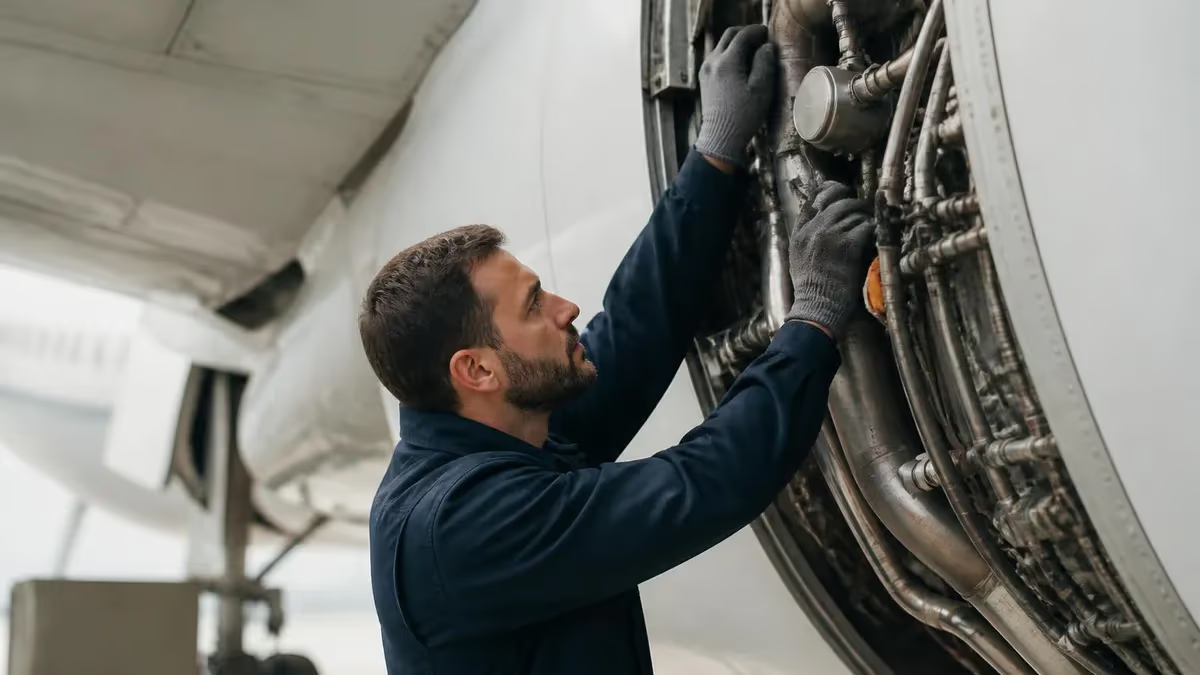
Picking the right school is half the battle when you want a career fixing aircraft. An FAA-approved aviation maintenance technician school isn't just a campus with hangars and toolboxes — it's a program certificated under 14 CFR Part 147, which means the FAA has reviewed the curriculum, facilities, instructors, and equipment, then signed off that graduates can sit the General, Airframe, and Powerplant exams.
You'll see roughly 170 Part 147 schools spread across the country, from community colleges charging $8,000 a year to private institutes north of $50,000. The differences? Class size, lab time on real turbine engines, job-placement support, and how quickly you actually finish.
This guide walks through what the regulation requires, where to find the official school directory, the curriculum you'll grind through, what tuition looks like in 2026, and how the GI Bill, Pell Grants, and employer tuition-reimbursement programs can chop the bill in half. If you'd rather skip school entirely and use military experience, we cover that route too. Want to test what you already know? Run the AMT FAA regulations and publications practice test first.
FAA-Approved AMT Schools at a Glance

What 14 CFR Part 147 Actually Requires
Part 147 is the slice of federal regulation that governs aviation maintenance technician schools. It sets minimums for everything: classroom hours, shop equipment, instructor ratios, and the subjects you must touch before graduation. A school that loses its Part 147 certificate can't sign off your training time — which means you can't take the FAA written, oral, or practical tests through that program. So yes, the magic words "FAA-approved" matter.
The regulation breaks training into three certificates:
- General (400 hours minimum) — basic electricity, drawings, weight and balance, fluid lines, materials, cleaning, math, physics, FAR familiarity
- Airframe (750 hours minimum) — structures, sheet metal, composites, hydraulics, landing gear, fuel systems, ice/rain control, fire protection
- Powerplant (750 hours minimum) — reciprocating and turbine engines, ignition, fuel metering, propellers, lubrication, engine inspection
Most schools run a combined A&P program (Airframe + Powerplant) hitting roughly 1,900 hours total, though some stretch to 2,000+ to add depth. Don't get scared by the hour count — it's a floor, not a ceiling. Programs typically span 18 to 24 months of full-time study, or up to 3 years part-time.
Once you graduate, the FAA waives the experience requirement (otherwise it's 30 months of documented work) and you can sit straight for the written, oral, and practical exams. Check the FAA regulations practice quiz before you start — you'll see Part 147 references everywhere on the General exam.
FAA Part 147 School Directory
The FAA publishes a current list at faa.gov. Search for "Part 147 aviation maintenance technician schools" or pull the directory directly from the Flight Standards District Office (FSDO) page. The list shows certificate number, school address, ratings held (G, A, P), and the FSDO that has oversight. Always verify a school's status before you pay tuition — certificates do get suspended or revoked, and a school can advertise the rating it held last year while quietly operating under provisional terms today.
Top FAA-Approved AMT Schools in 2026
Reputation matters because airlines and MRO shops recruit directly from a handful of programs they trust. Here's where name-brand recruiters spend their time:
Pittsburgh Institute of Aeronautics (PIA)
One of the oldest Part 147 schools in the country (certificated 1929), PIA runs campuses in Pittsburgh, Hagerstown MD, and Youngstown OH. Class sizes hover around 18 students. Recruiters from American, FedEx, and PSA fly in monthly. Program runs 16 months, tuition around $34,000 all-in.
Spartan College of Aeronautics and Technology
Tulsa-based, with a second campus in LA. Spartan adds avionics and quality control electives on top of the standard A&P. Cost is steeper (~$48,000) but the program length is just 14 months for full-time tracks.
Embry-Riddle Aeronautical University
The university-style option. You earn an associate or bachelor's degree alongside your A&P. Daytona Beach campus runs full Part 147 plus general-ed classes — ideal if you want to climb into engineering or management later. Higher cost (~$40K/year) but unmatched alumni network.
Tulsa Technology Center
A career-tech high school program that also enrolls adults. Tuition is unreal cheap (~$8,000 for the entire 21-month A&P) because it's publicly funded. Hard to beat on price, though job-placement support is lighter than at private programs.
San Bernardino Valley College
A California community-college program with the same publicly-subsidized tuition advantage. About $1,400 per year in fees for California residents. Two-year track ends with an associate degree plus A&P eligibility. Heavy emphasis on airframe due to proximity to SoCal MRO shops. Practice the airframe structures questions before clinicals.
How AMT School Curriculum Is Structured
Math, physics, basic electricity, aircraft drawings, weight and balance, materials and processes, ground operation and servicing, cleaning and corrosion control, and FAR Parts 1, 21, 39, 43, 65, 91, and 147. Sets the foundation every aviation mechanic needs before moving into airframe or powerplant specialty work.
Sheet metal repair, composite bonding, hydraulics, pneumatic systems, fuel systems, ice and rain protection, landing gear, fire protection, cabin atmosphere, and assembly and rigging. Heavy lab time bending metal, patching skins, riveting structures, and pressure-testing hydraulic mock-ups on training airframes.
Reciprocating engines, turbine engines, propellers, ignition and starting systems, fuel metering, fuel systems, lubrication, induction and exhaust, cooling, engine instrument systems, fire protection, and inspection. Tear-down and reassembly on real Lycoming, Continental, PT6, and JT8D training engines.
Three written exams (General, Airframe, Powerplant), an oral interview conducted by a Designated Mechanic Examiner, and three practical projects performed on real aircraft hardware. Pass all of them and you walk away holding a permanent FAA A&P certificate with no expiration date.
Online vs In-Person: What the FAA Actually Allows
Here's the rule nobody tells you upfront: Part 147 requires hands-on lab work. Period. You cannot earn a full A&P certificate by sitting in your kitchen watching videos. The FAA mandates physical contact with sheet metal, engines, hydraulic mock-ups, and electrical systems. So when a program advertises "online AMT school," what they really mean is a hybrid setup — the General phase classroom theory happens online, then Airframe and Powerplant labs require campus attendance.
That said, hybrid programs are growing. Aviation Institute of Maintenance (AIM), Vincennes University, and Liberty University all run partial-online tracks. You'll save commute time and gas during Phase 1, then move to campus for the messy stuff in Phase 2-3. Total time on-site usually compresses to 12-15 months instead of 18-24. A few programs also use simulators during virtual labs — you'll log a turbine engine teardown in software, then prove competence on the real PT6 once you reach campus. It's not a replacement, but it does shorten the on-site portion meaningfully.
Two warnings:
- Watch the residency clause — some programs require you to be physically present for at least 51% of curriculum hours. Confirm before enrolling.
- FSDO sign-off still happens in person — the oral and practical exams are conducted live with a Designated Mechanic Examiner (DME). No video calls.
Bottom line: online is a starter, not a finisher. Plan on relocating or commuting once labs kick in. If you can't do that, consider the military or 30-month documented work-experience route instead.
Program Format Options Compared
Schedule: 18–24 months, Monday through Friday, around 30 hours per week of classroom plus lab time. Best for: career-changers and recent high-school graduates with no current job. Cost trade-off: highest opportunity cost since you cannot work much, but the fastest path to your certificate. Most VA students choose this format because the GI Bill housing allowance offsets lost wages. Schools start cohorts every 6–10 weeks, so you rarely wait long to begin.
Tuition Ranges and How to Pay for It
Cost varies wildly. A community-college Part 147 program runs $6,000–$15,000 total. A private institute like Spartan or Aviation Institute of Maintenance hits $35,000–$50,000. Embry-Riddle is the outlier at $40K+ per year because you're paying for the degree wrapper.
Funding sources that actually move the needle:
- GI Bill (Chapter 33) — covers full tuition at public schools, capped at $27,120/year for private. Yellow Ribbon schools (Spartan, Embry-Riddle) fill the gap. Veterans get monthly housing allowance on top.
- Pell Grant — up to $7,395 per year for eligible students. Doesn't have to be repaid.
- Workforce Innovation and Opportunity Act (WIOA) — if you're laid off or underemployed, your state may pay for your A&P. Talk to your local American Job Center.
- Employer tuition reimbursement — Delta TechOps, FedEx, AAR, StandardAero, and AAR all run apprenticeship-style programs where they cover part of tuition in exchange for a 2–3 year employment commitment.
- Aviation Maintenance Workforce Grant — Congress funded $5M annually under the AAIM Act; schools redistribute as scholarships. Apply directly to the school.
Don't take federal student loans without checking these first. The grant + employer path can knock $20,000 off the sticker price without putting you in debt. Combine WIOA + Pell + an employer apprenticeship and you can finish your A&P for under $5,000 out of pocket. Get ready for the powerplant theory exam while the paperwork moves.
Watch out for two billing tricks. First, some private schools quote tuition only — books, lab kits, FAA testing fees, lodging, and uniforms can add $3,000–$6,000 on top. Always demand a full cost of attendance sheet before signing anything. Second, some programs use income-share agreements (ISAs) that look cheap upfront and then claim a chunk of your first three years of paychecks. Run the math: a 10% ISA on a $65,000 salary for three years equals $19,500. That's more than most private school tuition. Federal loans plus grants are almost always cheaper than ISAs, even if the marketing suggests otherwise.
Some schools advertise Part 147 status while operating under FAA probation. Others let their certificate lapse and never tell prospective students. Always pull the current FAA directory before you wire tuition. Ask the school for its Air Agency Certificate number and verify it on faa.gov. If they hesitate or send you a screenshot instead of a link, walk away.
How to Compare Schools Side-by-Side
Once you've got three or four programs on your shortlist, line them up against the same checklist. Brochures hide weak spots, so demand specifics on each item below. If a school can't give you straight answers, that's your answer.
Visit campus if you can. Walk the labs. Count the engines. Ask current students two simple questions: “Are instructors actually here?” and “Where did last year's grads go?” Recruiters who haven't visited in five years should make you nervous. Programs with 80%+ first-time written-exam pass rates and 90%+ employment within six months are doing something right.
One more thing nobody mentions: FSDO oversight quality varies. A school under a strict FSDO will run tighter exams and produce stronger mechanics. A loose FSDO produces mechanics who struggle on the FAA practical when they show up at another shop. Ask the school which FSDO oversees them and Google that office's reputation. If it has a backlog of overdue inspections, consider that a yellow flag. Your goal isn't just to pass the test — it's to actually be the kind of tech an airline will hire and keep. The good schools know the difference, and the bad ones don't.
Also ask about the school's retest policy. The FAA written, oral, and practical each have a 30-day mandatory wait after a failure. Good schools build in extra prep time before scheduling you with a Designated Mechanic Examiner, because a fail looks bad on their pass-rate metrics too.
Weak schools push students through too early and watch first-time pass rates suffer. Look for programs that openly publish pass rates and don't hide bad years. Transparency on numbers tells you a lot about how a school will treat you when you actually need help during the powerplant teardown that isn't going your way.
School Comparison Checklist
- ✓Air Agency Certificate number verified directly on faa.gov today, not last year — certificates do get suspended or revoked
- ✓Current Part 147 ratings held: General, Airframe, and Powerplant — confirm all three if you want full A&P eligibility
- ✓First-time FAA written exam pass rate published by the school — look for programs hitting 80 percent or higher consistently
- ✓Employment placement rate within 6 months of graduation, with names of recent employers, not vague percentages
- ✓Class size and student-to-instructor ratio — under 20 students per instructor is healthy, over 30 is a warning sign
- ✓Real-engine lab inventory including turbines (PT6, JT8D), reciprocating engines (Lycoming, Continental), props, and hydraulic mock-ups
- ✓Yellow Ribbon GI Bill participation if you are a veteran — fills the gap above the federal private-school cap
- ✓Total cost of attendance, not just tuition — include books, lab kits, FAA testing fees, lodging, uniforms, and tools
- ✓Length of program in months and frequency of new-cohort start dates, so you know when you can actually begin
- ✓Active recruiting relationships with airlines, MROs (AAR, StandardAero, Delta TechOps), or military contractors

Military Experience as an Alternative Path
If you served as an aircraft mechanic in the Air Force, Navy, Marines, Coast Guard, or Army, you may skip Part 147 school entirely. Under FAR 65.77, the FAA accepts documented military maintenance experience in lieu of school time. You'll need:
- At least 18 months of practical experience in airframe (for the A rating) or powerplant (for the P rating), or 30 months for both
- A signed JST (Joint Services Transcript) documenting your AFSC/MOS/NEC and time in maintenance
- An FAA Form 8610-2 recommending you for testing, signed by your commanding officer or a designated representative
- Authorization letter from your service branch confirming the work qualifies under 65.77
The bigger hurdle is the writtens. Military training covers the airframes you actually worked on — not necessarily the general-aviation platforms the FAA tests on. Most veterans grab a 4–6 week test-prep course (Tulsa Tech, AMTS Aerospace, and ABRTC all run these) before sitting the General, Airframe, and Powerplant writtens. That bridge program costs $2,000–$5,000 and is fully covered by the GI Bill.
The advantage is huge: you're working as a mechanic with an A&P 6–8 weeks after separation, instead of spending two years in a classroom you don't need. Don't sleep on this path if your DD214 supports it.
Part 147 School vs Military / Experience Path
- +Structured curriculum guarantees you cover every FAA subject
- +Hands-on lab time on multiple aircraft types you'd never see in field work
- +Career services and direct airline recruiter access
- +GI Bill, Pell, and state grants make many programs nearly free
- +Graduation waives the 30-month experience requirement
- −Costs $8K–$50K and consumes 18–24 months full-time
- −Less flexibility than the work-and-test pathway under 65.77
- −Some schools have outdated lab equipment vs current fleet
- −Heavy theory load on platforms you may never touch professionally
- −FSDO oversight quality is inconsistent across regions
Pros and Cons at a Glance
| Pros | Cons |
|---|---|
| Structured curriculum guarantees you cover every FAA subject | Some schools have outdated lab equipment vs current fleet |
| Hands-on lab time on multiple aircraft types you'd never see in field work | Heavy theory load on platforms you may never touch professionally |
| Career services and direct airline recruiter access | FSDO oversight quality is inconsistent across regions |
Putting It All Together: Your Next 90 Days
If you're serious about becoming an A&P, here's what the next three months should look like. Week 1–2: pull the current Part 147 directory from faa.gov and write down every school within 200 miles plus the top five national programs. Week 3–4: request info packets from your top eight. Compare tuition, length, start dates, and certificate ratings.
Month 2: visit two campuses in person. Sit in on a class. Talk to current students at lunch — not the ones the admissions office picks for you. Walk the engine lab and count active turbines. Month 3: file your FAFSA, apply for the Aviation Maintenance Workforce Grant, talk to your VA rep if you're a veteran, and submit applications to your top two schools.
Once you're accepted, start studying the General phase material before classes begin. The students who breeze through Phase 1 are the ones who walked in already knowing basic electricity and weight-and-balance math. Free practice questions are everywhere — use them. Twelve months from your first day of class, you can be sitting for the FAA writtens. Twenty-four months from today, you can be signing off your first 100-hour inspection. That's a faster ROI than almost any other skilled trade in America.
One subtle move that helps: contact your target school's career services office before you enroll, not after you graduate. Ask which airlines and MROs they have signed recruitment agreements with. Some schools funnel graduates straight into Delta TechOps, AAR, FedEx, or American Airlines. Others have weaker pipelines. The recruiters will sometimes pre-screen you while you're still in school and reserve a job offer for the day you pass your writtens. That's the kind of edge you only get by asking. Don't wait until your last semester to start that conversation — by then, the prime slots are already filled.
Final Thoughts on Picking Your AMT School
The decision boils down to three honest questions: How fast do I need to graduate? How much can I spend? Where do I want to work after? Answer those and the right school usually picks itself. Community-college programs win on price. Pittsburgh Institute of Aeronautics and Spartan win on industry network. Embry-Riddle wins if you want a degree and a long-term path into management. Hybrid online wins if you can't relocate for Phase 1. Military experience wins if your DD214 supports 65.77 alone.
Whatever you pick, verify the Air Agency Certificate today, not last year. Ask hard questions about FAA pass rates and graduate placement. Use Pell, GI Bill, WIOA, and employer reimbursement before you take a single dollar in private student debt. And start studying General-phase material now — before you've even paid your deposit. The mechanics who land six-figure jobs at major airlines five years after graduation are the ones who treated school as a stepping stone, not a finish line. Get going.
One last reminder: this industry rewards curiosity. Mechanics who keep reading FAA airworthiness directives, who collect inspection authorization endorsements, and who chase additional ratings like inspection authorization or repairman certificates outearn peers by 20% within a decade. Pick a school that sets the foundation, then keep building. Your A&P is the start of a 30-year career, not the end.
Sample Aviation Maintenance Technician Practice Questions
Try these questions from our free Aviation Maintenance Technician practice tests. The correct answer and an explanation follow each question.
Which part of the CFR covers the certification of aviation maintenance technician schools?
- A. 14 CFR Part 65
- B. 14 CFR Part 147
- C. 14 CFR Part 43
- D. 14 CFR Part 21
Answer: B. 14 CFR Part 147
14 CFR Part 147 establishes the requirements for certification and operation of Aviation Maintenance Technician Schools (AMTS).
What regulation governs the content requirements for maintenance record entries made after performing maintenance, preventive maintenance, rebuilding, or alteration?
- A. 14 CFR 43.9
- B. 14 CFR 65.95
- C. 14 CFR 91.409
- D. 14 CFR 145.219
Answer: A. 14 CFR 43.9
14 CFR 43.9 specifies the content requirements for maintenance record entries, including description of work, date, aircraft total time, and the certificate number and signature of the approving person.
Under 14 CFR Part 43, which maintenance record entry is required after an annual inspection?
- A. Date, signature, certificate number, and a statement of airworthiness or return to service
- B. Only the date and inspector's name
- C. A list of all discrepancies found during inspection
- D. The aircraft total time and signature only
Answer: A. Date, signature, certificate number, and a statement of airworthiness or return to service
Part 43.11 requires the date, signature, certificate number, and a signed statement that the aircraft is airworthy or a list of defects preventing airworthiness.
According to 14 CFR Part 43.9, which of the following is required to be included in a maintenance record entry after performing a repair?
- A. The total time-in-service of the airframe.
- B. The signature, certificate number, and kind of certificate held by the person approving the work.
- C. The part numbers of all components that were replaced.
- D. The date the next required inspection is due.
Answer: B. The signature, certificate number, and kind of certificate held by the person approving the work.
14 CFR 43.9 explicitly requires that a maintenance record entry contain: a description of the work, the date of completion, and if the work was performed satisfactorily, the signature, certificate number, and kind of certificate held by the person approving the work for return to service. Total time-in-service is required for inspection entries under 43.11, not general maintenance entries under 43.9.
AMT Questions and Answers
About the Author

Commercial Pilot & FAA Certification Specialist
Embry-Riddle Aeronautical UniversityCaptain Jennifer Walsh graduated with honors in Aerospace Engineering from Embry-Riddle Aeronautical University and holds FAA Airframe & Powerplant and Airline Transport Pilot certificates. With 11 years of commercial aviation experience and 6 years as a ground school instructor, she guides aviation mechanics and student pilots through FAA written exams and practical tests.
Join the Discussion
Connect with other students preparing for this exam. Share tips, ask questions, and get advice from people who have been there.
View discussion (9 replies)