
Aviation Maintenance Technician: A&P Mechanic Career Guide 2026 October
Aviation maintenance technician career guide. 🎯 FAA A&P certification, schools, 3 exams, salary $55-$95k, IA credential, prep timeline.
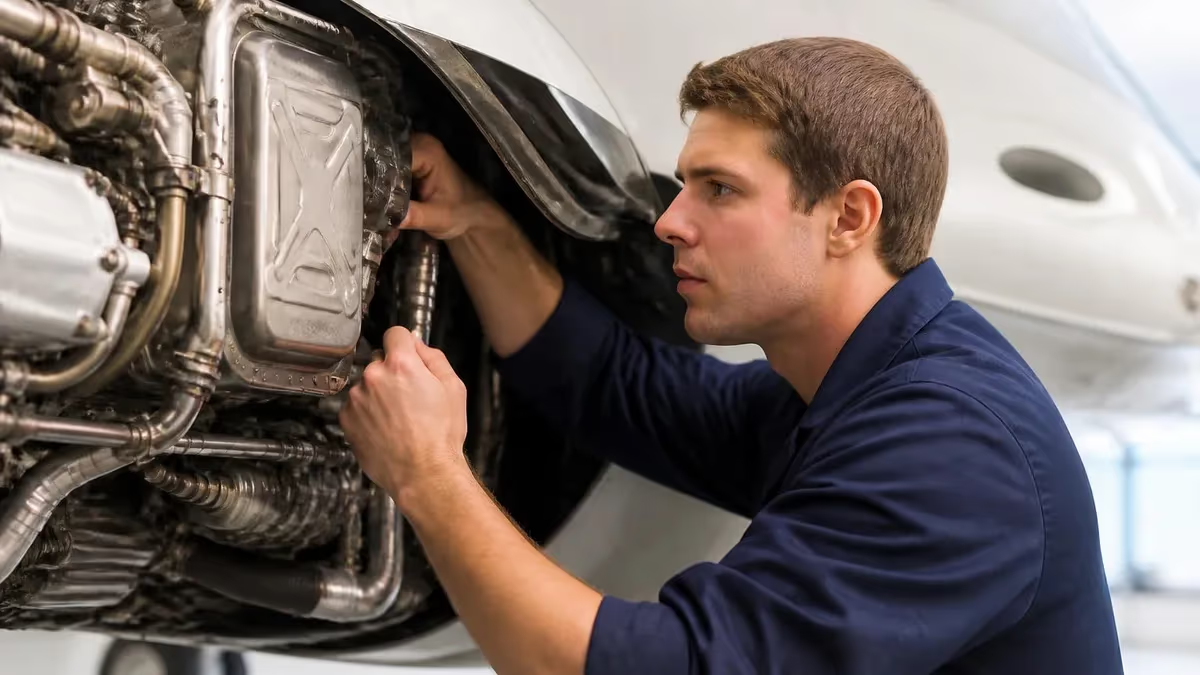
The path to becoming a certified aviation maintenance technician is one of the most respected technical careers in the United States, blending hands-on mechanical work with the precision demanded by federal aviation safety standards. Often called an A&P mechanic, short for Airframe and Powerplant, this professional holds the federal authorization to inspect, maintain, repair, and approve aircraft for return to service. Without certified AMTs, no commercial flight leaves the ground.
The Federal Aviation Administration regulates the credential through Title 14 of the Code of Federal Regulations, Part 65. The requirements are strict, the testing is layered, and the responsibility is enormous. But for technically minded people who want a stable, well-paid career without the cost of a four-year degree, the AMT route is hard to beat. You can earn your wings, so to speak, in about two years, and the demand has rarely been higher.
This guide walks through every checkpoint on the road to certification: eligibility paths, the three FAA knowledge tests, oral and practical exams, costs, study timelines, salary expectations, and the advanced credentials that follow. Whether you are just researching the field or already enrolled at a Part 147 school, you will find the framework you need to plan the next twelve to twenty-four months with confidence.
Aviation Maintenance Technician at a Glance

So what does the day actually look like? AMTs split their time between scheduled inspections, troubleshooting unexpected problems, and the relentless paperwork that proves every action complies with FAA standards. A morning might begin with a routine A-check on a regional jet, then shift to chasing an intermittent hydraulic warning, and finish with logbook entries that will outlive the technician's career. The work is methodical, the standards are non-negotiable, and the satisfaction of signing off an airworthy aircraft is real.
What the AMT Credential Actually Authorizes
A certified AMT holding both Airframe and Powerplant ratings has federal authority under 14 CFR Part 65 to inspect, maintain, repair, and approve aircraft for return to service. No commercial flight in U.S. airspace is legal without certified mechanics behind the signatures in the logbook. The certificate does not expire, but FAA recency rules require six months of mechanic work in the trailing 24 months to keep return-to-service privileges active.
Why Aviation Maintenance Technician is a High-Demand Career
Boeing's most recent Pilot and Technician Outlook projects that the global aviation industry will need roughly 716,000 new maintenance technicians over the next two decades. In North America alone, the shortfall is measured in tens of thousands. Airlines have been signing bonuses, regional carriers offer tuition reimbursement, and corporate flight departments compete fiercely for experienced talent. The Bureau of Labor Statistics consistently ranks the role in its higher-than-average growth bucket, well above the national average for skilled trades.
Three forces drive the demand. First, the existing workforce is aging — a large percentage of certified mechanics are within a decade of retirement, and replacement training takes years. Second, global air travel has rebounded past pre-pandemic levels, and every new aircraft entering service needs a maintenance team behind it. Third, the rise of regional jets, business aviation, and emerging electric vertical takeoff platforms keeps adding new aircraft types that all require certified hands.
For someone weighing trade school against a four-year college, the math is friendly. A&P programs run roughly 18 to 24 months. Tuition at community-college-affiliated Part 147 schools often falls under $25,000, and many states subsidize the program through workforce development grants. Within five years of certification, working AMTs commonly earn between $70,000 and $90,000 — figures that compare favorably to many bachelor's-degree careers, especially when you factor in the absence of student debt.
The Three Routes to FAA Eligibility
An FAA-approved Aviation Maintenance Technician School delivers roughly 1,900 hours of structured curriculum across general, airframe, and powerplant subjects. Programs run 18 to 24 months. They integrate the hands-on tasks the practical exam will test and graduate students directly eligible for all three written exams. Community-college-affiliated schools typically charge $15,000 to $25,000, with some state workforce-development grants reducing the net cost further. Federal financial aid is widely available because Part 147 schools are accredited postsecondary institutions.
Active and prior-service military aviation maintainers — Air Force crew chiefs, Navy aviation structural mechanics, Marine Corps avionics technicians, Army helicopter mechanics — can present documented experience to a Flight Standards District Office to establish eligibility. The military-to-FAA bridge is well established. Most veterans with two or more years of aircraft maintenance time qualify directly for the written exams. GI Bill benefits will also fund a Part 147 program if the veteran prefers the structured classroom route as a transition tool.
Civilian technicians who have spent at least 30 months performing maintenance work under the supervision of a certified mechanic at a Part 145 repair station, an air carrier, or a general aviation shop can present documented experience to qualify. This is the slowest path but the most flexible for working adults. The supervisor must sign off on documented hours covering both airframe and powerplant tasks. Many shops formalize the apprentice arrangement so the technician earns wages throughout the qualifying period.
The FAA Part 65 Framework Explained
Federal Aviation Regulations Part 65 governs every certified airman who is not a pilot, and Subpart D specifically covers mechanics. The regulation defines who may apply, what they must demonstrate, and how the credential is maintained. The current version recognizes two ratings — Airframe and Powerplant — and the vast majority of working mechanics hold both, which is why the combined credential is universally called the A&P.
Holding the Airframe rating alone permits work on the aircraft structure, control systems, landing gear, and most aircraft systems excluding the engine. The Powerplant rating covers the engine itself, propellers, and engine-mounted accessories. Possessing only one rating limits the work you can sign off, which is why nearly every Part 147 school structures its curriculum to qualify students for both ratings simultaneously. Holding both opens the full scope of return-to-service authority.
Part 65 also defines the eligibility doors you must walk through before testing, the testing format itself, and the continuing experience required to keep your privileges active. A certificate does not expire, but to actually exercise the privileges you must perform at least six months of mechanic work in the previous 24 months, or pass a refresher exam administered by the FAA. This recency requirement keeps the credential active for working professionals while protecting against rusty skills.

The Three FAA Exams Plus the Oral and Practical
Two hours, 60 questions, 70 percent to pass. Covers basic electricity, weight and balance, ground operations, materials and processes, FAA regulations, and forms and records. Must be passed before testing Airframe or Powerplant. Approximately $175 at PSI testing centers. Most candidates find this the easiest of the three writtens because much of the material overlaps with foundational shop knowledge.
The Three Routes to Eligibility
Before you can sit for the FAA knowledge exams, you must establish eligibility under one of three federally recognized paths. The route you choose shapes everything that follows — timeline, cost, study load, and the quality of hands-on experience you carry into the practical exam.
The General written exam must be passed before you can sit for the Airframe or Powerplant. Test General first, confirm your study method works, then schedule the other two with confidence. The oral and practical can only be taken after all three writtens are complete and your eligibility paperwork has been verified by a Flight Standards District Office. Skipping the verification step is the most common scheduling delay candidates face.
The Three FAA Exams: Knowledge, Oral, and Practical
The certification itself is split into three knowledge tests followed by an oral and practical examination conducted by a Designated Mechanic Examiner. The order is fixed: you must pass the General written test before you can take Airframe or Powerplant, because the General covers the foundational regulations and procedures every certified mechanic relies on. Each written exam runs two hours and contains roughly 60 multiple-choice questions drawn from the FAA's published Airman Knowledge Testing Supplement.
The General test covers basic electricity, weight and balance, ground operations, materials and processes, FAA regulations, and forms and records. The Airframe test goes deeper into structures, sheet metal, hydraulics, environmental systems, instruments, communications, and inspection procedures. The Powerplant test covers reciprocating and turbine engines, induction systems, fuel metering, ignition, lubrication, exhaust, and propellers. Each is scored independently, and a passing score is 70 percent.
The oral and practical follow only after all three written exams are passed and your eligibility documentation is verified. The oral component is a conversational interview where the Designated Mechanic Examiner probes your understanding of regulations, theory, and judgment under realistic shop scenarios. The practical component requires you to actually perform tasks — safety wire a turnbuckle, troubleshoot a magneto, inspect a wheel bearing, identify a corrosion pattern. The combined oral and practical typically takes a full day, sometimes two for candidates testing all three certificates in one sitting.
Once you sign the final paperwork, the examiner issues a temporary certificate effective immediately, and the FAA mails the permanent plastic card within about six weeks. From that moment, you are an A&P, with full federal authority to inspect, maintain, and approve aircraft for return to service within the scope of your ratings.
Test-Ready Checklist Before You Schedule
- ✓Read the FAA General, Airframe, and Powerplant Aviation Maintenance Technician Handbooks cover to cover at least once
- ✓Work through at least 1,000 question-bank sample questions across all three subject areas with timed sessions
- ✓Pass three full-length timed practice exams at 80 percent or higher before scheduling the real test
- ✓Spend at least 40 hours of hands-on shop time practicing the projected practical tasks under a certified mechanic
- ✓Confirm your eligibility documentation is signed and dated before booking the oral and practical with a DME
- ✓Test General first, then Airframe and Powerplant in whichever order matches your study strength
- ✓Build and inventory a complete personal toolkit meeting FAA-acceptable standards before the practical exam
- ✓Verify your photo ID, eligibility letter, and previous test scores are organized before the DME appointment

Study Timeline and What to Prepare
The realistic prep timeline depends on which eligibility door you came through. A Part 147 graduate has already absorbed 1,900 hours of structured training and typically tests within 30 to 90 days of finishing school. A candidate using military experience usually needs four to six months of focused study to bridge the gap between military maintenance procedures and FAA civil aviation standards. The 30-month work-experience candidate carries the heaviest lift, often dedicating six to twelve months of nights and weekends to working through the FAA handbook series and a structured prep course.
The single most useful study resource is the FAA's own free handbook library — the General, Airframe, and Powerplant Aviation Maintenance Technician Handbooks, plus AC 43.13-1B for acceptable methods of repair. Every question on every written exam traces back to material in those documents. Smart candidates pair the handbook reading with a question-bank prep course, building familiarity with the specific phrasing and answer patterns the FAA uses. Working through a thousand sample questions before the exam is not unusual, and it pays off the moment the testing screen lights up.
Part 147 School vs Work Experience Route
- +Structured 18-24 month curriculum with built-in practical tasks the FAA examiner will test on practical day
- +FAA-approved program eliminates eligibility paperwork delays and Flight Standards District Office visits before testing
- +Direct path to all three written exams immediately on graduation from the accredited program
- +Often eligible for veteran GI Bill benefits, state workforce-development grants, and federal Pell grants for financial aid
- +Peer cohort and instructor support throughout the program reduces dropout risk and accelerates concept mastery
- +Hands-on lab time on real aircraft components builds the muscle memory the practical exam demands
- −Tuition typically runs $15,000 to $25,000 even at community-college-affiliated schools, plus tools and fees
- −Calendar commitment is significant — most programs are full-time during the day for nearly two years
- −Less workplace earnings during training versus the 30-month work-experience route that pays as you learn
- −Limited geographic flexibility if no FAA-approved Part 147 school sits within reasonable commuting distance
- −Curriculum pace is fixed and may feel slow for fast learners or rushed for career-changers needing more time
- −Some programs lag the latest avionics and composite-structure technology found in newer commercial aircraft
Pros and Cons at a Glance
| Pros | Cons |
|---|---|
| FAA-approved program eliminates eligibility paperwork delays and Flight Standards District Office visits before testing | Calendar commitment is significant — most programs are full-time during the day for nearly two years |
| Direct path to all three written exams immediately on graduation from the accredited program | Curriculum pace is fixed and may feel slow for fast learners or rushed for career-changers needing more time |
| Often eligible for veteran GI Bill benefits, state workforce-development grants, and federal Pell grants for financial aid | Some programs lag the latest avionics and composite-structure technology found in newer commercial aircraft |
Comparing the Eligibility Paths Side by Side
Each path leads to the same credential, but the journey looks very different depending on the door you choose. The trade-offs involve cost, calendar, and the quality of preparation you bring into the testing center. Use the comparison below to anchor your decision before you commit financial and time resources.
What the Costs Actually Look Like
Beyond tuition or military service, the certification carries direct testing costs. The three written exams run roughly $175 each at a PSI testing center. The combined oral and practical with a Designated Mechanic Examiner typically falls between $600 and $1,200, depending on regional rates and how many ratings you test in one sitting.
Add a quality prep course, FAA handbook printing or e-book licenses, and the personal toolkit any working AMT must build. The realistic out-of-pocket investment beyond school lands at $1,500 to $3,000.
That figure is small compared to the salary lift the credential provides, but it is real money that catches some candidates by surprise. Plan for it. Many Part 147 schools build testing fees into tuition; others leave them as a separate line item. Confirm before you enroll, and budget conservatively for retests in case any individual exam needs a second attempt.
The 70 Percent Rule and Retesting
A passing score on each written exam is exactly 70 percent. There is no curve, no extra credit, and no partial credit on a missed question. If you score 69, you fail that exam and must wait 30 days before retesting.
The fail does not affect any other exam. You may continue taking the others on the original schedule. Most candidates who fail one section pass cleanly on the retest, because the gap is usually a study weakness in one specific topic area rather than a general lack of preparation.
Test the General first to confirm your study method works before scheduling the longer Airframe and Powerplant sections. That sequencing alone saves a surprising number of candidates from costly retest cycles.
Building Real Shop Skills Before Test Day
The oral and practical exam is where book knowledge meets shop reality, and it is where unprepared candidates most often stumble. The Designated Mechanic Examiner watches your hands as much as your answers. Smooth, confident tool handling tells a story memorized regulation cannot replace. Spend time in a working hangar — even as a volunteer cleaning bays at a local flight school — before you schedule your practical.
Build a checklist of the projected practical tasks for your rating and practice each one to muscle memory. Safety wire, torque seal, corrosion identification, weight and balance computation, magneto timing, sheet metal layout — every one of these shows up regularly. The examiner is not trying to trick you. They are confirming that the FAA can trust you with the signature authority you are about to receive.
Salary Reality and Geographic Variation
The Bureau of Labor Statistics reports a national median annual wage for aircraft mechanics in the upper $70,000 range. The top quartile clears $95,000, and senior airline technicians on heavy maintenance contracts push past $110,000.
Entry-level certified mechanics typically start between $55,000 and $65,000, climbing quickly as experience accumulates. Geographic variation matters — major airline hubs like Atlanta, Dallas, and Miami pay above the median, while smaller regional markets often pay 15 to 20 percent below.
Specialization matters too. Avionics-capable AMTs who hold an FCC license and work deeply on communication and navigation systems command a premium. Inspection Authorization holders earn 10 to 20 percent above their non-IA peers because they sign off annual inspections and major repairs that other mechanics cannot.
Career Paths After Certification
The A&P credential opens four broad career corridors, and the choice often comes down to lifestyle more than pay. Major airline maintenance is high-volume, often unionized, with structured shift work and excellent benefits. Corporate aviation runs smaller flight departments serving high-net-worth owners or corporate fleets, with more variety in aircraft type and lighter hours.
Maintenance Repair and Overhaul facilities — MROs — run heavy maintenance contracts on aircraft from many operators, offering deep specialization in specific airframes or engines. General aviation and FBOs serve flight schools, private owners, and air taxi operations, with the most variety in daily work and often the most personal autonomy.
Government and military civil-service positions form a fifth track. The FAA itself, the Department of Defense civilian workforce, and agencies like the Coast Guard and Border Patrol all employ certified mechanics. These roles trade some of the pay premium for outstanding benefits and stability, and they often credit prior military maintenance experience toward seniority.
Inspection Authorization: The Next Credential
Three years after earning your A&P, you become eligible to apply for Inspection Authorization, the advanced FAA credential that lets you perform annual inspections on light aircraft and approve major repairs and major alterations. IA holders are the senior technical authority in general aviation, and the credential is required for any mechanic running an independent maintenance shop that serves the owner-flown fleet.
The IA exam itself is a 50-question multiple-choice test scored at 70 percent to pass, but the prerequisites are demanding. You must have been actively performing mechanic work for at least two of the previous three years, maintained your A&P in good standing, and have access to current regulatory and technical reference materials.
Once earned, the IA must be renewed every two years by completing one of several approved activity options — performing a minimum number of annual inspections, attending FAA-recognized training, or passing the IA renewal test.
The Trade-Offs of Adding Inspection Authorization
For mechanics planning a long career in general aviation, the IA is nearly a requirement. For those who plan to stay at a major airline working on transport-category aircraft, the credential adds less direct value. Heavy maintenance there happens under a 14 CFR Part 145 repair-station certificate that already grants the necessary approval authority. Before pursuing IA, think carefully about where you want to be working in ten years and whether the renewal commitment fits that picture.
AMT vs Avionics Technician: Two Adjacent Trades
People new to aviation maintenance often confuse the AMT with the avionics technician. The certification paths are completely separate. An AMT is certified under FAA Part 65 with Airframe and Powerplant ratings and works on the mechanical systems of the aircraft. An avionics technician specializes in the electronic systems — communication radios, navigation equipment, autopilots, transponders, and integrated flight displays.
Avionics work is not regulated under Part 65 in the same way the A&P is. Many avionics technicians hold an FCC General Radiotelephone Operator License rather than an FAA mechanic certificate, and major avionics repairs are usually performed under a Part 145 repair station authorization.
Some technicians hold both the A&P and an FCC license, which dramatically expands the range of work they can sign off independently. The dual-credentialed mechanic is highly valued at corporate flight departments and smaller airlines where consolidating specialties on fewer people keeps overhead down.
Putting the Pieces Together
The full picture of becoming a certified aviation maintenance technician comes down to choosing your eligibility path, executing the study plan, clearing the three written exams, and deciding which corner of the industry to launch into.
The credential is portable, the demand is real, and the work is meaningful. Aircraft do not fly unless mechanics sign them off, and that responsibility is the foundation of every flight that leaves an American runway.
Sample Aviation Maintenance Technician Practice Questions
Try these questions from our free Aviation Maintenance Technician practice tests. The correct answer and an explanation follow each question.
When inspecting a piano-type hinge on a control surface, a technician finds white powdery deposits and notices the hinge is stiff. What is the most appropriate initial maintenance action?
- A. Replace the entire hinge assembly immediately.
- B. Apply a water-displacing lubricant and cycle the hinge until it moves freely.
- C. Clean the hinge thoroughly, remove the corrosion, and lubricate before re-evaluating.
- D. Paint over the affected area to seal out moisture.
Answer: C. Clean the hinge thoroughly, remove the corrosion, and lubricate before re-evaluating.
The standard procedure for a corroded piano hinge involves thorough cleaning and removal of the corrosion products to allow for a proper inspection of the damage. After cleaning and light corrosion removal, the hinge should be lubricated and actuated to work the lubricant in and ensure it operates freely. Replacement is only necessary if the corrosion is severe and has compromised the part's integrity.
According to 14 CFR Part 43, a certificated mechanic may approve for return to service maintenance work performed on which of the following?
- A. A large transport category aircraft he or she performed work on
- B. An aircraft he or she did not personally work on
- C. Only aircraft that hold a Special Airworthiness Certificate
- D. Only experimental amateur-built aircraft
Answer: A. A large transport category aircraft he or she performed work on
Part 43.7 allows a certificated mechanic to approve for return to service maintenance work that he or she personally performed or supervised.
A technician is servicing an aircraft that uses Skydrol, a phosphate-ester based hydraulic fluid. Which of the following is a critical safety and maintenance consideration when handling this type of fluid?
- A. Skydrol is compatible with natural rubber seals and hoses.
- B. It is non-toxic and requires no special personal protective equipment.
- C. It is highly flammable and must be kept away from ignition sources.
- D. Skydrol is an excellent solvent and can damage many paints, plastics, and adhesives.
Answer: D. Skydrol is an excellent solvent and can damage many paints, plastics, and adhesives.
Skydrol is known for its excellent fire-resistant properties, but it is also a very aggressive solvent. It is incompatible with many common materials, including certain paints, plastics, and elastomers like natural rubber. Technicians must use Skydrol-resistant materials for seals (like Butyl or Ethylene Propylene) and exercise care to prevent it from contacting incompatible aircraft surfaces or wiring insulation. It is also irritating to human tissue, requiring proper PPE.
A technician is performing a repair that specifies the use of a universal head rivet made from 2117-T4 aluminum alloy. What manufacturer's mark should the technician look for on the head of the correct rivet?
- A. A raised dot
- B. Two raised dashes
- C. A small dimple
- D. A plain, unmarked head
Answer: C. A small dimple
Solid shank rivets are marked on their heads to identify the material alloy. A rivet made from 2117-T4 aluminum alloy, designated by the letters 'AD' in its part number (e.g., AN470AD), is identified by a small dimple in the center of the head. A raised dot indicates a 2017 ('D') alloy, two raised dashes indicate a 2024 ('DD') alloy, and a plain head indicates 1100 ('A') aluminum.
AMT Questions and Answers
About the Author

Commercial Pilot & FAA Certification Specialist
Embry-Riddle Aeronautical UniversityCaptain Jennifer Walsh graduated with honors in Aerospace Engineering from Embry-Riddle Aeronautical University and holds FAA Airframe & Powerplant and Airline Transport Pilot certificates. With 11 years of commercial aviation experience and 6 years as a ground school instructor, she guides aviation mechanics and student pilots through FAA written exams and practical tests.
Join the Discussion
Connect with other students preparing for this exam. Share tips, ask questions, and get advice from people who have been there.
View discussion (9 replies)