
AMCAT Percentile Guide — How to Interpret Your AMCAT Score 2026 September
🗨️ Free AMCAT Percentile Guide practice test with questions and answer explanations. Prepare for the 2026 September exam with instant scoring.

How AMCAT Percentile Scoring Works
AMCAT (Aspiring Minds Computer Adaptive Test) uses an adaptive testing engine that adjusts question difficulty based on your answers in real time. This means two candidates answering the same number of questions correctly may receive different raw scores depending on the difficulty of the questions they faced.
Once raw scores are calculated, AMCAT converts them into percentiles using a national normative dataset — a large pool of candidates who have taken the same module. Your percentile tells you what percentage of that reference group you outperformed. A 70th percentile score in Quantitative Ability, for example, means you scored higher than 70% of all candidates in the comparison pool for that section.
AMCAT reports percentiles section-wise (one for each module you attempt: English, Quantitative Ability, Logical Reasoning, Computer Science, etc.) as well as an overall composite percentile. Most companies look at individual section percentiles, not just the overall figure, so a strong overall score does not hide a weak domain score.
Learn more about what the raw numbers mean in our AMCAT Score Guide and get a full overview of the exam structure in our Complete AMCAT Guide.
How to Read Your AMCAT Score Report
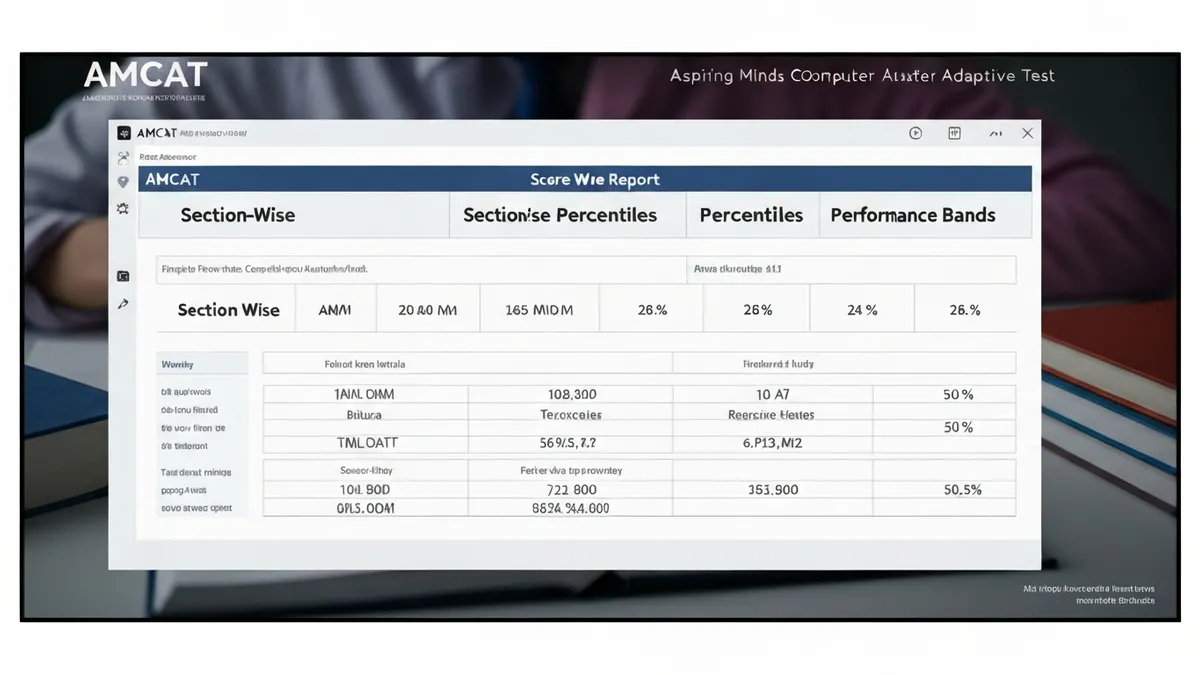
After your AMCAT exam, you receive a detailed score report on the Aspiring Minds portal. The report is divided into two main sections: Section-Wise Scores and an Overall Summary.
Section-Wise Scores
Each module you attempted — English Comprehension, Quantitative Ability, Logical Reasoning, and any optional domain modules — gets its own row showing:
- Raw Score: Your actual adaptive score for that module (not a simple correct/total count)
- Percentile: Where you stand among all candidates who took that module
- Performance Band: A label such as Excellent, Good, Average, or Below Average mapped to your percentile range
Overall Composite Percentile
The composite percentile is a weighted aggregate across all sections. While useful for a quick summary, companies typically examine individual section percentiles during shortlisting, so a high composite built on one strong section and one very weak section may still result in rejection if the weak section falls below a company's cut-off.
Validity and Score Sharing
AMCAT scores are valid for two years from the test date. You can share your score report directly with recruiters from the portal, and many companies have integrated AMCAT into their applicant tracking systems, meaning scores are automatically pulled when you apply. Keep your report URL handy — some job portals request it during application.
For a deeper look at the logical reasoning section specifically, see our AMCAT Logical Reasoning guide, and for full preparation strategy visit AMCAT Tips to Crack.
AMCAT Checklist
- ✓Download and save your AMCAT score report PDF from the portal
- ✓Note section-wise percentiles — highlight any module below 50th percentile
- ✓Compare your percentiles against the cut-offs for your target companies
- ✓If below cut-offs: schedule a retake (45-day minimum gap) and build a prep plan
- ✓If above cut-offs: apply to AMCAT job listings on the Aspiring Minds jobs portal
- ✓Share your score report link with recruiters and add it to your resume/LinkedIn
- ✓Sign up for AMCAT Smart Hire (if 70+ percentile) for direct interview referrals
- ✓Practice domain-specific modules if applying to technical or specialised roles
- ✓Monitor your email for shortlisting notifications — companies contact directly via registered email
- ✓Take the free AMCAT practice test below to benchmark before your next attempt
AMCAT Study Tips
What's the best study strategy for AMCAT?
Focus on weak areas first. Use practice tests to identify gaps, then study those topics intensively.
How far in advance should I start studying?
Most successful candidates begin 4-8 weeks before the exam. Create a structured study schedule.
Should I retake practice tests?
Yes! Take each practice test 2-3 times. Focus on understanding why answers are correct, not memorizing.
What should I do on exam day?
Arrive 30 min early, bring required ID, read questions carefully, flag difficult ones, and review before submitting.

AMCAT Pros and Cons
- +Published score scales and passing thresholds create transparent, predictable targets for preparation
- +Scaled scoring systems allow fair comparison of performance across different test dates with varying difficulty
- +Detailed score reports identify section-specific performance, enabling targeted remediation for retake candidates
- +Score validity periods provide candidates flexibility in application timing after passing
- +Multiple scoring components mean strong performance in some areas can compensate for weaker performance in others
- −Scaled scores can be confusing — the same raw score translates to different scaled scores across test dates
- −Passing cutoffs set by credentialing bodies may not align with what candidates expect based on content mastery
- −Score report delivery times vary — delays in receiving results can delay application or registration deadlines
- −Performance on a single test date may not accurately reflect a candidate's actual knowledge level
- −Score reports often lack granularity below the section level, making it difficult to pinpoint specific topic weaknesses
AMCAT Percentile Questions and Answers

AMCAT Score — What Your Score Means and Company Cutoffs 2026

AMCAT Complete Guide 2026 — What It Is, Format, and How to Prepare

AMCAT Tips to Crack — Proven Strategies to Score High 2026

AMCAT Logical Reasoning: Complete Guide to All Question Types, Time Strategy & Hiring Cutoffs

The Ultimate Guide to AMCAT Test: Prepare for Aspiring Minds Computer Adaptive Test
About the Author

Educational Psychologist & Academic Test Preparation Expert
Columbia University Teachers CollegeDr. Lisa Patel holds a Doctorate in Education from Columbia University Teachers College and has spent 17 years researching standardized test design and academic assessment. She has developed preparation programs for SAT, ACT, GRE, LSAT, UCAT, and numerous professional licensing exams, helping students of all backgrounds achieve their target scores.
Join the Discussion
Connect with other students preparing for this exam. Share tips, ask questions, and get advice from people who have been there.
View discussion (8 replies)