
How to Become an Airframe Mechanic: FAA A&P Certification Guide 2026 October
🧠 Free How to Become an Airframe Mechanic: FAA practice test with questions and answer explanations. Prepare for the 2026 October exam with instant scoring.
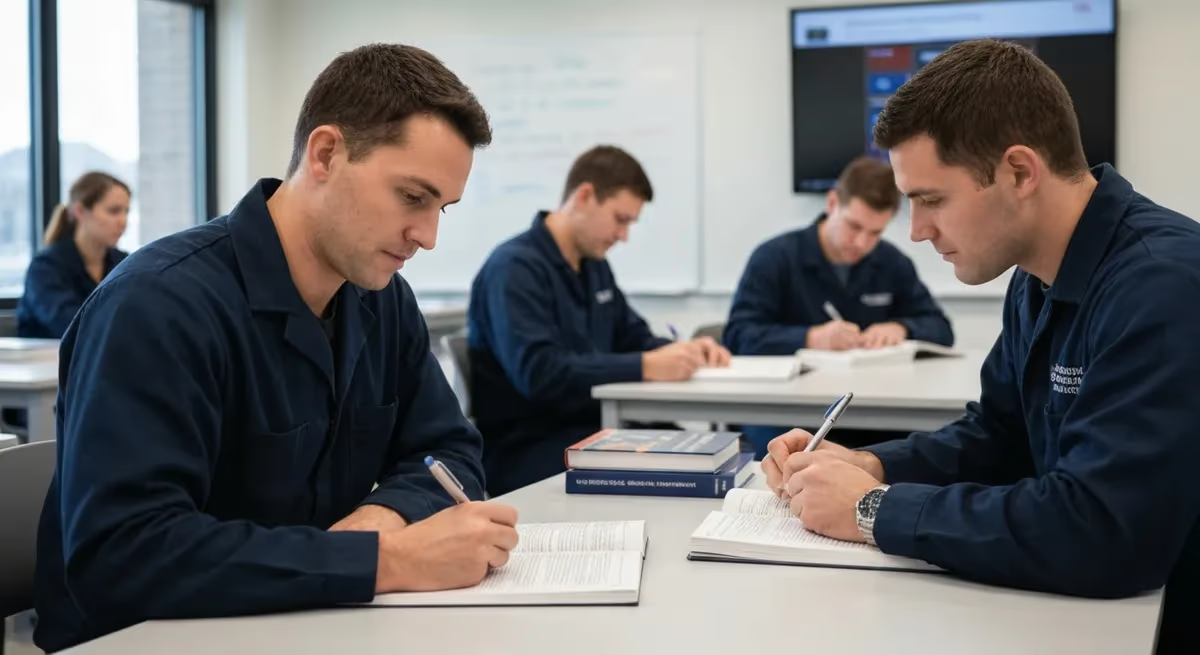
Becoming an FAA-certified airframe mechanic requires completing an FAA-approved Aviation Maintenance Technician (AMT) school program of 1,900 curriculum hours — or accumulating 30 months of practical experience on airframes — followed by passing three written knowledge tests and a hands-on practical exam. The full A&P certificate authorizes you to inspect, repair, and return aircraft to service, with median salaries ranging from $65,000 to over $100,000 depending on employer and location.
Maintenance and mechanical trade candidates should also practice with our Ramsay mechanical test 2026, which covers the electrical, hydraulic, and mechanical reasoning sections used by employers across manufacturing and utilities.
Candidates can also sharpen their skills with our Prometric practice test 2026, which includes hundreds of practice questions in the exact format and difficulty of the real exam.
Candidates preparing for walmart maintenance will find our Walmart maintenance exam 2026 essential for mastering the exam content, format, and scoring criteria.
Students preparing for standardized admissions tests should also practice with our FAA practice test 2026, covering the quantitative, verbal, and analytical sections tested in the real exam.
Candidates targeting this certification can strengthen their exam readiness with our Associate of Arts degree guide 2026, which covers all key content areas and question formats from the official exam blueprint.
The Airframe Mechanic Certification exam uses a multiple-choice format with questions covering all major domains. Most versions allow 2-3 hours for completion.
Questions test both knowledge recall and application skills. A score of 70-75% is typically required to pass.

What Does an Airframe Mechanic Do?
An airframe mechanic specializes in the non-engine structural and mechanical systems of an aircraft. While the term "airframe mechanic" focuses on the airframe rating, most professionals pursue the full A&P certificate, which covers both airframe and powerplant systems.
Core airframe mechanic responsibilities include:
- Structural inspection and repair — Examining fuselage, wings, empennage, and control surfaces for corrosion, cracks, fatigue, and damage using visual inspection and NDT methods
- Sheet metal and composite work — Riveting, forming aluminum alloy skins, and repairing advanced composite structures (carbon fiber, fiberglass, Kevlar)
- Flight control systems — Rigging, adjusting, and troubleshooting cables, pushrods, bellcranks, and fly-by-wire actuators
- Hydraulic and pneumatic systems — Maintaining landing gear, brakes, flaps, and flight control actuators
- Electrical systems — Wiring, avionics installation, troubleshooting circuits, and maintaining generators and batteries
- Fuel systems — Inspecting integral and bladder fuel tanks, fuel lines, pumps, and fuel quantity indication systems
- Landing gear — Overhaul and inspection of struts, tires, wheels, brakes, and retraction mechanisms
Airframe mechanics work in hangars, on flight lines, and at maintenance repair and overhaul (MRO) facilities. The work is physically demanding and requires attention to detail — a missed defect can have serious safety consequences. Test your airframe knowledge with our Aircraft Structures Practice Quiz.
FAA A&P Certification Requirements
The FAA sets two pathways to qualify for the Airframe and Powerplant mechanic certificate under 14 CFR Part 65:
Pathway 1: FAA-Approved AMT School (Most Common)
- Complete a program at an FAA Part 147 certified Aviation Maintenance Technician school
- Minimum 1,150 curriculum hours for the airframe rating alone, or 1,900 hours for the combined A&P certificate
- Programs typically last 18-24 months for the full A&P
- The school issues a completion certificate that authorizes you to take the FAA exams
Pathway 2: Practical Experience
- 18 months of practical experience working on either airframes or powerplants for a single rating
- 30 months of practical experience working on both airframes and powerplants for the full A&P
- Experience must be documented and verifiable — keep detailed logbooks of all maintenance tasks performed
- Military aircraft maintenance experience qualifies, and the FAA accepts DD Form 214 and training records
- You must obtain a letter from your employer or military branch verifying the type and duration of experience
Basic eligibility (both pathways):
- Must be at least 18 years old
- Must be able to read, write, speak, and understand English
- Must be a US citizen or hold appropriate work authorization
The school pathway is recommended for most people because it provides structured training, hands-on lab work, and direct exam eligibility. Military veterans with aircraft maintenance specialties often qualify immediately through the experience pathway.
- ✓Confirm your exam appointment and location
- ✓Bring required identification documents
- ✓Arrive 30 minutes early to check in
- ✓Read each question carefully before answering
- ✓Flag difficult questions and return to them later
- ✓Manage your time — don't spend too long on one question
- ✓Review flagged questions before submitting
AMT Schools and Training Programs
Choosing the right Aviation Maintenance Technician school is one of the most important decisions in your career path. Here is what to look for and what to expect:
Types of AMT programs:
- Community college programs — 18-24 months, often the most affordable ($8,000-$20,000 total). Many offer associate degrees alongside the A&P certification, which can boost starting salary.
- Dedicated aviation technical schools — 14-21 months, focused curriculum ($15,000-$40,000). Schools like Aviation Institute of Maintenance (AIM), National Aviation Academy, and Spartan College.
- University programs — 2-4 years, combine A&P with a bachelor's degree in aviation maintenance management ($30,000-$80,000). Best for those targeting management or engineering roles.
- Military transition programs — Some schools offer accelerated tracks for veterans with military maintenance experience, reducing program length by several months.
What AMT school covers:
The FAA Part 147 curriculum includes three subject areas that mirror the certification exams:
- General — Mathematics, physics, regulations (14 CFR), maintenance publications, ground operations, cleaning and corrosion control, fluid lines and fittings, materials and processes
- Airframe — Structures (wood, fabric, sheet metal, composites), assembly and rigging, hydraulics, pneumatics, landing gear, electrical systems, fuel systems, instruments, cabin atmosphere, fire protection
- Powerplant — Reciprocating engines, turbine engines, engine electrical, fuel metering, lubrication, ignition, starting, propellers, exhaust and reverser systems
Most programs include substantial hands-on lab time where you work on actual aircraft components, engines, and systems. The best schools maintain training aircraft and modern avionics trainers.
Financial aid: AMT programs qualify for federal financial aid (FAFSA), VA benefits (GI Bill), and many state workforce development grants. Some airlines offer tuition reimbursement programs for students who commit to working for them after graduation.
The FAA Knowledge and Practical Exams
After completing your training or accumulating the required experience, you must pass FAA exams to earn your airframe mechanic certificate:
Written Knowledge Tests (computerized):
- General (AMG) — 60 questions, covering basic math, physics, regulations, maintenance forms, ground operations, and materials
- Airframe (AMA) — 100 questions on aircraft structures, systems, instruments, and regulations specific to airframe work
- Powerplant (AMP) — 100 questions on engine theory, systems, troubleshooting, and powerplant-specific regulations
- All tests require a minimum score of 70% to pass
- Tests are taken at FAA-approved testing centers (PSI/Prometric) for $165 each
- You have 24 months from passing the first written test to complete all remaining exams
Oral and Practical (O&P) Exam:
This is the final and most comprehensive exam, administered by a Designated Mechanic Examiner (DME):
- The DME asks oral questions on each subject area and assigns practical tasks
- Tasks include hands-on demonstrations such as performing a sheet metal repair, rigging a flight control, troubleshooting a system, and interpreting maintenance manuals
- The exam takes 6-8 hours per rating (full day for combined A&P)
- You must demonstrate proficiency in each subject — failing one area requires retesting only that section
- DME fee is typically $300-$600 depending on location
Prepare thoroughly with our practice quizzes covering key exam areas: Aircraft Structures and Flight Control Systems.
Career Outlook and Next Steps
The aviation maintenance industry is experiencing a significant technician shortage, making this an excellent time to enter the field.
Industry demand:
- Boeing's 2026 Technician Outlook projects a need for 690,000 new maintenance technicians worldwide through 2043
- The US alone needs approximately 40,000 new technicians in the next decade
- Retirements of baby-boomer mechanics are creating thousands of openings annually
- Airlines, MROs, and business aviation are all competing for certified mechanics
Where A&P mechanics work:
- Airlines — Major carriers (Delta, United, American, Southwest) offer top pay, benefits, and union representation. Starting pay $28-$35/hour with progression to $45-$55/hour.
- MRO facilities — Companies like AAR, ST Engineering, and HAECO perform heavy maintenance on airline fleets. Good entry-level option with competitive pay.
- Business/corporate aviation — Maintaining private jets and turboprops. Often smaller teams with varied work and competitive salaries.
- General aviation — FBOs and small repair stations. More variety in aircraft types but typically lower pay than airlines.
- Government/military contractors — Defense contractors and government agencies employ A&P mechanics for military and government aircraft.
Career advancement paths:
- Inspection Authorization (IA) — After 3 years as an A&P, you can earn the IA rating, which allows you to perform annual inspections and approve aircraft for return to service after major repairs
- Designated Mechanic Examiner (DME) — Experienced mechanics can be designated by the FAA to administer practical exams to new A&P candidates
- Lead mechanic / crew chief — Supervisory roles overseeing teams of mechanics
- Quality assurance / technical management — Moving into management within MRO or airline maintenance departments
Visit our Airframe Mechanic Certification masterpage for additional study resources and practice tests to help you pass your FAA exams on the first attempt.
FAA Pros and Cons
- +FAA has a defined, publicly available content blueprint — candidates know exactly what to prepare for
- +Multiple preparation pathways (self-study, courses, coaching) accommodate different learning styles and schedules
- +A growing ecosystem of study resources means candidates at any budget level can access quality preparation materials
- +Clear score reporting allows candidates to identify specific strengths and weaknesses for targeted remediation
- +Professional recognition associated with strong performance provides tangible career and academic benefits
- −The scope of tested content requires substantial preparation time that competes with existing professional or academic commitments
- −No single resource covers the full content scope — candidates typically need multiple study tools for comprehensive preparation
- −Test anxiety and exam-day performance variability mean preparation effort does not always translate linearly to scores
- −Registration, preparation, and potential retake costs accumulate into a significant financial investment
- −Content and format can change between exam versions, making older preparation materials less reliable
Pros and Cons at a Glance
| Pros | Cons |
|---|---|
| FAA has a defined, publicly available content blueprint — candidates know exactly what to prepare for | The scope of tested content requires substantial preparation time that competes with existing professional or academic commitments |
| Multiple preparation pathways (self-study, courses, coaching) accommodate different learning styles and schedules | No single resource covers the full content scope — candidates typically need multiple study tools for comprehensive preparation |
| A growing ecosystem of study resources means candidates at any budget level can access quality preparation materials | Test anxiety and exam-day performance variability mean preparation effort does not always translate linearly to scores |
| Clear score reporting allows candidates to identify specific strengths and weaknesses for targeted remediation | Registration, preparation, and potential retake costs accumulate into a significant financial investment |
| Professional recognition associated with strong performance provides tangible career and academic benefits | Content and format can change between exam versions, making older preparation materials less reliable |
Sample Airframe Mechanic Certification Practice Questions
Try these questions from our free Airframe Mechanic Certification practice tests. The correct answer and an explanation follow each question.
Which condition would cause high oil temperature and low oil pressure simultaneously in a reciprocating engine?
- A. Clogged oil filter
- B. Low oil quantity
- C. Stuck-open oil cooler thermostat
- D. Faulty oil temperature gauge only
Answer: B. Low oil quantity
Low oil quantity means less oil is available to absorb heat and maintain pressure, causing both high temperature and low pressure simultaneously.
A technician inspecting a multi-disc brake system notices that one of the brakes is dragging after pressure is released. Which of the following is a plausible cause for this issue?
- A. The use of nitrogen instead of compressed air to service the tire.
- B. Excessive wear on the brake disc's anti-skid sensor.
- C. A weak or broken return spring in the brake assembly.
- D. Creep marks on the tire are misaligned by more than one inch.
Answer: C. A weak or broken return spring in the brake assembly.
Brake drag occurs when the brake pads do not fully retract from the rotor after braking pressure is released. A weak or broken return spring within the brake caliper or piston housing is a common cause, as it fails to provide the necessary force to pull the pistons and pads away from the disc. Other causes can include a jammed piston, contaminated hydraulic fluid, or a malfunctioning master cylinder.
What is the minimum number of rivets required in a single rivet row for a repair splice on primary aircraft structure according to AC 43.13-1B?
- A. Two rivets per side of the splice
- B. Three rivets per side of the splice
- C. Four rivets per side of the splice
- D. One rivet per inch of splice length
Answer: B. Three rivets per side of the splice
AC 43.13-1B requires at least three rivets per side of the splice in any single row to ensure adequate load transfer in primary structure repairs.
When inspecting a pressurized fuselage for fatigue cracks, which location is considered highest risk and should receive the most attention?
- A. The area adjacent to the nose baggage door
- B. Around window and door cutouts and skin lap joints
- C. Along the lower fuselage belly skin only
- D. At the tailcone attachment ring
Answer: B. Around window and door cutouts and skin lap joints
Stress concentrations at window frames, door cutouts, and skin lap joints make these areas the most fatigue-critical zones in a pressurized fuselage.
Airframe Mechanic Questions and Answers
About the Author

Commercial Pilot & FAA Certification Specialist
Embry-Riddle Aeronautical UniversityCaptain Jennifer Walsh graduated with honors in Aerospace Engineering from Embry-Riddle Aeronautical University and holds FAA Airframe & Powerplant and Airline Transport Pilot certificates. With 11 years of commercial aviation experience and 6 years as a ground school instructor, she guides aviation mechanics and student pilots through FAA written exams and practical tests.
Join the Discussion
Connect with other students preparing for this exam. Share tips, ask questions, and get advice from people who have been there.
View discussion (1 reply)