
Pearson VUE AFOQT: Eligibility, Registration, and What to Expect 2026 October
⏳ Get ready for your Pearson VUE AFOQT: Eligibility, certification. Practice questions with step-by-step answer explanations and instant scoring.

AFOQT at Pearson VUE — What Changed and What It Means for You
The Air Force Officer Qualifying Test (AFOQT) moved to computer-based testing through Pearson VUE in recent years, replacing the older paper-and-pencil format. If you're researching the AFOQT now, you're dealing with this newer system — and understanding how Pearson VUE AFOQT testing works is the first step in planning your preparation and registration.
This matters practically: you don't just show up to take the AFOQT. You need to be nominated by an Air Force recruiter or officer accession source, you must be within the eligible testing window for your application timeline, and you need to schedule your exam at an approved Pearson VUE testing centre. The logistics are specific, and getting them wrong can cost you time you don't have in a competitive officer selection cycle.
AFOQT Eligibility Requirements
Not everyone can just walk in and take the AFOQT. Eligibility is tied to your status as a prospective Air Force officer. The main eligibility categories are:
- Officer Training School (OTS) applicants — Active duty enlisted members applying for OTS, or civilians applying through the OTS accession pipeline
- AFROTC cadets — Air Force ROTC students at participating universities; typically tested during their junior or senior year as part of the ROTC commissioning process
- Air Force Academy candidates — Used for assessment within the Academy pathway in some circumstances
- Airmen applying for officer specialties — Some warrant officer and specialised officer programs require AFOQT scores
You don't self-register for the AFOQT through Pearson VUE independently. Your recruiter or accession source initiates the testing authorisation, which then allows you to schedule at a Pearson VUE location. If you contact Pearson VUE directly without that authorisation, you won't be able to book an AFOQT appointment.
How to Register for the Pearson VUE AFOQT
Once your recruiter or ROTC advisor authorises your testing, the registration process works like this:
- Receive your testing authorisation — your recruiter or unit provides the authorisation code or scheduling instructions tied to the Pearson VUE AFOQT program
- Find a Pearson VUE test centre — Pearson VUE has testing centres in most major cities and many smaller markets. Use the Pearson VUE website to find locations and available appointment slots
- Schedule your appointment — book well in advance. Popular test centres can be booked out several weeks. Don't wait until you're close to a deadline to schedule
- Bring required identification — government-issued photo ID is required. Check Pearson VUE's current ID requirements for the AFOQT when you schedule, as requirements can be updated
On test day, arrive early, bring your ID, and leave personal electronic devices in your car or a locker — Pearson VUE testing centres have strict rules about what you can bring into the testing room. Your afoqt exam preparation should also include familiarity with the computer-based format, since the interface itself can feel unfamiliar if you've only practised on paper.
Important: The AFOQT exam covers multiple domains. Allocate more study time to unfamiliar topics while maintaining review of strong areas.
AFOQT Retake Rules — The 150-Day Wait
This is one of the most important pieces of AFOQT eligibility information you need to know: you can only take the AFOQT twice in a lifetime. Full stop. If you've already taken it once, you must wait a minimum of 150 days before retaking it. If you've taken it twice, that's it — no further attempts are permitted.
The lifetime limit of two attempts is a hard rule with no known exceptions. This is why going into your first attempt prepared matters so much. A lot of candidates treat the first attempt as a "practice run" — that's a costly mistake that can permanently cap your officer candidacy at a suboptimal score.
The 150-day waiting period between attempts also affects application timelines. If you take the AFOQT six weeks before your application board meets and score below competitive thresholds, you won't have time to retake and rescore before the board convenes. Factor this into your preparation timeline.
What the AFOQT Tests and How It's Scored
The AFOQT has 12 subtests that produce five composite scores:
- Pilot composite — Based on arithmetic reasoning, math knowledge, instrument comprehension, table reading, and aviation information subtests
- Navigator-Technical composite — Arithmetic reasoning, math knowledge, instrument comprehension, table reading, and general science
- Academic Aptitude composite — Verbal analogies, arithmetic reasoning, word knowledge, and reading comprehension
- Verbal composite — Verbal analogies and word knowledge
- Quantitative composite — Arithmetic reasoning and math knowledge
Composite scores range from 1 to 99, representing percentile scores relative to a norming group. The Air Force sets minimum qualifying scores for each officer accession program. Pilot candidates typically need a Pilot composite of 25 or higher and a Combined Pilot-Navigator score of 50 or higher, though specific selection boards often set competitive thresholds considerably higher than the minimums.
Your afoqt practice tests preparation should target your weakest composites while maintaining your strong ones. If your pilot composite is solid but your academic aptitude composite is low, focus your final prep weeks on the verbal and reading comprehension subtests that feed into academic aptitude.
How Long Should You Study for the AFOQT?
Most candidates benefit from 8 to 16 weeks of structured preparation. The pilot subtest components — instrument comprehension, table reading, aviation information — are often the least familiar to candidates without aviation background, and they require specific study that isn't covered in general test prep.
Instrument comprehension tests your ability to read aircraft attitude indicators and directional indicators. It's a visual-spatial skill that doesn't improve much from book study alone — you need to practice reading these instruments in the specific format the AFOQT uses. Aviation information covers basic aeronautical knowledge: flight principles, weather, airspace, navigation concepts. No prior aviation experience is required, but the vocabulary and concepts need to be learned.
The verbal and quantitative subtests draw on broader academic skills — math through algebra and geometry, vocabulary breadth, reading comprehension, and logical reasoning. These are areas where solid academic preparation and targeted practice pay off.
Use our afoqt study guide resources alongside your subtest-specific practice. The afoqt prep content includes both the academic subtests and aviation-specific materials so you can cover the full AFOQT content in one structured approach.
What to Expect at the Pearson VUE Testing Centre
Pearson VUE AFOQT testing is a computer-based experience. You'll be seated at a workstation with a monitor, keyboard, and mouse. The subtests are presented sequentially with specific time limits for each. The interface allows you to flag questions for review and navigate within a subtest, but you typically can't go back to a previously completed subtest.
The AFOQT runs approximately 3.5 to 4 hours total including all subtests. Breaks between subtests may or may not be available depending on the testing protocol — check current AFOQT administration guidance for specifics. The testing centre staff will explain the check-in procedures, personal item storage, and testing rules before you begin.
Bring your required ID. Don't bring study materials, phones, or anything else that isn't explicitly permitted. The check-in process is strict, and items found after the test has begun can result in score cancellation.

AFOQT: Pros and Cons
- +AFOQT exam preparation strengthens your knowledge across all domains
- +Passing the exam proves competency to employers and clients
- +Study materials and practice tests are widely available
- +Exam-based credentials are portable across states and employers
- +Clear exam objectives help focus your study plan effectively
- −Exam anxiety can affect performance — practice tests help reduce it
- −Registration fees are non-refundable if you miss your test date
- −Limited retake opportunities may apply with waiting periods
- −Exam content updates periodically — use current study materials
- −Testing center availability may require advance scheduling



Maximising Your One or Two Chances
Given the lifetime limit of two AFOQT attempts, your approach to preparation should reflect how much is riding on each test. Don't schedule your exam until you're genuinely ready. "Ready" means: you've worked through all five composite areas, you've practised timed subtests under realistic conditions, and you've consistently scored at or above your target on practice materials.
The candidates who walk into the AFOQT most confident are the ones who've drilled the aviation subtests until instrument comprehension becomes automatic, who've worked through enough quantitative problems that the math subtests feel familiar, and who've built the vocabulary depth that makes verbal analogies tractable rather than random.
Use our afoqt practice tests to build that familiarity across all subtests. Our afoqt study guide materials cover both the academic and aviation-specific content areas. And when you're consistently hitting your target composite scores on timed practice, book your Pearson VUE appointment with confidence rather than anxiety.
The AFOQT is a high-stakes test for a high-stakes goal. Your preparation should match the stakes.
About the Author
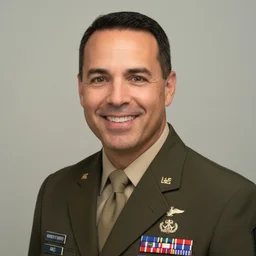
Retired Military Officer & Armed Forces Test Preparation Specialist
United States Army War CollegeColonel Steven Harris (Ret.) served 28 years in the US Army, earning a Master of Arts in Military Science from the Army War College and a Bachelor of Science in Criminal Justice. He has coached thousands of military enlistment and officer candidate program applicants through the ASVAB, AFQT, AFCT, OAR, and officer selection assessment processes across all military branches.