
AFOQT vs ASVAB: Key Differences Explained 2026 October
💯 Free AFOQT vs ASVAB: Key Differences practice test with instant feedback and detailed answer explanations. Prepare for your exam.

AFOQT vs ASVAB: Two Tests, Two Different Paths
If you're weighing your options in the military, you've probably encountered both the AFOQT and the ASVAB — and wondered what actually separates them. The short answer: they serve completely different purposes. The longer answer involves understanding what each test measures, who takes it, and where it leads.
The ASVAB (Armed Services Vocational Aptitude Battery) is the gateway test for enlisted military service across all branches — Army, Navy, Marines, Air Force, Coast Guard. Nearly everyone who enlists takes it. Your ASVAB scores determine your eligibility for specific military occupational specialties (MOS in the Army, ratings in the Navy, etc.).
The AFOQT (Air Force Officer Qualifying Test) is a different animal entirely. It's specifically for people pursuing commissioned officer status in the Air Force or Space Force — either through ROTC, Officer Training School (OTS), or the Air Force Academy. Enlisted personnel don't take the AFOQT. Aspiring officers do.
So if someone tells you to "take the ASVAB vs. AFOQT" as if they're interchangeable options — they're not. Your path determines which test you need. Want to enlist? ASVAB. Want to become an Air Force officer? AFOQT (and possibly the ASVAB first, if you enlisted before commissioning).
What the ASVAB Tests
The ASVAB has ten subtests covering: General Science, Arithmetic Reasoning, Word Knowledge, Paragraph Comprehension, Mathematics Knowledge, Electronics Information, Auto and Shop Information, Mechanical Comprehension, Assembling Objects, and Verbal Expression. The overall AFQT score (derived from four subtests) is what determines basic eligibility. Branch-specific composite scores then influence job placement.
The test is designed to be broadly accessible — it's used for all branches, not just the Air Force, so it covers a wide range of vocational and technical skills. Mechanical aptitude, electronics, and shop knowledge are significant components that reflect the hands-on nature of many enlisted roles.
What the AFOQT Tests
The AFOQT is more demanding academically and more targeted to officer-level cognitive and technical skills. It has twelve subtests: Verbal Analogies, Arithmetic Reasoning, Word Knowledge, Mathematics Knowledge, Reading Comprehension, Situational Judgment, Self-Description Inventory, Physical Science, Table Reading, Instrument Comprehension, Block Counting, and Aviation Information.
Five composite scores come out of this: Pilot, Combat Systems Officer (CSO), Air Battle Manager (ABM), Academic Aptitude, and Verbal. Each Air Force officer career field has minimum composite score requirements — and those minimums are non-negotiable. If you want to fly, you need a Pilot composite score above a specific threshold. The Air Force is strict about this.
The Aviation Information and Instrument Comprehension subtests have no ASVAB equivalent. These test aviation-specific knowledge — cockpit instruments, aircraft maneuvers, basic aeronautics — that the ASVAB simply doesn't cover because enlisted roles rarely require it.
Key Takeaway: AFOQT certification demonstrates expertise in this field. Most candidates spend 4-8 weeks preparing with practice tests before taking the exam.
Side-by-Side Comparison: AFOQT vs ASVAB
Here's where the two tests actually differ in structure and stakes:
Purpose: ASVAB determines enlisted eligibility and job placement across all branches. AFOQT determines officer commissioning eligibility and specialty path in the Air Force/Space Force only.
Who takes it: ASVAB — essentially everyone pursuing military service. AFOQT — Air Force and Space Force officer candidates only.
Retake policy: ASVAB can be retaken after a one-month waiting period, then six-month intervals. AFOQT allows only two lifetime attempts. That's it. Two chances, ever. This single fact makes AFOQT preparation far more consequential — you can't just retake it until you get a good score.
Difficulty: The AFOQT math and verbal sections are generally more advanced than their ASVAB counterparts. The AFOQT expects college-level reasoning and quantitative skills, which reflects the academic profile of officer candidates.
Aviation content: ASVAB has none. AFOQT has dedicated aviation subtests that matter enormously if you're pursuing a pilot or CSO slot.
Scoring: What You Actually Need
ASVAB scores are reported as percentiles — an AFQT of 65 means you scored higher than 65% of the reference population. Higher scores open more job options; Air Force minimums are relatively higher than some other branches.
AFOQT scores are composite scores ranging from 1–99. The Air Force publishes minimum composite scores for officer career fields. Pilot minimum is typically 25 Pilot composite and 10 CSO composite, but program minimums can be higher depending on competition. ROTC programs and OTS selection boards also consider your GPA, physical fitness, extracurriculars, and interview performance alongside your AFOQT scores — so the test is one component, not the whole picture.
Can You Need Both Tests?
Sometimes, yes. If you enlisted (took the ASVAB), served, and are now pursuing a commission through the Officer Training School, you'll take the AFOQT. Your ASVAB history doesn't substitute for the AFOQT — they're separate requirements for separate things.
Reserve and National Guard officer candidates also need the AFOQT. ROTC cadets take it during their junior year typically. Air Force Academy applicants don't take the AFOQT — they have their own selection process using SAT/ACT scores and other criteria.
Studying for the AFOQT: Where to Focus
Given that you only get two lifetime attempts at the AFOQT, preparation is not optional. Here's where candidates most often underinvest:
Instrument Comprehension: This subtest shows images of aircraft attitude indicators and directional gyros. You need to identify the aircraft's direction and orientation. If you've never spent time around aviation instruments, this can feel completely foreign. Study it early and often — don't leave it for the week before the test.
Aviation Information: Basic aerodynamics, aircraft systems, weather, flight principles. If you already fly or have been around aviation, this section rewards that background. If not, a focused review of private pilot study materials helps more than most dedicated AFOQT prep books on this topic.
Mathematics Knowledge and Arithmetic Reasoning: These are harder than ASVAB equivalents. Algebra, geometry, trigonometry fundamentals. If it's been a few years since college math, refresh the fundamentals before exam day.
Check out the AFOQT exam eligibility and registration guide for the full application process, and use the AFOQT exam prep resources available here to build your study plan by subtest.

- +Industry-recognized credential boosts your resume
- +Higher earning potential (10-20% salary increase on average)
- +Demonstrates commitment to professional development
- +Opens doors to advanced career opportunities
- −Exam preparation requires significant time investment (4-8 weeks)
- −Certification fees can be $100-$400+
- −May require continuing education to maintain
- −Some employers may not require certification

Sample AFOQT Practice Questions
Try these questions from our free AFOQT practice tests. The correct answer and an explanation follow each question.
An officer who is 'dogmatic' in their approach to leadership is most likely to be perceived as:
- A. Flexible and open-minded
- B. Inquisitive and questioning
- C. Uncaring and apathetic
- D. Asserting opinions as if they are facts
Answer: D. Asserting opinions as if they are facts
'Dogmatic' describes someone who is inclined to lay down principles as incontrovertibly true, without consideration of evidence or the opinions of others. This translates to asserting opinions as facts.
GREGARIOUS most nearly means:
- A. Sociable
- B. Solitary
- C. Angry
- D. Honest
Answer: A. Sociable
Gregarious describes someone who enjoys the company of others.
On the attitude indicator the wings are below the horizon line and tilted so the left wing is lower. The aircraft is:
- A. Climbing and banking right
- B. Descending and banking left
- C. Level and turning right
- D. Climbing and banking left
Answer: B. Descending and banking left
Wings below the horizon indicate a descent, and the lower left wing indicates a left bank.
Which state of matter has a definite volume but no definite shape?
- A. Solid
- B. Liquid
- C. Gas
- D. Plasma
Answer: B. Liquid
Liquids have a fixed volume but take the shape of their container.


Making the Right Prep Decision
The AFOQT vs ASVAB question isn't really a comparison of difficulty or fairness — it's a question of which path you're on. If you're headed toward Air Force or Space Force officer service, the AFOQT is what matters. Start preparing months out, not weeks. Two chances is a hard constraint that changes how you should approach this test.
If you're still exploring military careers and haven't committed to a specific branch or officer vs. enlisted path, understanding both tests helps. The ASVAB is a good baseline — it tells you where your academic strengths are and opens doors across multiple branches. The AFOQT then layers on aviation and officer-specific skills if that's where your path leads.
Don't go into either test cold. Both exams can be prepared for systematically, and practice testing is one of the highest-use activities you can do. Seeing the question formats, timing your pacing, and reviewing explanations for wrong answers builds the kind of test fluency that translates to actual score improvement on test day.
About the Author
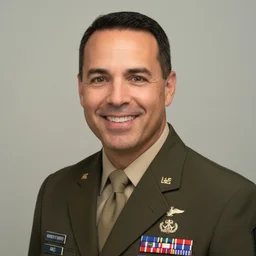
Retired Military Officer & Armed Forces Test Preparation Specialist
United States Army War CollegeColonel Steven Harris (Ret.) served 28 years in the US Army, earning a Master of Arts in Military Science from the Army War College and a Bachelor of Science in Criminal Justice. He has coached thousands of military enlistment and officer candidate program applicants through the ASVAB, AFQT, AFCT, OAR, and officer selection assessment processes across all military branches.