
AFCAT Question Paper 2026 September: Complete Practice Guide with Previous Year Papers
Master the AFCAT question paper with free practice tests, previous year papers & topic-wise quizzes. 📝 Boost your score with real exam-pattern questions.

The AFCAT question paper is the gateway to a commissioned officer career in the Indian Air Force, and understanding its structure, difficulty level, and question patterns is the single most effective step you can take before exam day. Every year, tens of thousands of candidates sit for the Air Force Common Admission Test, yet only a fraction clear the written stage.
The difference between those who succeed and those who fall short almost always comes down to one factor: deliberate, paper-based practice using real exam-format questions. Reviewing previous year papers and simulating full-length tests gives you an irreplaceable feel for timing, question density, and the cognitive stamina required to stay sharp through 100 questions in two hours.
When you study an authentic AFCAT question paper, you immediately notice that the exam is not about rote memorization alone. The paper blends Verbal Ability, Numerical Ability, Reasoning, Military Aptitude, and General Awareness into a single two-hour sprint. Each section tests a distinct cognitive skill, and the questions rotate in difficulty from straightforward recall to multi-step reasoning problems that punish both slow work and careless guessing. Candidates who treat every practice session as a genuine exam attempt — timing themselves strictly and reviewing every wrong answer — build the mental discipline that separates 160-plus scorers from the average field.
Previous year AFCAT question papers are particularly valuable because the Air Force maintains a consistent question style year after year. Vocabulary questions favor formal, technical, and defense-adjacent words. Numerical problems concentrate on percentages, averages, time-speed-distance, and profit-and-loss — areas where a solid formula sheet and pattern recognition can unlock near-perfect accuracy. Reasoning sections frequently feature syllogisms, analogy pairs, and spatial arrangement puzzles. Knowing these tendencies lets you allocate study time proportionally rather than spreading effort uniformly across topics of unequal weight.
General Awareness is the section that most candidates underestimate until their first mock test reveals a painful gap. The AFCAT paper routinely features 25 questions covering Indian geography, history, politics, science and technology, sports, defense news, and current events from the preceding 12 months. Unlike Numerical Ability, General Awareness cannot be crammed in a weekend — it requires a consistent daily reading habit maintained over months. Pairing a structured current-affairs reading plan with topic-wise practice quizzes is the most time-efficient strategy for building a robust knowledge base before the exam.
One of the smartest uses of an afcat question paper archive is pattern analysis. Download papers from the last four to six exam cycles and tally the frequency of each sub-topic. You will quickly see that certain grammar rules, specific historical events, and recurring mathematical concepts appear almost every cycle. Concentrating 60 to 70 percent of your preparation on these high-frequency zones — while still maintaining baseline familiarity with the rest of the syllabus — is a proven method for maximizing score per study hour. This targeted approach beats aimless reading of textbooks chapter by chapter.
Negative marking is a structural feature of the AFCAT question paper that demands a strategic, not just knowledgeable, approach. Every wrong answer costs one-third of a mark, which means wild guessing erodes your score even when you happen to be right about half the time. Smart test-takers develop a personal threshold: they answer questions where they can confidently eliminate at least two of the four options, and they skip questions where all four options feel equally plausible. Building this judgment through repeated timed mock tests — rather than hoping it materializes on exam day — is essential.
This guide walks you through everything you need to master the AFCAT question paper: the official exam format, section-wise difficulty analysis, preparation timelines, proven study strategies, and a curated set of free practice quizzes aligned to the real exam pattern. Whether you are sitting the exam for the first time or retaking after a borderline result, the resources on this page will help you approach the paper with confidence, efficiency, and a clear understanding of exactly what the Air Force is testing.
AFCAT Question Paper by the Numbers

AFCAT Exam Format 2026
| Section | Questions | Time | Weight | Notes |
|---|---|---|---|---|
| Verbal Ability in English | 30 | ~36 min | 30% | Vocabulary, comprehension, grammar |
| Numerical Ability | 15 | ~18 min | 15% | Arithmetic, percentages, ratios |
| Reasoning & Military Aptitude | 35 | ~42 min | 35% | Logical, spatial, verbal reasoning |
| General Awareness | 20 | ~24 min | 20% | Current affairs, defense, science |
| Total | 100 | 2 hours | 100% |
A deep section-wise analysis of past AFCAT question papers reveals patterns that dramatically sharpen your preparation focus. The Verbal Ability section, worth 30 questions, consistently prioritizes three skill clusters: reading comprehension passages drawn from formal or semi-technical texts, synonym-antonym pairs that favor advanced vocabulary seen in editorial writing, and error-identification sentences targeting subject-verb agreement, tense consistency, and preposition usage. Candidates who read quality English newspapers for at least 30 minutes daily for three months before the exam consistently outperform those who rely on vocabulary lists alone, because contextual reading builds intuitive grammar that no drills can replicate.
The Numerical Ability section packs 15 questions into what is arguably the highest reward-to-effort ratio segment of the paper. The topics are predictable: percentages, profit and loss, time and work, time-speed-distance, simple and compound interest, and basic statistics including mean, median, and mode.
Because the question count is low but each correct answer carries three marks, even modest improvement in this section — say, moving from 8 correct to 12 correct — adds 12 raw marks to your total. Candidates who practice 20 to 30 numerical problems daily for six weeks routinely achieve near-perfect accuracy here, making it one of the safest score-boosting investments in your preparation calendar.
The Reasoning and Military Aptitude block is the largest section at 35 questions and contains the greatest variety of question types. Logical reasoning sub-types include syllogisms, blood relations, direction-sense problems, coding-decoding sequences, and series completion. The Military Aptitude component adds spatial reasoning tasks — folded shapes, mirror images, and dot-in-figure problems — that specifically test the three-dimensional visualization skills relevant to aviation roles. These spatial questions are unfamiliar to most first-time test-takers, and dedicated practice with spatial reasoning workbooks in the final four weeks of preparation can realistically add five to eight correct answers in this block alone.
General Awareness is distributed across Indian history, geography, polity, science and technology, sports, and defense affairs. Analysis of recent AFCAT question papers shows that defense-specific questions — covering names of aircraft, naval vessels, missile systems, exercise names, and senior leadership appointments — appear in roughly 6 to 8 of the 20 General Awareness slots. This is a uniquely AFCAT-specific flavor that distinguishes the paper from civilian competitive exams. Dedicating one study session per week exclusively to defense news, official IAF press releases, and annual defense budget highlights provides a significant edge over candidates who ignore this sub-category.
Current affairs questions in the General Awareness section typically draw from a 12-month window preceding the exam notification date. For the 2026 cycle, this window runs from approximately mid-2025 through mid-2026, covering developments in Indian space missions, international defense agreements, sports championships, constitutional amendments, and significant scientific discoveries. Organizing your current affairs notes into a monthly summary document — revisiting it weekly with brief recall quizzes — prevents the common problem of learning facts once and forgetting them before exam day arrives.
Science and technology questions in recent papers have leaned toward applied physics concepts relevant to aviation: Bernoulli's principle, Newton's laws of motion, atmospheric layers, radar principles, and basic aerodynamics. Pure chemistry and biology questions appear infrequently, usually limited to one or two items per paper. This means that aviation-adjacent physics is worth prioritizing heavily while pure life-science revision can be kept to a quick overview. Cross-referencing these observations with your study of the official AFCAT syllabus and reviewing a few previous year papers confirms which science topics recur and which are genuinely rare.
Understanding the time allocation challenge is equally important as mastering content. One hundred questions in 120 minutes works out to 72 seconds per question — a pace that sounds generous but evaporates quickly when a reasoning puzzle or comprehension passage demands careful reading. High-scoring candidates develop a triage habit: they scan each question, flag difficult items for a second pass, and ensure they capture every straightforward point before investing time in harder problems. This strategy requires practice under timed conditions, which is why online mock tests and full-length AFCAT question paper simulations are non-negotiable in the final month of preparation.
AFCAT Question Paper Preparation Strategies
Building strong Verbal Ability performance on the AFCAT question paper requires a two-track approach: expanding your active vocabulary through daily contextual reading and drilling the grammar rules that examiners return to cycle after cycle. Read one editorial or opinion piece from a quality publication each morning, note any unfamiliar words, and write each word in two original sentences before bedtime. This active encoding technique moves vocabulary from passive recognition to confident active use far faster than flashcard repetition alone.
For reading comprehension, practice identifying the main idea, author's tone, and implied meaning of each paragraph before attempting the questions. AFCAT passages are typically 150 to 200 words and test inference rather than direct retrieval — the answer is rarely a verbatim sentence but a logical deduction from the passage. Practice 5 to 8 passages per week under a strict four-minute time limit per passage, reviewing every error to understand whether you misread, over-inferred, or simply missed a vocabulary cue. This disciplined review habit accelerates accuracy faster than raw practice volume alone.

Practicing with Previous Year AFCAT Papers: Advantages and Limitations
- +Reveals the exact question style and difficulty calibration used by official examiners
- +Builds timing awareness and helps you set realistic per-section time budgets
- +Identifies personal weak topics before the real exam rather than discovering them during it
- +Develops the mental stamina needed to sustain focus through 100 questions in 120 minutes
- +Allows pattern analysis to find high-frequency topics worth prioritizing in revision
- +Simulates negative-marking pressure and trains disciplined answer-or-skip decision-making
- −Older papers (pre-2019) may reflect a slightly different syllabus weightage
- −Repeated practice of the same papers eventually produces memory-based rather than skill-based answers
- −Does not replicate the online computer-based interface, which can feel unfamiliar on exam day
- −General Awareness questions from past papers are outdated and cannot substitute for current affairs study
- −Answer keys for unofficially circulated papers sometimes contain errors that reinforce wrong learning
- −Practicing alone without peer comparison makes it hard to gauge whether your score is competitive
AFCAT Question Paper Preparation Checklist
- ✓Download and attempt at least four official AFCAT question papers from previous exam cycles under strict timed conditions.
- ✓Create a personalized error log categorizing every wrong answer by section, topic, and error type (careless, conceptual, or vocabulary gap).
- ✓Build a one-page Numerical Ability formula sheet and memorize all formulas within the first two weeks of preparation.
- ✓Complete at least three full-length timed mock tests before the exam, treating each as a real attempt with no interruptions.
- ✓Dedicate one weekly study session exclusively to defense current affairs — exercises, inductions, and IAF news.
- ✓Practice 10 to 15 spatial reasoning problems daily for the four weeks preceding the exam to build Military Aptitude fluency.
- ✓Read one formal English editorial daily and note unfamiliar vocabulary with example sentences to build Verbal Ability organically.
- ✓Review the official AFCAT syllabus and cross-reference it against your error log to confirm you are covering all tested topics.
- ✓Set a personal answer-threshold rule for negative marking: only attempt questions where you can eliminate at least two options confidently.
- ✓Simulate the computer-based exam interface by taking at least two online mock tests to build familiarity with digital navigation under time pressure.

The 60-Second Rule That Separates Top Scorers
AFCAT data shows that candidates who score above 180 marks consistently spend no more than 60 seconds on their first pass through each question, reserving the final 20 minutes for revisiting flagged items. Practicing this strict pacing in every mock test — not just reading about it — is what makes it automatic when exam pressure is real.
Scoring well on the AFCAT question paper requires understanding the marking scheme at a mechanical level, not just an intellectual one. Each correct answer earns three marks, and each incorrect answer deducts one mark. A blank response carries no penalty. This asymmetry creates a clear mathematical rule: if you have no ability to eliminate any of the four options, leaving the question blank is mathematically preferable to guessing.
However, if you can confidently eliminate even one distractor, your expected value from attempting the question becomes positive. Most well-prepared candidates can eliminate at least one option on the vast majority of questions, which means aggressive, thoughtful answering is generally the right strategy.
The raw cutoff for qualifying the written stage of the AFCAT is not published in advance but is determined after each exam cycle based on the number of vacancies and the performance distribution of the candidate pool. In recent cycles, a raw score between 120 and 150 out of 300 has typically been competitive for the Flying branch, while Ground Duty Technical and Non-Technical branches have historically required scores above 100 to 120.
These numbers shift with each cycle depending on difficulty and vacancy count, so treating them as precise targets rather than rough guides is a mistake. Instead, aim for 170-plus raw marks to build a comfortable buffer above typical cutoffs regardless of which branch you are applying for.
Time management during the actual exam is best approached with a two-pass system that many high scorers describe independently. On the first pass, move through all 100 questions at a pace of roughly 60 to 70 seconds each, answering every question you can solve quickly and confidently, and marking difficult questions for review.
After completing the first pass — which should take roughly 75 to 85 minutes — use the remaining time to return to flagged questions. In the second pass, apply a stricter filter: only attempt flagged questions where you have narrowed down to two options and can reason your way to a likely answer. Leave the rest blank.
Sectional time targets are not enforced by the AFCAT system — you can move freely between questions — but imposing your own internal time budgets prevents a single difficult section from consuming disproportionate exam time. Experienced test-takers often allocate roughly 35 to 40 minutes to the Reasoning and Military Aptitude block, given its 35-question size and the spatial tasks that demand more careful visual analysis.
Verbal Ability typically runs 25 to 30 minutes for its 30 questions, while Numerical Ability and General Awareness together account for the remaining 50 to 55 minutes. These are guidelines, not rules, and your personal benchmark should emerge from analyzing your own timed mock test performance rather than copying someone else's allocation.
Answer review strategy also matters in the final minutes of the exam. Many candidates instinctively change answers during review, and research on standardized testing consistently shows this is a net-negative behavior unless you have found a clear factual reason — a misread question stem, a calculation error you can identify precisely — for the change.
If you are reviewing a Reasoning question and your gut feeling has simply shifted, the probability that your first answer was correct is higher than the probability that your second-guess impulse is correct. Build the discipline to change only when you have a concrete, articulable reason, not just residual uncertainty.
Post-exam analysis is where long-term score improvement is built. After every full-length mock test, spend at least 45 minutes reviewing your performance across four dimensions: accuracy by section, accuracy by topic, time spent per question versus recommended time, and the pattern of your wrong answers (careless errors, conceptual gaps, or vocabulary failures). Logging these dimensions in a simple spreadsheet over eight to ten mock tests reveals trends that point directly to the highest-leverage preparation actions remaining before your exam.
This analytical discipline is what separates candidates who plateau at a moderate score from those who systematically close gaps and arrive at the real exam performing at their genuine ceiling.
The role of practice quizzes alongside full-length papers deserves emphasis. Full-length mocks build stamina and timing judgment, but topic-specific quizzes are more efficient for targeted skill development. If your error log shows consistent weakness in syllogism questions, 20 minutes of focused syllogism practice will yield more improvement per minute than retaking a full 100-question paper where syllogisms appear only three or four times. Combining both modalities — weekly full mocks for integration and daily topic quizzes for skill-building — creates a preparation rhythm that produces steady, measurable score improvement over a 10 to 14 week preparation window.
AFCAT applications close several weeks before the exam date, and late applications are not accepted under any circumstances. Verify your eligibility for age, educational qualification, and physical standards before beginning the application process. Missing the deadline or submitting incorrect documentation results in immediate disqualification, regardless of your preparation level or exam score.
Previous year AFCAT question papers offer a window into the examiner's mindset that no coaching material can replicate. When you work through papers from 2019, 2020, 2021, 2022, and 2023, you begin to see that certain vocabulary words — particularly those drawn from formal bureaucratic and military communication — appear across multiple cycles with only minor variation.
Words like 'ostensible,' 'equivocal,' 'pugnacious,' and 'ameliorate' have featured in AFCAT Verbal Ability sections repeatedly, suggesting the examiners maintain an informal list of preferred vocabulary drawn from a formal-English tradition. Building your personal high-frequency vocabulary list directly from past papers is therefore more targeted than using generic GRE or civil services word lists.
Numerical Ability questions in past papers cluster tightly around a core of 12 to 15 topic types. Time-speed-distance problems account for roughly 3 to 4 questions per paper on average, percentage-based problems appear 2 to 3 times, and profit-and-loss questions appear 1 to 2 times per cycle.
Problems involving trains, boats and streams, and pipes and cisterns — which are common in other competitive exams — appear less frequently in AFCAT papers, suggesting lower priority in your study schedule. Detailed topic-frequency analysis across five or more past papers takes about two hours but produces a prioritization map that is worth dozens of hours of unfocused study.
Reasoning questions in past AFCAT papers reveal a consistent preference for five-step logical chains over simple two-step deductions. Syllogism problems typically present three statements and ask which of four conclusions follows validly — a format that requires familiarity with formal logical validity rather than intuitive reasoning. Blood-relation problems often involve four to five generations with multiple marriage links, making systematic diagramming essential. Candidates who approach these questions verbally — trying to hold the relationships in working memory — consistently make more errors than those who draw quick family-tree or directional diagrams even when it costs 15 extra seconds.
The Military Aptitude component of the Reasoning section is perhaps the most uniquely AFCAT-specific testing domain. These questions evaluate spatial visualization — mental rotation of three-dimensional objects, identification of hidden figures within complex patterns, and paper-folding and cutting sequences.
This skill set is not tested on most other competitive exams, which means many first-time AFCAT aspirants encounter it for the first time during their initial mock test. Starting spatial reasoning practice early — ideally in the first two weeks of preparation — prevents the scenario where candidates arrive at the exam having strengthened every other section but remaining weak in this significant block of 10 to 12 questions.
General Awareness questions from past papers are not directly useful for current affairs preparation because the facts they test are outdated, but they are extremely useful for understanding the style and depth of questioning. Past papers reveal that AFCAT General Awareness questions are direct and factual, not analytical or opinion-based.
The correct answer is always an objectively verifiable fact — a year, a name, a place, a scientific principle — never an interpretation or a policy evaluation. This means your General Awareness preparation should emphasize accurate factual retention over analytical understanding of events, which in turn means concise, structured notes are more effective than long-form reading for this specific section.
Reviewing the detailed afcat question paper breakdown on official IAF channels annually confirms whether any structural changes have been made to the paper format, section weights, or question count. The Air Force occasionally updates its testing approach to better align with the cognitive demands of modern aviation roles, and candidates who assume the 2026 paper is identical to the 2021 paper without verifying this assumption risk preparing for a format that no longer exists.
Checking official notifications and cross-referencing with recent test-taker accounts from online forums takes less than one hour and provides certainty worth far more than that time investment.
The integration of online mock tests, topic-level quizzes, and previous year paper analysis into a structured weekly schedule produces the most consistent score improvement. A well-designed weekly plan might include one full-length timed mock test on Saturday, a two-hour previous year paper review session on Sunday, and three to four 20-minute topic quizzes distributed across weekdays targeting your identified weak areas. This three-pronged approach ensures you are simultaneously building integration (full mocks), diagnosing weaknesses (paper analysis), and closing specific skill gaps (topic quizzes), rather than doing any one of these things in isolation.
Practical preparation tips for the AFCAT question paper begin with an honest self-assessment in the first week of your study period. Take one complete previous year paper under strict exam conditions — no phone, no breaks, strict 120-minute timer — and score it accurately using the three-mark correct, minus-one wrong formula. This baseline score tells you whether you are starting from a position of fundamental unfamiliarity, moderate competency, or near-readiness.
It also immediately reveals which sections are genuine strengths versus which require the most intensive investment. Many candidates skip this uncomfortable first step, preferring to begin with comfortable material, but the self-assessment is foundational to building an efficient, personalized preparation plan.
Building vocabulary systematically is one of the highest-return investments for the Verbal Ability section. Create a master word list from vocabulary questions in previous AFCAT papers, add words you encounter in daily reading that feel unfamiliar, and review this list using spaced repetition — a technique where you review words at increasing intervals based on how confidently you recalled them last time.
Free spaced repetition apps make this effortless to implement and are far more effective than re-reading a static vocabulary list each day. Target adding 10 to 15 new words per week while reviewing previously learned words daily, and your active vocabulary will expand dramatically over a 10-week preparation period.
For Numerical Ability, the most common preparation mistake is spending too much time on difficult multi-step problems while neglecting the simpler question types that appear most frequently on the actual paper. The AFCAT Numerical section favors clean problems with integer answers that test formula application rather than algebraic manipulation.
Practicing with timed sets of 15 questions — the same count as the real section — builds the pacing instinct needed to complete this section in roughly 18 minutes while maintaining accuracy. If your timed practice consistently shows you taking 25 to 30 minutes for 15 questions, your calculation speed needs targeted work before exam day.
The Reasoning and Military Aptitude section responds well to a categorized practice approach. Divide your practice into sub-types — syllogisms, blood relations, coding-decoding, direction sense, series completion, and spatial visualization — and track your accuracy separately for each.
You will almost certainly find that two or three sub-types account for the majority of your errors, and these are the areas where concentrated practice delivers the highest return. Ten minutes of syllogism practice daily for three weeks, for example, can realistically take you from 50 percent accuracy to 85 percent accuracy in that sub-type, which translates directly to two or three additional correct answers on the real paper.
General Awareness preparation benefits enormously from a structured monthly digest approach. At the beginning of each month, create a one-page summary covering the most significant defense news, sports results, scientific achievements, political developments, and international events of the preceding month. Include names, dates, and specific facts — not vague summaries. Review this digest using active recall quizzes every week until the exam. By exam day, you will have six to eight months of organized, fact-dense summaries that can be reviewed in a single afternoon, providing a comprehensive current affairs foundation that candidates who studied reactively will lack.
Physical preparation deserves mention because the AFCAT is not purely a written exam — it is the gateway to a process that includes medical and physical fitness evaluation, and the Air Force is selecting candidates who demonstrate the overall readiness profile for a commissioned officer. Maintaining physical fitness throughout your preparation period has documented cognitive benefits: regular aerobic exercise is associated with improved working memory, faster information processing, and better sustained attention, all of which directly benefit exam performance. Even three 30-minute runs per week maintain the baseline physical condition that keeps your study sessions cognitively efficient.
The week before the exam should be devoted to consolidation rather than learning new material. Review your error log and focus only on the conceptual corrections already identified — do not attempt new topics or difficult practice problems that might introduce anxiety or confusion. Take one light mock test three days before the exam to maintain mental sharpness, then rest on the day before.
Ensure you have your admit card, a valid photo ID, and your stationery ready the evening before the exam. Arriving at the examination center 30 minutes early prevents the stress-induced cognitive impairment that comes from rushing, which in turn ensures you enter the exam room in the composed, focused state that your months of preparation have earned you.
AFCAT Questions and Answers

AFCAT Exam Pattern 2026: Complete Guide to Structure, Sections & Scoring

AFCAT Final Merit List Marks: Complete Guide to Understanding Your Score and Selection

AFCAT Registration 2026: Complete Step-by-Step Guide to Apply Online

AFCAT Syllabus: Complete Subject-Wise Guide for Air Force Common Admission Test 2026
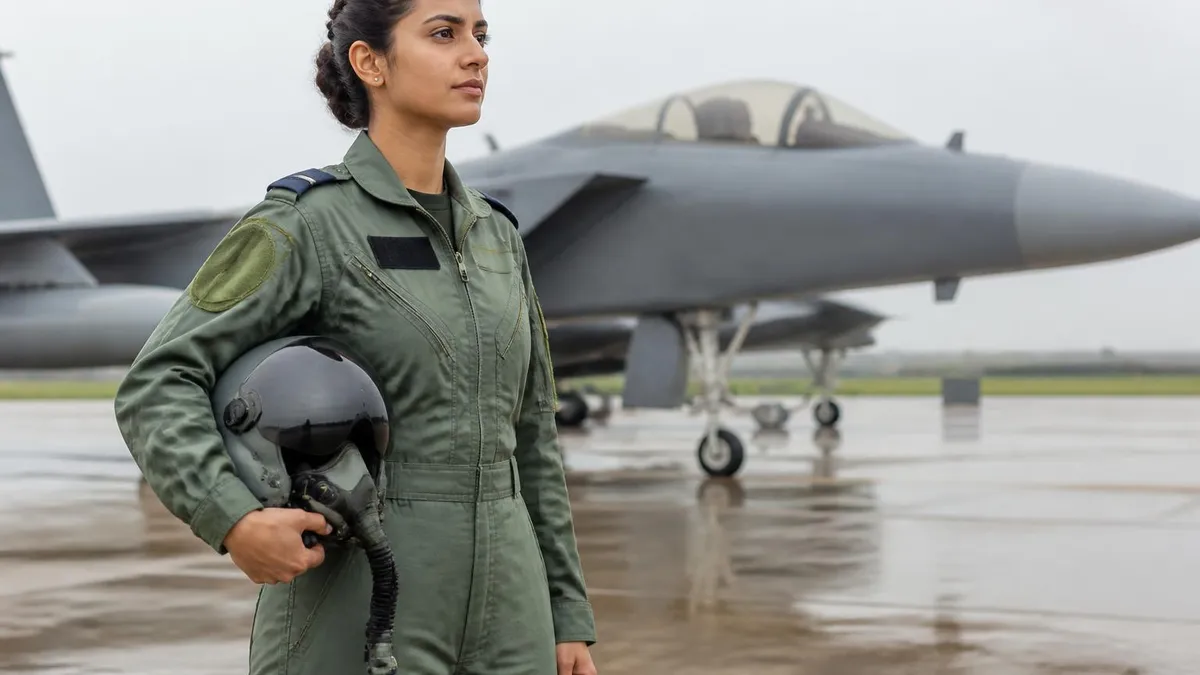
AFCAT Complete Guide: Air Force Common Admission Test Preparation, Syllabus & Strategy
About the Author

Educational Psychologist & Academic Test Preparation Expert
Columbia University Teachers CollegeDr. Lisa Patel holds a Doctorate in Education from Columbia University Teachers College and has spent 17 years researching standardized test design and academic assessment. She has developed preparation programs for SAT, ACT, GRE, LSAT, UCAT, and numerous professional licensing exams, helping students of all backgrounds achieve their target scores.