
JACS Journal American Chemical Society: The Complete Guide to the World's Most Cited Chemistry Publication
Discover the JACS journal American Chemical Society publishes — history, impact factor, submission tips & why it matters. 📚 Complete 2026 guide.
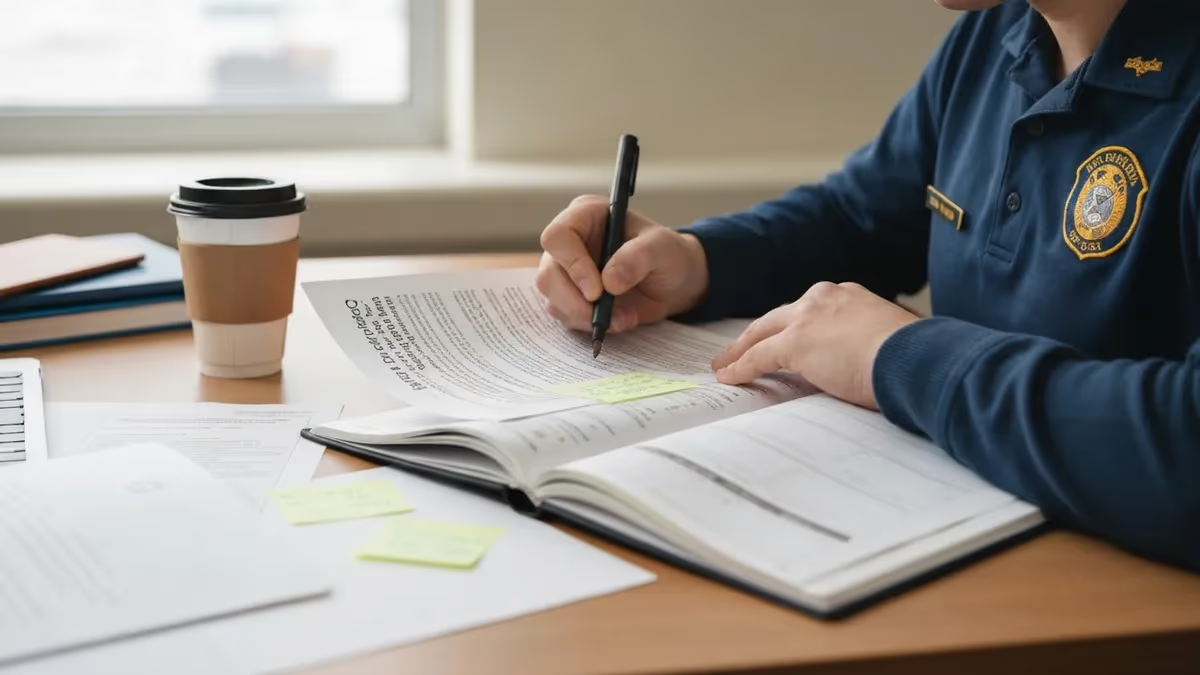
The JACS journal American Chemical Society publishes — formally known as the Journal of the American Chemical Society — stands as the single most influential peer-reviewed chemistry publication in the world. Founded in 1879, JACS has spent nearly 150 years setting the benchmark for what rigorous, significant chemical science looks like. Every week, thousands of researchers worldwide submit their best work hoping to earn a place in its pages, making acceptance one of the most coveted milestones in a chemist's career.
JACS covers the full breadth of chemical science: organic synthesis, inorganic coordination chemistry, physical chemistry, analytical methods, biochemistry, materials science, and computational chemistry all find a home within its scope. Rather than narrowing to a single subdiscipline, the journal deliberately cultivates cross-disciplinary dialogue, often publishing back-to-back studies that bridge what would otherwise be siloed fields. This interdisciplinary identity is central to its reputation and its outsized influence on how chemistry evolves.
Understanding JACS is not just useful for working researchers — it is essential knowledge for anyone studying chemical sciences at the advanced undergraduate or graduate level. Exam boards, professional certification programs, and graduate admissions committees frequently expect candidates to demonstrate familiarity with premier literature sources. Knowing what JACS publishes, how it evaluates submissions, and why its impact factor matters can sharpen both your academic perspective and your ability to answer knowledge-based questions on standardized assessments.
The journal operates under a rigorous double-blind peer-review system, meaning neither authors nor reviewers know each other's identities during evaluation. This structure is designed to eliminate bias and ensure that every manuscript is judged solely on scientific merit. Editors — themselves active researchers at leading institutions — first screen submissions for scope and novelty before forwarding qualified manuscripts to two or three external expert reviewers. This multi-stage vetting is why JACS acceptance rates hover below 30 percent in most years.
JACS publishes several distinct article types, including full Research Articles, Communications (short high-impact reports), Perspectives (invited synthesis pieces by leading scholars), and Reviews (comprehensive surveys of emerging subfields). Each format serves a different communication purpose. A Communication might announce a breakthrough catalytic method in four concise pages, while a full Research Article provides the exhaustive experimental detail needed for replication. Perspectives invite senior scientists to chart future directions for an entire area of inquiry.
For students preparing for ACS-affiliated exams or professional development assessments, the jacs journal represents the gold standard of primary literature. Citations to JACS appear across ACS exam study guides, textbook footnotes, and course syllabi from introductory courses through doctoral seminars. Engaging with even a handful of JACS abstracts builds scientific reading fluency and exposes you to the vocabulary and reasoning patterns that appear in high-stakes chemistry testing.
This guide walks through everything you need to know about JACS — its history, editorial standards, impact metrics, submission process, and its broader role within the American Chemical Society ecosystem. Whether you are a student, a researcher, or simply a curious learner exploring the chemistry publishing landscape, you will leave with a clear, practical understanding of why JACS matters and how to engage with it strategically.
ACS: upcoming dates and official changes
- Updated Oct 26, 2026: Delivery is now Secure, proctored administration by authorized staff (previously Secure, proctored administration).
- Updated Oct 26, 2026: Delivery (Paper exam administration) is now Paper test booklet and answer sheet; non-programmable calculators only (previously Test booklet and answer sheet).
- Updated Oct 26, 2026: Eligibility (Institutional ordering) is now Sold to institutions; the department chair requests the order form (previously Department chair requests the order form).
Facts verified Oct 27, 2026 against ACS Division of Chemical Education Examinations Institute (ACS Exams), University of Wisconsin–Milwaukee. Dates that have passed are removed automatically.
- The 2025 ACS General-Organic-Biochemistry Condensed exam (GB25D) has 60 questions with a 55-minute time limit. (ACS Division of Chemical Education Examinations Institute (ACS Exams), University of Wisconsin–Milwaukee)
- The 2021 ACS General Chemistry Full Year exam (GC21) has 70 questions with a 110-minute time limit. (ACS Division of Chemical Education Examinations Institute (ACS Exams), University of Wisconsin–Milwaukee)
- For ACS Exams, students may bring non-programmable calculators but no reference material, because the required reference data is printed in each test booklet. (ACS Division of Chemical Education Examinations Institute (ACS Exams), University of Wisconsin–Milwaukee)
- Under the ACS Exams 2026 price list (effective January 1–December 31, 2026), institutions pay $2.50 per General Chemistry exam copy for 25–95 copies, falling to $1.75 each for 500 or more; shipping is extra. (ACS Division of Chemical Education Examinations Institute (ACS Exams), University of Wisconsin–Milwaukee)
- The official ACS Exams study guides for General, Organic, Physical Chemistry and Biochemistry cost $30.00 each. (acsexamsinstitute.com)
- ACS Exams must be given in a secure environment, proctored by authorized personnel for the whole exam, and test takers may not have camera-capable devices. (ACS Division of Chemical Education Examinations Institute (ACS Exams), University of Wisconsin–Milwaukee)
- For normed ACS Exams, each student gets a test booklet, pencil, answer sheet and scratch paper, and may use a non-programmable calculator but no reference material. (ACS Division of Chemical Education Examinations Institute (ACS Exams), University of Wisconsin–Milwaukee)
- ACS Exams are ordered by institutions, not students: the order form must be requested by the department chair, and the chair must sign it. (ACS Division of Chemical Education Examinations Institute (ACS Exams), University of Wisconsin–Milwaukee)
- ACS Exams produces score reports within 24 hours of receiving scanned or mailed answer sheets; answer sheets are no longer sold, and a copyable sheet comes with every order. (ACS Division of Chemical Education Examinations Institute (ACS Exams), University of Wisconsin–Milwaukee)
Facts verified Oct 27, 2026 against ACS Division of Chemical Education Examinations Institute (ACS Exams), University of Wisconsin–Milwaukee. Dates that have passed are removed automatically.
ACS Exam at a Glance
Facts verified Oct 27, 2026 against ACS Division of Chemical Education Examinations Institute (ACS Exams), University of Wisconsin–Milwaukee. Dates that have passed are removed automatically.
JACS Journal by the Numbers
History & Structure of JACS
Founded in 1879
Early 20th Century Growth
Digital Transition (1990s–2000s)
Open Access Evolution (2010s)
Modern JACS Au Launch (2021)
The impact factor of JACS has consistently placed it among the top five most cited journals in all of chemistry, a distinction that carries enormous weight in academic hiring, grant review, and tenure decisions. As of the most recent Journal Citation Reports cycle, JACS carried an impact factor of approximately 15.4, meaning each article published in the journal receives an average of over fifteen citations within two years of publication. For context, most specialty chemistry journals operate with impact factors below five.
What does a high impact factor mean in practical terms? It signals that JACS articles are not only read widely but actively built upon by subsequent research across the globe. When a synthetic chemist in Germany develops a new catalytic method, she searches JACS first. When a materials scientist in South Korea needs benchmark data on conductive polymers, JACS archives are his primary reference. This citation velocity reflects both the journal's topical breadth and the trust the global chemistry community places in its editorial vetting process.
JACS reaches authors and readers in more than 180 countries. The editorial board itself is internationally diverse, featuring prominent researchers from North America, Europe, Asia, and Australasia. This geographical spread is intentional: the journal's editors recognize that chemical innovation is globally distributed, and a purely American editorial lens would systematically undervalue breakthrough science emerging from laboratories in China, India, Japan, and across Europe. The result is a publication that genuinely reflects the international character of modern chemistry.
The journal's reach extends beyond professional researchers. University libraries at virtually every research-intensive institution worldwide subscribe to JACS, making it accessible to graduate students during their literature reviews and qualifying exam preparation. Many undergraduate honors programs now require seniors to read and critically analyze at least one JACS article as part of their capstone projects, exposing the next generation of chemists to primary literature standards early in their development.
Citation analysis tools like Web of Science, Scopus, and Google Scholar all track JACS as a top-tier source. When researchers build literature maps of any major chemistry subfield — whether that is asymmetric catalysis, metal-organic frameworks, or CRISPR-based chemical biology — JACS articles reliably cluster at the center of the citation network, indicating foundational importance rather than peripheral contribution. This structural centrality is what distinguishes JACS from thousands of other chemistry periodicals.
For students sitting ACS professional examinations or graduate qualifying exams, understanding the landscape of chemistry publishing — and JACS's place within it — is genuinely testable knowledge. Exam questions may reference landmark discoveries first reported in JACS, ask students to evaluate research methodologies typical of high-impact publications, or probe understanding of peer review and scientific communication. Familiarity with the journal's scope and standards strengthens the conceptual framework you bring to any chemistry assessment.
The American Chemical Society publishes over 80 peer-reviewed journals in total, but JACS remains the crown jewel — the publication where the most significant, most broadly relevant chemical discoveries are announced to the world. Its position at the top of chemistry's publishing hierarchy has been maintained not through institutional inertia but through consistently rigorous editorial standards applied decade after decade, attracting the field's best work in a self-reinforcing cycle of quality and prestige.
Article Types & Submission Process in JACS
Full Research Articles are the backbone of JACS, presenting complete experimental investigations with exhaustive methods, results, and discussion sections. These manuscripts typically run 8 to 12 published pages and include detailed synthetic procedures, spectral characterization data, and statistical analyses. Authors must demonstrate that their findings represent a significant conceptual advance — incremental improvements to known methods are rarely accepted at this article length. Reviewers scrutinize every experimental claim for reproducibility and logical consistency.
The submission process for a Research Article begins with an online precheck through the ACS Paragon Plus system, where authors upload a manuscript, cover letter, and any supporting information files. Editors perform an initial scope and novelty screening within one to two weeks before sending qualifying manuscripts out for external peer review. Two to three expert reviewers evaluate the work and return detailed critiques, which authors must address in a point-by-point response letter. The typical time from initial submission to first decision is four to six weeks.

Publishing in JACS: Advantages and Challenges
- +Instant global visibility to over 180 countries of active chemistry researchers
- +An acceptance in JACS significantly strengthens graduate school applications and faculty job searches
- +High impact factor amplifies citation counts, boosting your h-index and research profile
- +Editorial board connections may open doors to invited reviews and conference invitations
- +Rigorous peer review improves manuscript quality before it reaches the permanent scientific record
- +Open-access options via ACS AuthorChoice allow compliance with NIH and NSF public access mandates
- −Acceptance rates below 30 percent mean most submitted manuscripts are rejected
- −Peer review can take four to eight weeks, delaying dissemination of urgent findings
- −Article processing charges for open-access publication can exceed $4,000 per article
- −Incremental or narrow-scope studies are routinely desk-rejected regardless of technical quality
- −High visibility amplifies scrutiny — errors in JACS articles attract swift public criticism from peers
- −Competition from well-resourced international groups can disadvantage labs with fewer resources
How to Read and Use JACS Effectively
- ✓Start with the abstract and TOC graphic to quickly assess whether the article is relevant to your needs.
- ✓Read the introduction section carefully to understand what gap in knowledge the authors claim to address.
- ✓Examine the figures and tables before reading the full results text to form your own interpretations.
- ✓Critically evaluate the experimental methods section to assess reproducibility and potential limitations.
- ✓Check the Supporting Information file for raw data, NMR spectra, and detailed synthetic procedures.
- ✓Use ACS SciFinder or Web of Science to trace how the article cites earlier JACS and journal work.
- ✓Search for papers that have cited this article since publication to track how the field has built on it.
- ✓Note the institutional affiliations of authors to map where leading research groups are working globally.
- ✓Set up keyword alert emails through ACS Publications to receive new JACS articles in your subfield weekly.
- ✓Practice summarizing each article in three sentences to build the literature synthesis skills exams test.
JACS Abstracts Are Free — Use Them for Exam Prep
Even without full institutional access, every JACS abstract is freely available on the ACS Publications website. Reading 10 to 15 JACS abstracts in your exam's subject area — organic chemistry, analytical methods, biochemistry — builds the vocabulary and conceptual fluency that separates high scorers from average performers on ACS-style assessments. Abstracts also model how experts frame scientific claims concisely, a skill directly tested in literature interpretation questions.
Within the academic and professional landscape of chemistry, a publication record in JACS carries a weight that few other credentials can match. Faculty hiring committees at research-intensive universities routinely treat first-author JACS publications as a primary screening criterion, often using them to distinguish finalists from a large applicant pool. This is not mere prestige signaling — it reflects a rational inference that a researcher who has navigated JACS's demanding peer review has demonstrated both scientific rigor and the ability to identify problems of broad significance.
For graduate students, the strategic question of when and whether to target JACS is a genuine career decision. Publishing one strong JACS paper during doctoral training can open doors that a larger number of publications in lower-impact specialty journals might not. Advisors at top chemistry programs often counsel their students to save their most novel, most broadly relevant findings for JACS submissions, reserving more specialized work for field-specific journals where it will reach its most targeted audience without competing against the journal's broader scope requirements.
Postdoctoral researchers face a similar calculus. A JACS paper completed during a postdoctoral fellowship signals productivity and independence at a critical career stage, when faculty hiring committees are evaluating a candidate's potential to build a competitive research program. Funding agencies including the National Science Foundation and the National Institutes of Health also track publication venues during grant review, and a JACS record supports claims of research excellence in any competitive funding application.
Beyond individual career trajectories, JACS plays a structural role in how chemistry as a discipline allocates prestige and resources. The journals where discoveries are first published shape which research programs receive sustained funding, which graduate programs attract the best students, and which intellectual directions gain enough momentum to become established subfields. JACS, by consistently selecting the most significant cross-cutting science, functions as a kind of informal roadmap for where the field's frontier is currently located and where it is likely to move next.
Industrial chemists and R&D scientists at pharmaceutical, materials, and energy companies also read JACS regularly. Drug discovery teams scan JACS for new synthetic methodologies that might simplify the production of active pharmaceutical ingredients. Battery researchers track JACS for electrolyte chemistry and electrode materials innovations. This industrial readership ensures that JACS research does not remain purely academic — it flows into applied technology pipelines with real-world consequences for healthcare, energy, and advanced manufacturing.
The ACS itself uses JACS's reach and reputation as a cornerstone of its broader scientific communication mission. JACS press releases, distributed through ACS Newsroom, frequently generate coverage in outlets like Science, Nature News, Chemical and Engineering News, and even mainstream publications when discoveries have clear public relevance. This amplification infrastructure means that a JACS publication can reach not just the chemistry community but also science journalists, policymakers, and educated general audiences worldwide.
For anyone deepening their understanding of the American Chemical Society's broader role in science — whether to prepare for an ACS exam or to navigate a chemistry career — recognizing JACS as more than a journal, but as an institution within an institution, is essential context. Its editorial decisions, its acceptance criteria, and its citation network all shape the intellectual culture of chemistry in ways that ripple through graduate education, industrial innovation, and public understanding of chemical science for decades after each article is published.
Many readers pair this guide with the acs general chemistry study guide to check their readiness before exam day.

Full-text access to JACS requires either an institutional library subscription or an ACS membership that includes publications access. Graduate students and faculty at subscribing universities can access all JACS content through the ACS Publications portal at no additional cost. Individual ACS members can also purchase all-access plans. If you lack access, many authors post preprints on ChemRxiv, ACS's own preprint server, before or alongside formal publication.
Preparing for ACS-affiliated examinations — whether a standardized undergraduate final, a graduate qualifying exam, or a professional certification assessment — benefits directly from strategic engagement with primary chemistry literature. JACS, as the field's leading general journal, provides a rich archive of the landmark experiments, analytical methods, and theoretical frameworks that ACS exams draw from when constructing rigorous, research-aligned questions. Understanding how published chemical science is structured and communicated is itself a testable competency.
The ACS Exams Institute, which develops standardized chemistry assessments used by hundreds of universities, explicitly grounds its test blueprints in the research literature of each subdiscipline. Questions on organic chemistry exams may reference stereochemical concepts first systematically investigated in JACS papers from the 1960s through the 1990s. Analytical chemistry assessments test spectroscopic interpretation skills developed through decades of JACS publications establishing NMR, mass spectrometry, and chromatographic standards. Knowing the publication ecosystem helps you understand why exam questions are framed the way they are.
A practical exam preparation strategy involves reading JACS abstracts in your target subject area alongside your primary study materials. This dual approach reinforces conceptual vocabulary, exposes you to the precision of language that chemistry assessments reward, and helps you develop the habit of connecting general principles to specific experimental contexts. Many ACS exam questions present short experimental vignettes — a scenario that mirrors the structure of a JACS abstract far more than it resembles a textbook problem set.
Online resources curated by the ACS, including the ACS Publications website and the ACS Learning Center, provide structured pathways into the primary literature for students at all levels. The ACS Virtual Collection archives thematic groupings of JACS and other ACS journal articles organized around topics like green chemistry, materials science, and chemical biology, making literature exploration more manageable for exam-focused students who cannot afford to browse freely across thousands of unfiltered articles.
Study groups that incorporate primary literature discussion — reading a short JACS Communication together and discussing its methodology, conclusions, and limitations — develop the analytical reasoning skills that separate exceptional exam performers from good ones. This practice aligns with the pedagogical philosophy underlying ACS exam design: the goal is not to test memorized facts but to assess the ability to reason scientifically from evidence, exactly as JACS peer reviewers and editors do when evaluating submitted manuscripts.
For those specifically preparing for ACS organizational knowledge questions — covering the society's history, structure, publications, and awards — understanding the flagship role of JACS within the ACS ecosystem is essential. Questions about ACS's scientific communication activities, its publication portfolio, or its influence on global chemistry will almost always have JACS as a central reference point. Knowing its founding date (1879), its article types, its peer-review model, and its impact factor arms you with the specific factual knowledge these questions require.
The practice quizzes available through PracticeTestGeeks are designed to reinforce exactly this kind of organizational and scientific literacy. By combining targeted quiz practice with engagement with real JACS content — even at the abstract level — you build the layered understanding that makes chemistry assessments not just passable but genuinely illuminating. The goal is not to memorize the right answers but to develop the chemical reasoning and institutional awareness that make correct answers feel obvious rather than guessed.
Developing a practical relationship with JACS does not require a university library card or a research position. The ACS Publications website makes abstracts, TOC graphics, and in many cases full author manuscripts freely accessible through the ACS AuthorChoice open-access provisions or author self-archiving on ChemRxiv. Starting with five to ten abstracts per week in your exam's primary subject area is a manageable commitment that pays significant dividends over a semester of preparation.
When you read a JACS abstract, train yourself to extract four pieces of information: the problem being addressed, the approach the authors used to address it, the key result they obtained, and the significance they claim for that result. This four-part reading framework maps directly onto the structure of many ACS exam vignette questions, which present a simplified experimental scenario and ask you to evaluate methodology, interpret results, or assess implications. Practicing this extraction process on real JACS content sharpens the same cognitive skills the exam is testing.
Pay particular attention to the language of significance in JACS articles. Phrases like "unprecedented selectivity," "first reported example," "challenges the prevailing model," and "enables a previously inaccessible class of compounds" are not mere rhetoric — they signal precisely the kind of conceptual advance that JACS editors require for acceptance. Recognizing this language helps you develop a sense of what constitutes a meaningful scientific contribution, which in turn helps you evaluate experimental scenarios on assessments with greater confidence and nuance.
For students preparing specifically for ACS organizational awareness questions, it helps to know the governance relationship between JACS and the ACS as an institution. JACS is owned and published by the American Chemical Society, with revenue from subscriptions and article processing charges contributing to ACS's broader mission of advancing chemistry education, advocacy, and professional development. The journal is governed by an editor-in-chief supported by a large international associate editor team, all of whom are volunteer academics rather than paid editorial staff — a structure common across ACS's publication portfolio.
Building a reading habit around JACS also helps contextualize the specific subdisciplines and methodological approaches you encounter in coursework and on exams. When you study carbonyl chemistry in organic lecture and then read a JACS abstract on enantioselective aldol reactions, the connection between textbook principles and frontier research becomes visceral rather than abstract. This kind of conceptual bridging accelerates deep learning in ways that problem set repetition alone cannot achieve.
Finally, remember that JACS is not an intimidating monolith reserved for faculty and doctoral students — it is a public intellectual resource that belongs to the entire chemistry community. The American Chemical Society was founded on the conviction that chemistry thrives when knowledge flows freely among practitioners at all career stages.
Engaging with JACS as a student, even in the limited way of reading abstracts and scanning TOC graphics, is an act of participation in that community, not presumption. The journal exists to advance chemical science broadly, and your engagement with it — however early in your career — is exactly the kind of readership the ACS and JACS editors intend to cultivate.
ACS Questions and Answers

ACS Science Releases December 09 2020: What the American Chemical Society Published and Why It Matters
Journal Impact Factor Directory for the American Chemical Society
ACS Organic Chemistry Study Guide: Complete 2026 Prep Roadmap for the American Chemical Society Exam

Is ACS Open? Understanding the American Chemical Society's Structure, Membership & Mission

ACS General Chemistry Practice Test: Complete 2026 Prep Guide for the American Chemical Society Exam
How this page was made: written with AI tools and published by Nathan Beja, founder of Practice Test Geeks, who is responsible for its content. Exam facts are checked against the official sources listed below. Not reviewed by a subject-matter expert. Editorial policy
Sources & references
Exam facts on this page (fees, format, dates, passing scores) are checked against these official sources; the date is our last check. Editorial policy
- uwm.edu — Score release, test delivery, time limit, exam format, fees, eligibility · verified Oct 2026
- acsexamsinstitute.com — Fees · verified Oct 2026