
American Chemical Society 2026 — ACS Membership, Exams, and Certifications
❓ Boost your American Chemical Society 2026 exam score with practice questions and detailed answer explanations. Track progress with instant feedback.
ACS Standardized Exams
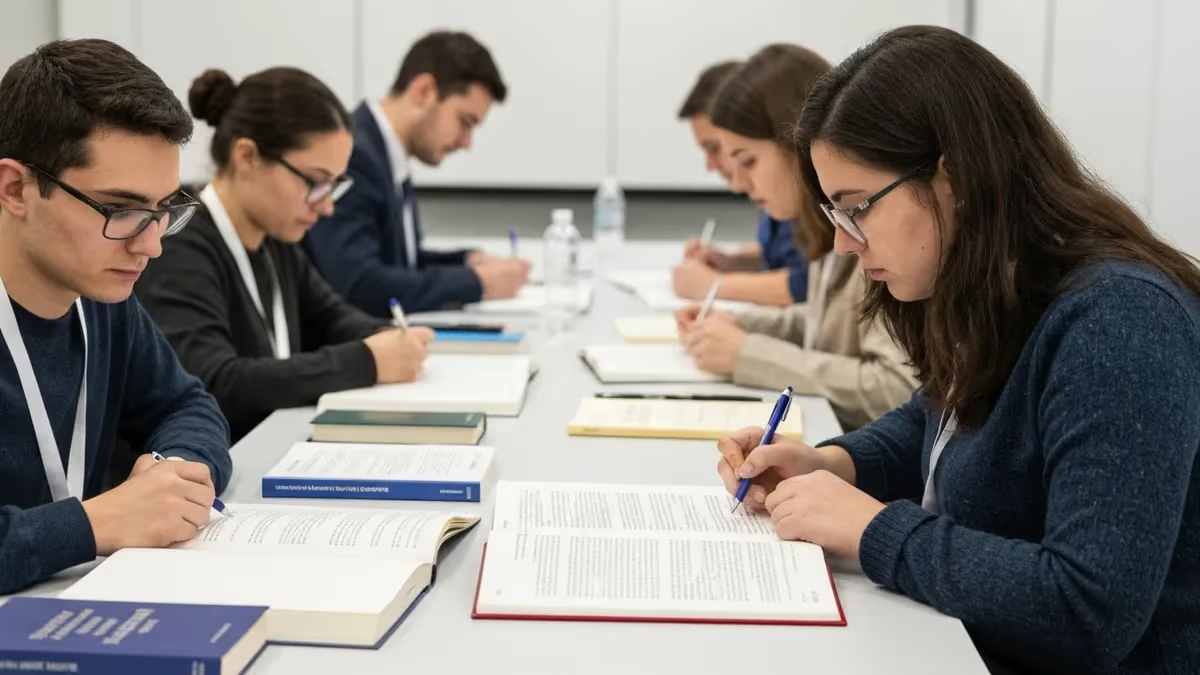
ACS Exams Institute produces and administers standardized chemistry exams used by colleges and universities throughout the United States. If your professor gives a final exam from the ACS, it is one of these standardized assessments — the scores are norm-referenced against national student populations.
Most common ACS exams by course level:
- General Chemistry I and II ACS Exam: The most frequently administered ACS exam. Tests stoichiometry, atomic structure, bonding, gases, thermodynamics, kinetics, equilibrium, electrochemistry, and descriptive chemistry. Multiple choice, 70–110 questions, 110 minutes.
- Organic Chemistry I and II ACS Exam: Tests nomenclature, reaction mechanisms, stereochemistry, spectroscopy (IR, NMR, MS), and functional group reactions. 70 questions, 110 minutes.
- Physical Chemistry ACS Exam: Covers thermodynamics, quantum mechanics, statistical mechanics, and kinetics at the physical chemistry level. More mathematically intensive than general or organic chemistry ACS exams.
- Analytical Chemistry ACS Exam: Tests quantitative analysis, equilibrium calculations, spectroscopy, and chromatography.
- Biochemistry ACS Exam: Tests amino acids, proteins, enzymes, metabolism, DNA/RNA, and cell signalling at the biochemistry level.
How ACS exams are scored: ACS exams report scores as a percentile based on the national norming group — not as a raw percentage. A score at the 50th percentile means you performed better than 50% of all students who took that exam nationally. Many departments set a minimum percentile (often 40th–60th) for a passing grade on the ACS final.
Preparing for an ACS exam: ACS Exams Institute sells official study guides and previous exam editions at acsexams.com. The official study guide for each exam is the most targeted prep resource — it shows the content breakdown by topic and includes practice questions written in ACS format. Third-party prep books (Orgo Made Easy, ACS General Chemistry study guides) are also available.
ACS for Chemistry Students
For chemistry students, the most important ACS interactions are typically:
ACS Exams (college finals): Understanding the ACS exam format is critical when your professor uses an ACS standardized final. Key preparation strategies:
- Buy the official ACS study guide for your specific course from acsexams.com
- Practice the question style — ACS questions are conceptual and calculation-based, not definition-heavy
- Know the topic breakdown: the study guide tells you exactly how many questions come from each content area
- Aim to understand concepts rather than memorize — ACS exams test application and reasoning
ACS Olympiad: The ACS US National Chemistry Olympiad (USNCO) is a multi-round competition for high school students. Top performers compete at the national level, with the highest scorers representing the US at the International Chemistry Olympiad (IChO). Contact your high school chemistry teacher or local ACS section about participating.
ACS Student Affiliates: Student chapters of ACS at universities host outreach events, professional development workshops, and networking with local industry. Active participation in an ACS Student Affiliate chapter demonstrates professional engagement on a graduate school or job application.
ACS Career and Professional Development
ACS supports chemistry career development across the professional lifecycle:
- ACS Careers job board (acs.org/careers): Job postings in chemistry, biochemistry, pharmaceutical, materials, environmental, and chemical engineering sectors
- Salary survey: ACS publishes an annual comprehensive salary survey of chemistry professionals by degree level, sector, experience, and geography — useful benchmarking data
- Professional development workshops: National and regional ACS meetings (Spring and Fall) include career workshops, networking receptions, and employer meetups
- ACS Webinars: Free and member-only webinars on chemistry topics and career skills
ACS National Meetings: ACS holds two major national meetings per year (Spring and Fall) attracting 10,000–20,000 chemists. These are significant networking and career development events for chemistry professionals and students — poster presentations, symposia, and employer recruiting all happen at national meetings.
- ✓Review the official ACS exam content outline
- ✓Take a diagnostic practice test to identify weak areas
- ✓Create a study schedule (4-8 weeks recommended)
- ✓Focus on your weakest domains first
- ✓Complete at least 3 full-length practice exams
- ✓Review all incorrect answers with detailed explanations
- ✓Take a final practice test 1 week before exam day
- +Industry-recognized credential boosts your resume
- +Higher earning potential (10-20% salary increase on average)
- +Demonstrates commitment to professional development
- +Opens doors to advanced career opportunities
- −Exam preparation requires significant time investment (4-8 weeks)
- −Certification fees can be $100-$400+
- −May require continuing education to maintain
- −Some employers may not require certification
American Chemical Society Questions and Answers
More Science and Professional Resources
How this page was made: written with AI tools and published by Nathan Beja, founder of Practice Test Geeks, who is responsible for its content. Exam facts are checked against the official sources listed below. Not reviewed by a subject-matter expert. Editorial policy
Sources & references
Exam facts on this page (fees, format, dates, passing scores) are checked against these official sources; the date is our last check. Editorial policy
- uwm.edu — Exam format, time limit, test delivery, score release, fees, eligibility · verified Oct 2026