
7D Pupil Driver Exam: A Complete Guide to Passing the Test 2026 September
📚 Get ready for your 7D Pupil Driver certification. Practice questions with step-by-step answer explanations and instant scoring.
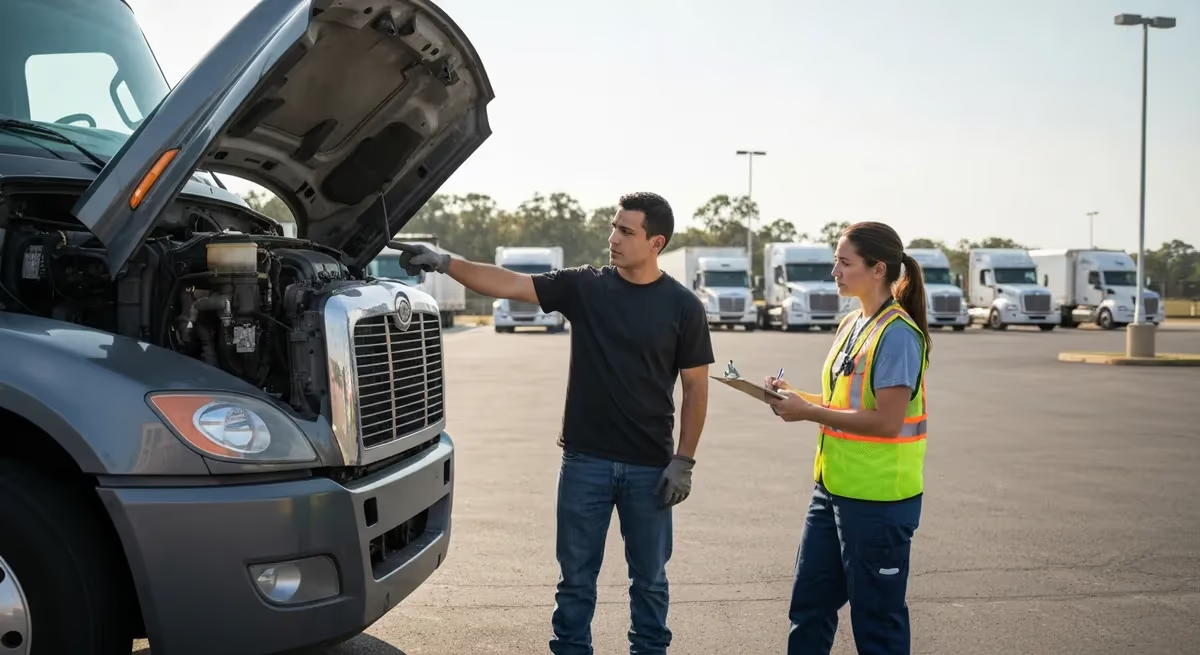
If you're planning to transport students in Massachusetts, the 7D pupil driver exam stands between you and a rewarding career behind the wheel. This isn't your standard road test — it's a specialized assessment that covers child safety protocols, vehicle inspection procedures, and state-specific regulations that every school bus operator needs to master. Whether you're brand new to the field or transitioning from another driving role, this 7D pupil driver exam a complete guide to passing the test will walk you through everything from application requirements to test-day strategy.
Getting your commercial driver's license opens doors across the transportation industry, but the 7D certificate targets a very specific niche — transporting school-age children in vehicles that seat 16 passengers or fewer. Unlike the full CDL, you won't need to operate an 18-wheeler. You will, however, need to demonstrate that you can keep kids safe in situations most drivers never think about. It's a responsibility that carries real weight, and the exam reflects that.
Every truck driver on the road has passed some version of a knowledge and skills test, but the 7D adds layers of child-specific safety that make it unique. From emergency evacuation drills to railroad crossing protocols, the material is dense. Don't let that intimidate you, though. With the right preparation — and this guide — you can walk into your testing appointment with genuine confidence. Let's break down what you're facing, how to study effectively, and the mistakes that trip up most first-time test-takers.

Before you start memorizing traffic laws and evacuation procedures, you need to understand the bigger picture. The 7D certificate is Massachusetts-specific — it doesn't exist in most other states. It was created because the Commonwealth treats student transportation differently than the federal CDL framework does. If you already hold a CDL, some of the material will feel familiar. If you're coming from a background as a truck driver in another sector, expect a learning curve around child safety content that goes well beyond standard road rules.
Your driver license renewal schedule matters here, too. Massachusetts ties the 7D certificate to your base license, so if your underlying license lapses, your 7D goes with it. Set calendar reminders — losing your certification because you forgot a renewal date is more common than you'd think. The RMV won't send you a courtesy reminder, and your employer can't legally let you drive without current credentials.
The exam itself gets updated periodically. The immigrant commercial driver's license lawsuit brought national attention to how states handle testing accommodations, and Massachusetts has since expanded language support options. If English isn't your first language, ask about available translations when you schedule your appointment. The testing center staff are required to inform you of your options, but proactive candidates get better results.
One of the first questions people ask when considering this career path is how much do truck drivers make — and the answer varies wildly depending on your specific role. A long-haul freight driver and a school van operator live in different financial worlds. 7D pupil drivers in Massachusetts typically earn between $18 and $28 per hour, with experienced drivers in urban districts pushing past $30. That's not wealth-building money, but the schedule is hard to beat: mornings and afternoons, summers off if you want them, and holiday breaks built into the calendar.
The Spanish-speaking community in Massachusetts has shown strong interest in 7D certification, and the examen de manejo preparation resources have expanded considerably. The RMV now offers study materials in multiple languages, though the actual exam format remains standardized. Practice tests in your preferred language can help you build confidence before switching to the English version if needed.
Benefits often sweeten the compensation package beyond the hourly rate. Many school districts offer health insurance, retirement contributions, and paid training days. Some districts even cover the cost of your initial 7D certification, including the exam fee and background check. If you're comparing this to other entry-level transportation jobs, factor in the total package — not just the paycheck.
CDL Study Tips
What's the best study strategy for CDL?
Focus on weak areas first. Use practice tests to identify gaps, then study those topics intensively.
How far in advance should I start studying?
Most successful candidates begin 4-8 weeks before the exam. Create a structured study schedule.
Should I retake practice tests?
Yes! Take each practice test 2-3 times. Focus on understanding why answers are correct, not memorizing.
What should I do on exam day?
Arrive 30 min early, bring required ID, read questions carefully, flag difficult ones, and review before submitting.
What the 7D Exam Covers
The written portion tests your knowledge of Massachusetts regulations specific to pupil transportation. Expect questions on pre-trip inspections, student loading and unloading zones, emergency procedures, and railroad crossing rules. You'll also see questions about driver conduct standards — things like cell phone policies, interaction with students, and mandatory reporting requirements. The passing threshold is 80%, which means you can miss about 10 questions out of 50. Study the Massachusetts School Pupil Transport Regulations document — it's the source material for roughly 70% of the questions.
Let's talk money in more detail, because it affects your decision to pursue this path. The truck driver salary conversation gets complicated when you drill into specializations. A flatbed hauler in Texas earns differently than a 7D van operator in Boston — but both fall under the broad "commercial driver" umbrella. For Massachusetts 7D drivers specifically, the median annual income hovers around $38,000 to $45,000 for a typical split-shift schedule. That number climbs if you pick up field trip routes, athletic event transportation, or summer program driving.
You might hear people talk about a "truck truck driver" earning six figures, and while that's possible in long-haul or specialized freight, it's not the 7D reality. What the 7D offers instead is lifestyle balance. You're home every night. You're off when school's out. You're not sleeping in truck stops or missing your kid's soccer game. For many drivers, that trade-off is worth more than the salary gap.
Districts with higher costs of living — think Greater Boston, Cambridge, Brookline — tend to pay at the upper end of the scale. Rural western Massachusetts districts pay less but often provide take-home vehicle privileges, which eliminates a commute expense. Run the full numbers before you choose where to apply. A district that pays $2 less per hour but covers your health insurance might save you $400 a month — that math matters.
Understanding truck driver earning potential across the industry helps you contextualize where the 7D fits. Entry-level positions in freight pay $40,000-$50,000, but they demand 60-hour weeks and extended time away from home. The 7D's split-shift structure — typically 6:00-9:00 AM and 2:00-4:30 PM — means you're working about 5.5 hours per day during the school year. Hourly, that's competitive with many trucking jobs. It just doesn't stack up in annual totals because you're working fewer hours.
For Spanish-speaking candidates, the examen de licencia de conducir preparation resources have improved dramatically over the past five years. Massachusetts now partners with community organizations to offer bilingual study groups and practice sessions. These aren't just translated materials — they're culturally adapted programs that address common confusion points specific to candidates whose driving education happened in Latin American countries with different road rule frameworks.
Side gigs fill the midday gap for many 7D drivers. Some drive for ride-share services. Others work part-time retail or food service. A few entrepreneurial types run their own small delivery operations during school hours. The schedule flexibility is genuinely unusual in the transportation industry, and smart drivers leverage it.
7D Pupil Driver Career: Pros and Cons
- +Split-shift schedule means you're home every night and free during midday hours
- +Summers, holidays, and school breaks off — or optional extra driving for field trips and athletics
- +Many districts cover certification costs including exam fees and background checks
- +Health insurance and retirement benefits available in most public school districts
- +No long-haul driving — all routes are local with predictable, short distances
- +Growing demand as Massachusetts faces a persistent shortage of qualified pupil transport drivers
- −Annual income is lower than full-time trucking positions due to fewer total working hours
- −Early morning start times (5:30-6:00 AM) can be difficult for night owls to sustain long-term
- −Managing student behavior adds stress that freight drivers never deal with
- −Background check disqualifications can surface unexpectedly and end the process
- −Seasonal employment gaps during summer require financial planning or supplemental income
- −Vehicle types vary by district — you may need to adapt to different van and bus configurations
The immigrant commercial driver's license lawsuit that made headlines reshaped how several states — including Massachusetts — approach language accessibility in driver testing. For 7D candidates, this means more accommodations exist than most people realize. Interpreters can be requested for the skills test portion, and translated study materials are available in Spanish, Portuguese, Haitian Creole, and Mandarin. Don't assume you have to struggle through English-only resources if that's not your strongest language.
When calculating pay for truck driver roles against 7D positions, remember to factor in hidden costs. Long-haul truckers pay for meals on the road, laundry at truck stops, and often their own health insurance as independent contractors. A 7D driver eating lunch at home and covered by district health insurance might net more disposable income despite a lower gross salary. The math isn't always obvious.
Your preparation approach matters more than raw study hours. Candidates who pass on the first attempt typically use a combination of the official Massachusetts study guide, practice tests, and peer study groups. Those who fail usually relied on a single resource or tried to cram the night before. Space your studying over two to three weeks minimum — your retention will be dramatically better.
7D Exam Preparation Checklist
- ✓Download and read the full Massachusetts School Pupil Transport Regulations document from the RMV website — this is your primary study source
- ✓Complete all background checks including CORI, SORI, and FBI fingerprints at least 6 weeks before your target test date to avoid delays
- ✓Schedule and pass your DOT physical examination with an approved medical examiner — bring glasses or contacts if you use them
- ✓Enroll in and complete a state-approved pupil transport training program covering 8 to 12 hours of required instruction
- ✓Study pre-trip inspection procedures using the actual vehicle type you'll be driving on test day for accurate muscle memory
- ✓Take at least 3 full-length practice tests and score above 85% consistently before booking your exam appointment
- ✓Review all railroad crossing rules thoroughly — these questions are heavily tested and among the most commonly missed
- ✓Practice student loading and unloading procedures including proper stop-arm deployment timing and mirror usage
- ✓Memorize the complete emergency evacuation drill steps in the correct sequence as specified by Massachusetts regulations
- ✓Get at least 8 hours of sleep the night before your exam — fatigue undermines recall and decision-making under pressure
Your DMV eye examination is one checkpoint that catches candidates off guard. Massachusetts requires corrected vision of 20/40 or better in each eye, and you need adequate peripheral vision as well. If you wear glasses or contacts, bring them. If you haven't had your prescription updated recently, schedule an optometrist visit before your DOT physical — failing the vision screening wastes your physical exam fee and delays your timeline by weeks.
The market for CDL driver jobs remains strong across New England, and 7D-specific positions are particularly hard to fill. School districts in Massachusetts have been raising wages, offering sign-on bonuses, and even providing paid training to attract candidates. If you're on the fence about whether the investment in certification is worthwhile, the supply-demand picture is clear: qualified drivers have leverage right now, and that trend shows no signs of reversing in the next five years.
Networking helps more than most candidates expect. Current 7D drivers at your target district can tell you exactly what the examiner emphasizes, which pre-trip inspection items get the most scrutiny, and what driving errors result in automatic failures. This insider knowledge isn't available in any study guide. Buy a current driver coffee and ask questions — it's the single highest-ROI hour you'll spend during your entire preparation process leading up to exam day.
People often ask what is a commercial driver's license and how it differs from the 7D certificate. Here's the short version: a CDL is a federal credential that allows you to operate vehicles over 26,001 pounds or transport 16+ passengers. The 7D is a Massachusetts state certificate for vehicles carrying 16 or fewer students. You don't need a CDL to get a 7D, but holding a CDL can exempt you from portions of the 7D training. They're complementary credentials, not competing ones.
If you hold a class C driver license — the standard passenger vehicle license in most states — that's your starting point for the 7D path in Massachusetts (it's called a Class D here, but the concept is identical). You don't need to upgrade to a Class A or B unless you plan to drive full-size school buses, which fall under CDL requirements rather than the 7D framework. Understanding this distinction saves candidates from pursuing unnecessary and expensive CDL training.
The testing center environment itself can throw you off if you're not prepared. Rooms are often crowded, the computer terminals are older, and distractions are constant. Practice tests in noisy environments — a coffee shop, a busy library — so the testing center doesn't rattle your concentration. Candidates who've only studied in quiet rooms at home sometimes underperform simply because the environment feels foreign.
The pre-trip inspection portion accounts for a significant chunk of your skills test score. Many candidates focus exclusively on the driving portion and treat the inspection as an afterthought. That's a mistake. You need to verbally identify and check every component — tires, lights, mirrors, emergency equipment, fluid levels, and safety devices — in a systematic order. Practice this out loud until it feels natural, not rehearsed.
Candidates searching for a class a drivers license practice test are usually aiming higher than the 7D, but the knowledge overlap is substantial. Air brake systems, vehicle inspection protocols, and general safety knowledge all appear in both the CDL Class A exam and the 7D written test. If you've already studied for a Class A, you've covered maybe 40% of the 7D material without realizing it. The remaining 60% is child-specific safety content that you won't find in any CDL prep material.
For those exploring the california driver license process as a comparison, Massachusetts operates quite differently. California doesn't have an equivalent to the 7D certificate — they use a different classification system for pupil transport. If you're relocating between states, don't assume your 7D transfers. Each state has its own credentialing framework, and Massachusetts is particularly strict about reciprocity. You'll likely need to retest, though your experience may shorten the training requirement.
The exam's pass rate hovers around 75% for first-time test-takers, which means one in four people fail on their initial attempt. That statistic isn't meant to discourage you — it's meant to motivate serious preparation. The candidates who fail are overwhelmingly those who underestimated the child safety content or skipped practice tests entirely. You're reading this guide, which already puts you ahead of most applicants. Take that advantage seriously and put in the study hours before booking your test date.
CDL Practice Test Questions
Prepare for the CDL - Commercial Driver's License exam with our free practice test modules. Each quiz covers key topics to help you pass on your first try.
CDL Alabama CDL Combination Vehicles Pract...
CDL Exam Questions covering Alabama CDL Combination Vehicles Practice Test. Master CDL Test concepts for certification prep.
CDL Alabama CDL General Knowledge Practice...
Free CDL Practice Test featuring Alabama CDL General Knowledge Practice Test #. Improve your CDL Exam score with mock test prep.
CDL Alabama General Knowledge CDL Practice...
CDL Mock Exam on Alabama General Knowledge CDL Practice Test. CDL Study Guide questions to pass on your first try.
CDL Airbrakes Practice Test
CDL Test Prep for Airbrakes Practice Test. Practice CDL Quiz questions and boost your score.
CDL Air Brakes Practice Test
CDL Questions and Answers on Air Brakes Practice Test. Free CDL practice for exam readiness.
CDL CLASS A COMMERCIAL DRIVER'S LICENSE PR...
CDL Mock Test covering CLASS A COMMERCIAL DRIVER'S LICENSE PRACTICE TEST. Online CDL Test practice with instant feedback.
CDL Class B Commercial Driver's License Pr...
Free CDL Quiz on Class B Commercial Driver's License Practice Test. CDL Exam prep questions with detailed explanations.
CDL Combination Vehicles Practice Test
CDL Practice Questions for Combination Vehicles Practice Test. Build confidence for your CDL certification exam.
CDL Doubles and Triples Practice Test
CDL Test Online for Doubles and Triples Practice Test. Free practice with instant results and feedback.
CDL Doubles Triples Practice Test
CDL Study Material on Doubles Triples Practice Test. Prepare effectively with real exam-style questions.
CDL General Knowledge Practice Test
Free CDL Test covering General Knowledge Practice Test. Practice and track your CDL exam readiness.
CDL General Knowledge Practice Test1
CDL Exam Questions covering General Knowledge Practice Test1. Master CDL Test concepts for certification prep.
CDL Hazardous Materials (Hazmat) Practice ...
Free CDL Practice Test featuring Hazardous Materials (Hazmat) Practice Test. Improve your CDL Exam score with mock test prep.
CDL Hazardous Materials Hazmat Practice Test
CDL Mock Exam on Hazardous Materials Hazmat Practice Test. CDL Study Guide questions to pass on your first try.
CDL Hazmat Practice Test
CDL Test Prep for Hazmat Practice Test. Practice CDL Quiz questions and boost your score.
CDL Passenger Transport Practice Test
CDL Questions and Answers on Passenger Transport Practice Test. Free CDL practice for exam readiness.
CDL Road Signs and Signals Practice Test
CDL Mock Test covering Road Signs and Signals Practice Test. Online CDL Test practice with instant feedback.
CDL School Bus Endorsement Practice Test
Free CDL Quiz on School Bus Endorsement Practice Test. CDL Exam prep questions with detailed explanations.
CDL School Bus Endorsement S Practice Test
CDL Practice Questions for School Bus Endorsement S Practice Test. Build confidence for your CDL certification exam.
CDL Tanker Practice Test
CDL Test Online for Tanker Practice Test. Free practice with instant results and feedback.
CDL Class A Commercial Driver's License Pr...
CDL Study Material on Class A Commercial Driver's License Practice Test -1. Prepare effectively with real exam-style questions.
CDL Class A Driver's License Practice Test -2
Free CDL Test covering Class A Driver's License Practice Test -2. Practice and track your CDL exam readiness.
CDL Class A Driver's License Practice Test -3
CDL Exam Questions covering Class A Driver's License Practice Test -3. Master CDL Test concepts for certification prep.
CDL Class A Driver's License Practice Test -5
Free CDL Practice Test featuring Class A Driver's License Practice Test -5. Improve your CDL Exam score with mock test prep.
CDL Class B Commercial Driver's License Pr...
CDL Mock Exam on Class B Commercial Driver's License Practice Test -2. CDL Study Guide questions to pass on your first try.
CDL Class C CDL with Hazmat Endorsement Pr...
CDL Test Prep for Class C CDL with Hazmat Endorsement Practice Test. Practice CDL Quiz questions and boost your score.
CDL Class C CDL with Hazmat Endorsement Pr...
CDL Questions and Answers on Class C CDL with Hazmat Endorsement Practice Test -2. Free CDL practice for exam readiness.
CDL Class C CDL with Hazmat Endorsement Pr...
CDL Mock Test covering Class C CDL with Hazmat Endorsement Practice Test -3. Online CDL Test practice with instant feedback.
So how much does a truck driver make compared to a 7D operator? The Bureau of Labor Statistics puts the national median for heavy and tractor-trailer truck drivers at $54,320 annually. Massachusetts 7D drivers working a full school-year schedule earn roughly $38,000-$45,000. But here's what the BLS number doesn't tell you: truck drivers average 48-60 hours per week, while 7D drivers work about 27.5 hours weekly during the school year. On a per-hour basis, the gap narrows considerably — and sometimes disappears entirely in high-paying metro districts.
Holding a class a commercial driver's license alongside your 7D certificate creates maximum career flexibility. During the school year, you drive students. During summer break, you can drive freight, tankers, or any other CDL-requiring vehicle. Some drivers earn more in their three summer months of trucking than they do in four months of school-year driving. It's the best of both worlds — if you're willing to invest in both credentials.
Your next step is straightforward: download the Massachusetts study guide today, schedule your background checks this week, and commit to a two-week study plan. The 7D exam isn't designed to trick you — it's designed to confirm you can keep children safe. Approach it with that mindset, prepare thoroughly, and you'll join the thousands of qualified pupil transport drivers who passed before you. The kids are counting on qualified drivers like you. Don't let them down.
CDL Questions and Answers
About the Author

Licensed Driving Instructor & DMV Test Specialist
Penn State UniversityRobert J. Williams graduated from Penn State University with a degree in Transportation Management and has spent 20 years as a certified driving instructor and DMV examiner consultant. He has personally coached thousands of applicants through written knowledge tests, skills assessments, and commercial driver licensing programs across more than 30 states.
Join the Discussion
Connect with other students preparing for this exam. Share tips, ask questions, and get advice from people who have been there.
View discussion (7 replies)