
Written English Proficiency Test (WPT): Complete Career & Study Guide
Master the written english proficiency test with our complete guide — formats, scoring, prep tips & free practice questions. 🏆

The written english proficiency test is a standardized assessment used by employers, government agencies, and educational institutions across the United States to measure how well a candidate can read, comprehend, and respond in written English. Whether you are applying for a position that requires drafting memos, communicating with clients, or creating detailed reports, this test serves as an objective benchmark for evaluating your written communication skills before hiring decisions are made.
Understanding the purpose and structure of the written english proficiency test is the first step toward performing well. Unlike grammar quizzes that focus on isolated rules, this assessment evaluates your ability to interpret written passages, identify errors in context, and respond appropriately to real-world writing scenarios. Employers value these skills because poor written communication costs American businesses an estimated $400 billion per year in lost productivity, misunderstandings, and rework caused by unclear instructions or correspondence.
The test is used across a wide range of industries. Government agencies at the federal, state, and local levels frequently require it as part of civil service hiring. Healthcare organizations ask applicants to demonstrate writing competency when applying for roles in patient coordination, billing, and administration. Technology companies use it to assess technical writers, customer support specialists, and project managers. No matter which field you are entering, strong written English skills open doors to better job titles, higher pay, and faster promotions.
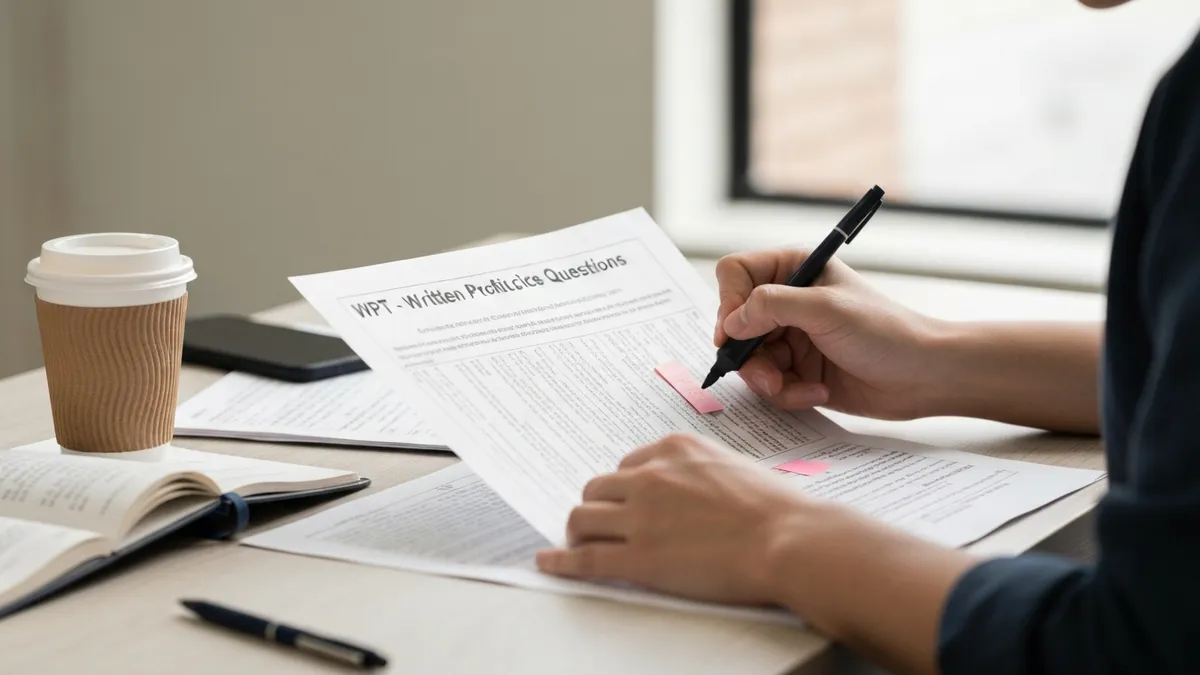
Preparation is the single most important factor that separates passing candidates from those who must retest. Candidates who study deliberately — practicing passage reading, grammar error correction, and written response construction — consistently outperform those who walk in cold. You can access a free written english proficiency test resource to get a feel for the question formats before your official testing date, which dramatically reduces test-day anxiety and improves your overall score.
Many test-takers underestimate the range of skills measured. A typical administration covers reading comprehension at the paragraph and multi-paragraph level, identification of grammatical and mechanical errors, vocabulary used in context, and sometimes a short written response task. Each of these sections tests a different dimension of written English ability, so a well-rounded study plan must address all of them rather than concentrating only on the areas where you already feel confident.
This guide covers everything you need to know about the written english proficiency test: the format, scoring, typical career pathways that require it, preparation strategies, and the common mistakes that cause otherwise qualified candidates to fall short. By the end, you will have a clear action plan for approaching the exam with confidence, understanding what the scores mean for your career prospects, and knowing exactly which skills to prioritize in the weeks before your scheduled test date.
Whether you are a recent college graduate entering the job market, a mid-career professional changing industries, or a non-native English speaker who has been building language skills over years of study and work, this guide is designed to meet you where you are. The written english proficiency test is a fair and achievable assessment when you understand what it measures and invest the time to prepare systematically.
Written English Proficiency Test by the Numbers

WPT Format & Structure: What to Expect
You will read short to medium-length passages on everyday and professional topics, then answer multiple-choice questions about main ideas, supporting details, vocabulary in context, and the author's tone or purpose. Passages grow progressively more complex.
Questions present sentences or short paragraphs containing errors in punctuation, subject-verb agreement, pronoun reference, verb tense, and sentence structure. Your task is to identify the error, choose the correct revision, or select the error-free version.
Rather than testing definitions in isolation, these items embed words inside sentences so you must determine meaning from context. Strong vocabulary knowledge significantly improves both reading comprehension scores and writing response quality.
Some employer versions include a short writing task — typically 100 to 200 words — where you respond to a prompt related to a workplace scenario. Raters evaluate clarity, organization, grammar, and appropriate professional tone.
Certain government and federal contractor versions include a dictation or audio component where a passage is read aloud and you must transcribe it accurately. This tests spelling, punctuation under pressure, and audio comprehension simultaneously.
Scoring on the written english proficiency test varies by the organization administering the exam, but most versions assign candidates to one of four proficiency levels: Basic, Intermediate, Advanced, and Superior. Each level corresponds to a range of raw scores and carries specific implications for the roles a candidate can hold. Basic level performers can handle simple, routine written tasks with frequent errors on complex material. Intermediate performers write clearly on familiar topics but may struggle with nuanced grammar or sophisticated vocabulary. Advanced and Superior performers demonstrate near-native or native-equivalent fluency and precision.
Most private-sector employers set a passing threshold that corresponds to the Intermediate or Advanced level, depending on the role. An administrative assistant position might require Intermediate proficiency, while a technical writer, communications manager, or policy analyst role typically demands Advanced or Superior performance. Federal government agencies often publish their required levels in the job announcement itself, so reading the posting carefully before your test date will help you understand your target score and calibrate your preparation accordingly.
Raw scores are typically expressed as a percentage of correct answers, a points total, or a scaled score that accounts for question difficulty. If your employer uses a scaled score system, a score of 70 on their scale does not necessarily mean 70% correct — it may reflect a more complex formula. Ask the human resources department or the testing coordinator what the passing score is and how scores are reported so you can interpret your results accurately when they are released.
One important nuance is that some tests are adaptive, meaning the difficulty of the next question adjusts based on your answer to the previous one. Adaptive tests are designed to home in on your exact proficiency level with greater precision than a fixed-form test, but they can feel disorienting if you are not expecting them. If a question suddenly seems much harder, that is actually a positive sign — it means you answered the previous question correctly and the system is challenging you at a higher level.
Score reporting timelines differ substantially across administrations. Computer-based tests in a proctored testing center often provide immediate unofficial results at the end of the session, with official score reports emailed within a few business days. Paper-based tests may take two to four weeks for official results. If you are applying under a deadline, check with the hiring agency or employer about their score release timeline so you can plan accordingly and ensure your scores arrive before any application deadlines close.
Retesting policies are another critical consideration. Many employers allow one free retest after a waiting period of 30 to 90 days if you do not meet the required proficiency level on your first attempt. Some testing programs charge a fee for the second attempt. Use the waiting period productively: review your score report if detailed feedback is provided, identify the specific skill areas where you lost points, and focus your study time there before attempting the exam again.
Score validity periods are also important to understand. Most employers accept scores that are no more than two to three years old. If you took the written english proficiency test for a previous employer and are now applying somewhere new, confirm that your scores are still within the acceptable window. If they have expired, you will need to retest — which is actually an opportunity to demonstrate growth if you scored at the lower end of passing the first time around.
Study Strategies by Skill Area
The most effective strategy for reading comprehension sections is active reading: before you read a passage, skim the questions so you know what information to look for. When you encounter a question about the main idea, look at the opening and closing sentences of each paragraph rather than trying to process every detail. For vocabulary-in-context questions, always read at least two full sentences surrounding the unfamiliar word before selecting an answer, because context clues are almost always present in the surrounding text.
Build your reading speed and stamina by reading one to two medium-length articles daily on varied topics — science, history, business, and policy all appear on the exam. Time yourself to simulate test conditions. Aim to read a 300-word passage and answer five questions in under four minutes. Track which question types cause the most errors (detail retrieval, inference, tone, or vocabulary) and spend extra practice time on your weakest category in the week before the test.
Is the Written English Proficiency Test Worth Preparing For?
- +A strong score opens doors to higher-paying administrative, communications, and government roles
- +Preparation improves real-world writing skills that benefit your entire career, not just the exam
- +Demonstrates to employers that you take professional standards seriously before you are even hired
- +Many employers accept scores for two to three years, so one strong performance pays off long-term
- +Familiarity with the format reduces test anxiety and allows you to perform closer to your true ability
- +A superior-level score can accelerate promotions and assignments to leadership roles
- −Test preparation requires consistent daily study over several weeks to see meaningful score gains
- −Some employers require a specific minimum score that leaves no partial credit for near-passing performances
- −Retesting fees and waiting periods can delay your application if you do not pass on the first attempt
- −The written response component is subjective and rater variation can affect scores in ways studying alone cannot fully control
- −Test anxiety can cause under-performance even when a candidate possesses the actual skills being measured
- −Non-native English speakers may need significantly longer preparation time to reach Advanced or Superior levels
Written English Proficiency Test Preparation Checklist
- ✓Confirm the exact version of the test your employer or agency uses and research its specific format and passing score.
- ✓Schedule your study sessions at least four to six weeks before the test date for adequate preparation time.
- ✓Take a full-length diagnostic practice test in the first week to identify your strongest and weakest skill areas.
- ✓Study one grammar rule per day, complete 20 targeted practice questions, and review every incorrect answer in detail.
- ✓Read one 400–600 word article daily and practice summarizing the main idea in one sentence without looking back.
- ✓Practice timed written responses to workplace prompts, aiming for a clear three-paragraph structure within eight minutes.
- ✓Build vocabulary by studying 10 new words per week using context sentences rather than isolated definitions.
- ✓Complete at least three full-length timed practice tests before your exam date to build stamina and pacing skills.
- ✓Review all answer explanations for questions you answered correctly by guessing — understanding the reasoning prevents future errors.
- ✓Arrange your test logistics at least one week in advance: confirm the location, allowed ID documents, and arrival time.
Grammar Errors Cost More Points Than You Think
Research on standardized writing assessments consistently shows that candidates lose more points to mechanical errors (comma splices, subject-verb disagreement, misplaced apostrophes) than to vocabulary gaps or reading speed. Spending 40% of your total study time on grammar and proofreading exercises — rather than only on reading comprehension — produces the largest average score gains for most test-takers.
The written english proficiency test plays a central role in hiring decisions across a diverse range of career fields. In the federal government, positions classified under administrative, clerical, and professional occupational series often list a specific WPT score or equivalent writing assessment as a minimum qualification. Agencies such as the Department of Defense, the Department of Homeland Security, and the General Services Administration routinely screen candidates with writing proficiency assessments early in the hiring process to narrow large applicant pools before more resource-intensive interviews and background checks begin.
In the healthcare sector, the test is increasingly common for roles that involve documentation, patient communication, and insurance correspondence. Medical billing specialists, patient services coordinators, healthcare administrators, and clinical documentation specialists all require strong written English skills to perform their jobs accurately. Errors in written healthcare communication can have serious downstream consequences — from incorrect insurance claim submissions to miscommunication about patient care instructions — which is why employers in this field treat writing proficiency as a genuine safety and quality concern rather than merely a hiring formality.
The legal and paralegal field is another area where the written english proficiency test frequently appears. Law firms, corporate legal departments, and government legal offices rely on paralegals, legal assistants, and records managers who can draft correspondence, summarize case documents, and proofread contracts with a high degree of accuracy. The test provides an objective measure of these skills before candidates are placed in roles where written errors could have significant legal or financial consequences for the organizations they serve.
Technology companies — particularly those with customer-facing operations — use writing proficiency assessments to evaluate candidates for customer success, technical support, and content roles. A software company's technical support specialist who cannot write clear, grammatically correct responses to customer tickets damages the brand and reduces customer retention rates. As remote work has become standard across the technology sector, written communication has grown even more important because so much workplace interaction now happens through written channels like email, Slack, and project management tools rather than face-to-face conversation.
Financial services firms including banks, insurance companies, and investment advisory firms also require demonstrated writing proficiency for roles in customer service, compliance, and operations. Compliance-related writing in particular demands exceptional precision because regulatory documents, audit reports, and client disclosure materials must be clear, accurate, and free of ambiguity. Candidates who score at the Advanced or Superior level on writing proficiency tests are often fast-tracked for compliance-adjacent roles that carry higher salaries and greater career advancement potential.
Education is another major sector where the written english proficiency test appears routinely. School districts, community colleges, and universities use it to screen teaching candidates, instructional aides, administrative staff, and program coordinators. Many states have their own educator certification requirements that include a writing assessment component, and the WPT or a similar instrument is used to fulfill that requirement. Educators who demonstrate superior written communication skills are also more competitive for department chair positions, curriculum development roles, and administrative advancement over the course of their careers.
Beyond any single industry, the written english proficiency test ultimately reflects a universal truth about the modern professional environment: written communication is a foundational skill that underpins nearly every form of productive work. Employees who write clearly save their organizations time, reduce errors, and build credibility with colleagues, clients, and leadership. Investing in your writing proficiency — whether you are preparing for this specific test or simply developing your professional skills — is one of the highest-return activities you can pursue at any stage of your career.

Most employers only accept written english proficiency test scores that are two to three years old or less. If you completed the test for a previous job application, verify the date on your score report before submitting it to a new employer. Submitting an expired score can disqualify your application or delay the hiring process by weeks while you schedule a retest.
Test day performance depends as much on preparation quality as on what you do in the 24 hours before the exam. The night before your scheduled written english proficiency test, avoid cramming new material — your brain consolidates learning during sleep, and introducing new content the night before can interfere with recall of material you already know well.
Instead, spend 20 to 30 minutes reviewing your most reliable grammar rules, do a light vocabulary review of the words you have been studying, and then shift your focus to logistical preparation: confirm the testing location, lay out your identification documents, and plan your commute to arrive 15 minutes early.
On the morning of the test, eat a balanced meal that includes protein and complex carbohydrates. Research on cognitive performance consistently shows that test-takers who skip breakfast or eat high-sugar foods before a cognitive assessment score lower on average than those who maintain stable blood sugar levels throughout the session. Avoid excessive caffeine — one cup of coffee or tea is fine, but multiple cups can increase anxiety and make it harder to concentrate on reading comprehension passages that require sustained focus over several paragraphs.
During the test itself, pace management is critical. Most written proficiency tests are designed so that the average prepared candidate can complete all sections within the allotted time, but only if they do not spend disproportionate time on any single question. If you encounter a reading comprehension question that you cannot answer after two careful readings of the relevant passage section, mark it for review, move on, and return to it after completing the questions you can answer confidently. Unanswered questions always score zero; guessing strategically on questions you are 50/50 on gives you a statistically positive expected score improvement.
For grammar and mechanics sections, trust your first instinct on questions where you feel confident, but slow down on questions involving punctuation with compound sentences, pronoun reference in complex passages, and parallelism in lists — these are the three categories where test-takers most commonly change a correct answer to an incorrect one through second-guessing. Research on standardized test behavior shows that initial answer changes improve accuracy about 55% of the time, but changes made in the last five minutes of the test when anxiety is highest are more likely to be incorrect than the original response.
If your test includes a written response section, treat it as the section that differentiates Advanced from Superior scorers. A candidate who scores 85% on multiple-choice sections but produces a disorganized, error-filled written response often receives an overall score in the Intermediate range. Conversely, a well-organized, clear, grammatically correct response — even if brief — can pull an overall score into the Advanced range for a candidate who found the multiple-choice sections moderately challenging. Give the writing component the serious preparation and test-day attention it deserves.
After the test, resist the urge to look up answers to specific questions you are uncertain about. This practice, sometimes called post-exam rumination, has been shown in educational psychology research to increase anxiety without improving future performance. You have done the preparation; the outcome is largely determined. Focus instead on things within your control: following up with the hiring organization about the timeline for score reporting, continuing to maintain your professional writing habits so your skills do not atrophy, and, if needed, beginning a structured study plan for a potential retest.
If you do need to retest, use your experience from the first attempt as diagnostic information rather than a source of discouragement. Candidates who retest with a clear, targeted study plan focused on the specific sections where they underperformed almost always see meaningful score improvements. The written english proficiency test, like any standardized assessment, rewards systematic preparation over raw talent — and that is genuinely good news for anyone willing to invest the time and effort to prepare properly before their next test date.
Building lasting written English proficiency goes well beyond passing a single exam. The most successful professionals treat written communication as an ongoing skill they develop deliberately throughout their careers, not just a box to check during the hiring process. One of the most effective long-term practices is writing daily — even if only for ten minutes — in a professional context. Keep a journal of workplace reflections, draft practice emails responding to hypothetical client scenarios, or summarize articles you have read. Consistent writing practice builds the automaticity that allows you to produce clear, accurate prose quickly under time pressure.
Reading widely and intentionally is the complement to regular writing practice. Professionals who read high-quality writing — newspapers of record, professional publications in their field, well-edited books — internalize sentence structure patterns, vocabulary, and paragraph organization naturally over time. This process, sometimes called incidental learning, is slower than direct study but produces deep, durable gains. Many top scorers on the written english proficiency test report that their strongest preparation came from years of regular reading rather than last-minute test prep, even if short-term test preparation provided the final percentage points needed to cross the passing threshold.
Seek feedback on your writing from colleagues, managers, or mentors who write well themselves. Ask specifically for feedback on clarity, organization, and grammar rather than vague reactions. Detailed, specific feedback — "this sentence has two ideas that should be separated" or "you shift from first to third person mid-paragraph" — is far more actionable than general comments like "good job" or "needs work." If you do not have access to a strong writing mentor at your workplace, consider joining a professional writing group or using an AI-assisted writing tool to identify recurring error patterns in your draft documents.
Grammar reference materials remain valuable long after formal education ends. Keep a reliable style guide — the Associated Press Stylebook for journalism and communications roles, the Chicago Manual of Style for publishing and academia, or a general business writing guide for corporate environments — accessible at your workstation. Consulting a reference when you are unsure about a usage question takes 30 seconds and prevents an error that could undermine your credibility with readers. The professionals who write most accurately are not those who memorize every rule, but those who consistently check when they are uncertain rather than guessing.
Vocabulary development is a lifelong endeavor that pays compounding returns. When you encounter an unfamiliar word in professional reading, look it up immediately and note the sentence in which you found it. Review your vocabulary notes weekly. Research on language acquisition suggests that encountering a word in context five to seven times is sufficient for most adult learners to acquire it for active use. Digital vocabulary tools and flashcard applications can help you systematize this process, but even a simple handwritten notebook kept at your desk serves the purpose effectively.
If you are a non-native English speaker preparing for the written english proficiency test, consider working with an English language tutor who specializes in professional and academic writing. Tutors can identify the specific grammatical transfer errors most common for speakers of your first language — Spanish speakers, for example, tend to struggle with articles (a, an, the) and subject-verb agreement in sentences with intervening clauses, while native Mandarin speakers often find pronoun reference and relative clause construction challenging. Targeted instruction on your specific error patterns is dramatically more efficient than generic English study.
Finally, maintain perspective on what the written english proficiency test actually measures. It is an important professional benchmark, but it captures only a snapshot of your written communication ability at a single point in time. Your skills continue to develop with every document you write, every article you read, and every piece of feedback you incorporate. The test is a milestone, not a ceiling — and the preparation you invest today will pay dividends in professional credibility, career advancement, and effective communication for the rest of your working life.
WPT Questions and Answers



About the Author

Educational Psychologist & Academic Test Preparation Expert
Columbia University Teachers CollegeDr. Lisa Patel holds a Doctorate in Education from Columbia University Teachers College and has spent 17 years researching standardized test design and academic assessment. She has developed preparation programs for SAT, ACT, GRE, LSAT, UCAT, and numerous professional licensing exams, helping students of all backgrounds achieve their target scores.