
WorkKeys Study Guide: Prep for Applied Math, Reading & More 2026 October
Prepare for the WorkKeys Study Guide: 📝 Prep for Applied certification. Practice questions with answer explanations covering all exam domains.

WorkKeys Study Guide: What You Actually Need to Know
The ACT WorkKeys assessment is the test that stands between you and the National Career Readiness Certificate (NCRC). Employers in manufacturing, skilled trades, healthcare, and logistics increasingly require it — and passing at the Gold or Platinum level opens doors that Gold-level applicants without it simply can't access.
The good news: WorkKeys is studyable. Unlike aptitude tests that claim to measure fixed traits, WorkKeys measures skills you can genuinely improve with targeted practice. The right study approach makes a real difference — candidates who prep systematically do better than those who walk in cold.
This guide covers what each assessment tests, what score you need, and how to prepare effectively for each one.
The Three Core WorkKeys Assessments
The NCRC requires passing three WorkKeys assessments:
- Applied Math — Mathematical reasoning applied to workplace scenarios
- Workplace Documents — Reading and interpreting workplace documents (forms, charts, policies, schedules)
- Business Writing — Writing a clear, professional business communication (not always required for all NCRC levels)
Each assessment is scored on a scale from Level 3 to Level 7. Bronze NCRC = Level 3 minimum on all three. Silver = Level 4. Gold = Level 5. Platinum = Level 6. The level you need depends on the job or employer requirement — many skilled trades require Gold, while some technical and healthcare roles require Platinum.
Applied Math: What the Test Covers
Applied Math is the assessment most candidates worry about most — and for good reason. It's not a straightforward math test. It's a work-scenario problem-solving test where you read a workplace situation, identify the mathematical task embedded in it, and solve it using the information provided.
At Level 3–4, you're dealing with basic operations, simple fractions, and single-step problems. At Level 5–6, you're working with multi-step problems, rates, proportions, unit conversions, and sometimes basic geometry. Level 7 involves complex reasoning with multiple calculation steps.
Calculators are allowed on the Applied Math assessment — but knowing when and how to use one efficiently matters. Candidates who try to do Level 6 calculations mentally under time pressure consistently underperform compared to those who've practiced calculator-assisted problem-solving in realistic scenarios.
Did You Know? Passing the WorkKeys exam on your first attempt saves both time and money. Start with diagnostic practice tests to identify weak areas.

Workplace Documents: What to Expect
The Workplace Documents assessment replaced the older Reading for Information and Locating Information assessments. It presents realistic workplace documents — organizational charts, policies, safety notices, work schedules, order forms, instructional text — and asks questions that require you to extract specific information, make inferences, and apply document content to scenarios.
What distinguishes higher-level Workplace Documents questions from lower-level ones isn't reading complexity per se — it's the number of steps and inferential connections required. Level 5 might ask you to find specific information in a multi-part document. Level 6 requires you to synthesize information from multiple sections or apply a policy to an unstated scenario.
The best preparation for this section is practicing with real workplace documents. Many WorkKeys prep books include sample documents with practice questions, but you can also supplement with actual workplace materials — employee handbooks, safety procedure manuals, technical specifications. Reading these documents with the mindset of answering questions about them builds the active reading habits the test rewards.
Business Writing: Clear and Professional
Business Writing is a constructed-response assessment — you write, not just answer multiple choice. The prompt gives you a workplace scenario and asks you to write a document (memo, email, letter, or report section) that addresses it appropriately.
Scoring rubrics evaluate organization, supporting details, word choice, and sentence structure. You're not being graded on creative flair — you're being graded on whether your communication is clear, appropriately structured, and professional. Workplace writing is functional writing.
Common Business Writing mistakes: vague or missing subject lines, lack of clear opening statement of purpose, incomplete information, inappropriate tone (too casual or unnecessarily formal), and grammar errors that undermine credibility. Practicing by writing actual workplace documents — then reviewing them against the scoring criteria — is the most effective prep.
A Practical WorkKeys Study Plan
Here's a realistic 4-week approach if you have a test date on the horizon:
- Week 1: Take a full diagnostic practice set for each assessment. Identify your weakest level within each (what level questions are you missing most?). This tells you where to focus.
- Week 2: Applied Math intensive. Work through Level 4–5 problems daily. Practice identifying the math task in word problems before solving. Build calculator efficiency.
- Week 3: Workplace Documents intensive. Practice active reading of work documents — pre-reading headings, scanning for structure, then answering questions without re-reading from scratch every time.
- Week 4: Business Writing timed practice. Write one full-length response per day, then evaluate it against the rubric criteria. Focus on structure first, then vocabulary and mechanics.
The WorkKeys 30-day study plan offers a more detailed daily schedule if you prefer a structured guide. The core principle is the same: identify your specific gaps, practice at the level just above your current performance, and use timed practice as you get closer to your test date.
Score Targets by Job Category
Knowing your target score level before you study helps you calibrate your effort. If your employer needs Silver NCRC (Level 4 on all three), studying intensively for Level 6 mastery is wasted effort. If you're targeting Platinum for a technical role, you need to push your Applied Math to Level 6 or higher.
General benchmarks:
- Manufacturing and construction: often Gold (Level 5)
- Healthcare and medical administrative: Silver to Gold
- Advanced manufacturing and technical trades: Gold to Platinum
- Office and administrative: Silver minimum, often Gold preferred
Ask your employer or the organization requiring the NCRC exactly what level they need. It's a specific question with a specific answer, and it's worth asking before you start preparing.
The WorkKeys exam uses a multiple-choice format with questions covering all major domains. Most versions allow 2-3 hours for completion.
Questions test both knowledge recall and application skills. A score of 70-75% is typically required to pass.
- +Validates your knowledge and skills objectively
- +Increases job market competitiveness
- +Provides structured learning goals
- +Networking opportunities with other certified professionals
- −Study materials can be expensive
- −Exam anxiety can affect performance
- −Requires dedicated preparation time
- −Retake fees apply if you don't pass
Pros and Cons at a Glance
| Pros | Cons |
|---|---|
| Validates your knowledge and skills objectively | Study materials can be expensive |
| Increases job market competitiveness | Exam anxiety can affect performance |
| Provides structured learning goals | Requires dedicated preparation time |
| Networking opportunities with other certified professionals | Retake fees apply if you don't pass |



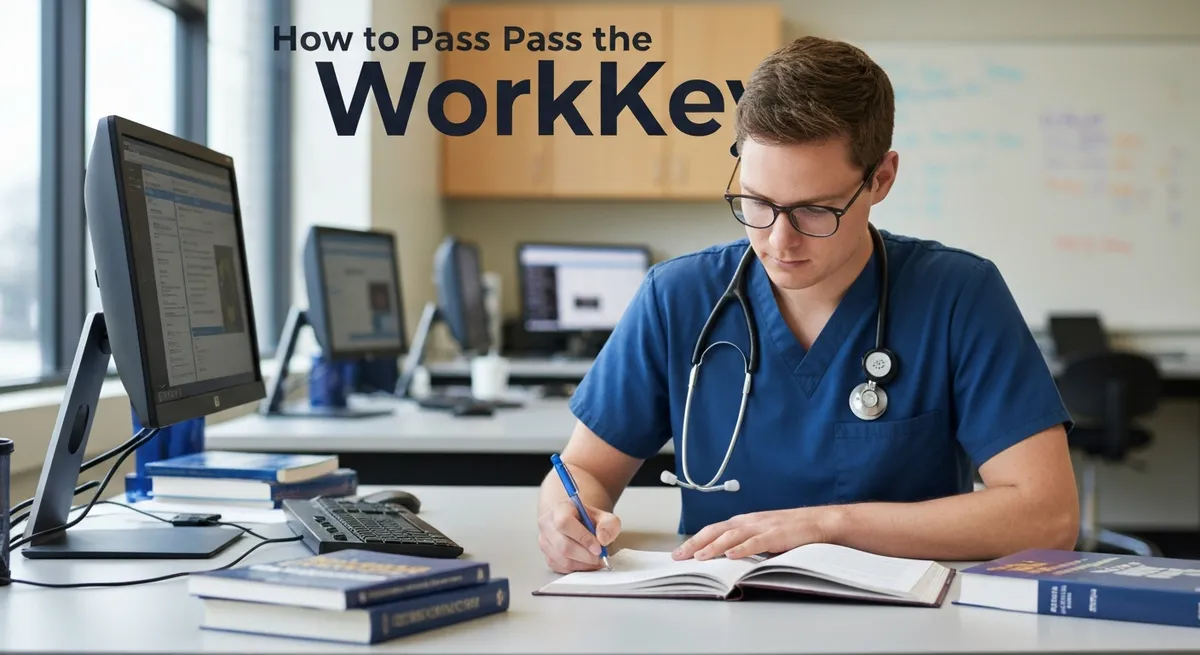
Putting It Together: Your WorkKeys Prep Approach
The candidates who perform best on WorkKeys aren't necessarily the ones who studied the longest — they're the ones who studied the most strategically. Take a diagnostic first, build a targeted plan based on your actual gaps, practice under realistic conditions, and use the final week for timed full-length practice sets.
The WorkKeys assessments are measuring real workplace skills. The preparation you do isn't just about passing a test — it's about sharpening the math reasoning, document literacy, and written communication abilities that employers are paying for. That framing makes the prep feel more worthwhile than grinding through drills for their own sake.
Work through our practice tests for WorkKeys Workplace Documents and WorkKeys Business Writing to benchmark your current level and identify where to focus your remaining prep time. The scores you're aiming for are achievable — and with the right preparation, they're within reach.
About the Author

Educational Psychologist & Academic Test Preparation Expert
Columbia University Teachers CollegeDr. Lisa Patel holds a Doctorate in Education from Columbia University Teachers College and has spent 17 years researching standardized test design and academic assessment. She has developed preparation programs for SAT, ACT, GRE, LSAT, UCAT, and numerous professional licensing exams, helping students of all backgrounds achieve their target scores.