
Wonderlic Practice Test: Tips, Format, and How to Score High 2026 September
💯 Use Wonderlic practice tests to boost your score. Learn the test format, question types, scoring scale, and strategies that work.

The Wonderlic Personnel Test is one of the most widely used pre-employment cognitive ability assessments in the country. Employers use it to gauge how quickly candidates can learn, adapt, and solve problems under time pressure. Fifty questions. Twelve minutes. That works out to about 14 seconds per question — not a lot of time to think. The test moves fast by design, and your ability to pace yourself effectively is a skill that practice builds directly.
A Wonderlic practice test replicates that pressure in a controlled setting. Working through timed practice sessions before your actual test accomplishes several things at once: you get familiar with the question formats so they don't surprise you on test day, you calibrate your pacing so you don't waste time on hard questions when easier ones are still available, and you identify which content areas need the most attention. Most people who take the Wonderlic without any preparation underperform relative to their actual ability — not because the content is beyond them, but because the format catches them off guard.
The Wonderlic isn't a knowledge test in the traditional sense. It measures fluid intelligence — your ability to reason through novel problems, spot patterns, and work quickly and accurately. That means there's no specific curriculum to memorize. But there are absolutely patterns to recognize, strategies to internalize, and calculation shortcuts to learn. Practice doesn't just build familiarity; it builds the reflexive thinking that 14-second time limits demand.
This guide covers how to use Wonderlic practice tests effectively, what question types to expect, how the scoring scale works, and what score you actually need for the job you're targeting. For an introduction to the Wonderlic exam itself including its history and structure, wonderlic background is covered in depth elsewhere on this site. Here the focus is on practice strategy and score improvement.
Before your scheduled test, aim to complete at least three to five full practice sessions under real timed conditions — 50 questions in 12 minutes, no pauses. The value of practice is only fully realized when the time constraint is real. Open-book, take-your-time practice will not prepare you for the actual test experience. Replicate the test environment as closely as possible — same time of day, no interruptions, no reference materials.
Employers in a wide range of industries use the Wonderlic — retail, manufacturing, logistics, finance, healthcare support roles, and many others. Its widespread adoption means that if you are pursuing multiple job applications simultaneously, you may encounter it more than once. Each time you take it, the experience is the same format, which is one of the advantages of deliberate preparation. The skills you build for one Wonderlic administration transfer directly to the next.
What to Expect on the Wonderlic Test
The Wonderlic covers five broad question categories. Arithmetic and math questions make up roughly 35-40% of the test — these include basic operations, percentages, fractions, word problems, and number sequences. You don't need advanced math, but you do need to be fast and accurate with the fundamentals. A slow calculation on question 7 eats time you will want back on question 40.
Verbal reasoning questions test reading comprehension, analogies, vocabulary in context, and logical conclusions drawn from short passages. These tend to be more straightforward for test-takers with strong reading habits but can trip up those who read slowly under pressure. The passages are brief — one to three sentences — so the challenge is processing and applying information quickly, not comprehending complex prose.
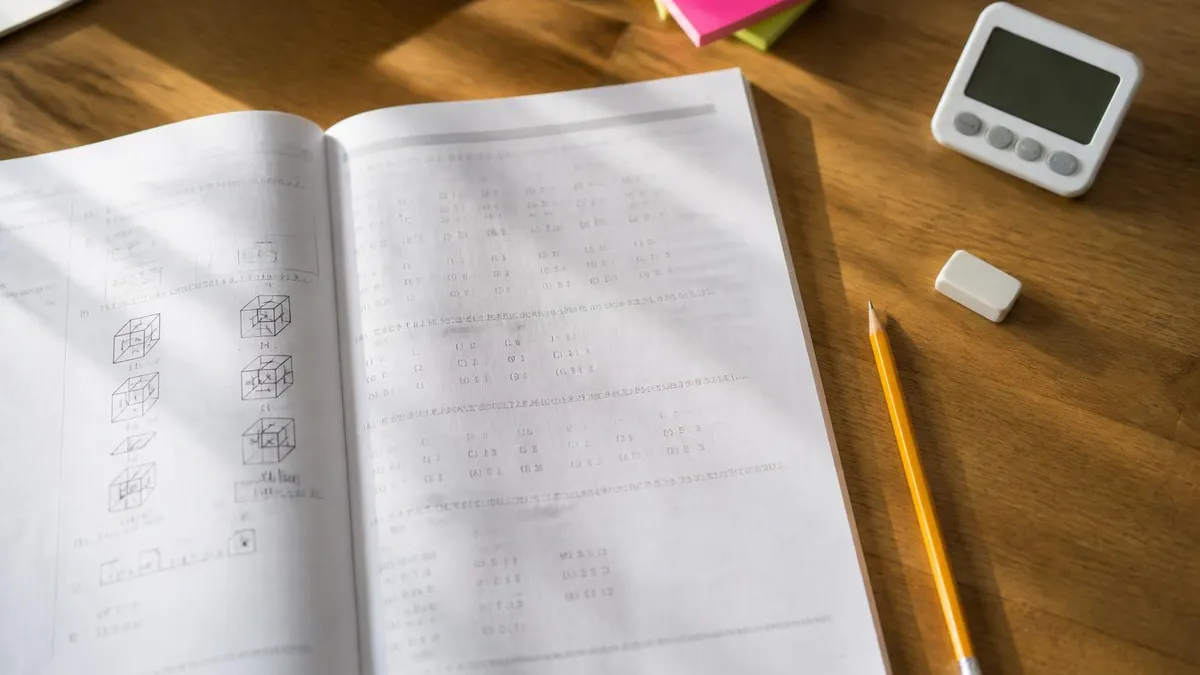
Spatial reasoning questions ask you to mentally rotate shapes, identify patterns in sequences, or determine how a folded shape would look when unfolded. These questions often stump test-takers who haven't practiced specifically with visual-spatial material. They're also the type most amenable to improvement through targeted practice — exposure to these question types repeatedly builds the pattern-recognition instinct that makes them faster.
Logic and general knowledge questions round out the test. Logic items give you a statement or series of premises and ask you to identify valid conclusions. General knowledge questions draw on a broad base of facts — vocabulary, geography, science concepts, historical events. You can't cram for these specifically, but a habit of wide reading helps over time.
One important pacing strategy: the questions are not ordered by difficulty. Hard and easy questions are mixed throughout. When you hit a question that's clearly going to take longer than 14 seconds, mark it mentally and move on — come back to it if you have time. Most high scorers answer questions in sequence, skipping and returning rather than getting stuck. Detailed strategies for this and other approaches are covered in the wonderlic wast strategy guide, which covers timing, guessing rules, and cognitive load management.
You can't leave questions blank — wrong answers and blank answers cost equally (one point each, or rather, zero points). Guessing never hurts you, so never leave time on the clock with unanswered questions. If the 12-minute mark is approaching and you have 10 questions left, fill in something for each one. A random guess is right one in four or five times depending on the question type; a blank is right zero times.

Wonderlic Question Types
Basic operations, percentages, fractions, decimals, number sequences, and word problems. Speed matters more than complexity — know your fundamentals cold and use shortcuts where possible.
Reading comprehension, analogies, antonyms, vocabulary in context, and logical conclusions from brief passages. Practice reading and extracting key points quickly.
Shape rotation, pattern recognition, folding/unfolding figures, and visual sequences. Practice specifically with spatial materials — this type improves significantly with exposure.
Syllogisms, premise-based conclusions, and broad factual knowledge. Logic items follow consistent structures; recognizing those structures makes them faster to solve.
How to Use Practice Tests Effectively
Not all practice is created equal. Untimed practice builds familiarity with question formats but doesn't prepare you for the cognitive pressure of the real test. Timed practice under real conditions — 50 questions, 12 minutes, no interruptions — is what actually raises your score. The time constraint changes how your brain engages with the problem. Getting comfortable with that pressure requires experiencing it repeatedly.
After every practice session, review every question you missed or skipped — including the ones you guessed correctly. Understanding why a correct answer is correct matters as much as identifying why a wrong answer was wrong. Many test-takers skim their review and miss the pattern-recognition opportunity that makes the next session faster. The goal isn't to memorize specific questions; it's to internalize the logic structure behind question types so you solve them more automatically.
Track your accuracy by question category across sessions. If you're consistently missing number sequence questions but acing word problems, that's where to invest extra time. Most people improve fastest when practice is targeted at their weakest category rather than distributed evenly across all types. Identify your ceiling — the question type where even with extra time you struggle — and spend disproportionate effort there.
Take your practice sessions at different times of day, including times when you're not at your sharpest. Cognitive ability tests administered by employers are often scheduled at inconvenient hours. If all your practice happens when you're fresh in the morning and the actual test is at 2 PM after a stressful morning, the mental state mismatch can hurt you. Practice under varied conditions to build robustness.
For structured exam preparation resources beyond individual practice questions, the wonderlic test prep guide provides a complete study schedule, targeted exercises for each question type, and timed mock tests organized by difficulty.
Space your practice sessions across the days leading up to your test rather than cramming everything into the final 24 hours. Research on learning consistently shows that distributed practice produces better retention than massed practice. Three 30-minute sessions over three days outperforms one 90-minute session the night before. Build in rest time between sessions so your brain can consolidate what you practiced.
When you review wrong answers, also note the time you spent on them — did you rush and make a careless error, or did you genuinely not understand the question? These two failure modes require different responses. Careless errors are fixed by slowing down slightly on questions you can solve. Conceptual gaps require more practice with that specific question type. Distinguishing between them makes your review sessions far more efficient.
One underused practice technique is interleaved training — mixing question types within a single session rather than blocking all math practice together and all verbal together. Interleaved practice feels harder in the moment because your brain keeps context-switching, but it produces better retention and better performance on the actual test, which mixes question types throughout.

Wonderlic Score Ranges
Wonderlic Score Requirements by Industry
The Wonderlic score that matters depends entirely on who's using it and for what role. There is no universal passing score — employers set their own cutoffs based on the cognitive demands of the position. Entry-level warehouse and logistics roles often screen around 15-18. Administrative and clerical positions typically look for 20-25. Management-track roles commonly require 25-30. Technical and engineering positions may require 28 or higher.
The NFL is the most famous user of a Wonderlic variant — they administer a 12-minute version to prospects at the Scouting Combine and have historically used it as one data point among many. Scores for skill positions like quarterback typically run higher than for linemen, reflecting the different cognitive demands of the roles. The average NFL score is around 20, comparable to the general population average despite the athletic selection.
For most job applicants, the practical target is beating the employer's cutoff score — not achieving the highest possible score. If you know you're being assessed by a company that uses 22 as a screening threshold, focus your preparation on consistently clearing 25 to give yourself a buffer. Overpreparation beyond a reasonable target is less efficient than focused preparation aimed at a specific outcome.
If you don't know the employer's threshold, target 25 or above as a safe benchmark. This score falls above the general population average and above the cutoffs for most positions that use the Wonderlic as a screener. Scoring 25 or higher puts you in a position where the Wonderlic will rarely be the reason you're screened out, regardless of the specific role.
For a comprehensive overview of what the test covers, how employers actually use scores, and how to request score information, the wonderlic practice exam page includes employer-by-employer context and guidance on requesting your own score report after the test.
Some employers will share your score after the test if you ask, and others will not. It is always worth requesting — knowing your actual score gives you concrete feedback on where you stand and, if you did not get the position, helps you calibrate future preparation. Federal law does not require employers to share test scores, but many will as a courtesy. Asking directly after the process concludes is the most straightforward approach.
If you know in advance which specific employer administered your test and what their industry benchmark is, you can calibrate your preparation precisely. A logistics warehouse screening at 18 and a financial analyst role screening at 30 require different levels of preparation intensity. Understanding your actual target score lets you prioritize practice time efficiently rather than preparing blindly for the full range of possible cutoffs.
Wonderlic Score Improvement Strategies
Arithmetic speed is the highest-leverage area for most Wonderlic test-takers. Knowing 7 x 8 = 56 without computing it saves a second per problem, and those seconds compound over 20 math questions. Daily arithmetic drills — even 5 minutes before bed — build the automatic recall that makes math questions feel easier under pressure.
Learn mental math shortcuts for percentages (10% is just moving a decimal, 15% is 10% plus half), fractions (common fraction-decimal conversions memorized cold), and estimation (round aggressively to eliminate answer choices quickly). On a 14-second-per-question test, estimation that eliminates two wrong answers is often more efficient than precise calculation that confirms one right answer.
What to Do the Day Before and Day of the Test
The day before your Wonderlic should not involve intensive practice. Your brain consolidates learning during sleep, and exhausting yourself with a three-hour practice marathon the night before typically hurts more than it helps. Light review — going over a set of practice questions for 20-30 minutes — is fine. What matters more is sleeping well and eating a normal meal.
On test day, arrive early and don't rush. Cognitive performance under mild time pressure (you're running late) is measurably lower than performance when you're settled. If the test is administered in a new location, arriving early also lets you adjust to the environment, which reduces the cognitive load of unfamiliarity during the test itself.
If the test is administered digitally on a computer, ask in advance whether scratch paper is provided. Mental calculation on a timed test is harder than paper calculation, and most administrators provide scratch paper for the Wonderlic. If it's not offered, request it — this is standard and virtually always granted.
During the test, trust your practice. You've done the timed run-throughs. You know how the questions feel. The biggest test-day mistake is shifting strategy mid-test — slowing down on questions you would normally skip, second-guessing answers you're confident in, abandoning your practiced approach because test anxiety is telling you to try something different. Stick to what you trained. Strategy and wonderlic test score reliability are directly linked to consistency — the approach that worked in practice is the approach that works on the day.
The Wonderlic is almost always administered as part of a broader hiring process — it usually follows or precedes an interview, application review, or skills assessment. Knowing this helps you mentally frame it correctly. It is one data point among several, not the only factor. Performing well matters, but a strong interview or impressive work history can complement a middle-of-the-road Wonderlic score. Do your best, prepare seriously, and keep its role in the overall process in perspective.
Stress affects cognitive test performance in well-documented ways. High anxiety narrows attention, reduces working memory capacity, and disrupts pattern recognition — all the things the Wonderlic specifically tests. Reducing test anxiety through repeated exposure to the timed format is one of the clearest benefits of structured practice. The more familiar the test feels, the less cognitive bandwidth anxiety consumes, leaving more for actually solving problems.
Wonderlic Practice Tests: Pros and Cons
- +Build familiarity with all five question types before test day — no surprise formats
- +Calibrate your pacing so 14 seconds per question feels natural, not frantic
- +Identify weak question categories to target practice efficiently
- +Reduce test anxiety through repeated exposure to the timed format
- +Track score improvement across sessions to build confidence and measure readiness
- +Free practice materials are widely available — preparation has no cost barrier
- −Over-reliance on easy untimed practice can create false confidence about real test performance
- −The Wonderlic measures fluid intelligence — practice improves familiarity but cannot dramatically raise underlying cognitive speed
- −Memorizing specific practice questions has no value — real test items differ; only strategy and reasoning skill transfer
- −Poor-quality free practice tests with errors or unrealistic question formats can build bad habits
- −Score requirements vary by employer — preparing without knowing the cutoff makes it harder to set a specific target
- −Test anxiety on the day can reduce performance below practice scores despite thorough preparation
Wonderlic Practice Test Questions and Answers
About the Author

I/O Psychologist & Workplace Assessment Specialist
University of MinnesotaDr. William Grant holds a PhD in Industrial-Organizational Psychology from the University of Minnesota and is a SHRM Certified Professional. With 15 years of talent assessment, workforce development, and psychometric testing experience, he coaches candidates through Wonderlic, WorkKeys, Ramsay, and workplace skills competency assessments used in employment screening and career readiness programs.