
What Is a Versant Test? Complete Guide to Format, Scoring & Preparation
What is a Versant test? 🎯 Learn the format, scoring, sections, and top prep strategies to ace your Versant English proficiency exam in 2026 October.
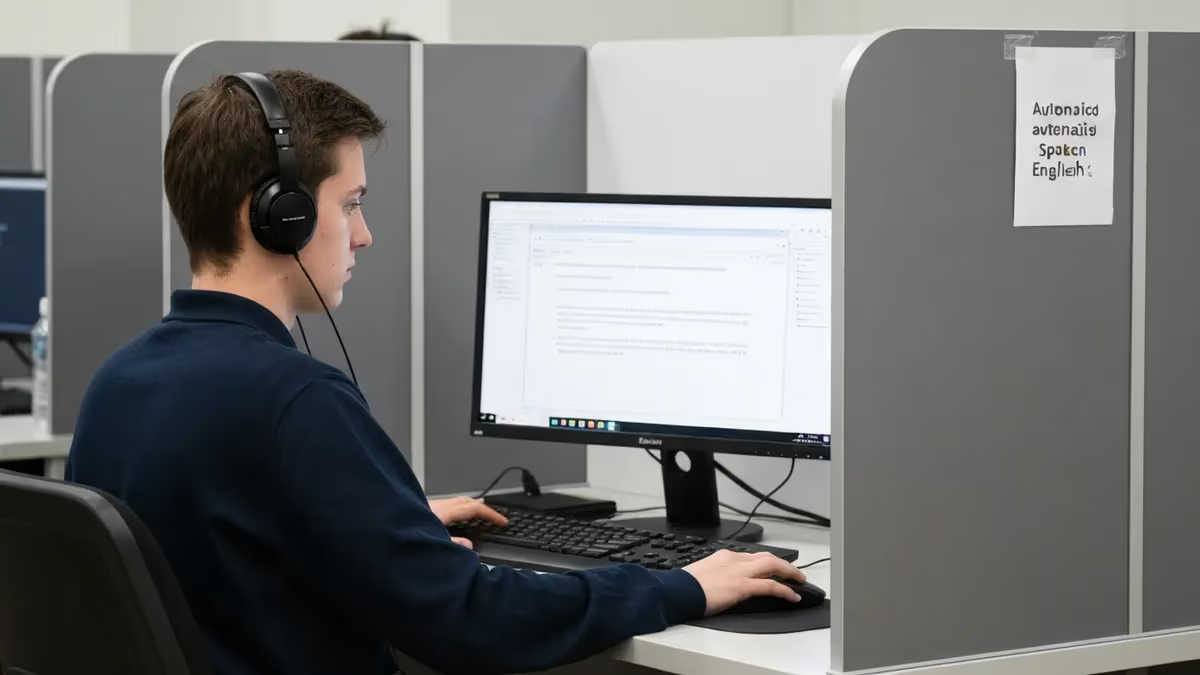
If you are preparing for a call center job, a BPO position, or any English-language customer service role, you have likely been asked to take what is a Versant test — a fully automated, phone-based or computer-based spoken English assessment developed by Pearson. The Versant English Test measures how naturally and accurately candidates use spoken English, evaluating everything from sentence fluency to vocabulary range and listening comprehension. It is one of the most widely used language screening tools in the hiring industry today, with millions of test-takers assessed each year across more than 50 countries.
The Versant test is unique because it requires no human evaluator. A proprietary speech recognition and scoring engine listens to your responses in real time, scores them instantly, and delivers results within minutes of test completion. This makes Versant extremely attractive to large employers who need to screen hundreds or thousands of candidates quickly and consistently. Companies ranging from global BPO giants to healthcare networks and financial services firms rely on Versant scores to decide which applicants advance to the next round of interviews.
Understanding what the Versant test actually measures is the first step toward preparing effectively. The standard Versant English Test consists of multiple sections that test reading aloud, sentence repetition, short answer questions, sentence builds, storytelling, and open questions. Each section targets a specific component of oral language proficiency, and the scoring engine weighs your pronunciation, fluency, vocabulary, and sentence structure simultaneously as you speak. There is no option to pause, rewind, or redo a prompt — which means pacing and composure are just as important as English knowledge itself.
Many test-takers are caught off guard because the Versant test feels nothing like a traditional written English exam. You speak your answers into a microphone or telephone handset, responding within tight time windows, sometimes as short as 15 to 30 seconds per item. The pressure of hearing a beep and knowing you must respond immediately can cause fluent English speakers to stumble. That is why practice under timed, realistic conditions is absolutely essential before sitting the real assessment. The more familiar you are with the format, the more naturally your language abilities will come through.
Scores on the Versant English Test range from 20 to 80, and employers set their own minimum cutoff scores depending on the role and the level of English proficiency required. A score of 41 to 50 is generally considered adequate for standard customer support roles, while positions requiring complex communication, negotiation, or technical explanation typically demand scores of 55 and above. Understanding versant power outages — that is, understanding how score bands map to real-world job requirements — helps you set a realistic preparation target before test day.
The good news is that the Versant test is highly learnable. Unlike general intelligence or aptitude tests, it specifically measures English language habits that respond well to focused practice. Candidates who dedicate two to four weeks of consistent, structured preparation consistently outperform those who walk in cold. The key is to practice the exact task types you will face — reading aloud at a natural pace, repeating sentences without hesitation, building sentences from scrambled words, and answering open-ended questions with organized, fluent responses.
This guide will walk you through every aspect of the Versant test: its structure, scoring methodology, section-by-section breakdown, preparation strategies, and common mistakes to avoid. Whether you are taking the exam for a first-time job application or retaking it to improve your score for a higher-tier position, this resource will give you the knowledge and tools to perform your very best. Let us start with the numbers that define this assessment.
Versant Test by the Numbers

Versant Test Format & Structure
| Section | Questions | Time | Weight | Notes |
|---|---|---|---|---|
| Reading Aloud | 16 | ~4 min | 20% | Read printed sentences into microphone |
| Repeat Sentences | 16 | ~5 min | 20% | Listen and repeat verbatim |
| Short Answer Questions | 12 | ~4 min | 15% | Brief spoken answers to factual prompts |
| Sentence Builds | 14 | ~5 min | 20% | Construct sentences from scrambled words |
| Story Retell | 10 | ~7 min | 15% | Listen to passage, retell in own words |
| Open Questions | 12 | ~6 min | 10% | Extended spoken responses to open prompts |
| Total | 80 | 15–35 minutes | 100% |
The Versant test scoring system is built on Pearson's Automated Speech Recognition (ASR) technology combined with natural language processing algorithms that have been trained on millions of spoken English samples. When you respond to a prompt, the engine evaluates four core linguistic dimensions simultaneously: sentence mastery, vocabulary, fluency, and pronunciation.
Each dimension receives its own subscore, and these subscores are combined using a weighted formula to produce your overall composite score on the 20–80 scale. The scoring process is entirely objective — there is no human listener, no subjective impression, and no possibility of bias based on your name or accent origin.
Sentence mastery is the single heaviest-weighted dimension in the Versant scoring model. It measures whether your spoken sentences are grammatically complete, correctly structured, and demonstrate an appropriate level of syntactic complexity for professional communication. The engine checks for subject-verb agreement, correct tense usage, appropriate use of articles and prepositions, and the overall coherence of your sentence construction. Candidates who regularly use compound and complex sentences — rather than defaulting to short, choppy phrases — tend to score significantly higher in this dimension, particularly on the Story Retell and Open Questions sections.
Vocabulary scoring examines both the range and precision of the words you choose. The engine flags candidates who rely on repetitive, low-level vocabulary (simple words like "good," "bad," "nice," and "thing") versus those who deploy varied, contextually accurate word choices.
This does not mean you need to sound academic or overly formal — in fact, natural, conversational vocabulary scores just as well as sophisticated vocabulary provided it is used accurately. What hurts your score is using incorrect words, choosing a word that does not fit the grammatical or semantic context, or repeating the same limited set of vocabulary throughout the test.
Fluency scoring is where many candidates lose significant points without realizing it. Fluency is not simply about speaking quickly — it measures the smoothness and continuity of your speech, including pause patterns, filler word frequency ("um," "uh," "like"), false starts, and mid-sentence corrections.
A candidate who speaks at a moderate pace with clean transitions will outscore a fast speaker who stumbles, pauses excessively, or restarts sentences multiple times. Practicing fluency means training yourself to think slightly ahead of what you are saying, so your speech flows forward without interruption. Reading texts aloud daily is one of the best exercises for building this habit.
Pronunciation scoring does not penalize non-native accents — this is one of the most important things to understand about the Versant test. The engine is calibrated to recognize a wide range of English accents, including Indian, Filipino, Latin American, West African, and many others. What it does penalize is pronunciation that makes words difficult to recognize or that causes intelligibility problems. The key targets are correct stress placement on syllables and words, accurate vowel and consonant sounds in high-frequency vocabulary, and clear enunciation of word endings (particularly plurals, past tenses, and third-person singular verbs).
For candidates exploring versant power — the full scope of what Versant assessments cover across different industries — it is worth knowing that Pearson offers several specialized Versant tests beyond the standard English version. These include the Versant Spanish Test, the Versant French Test, and industry-specific variants such as Versant for Healthcare, which includes medical terminology and clinical communication scenarios. The scoring methodology across all variants follows the same four-dimension model, but the item content is calibrated for the specific language or domain being assessed.
One important technical detail: your Versant score reflects your performance at the time of the test, under the specific conditions of that testing session. Factors like background noise, microphone quality, and internet connectivity (for computer-based versions) can affect how clearly the ASR engine captures your speech. Always take the test in a quiet room with a good-quality headset or handset, and ensure your internet connection is stable. A technically clean audio signal gives the scoring engine the best possible data to evaluate your actual language ability rather than environmental interference.
Versant Power: Section-by-Section Breakdown
The Reading Aloud section presents 16 sentences on screen or reads them through the phone, and you must read each sentence clearly into the microphone within the allotted time. The sentences increase in length and grammatical complexity as the section progresses. Focus on reading at a natural conversational pace — neither rushing through nor speaking unnaturally slowly. The engine rewards smooth intonation patterns and accurate word-stress over raw speed. Practice by reading newspaper articles or business emails aloud for 10 minutes daily.
The Repeat Sentences section requires you to listen to a sentence played through your headset, then immediately repeat it word-for-word with the same pronunciation and rhythm. Sentences grow progressively longer, reaching 10 to 16 words toward the end of the section. This section tests both your working memory and your phonological accuracy simultaneously. Candidates who struggle with sentence memory should practice shadowing — listening to audio clips and repeating phrases in real time — to build the neural pathways needed for accurate, rapid repetition under test conditions.

Versant Test: Advantages and Challenges for Job Seekers
- +Fully automated scoring eliminates human bias and ensures fair, consistent evaluation for all candidates
- +Results are delivered within minutes, so candidates know where they stand almost immediately after testing
- +The test is available remotely by phone or computer, making it accessible from any location worldwide
- +Standardized format means all candidates at the same company are measured on exactly the same criteria
- +Multiple industry-specific variants (healthcare, financial, technical) allow targeted assessment for specialized roles
- +Scores are portable and may be accepted by multiple employers within a validity window, reducing retesting burden
- −No opportunity to review, pause, or redo any individual prompt once the timer has started
- −Background noise or poor microphone quality can negatively affect speech recognition accuracy and scoring
- −The automated format can feel impersonal and stressful for candidates unfamiliar with speaking to machines
- −High minimum cutoff scores for premium roles can disqualify otherwise strong candidates with test anxiety
- −The short response windows (15–30 seconds per item) disadvantage candidates who process language more deliberately
- −Scores do not distinguish between accent variation and actual pronunciation errors, which can occasionally misclassify speakers
Versant Test Preparation Checklist
- ✓Take a full-length timed practice Versant test at least 7 days before your actual exam date.
- ✓Record yourself speaking for 5 minutes daily and listen back to identify fluency gaps and pronunciation errors.
- ✓Practice reading newspaper articles, business reports, or short stories aloud for 10 minutes every day.
- ✓Shadow native English speakers using podcasts or YouTube videos by repeating phrases in real time.
- ✓Drill Sentence Builds by scrambling sentences from texts you read and then reconstructing them aloud.
- ✓Expand your active vocabulary by learning 5 new professional-context words per day and using them in spoken sentences.
- ✓Practice answering open-ended questions with a 30-second limit — set a timer and force yourself to keep speaking.
- ✓Identify your weakest section from practice tests and dedicate extra daily time specifically to that section type.
- ✓Ensure your testing environment is quiet, your microphone is high quality, and your internet connection is stable.
- ✓Get 8 hours of sleep the night before the test — fatigue significantly reduces spoken fluency and processing speed.

Fluency Beats Speed: The #1 Versant Scoring Lesson
Research on automated speech scoring consistently shows that smooth, connected speech with minimal hesitation outperforms fast-but-choppy speech on every ASR-based assessment. Before your Versant test, spend at least one week practicing the habit of thinking one sentence ahead as you speak, so your words flow forward without mid-sentence stops. Candidates who master this single habit improve their fluency subscore by an average of 6 to 10 points — enough to cross the cutoff threshold for most mid-tier roles.
Developing an effective study plan for the Versant test starts with an honest self-assessment. Before you begin structured preparation, take a baseline practice test under real conditions — no pausing, no replaying prompts, and strict adherence to the time limits. Your baseline score reveals exactly which sections need the most attention and which are already near your target level. Candidates who skip the baseline assessment often over-prepare for their strong areas and under-prepare for their weak ones, which is an inefficient use of limited study time.
For candidates scoring below 40 on baseline, the priority is foundational grammar and pronunciation. Focus on the most common English sentence patterns — simple present, simple past, present perfect, and conditional structures — and practice producing them quickly without hesitation. Work with a grammar workbook that includes spoken exercises, not just written ones. At this level, daily speaking practice is more valuable than reading or listening practice alone, because the muscle memory for fluent speech production must be built through active use of the language, not passive exposure.
Candidates scoring between 40 and 55 on baseline are in the middle tier — functional communicators who need to smooth out their delivery and expand their vocabulary range. At this level, the most impactful practice is shadowing native speakers in professional contexts: business news programs, customer service training videos, and TED-style presentations. Shadowing builds the intonation patterns and natural rhythm of professional English in ways that grammar drills alone cannot replicate. Aim for 20 minutes of shadowing practice per day in addition to your structured section-by-section drills.
Candidates already scoring above 55 who need to reach 60 or higher for premium roles should focus on the Open Questions and Story Retell sections, which are where the highest differentiation occurs among advanced test-takers. At this level, the key is not making grammar errors or mispronunciations — it is organizing your thoughts quickly and speaking in sophisticated, multi-clause sentences that demonstrate complex reasoning. Practice by answering current-events questions, explaining abstract concepts, and describing processes in detail, always pushing yourself to use varied vocabulary and connected discourse markers ("furthermore," "as a result," "in contrast to").
Time management during the actual test is a skill in itself. Each section has its own pacing rules, and the test will move forward whether you are ready or not. Candidates who spend too long gathering their thoughts before speaking often find that the recording window closes before they have said enough. The safest strategy is to begin speaking within two to three seconds of the prompt ending, even if your first sentence is simple — then build your response as you go. Starting fast demonstrates confidence and buys you momentum for the rest of your answer.
One commonly overlooked preparation strategy is practicing in your actual test environment, not just in a quiet bedroom. If you will be taking the test at a testing center, visit the location beforehand if possible, or at least practice wearing headphones while speaking aloud, since this feels different from speaking freely in a room. If taking the test remotely, replicate your test setup exactly during practice: same desk, same headset, same microphone settings, same time of day. Environmental familiarity reduces cognitive load on test day and lets your language abilities take center stage.
The mental aspect of Versant preparation is real and important. Many candidates who are highly competent English speakers underperform on the Versant because the pressure of automated testing triggers anxiety that disrupts their fluency. Practicing mindfulness techniques — specifically slow breathing and a brief focus routine before beginning the test — has been shown to reduce anxiety-related fluency disruption significantly. In the 60 seconds before your test begins, take three slow breaths, remind yourself that you have prepared thoroughly, and mentally commit to starting each response immediately without overthinking.
Versant test scores are typically valid for 6 to 12 months from the date of testing, depending on the employer's policy. If you received a Versant score from a previous job application, check whether it falls within the employer's accepted validity window before assuming it can be used for a new application. Many candidates are surprised to learn their score has expired and must retake the test, sometimes under tighter timelines. Always confirm the validity policy directly with the employer or testing coordinator before your scheduled assessment.
On test day itself, your physical environment and technical setup are just as important as your English proficiency. Arrive at the testing location — or log into the remote testing platform — at least 15 minutes early so you have time to settle, check your audio equipment, and complete any identity verification steps without rushing. Rushed candidates make more errors in the early sections of the test, before they have had a chance to warm up, and those early errors disproportionately affect the final composite score because they can drag down multiple dimension subscores at once.
If you are taking the phone-based version of the Versant test, use a landline or a fully charged mobile phone in a room where signal strength is strong and consistent. Signal drops or call quality issues during the test can corrupt recordings and force you into a retake situation that may not be convenient to schedule quickly.
For the computer-based version, use a wired internet connection rather than Wi-Fi whenever possible, and make sure your browser and any required testing software are fully updated before the test begins. Technical problems during the test are one of the most common and most avoidable causes of a poor experience.
During the Reading Aloud section, resist the temptation to read ahead with your eyes before speaking. Reading ahead can cause your spoken delivery to feel rushed and choppy because you are processing the next sentence while still vocalizing the current one. Instead, read phrase by phrase, letting your voice catch up with your eyes at natural break points — comma pauses, prepositional phrase boundaries, and clause transitions. This phrase-by-phrase approach produces the smooth, natural intonation patterns that the scoring engine rewards with high fluency and pronunciation marks.
For the Repeat Sentences section, use active listening strategies rather than passive hearing. As the sentence plays, visualize the grammatical structure as it unfolds — identify the subject, the main verb, and the object or complement in real time. This structural visualization technique helps your working memory retain longer sentences more accurately because you are encoding the sentence as a meaningful grammatical pattern rather than as a random string of words. Candidates who practice this technique regularly can accurately repeat sentences up to 14 or 15 words long, which is the upper end of what appears on most Versant variants.
When answering Open Questions, use the PEEL structure (Point, Explanation, Example, Link back) as a mental template to organize your response within the time limit. State your main point in the first sentence, explain the reasoning behind it in the second, give a brief concrete example in the third, and if time allows, link it back to the original question or add a closing observation. This four-part structure ensures your response has clear logical organization, which boosts your sentence mastery subscore even when the question is unfamiliar or unexpected.
Reviewing your performance after a practice session is one of the most valuable habits you can build during preparation. After each practice test, listen to your recordings and evaluate yourself honestly across the four scoring dimensions: Did I use complete, grammatically correct sentences? Did I vary my vocabulary meaningfully? Was my speech smooth and continuous? Were my words clearly pronounced? For candidates preparing for versant health industry-specific assessments, this self-evaluation step is especially important because medical and healthcare contexts require precise terminology and clear patient-communication language that must be rehearsed explicitly.
Finally, remember that the Versant test is a snapshot, not a verdict. If your score on a first attempt does not meet the employer's cutoff, many companies allow a retake after a waiting period of 30 to 90 days.
Use that interval productively: identify the specific dimension scores that pulled down your composite (employers sometimes share these breakdowns), design a targeted preparation plan for those dimensions, and return to the test more prepared and more confident than before. Thousands of candidates who initially scored below cutoff have gone on to achieve their target scores — and the jobs that came with them — through focused, disciplined preparation.
Building lasting English fluency for the Versant test — and for the professional role you are pursuing — requires consistent daily habits rather than intensive last-minute cramming. Research on language acquisition consistently shows that 30 minutes of focused daily practice over four weeks produces significantly greater fluency gains than a 14-hour weekend marathon session. This is because spoken language skills are procedural, like playing a musical instrument — they are consolidated during sleep and reinforced through spaced repetition, not through volume alone. Design your preparation schedule with this in mind.
One of the most effective and underused preparation tools is the shadowing technique, which involves listening to a short audio clip — 30 to 60 seconds — and then immediately repeating it in exact sync with the speaker, matching not just the words but the rhythm, stress, and intonation. This technique builds prosody (the musicality of English speech) faster than almost any other method.
Use professional English content for shadowing: business news segments, customer service role-plays, or corporate training videos that reflect the register you will need in your target role. Even 10 minutes of shadowing daily produces measurable improvements in fluency within two weeks.
Vocabulary expansion for the Versant test does not require memorizing lists of advanced academic words. The most high-impact vocabulary for Versant success consists of precise, commonly used professional-context words that describe everyday actions, qualities, and relationships more accurately than their basic counterparts. For example: replacing "said" with "explained," "mentioned," "emphasized," or "suggested"; replacing "good" with "effective," "reliable," "consistent," or "satisfactory"; replacing "bad" with "problematic," "inefficient," "inconsistent," or "challenging." Practicing these substitutions in your daily spoken language — not just in test prep — is the fastest way to raise your vocabulary subscore.
Grammar practice for the Versant test should be output-focused, not input-focused. Many candidates spend too much time reading grammar rules and too little time actually producing grammatically correct spoken sentences under timed conditions. A more effective approach is grammar drills where you listen to a prompt — for example, "Tell me about something you accomplished last month" — and force yourself to respond entirely in accurate past-tense sentences within 20 seconds. Rotating through different tense targets (present perfect, conditional, passive voice) and different sentence types (questions, negative statements, compound sentences) builds the grammatical flexibility the Versant scoring engine rewards.
Candidates who have access to a language partner — a friend, family member, or online conversation partner who can provide honest feedback — gain a significant advantage over those who practice in isolation. Speaking English with another person creates social pressure that closely mimics the mild stress of the test environment, helping you practice maintaining fluency even when you are slightly nervous. Ask your partner to flag every filler word ("um," "uh," "like," "you know") and every incomplete sentence, and work specifically to eliminate those habits from your natural speech over the weeks leading up to your test.
For the versant provider login and practice test resources available online, make sure you are using materials that accurately reflect the current Versant format. The Versant test has been updated several times over its history, and older practice materials may include section types, timing structures, or prompt formats that no longer appear on the current version. Stick to practice resources from reputable sources that clearly state the edition or year of the content, and cross-reference the practice section types with the official Versant test description from Pearson's website.
As your test date approaches, shift your preparation from intensive skill-building to maintenance and confidence-building. In the final three days before the test, reduce your practice session length to 20 minutes per day and focus only on the section types where you feel least confident. Attempting major skill-building too close to the test date can actually introduce new errors by disrupting habits that are already well-established. Trust the preparation you have done, stay rested and well-nourished, and approach test day with the confidence that comes from knowing you have prepared consistently and thoroughly.
Versant Questions and Answers

What is the Versant Test? Format, Scoring & How to Prepare 2026

Email Writing for Versant Test: Complete Guide to Scoring High in 2026
Versant English Test Practice Test PDF (Free Printable 2026)

Versant Pearson Test Score: Complete Guide to Understanding Your Results in 2026

Versant Test Sections & Scoring Guide: All 8 Parts Explained (2026)
About the Author

Applied Linguist & Language Proficiency Exam Specialist
Georgetown UniversityDr. Yuki Tanaka holds a PhD in Applied Linguistics and an MA in TESOL from Georgetown University. A former language examiner with the British Council, she has 18 years of experience designing and teaching language proficiency preparation courses for TOEFL, IELTS, CELPIP, Duolingo English Test, JLPT, Cambridge FCE/CAE, and Versant assessments worldwide.