
Versant Test Online: Complete Practice Guide for 2026 October
Prepare for the Versant online test with free practice questions, scoring tips, and expert strategies. 🎯 Ace your English proficiency exam today.

Taking the Versant online test is a pivotal step for job seekers and professionals who need to demonstrate English fluency to employers across customer service, healthcare, finance, and government sectors. Unlike traditional paper-based assessments, the Versant online format uses automated speech recognition technology to evaluate your spoken and written English in real time, delivering scored results within minutes rather than days. Understanding what to expect and how to prepare efficiently can be the difference between a disappointing result and a score that opens doors to the career you want.
Versant online testing is administered through a secure browser platform or telephone interface, meaning you can complete the assessment from virtually any location with a stable internet connection and a quality microphone. The convenience factor is significant — employers and testing centers across the United States have embraced remote proctoring, making the Versant one of the most widely deployed English proficiency tools in the country. However, that same convenience means you need to be especially disciplined about your preparation environment and technical setup before test day arrives.
The exam itself covers multiple dimensions of English communication, including reading aloud, sentence building, passage reconstruction, and open-ended question responses. Each section is algorithmically scored against native speaker benchmarks, producing a composite score that employers use alongside other hiring criteria. If you are preparing for a role at a call center, a healthcare provider network, or a financial services company, your Versant score may be weighted heavily in the selection process, so consistent and targeted practice is essential.
One of the most effective preparation strategies is to simulate actual test conditions at home. This means sitting in a quiet room, using headphones with a built-in microphone, and timing yourself on each section without pausing. Many candidates underestimate the importance of pacing — the Versant online exam moves quickly, and hesitation or repetition can lower your fluency scores even when your grammar is correct. The more you practice under realistic conditions, the more naturally you will perform when it actually counts.
Resources for versant power preparation have grown substantially in recent years. PracticeTestGeeks.com offers free dictation exercises, sample sentence completion tasks, and full-length simulated exams that mirror the actual Versant scoring rubric. Using these tools consistently over two to four weeks gives most candidates a measurable improvement in their composite scores, particularly in the fluency and pronunciation subscores that weigh most heavily in employer evaluations.
Beyond practice tests, effective Versant preparation includes daily listening exercises with native-speaker audio content such as podcasts, news broadcasts, and instructional videos. Shadowing — the technique of repeating spoken content immediately after hearing it — is especially powerful for improving pronunciation accuracy and speech rate, two factors the Versant algorithm evaluates directly. Candidates who combine shadowing with targeted dictation practice typically see faster score gains than those who rely on reading comprehension exercises alone.
This guide walks you through every component of the Versant online exam, from the technical requirements and section formats to scoring benchmarks and proven study strategies. Whether you are taking the test for the first time or retaking it to improve a previous score, the information and practice resources here will help you approach the assessment with confidence and a clear plan for success.
Versant Online Test by the Numbers

Versant Online Test Format & Section Breakdown
| Section | Questions | Time | Weight | Notes |
|---|---|---|---|---|
| Reading Aloud | 16 | 2 min | 20% | Read sentences aloud into microphone |
| Repeat Sentences | 16 | 3 min | 20% | Hear and immediately repeat each sentence |
| Sentence Builds | 10 | 3 min | 15% | Rearrange scrambled words into a correct sentence |
| Story Retellings | 3 | 3 min | 15% | Listen to a short passage and retell it |
| Open Questions | 10 | 3 min | 15% | Respond to questions about everyday topics |
| Dictation | 25 | 3 min | 15% | Type exactly what you hear |
| Total | 80 | 17 minutes | 100% |
Understanding how the Versant online test is scored is just as important as mastering the content itself. The assessment uses a composite scoring system that combines six subscores — Reading, Sentence Mastery, Vocabulary, Fluency, Pronunciation, and Listening — into a single total score on a scale of 20 to 80. Each subscore reflects a distinct dimension of English proficiency, and employers typically set minimum thresholds for the composite as well as for individual subscores that are especially relevant to the target role.
Fluency and Pronunciation are the two subscores that cause the most anxiety for test takers, partly because they are evaluated automatically by a speech recognition engine rather than a human rater. The algorithm listens for unnatural pauses, excessive filler sounds, mispronounced vowels and consonants, and speech rate deviations from native-speaker norms. Candidates who speak too slowly in an attempt to sound careful often score lower on fluency than those who maintain a natural pace even if they make minor grammatical errors along the way.
The Listening subscore is derived primarily from the Repeat Sentences and Story Retellings sections. A strong Listening score requires you to retain and reproduce spoken content accurately even when sentences are long or syntactically complex. Research on language learning consistently shows that active listening — where you mentally predict the next word as you hear a sentence — significantly improves short-term retention, which is exactly the skill the Versant listening sections are designed to measure.
Sentence Mastery and Vocabulary subscores are evaluated across multiple sections simultaneously, including Sentence Builds and Open Questions. The Sentence Builds section is often underestimated by candidates who assume it simply tests grammar knowledge. In practice, it also rewards the ability to rapidly identify subject-verb-object structures under time pressure, a skill that is better developed through timed practice than through passive grammar review.
Reviewing your versant power outages report carefully after each practice session is one of the most valuable habits you can build during your preparation period. Most official Versant score reports break down your performance by subscore and include band descriptors that explain what each range means in practical terms. Candidates who review this feedback systematically and adjust their practice focus accordingly make significantly faster progress than those who simply repeat full-length practice tests without analyzing their results.
Score benchmarks vary by employer and industry. Customer service and call center roles in the United States typically require a minimum composite score of 40 to 50, with pronunciation and fluency subscores often needing to meet separate thresholds. Healthcare organizations and financial services firms frequently require scores of 50 or above, while roles involving complex client communication or technical explanation may demand scores in the 55 to 65 range. Understanding the specific benchmark for your target role before you begin studying allows you to calibrate your preparation intensity appropriately.
It is worth noting that the Versant English Test has multiple versions, including the Versant English Test, the Versant for Business, and the Versant for Healthcare. Each version is calibrated slightly differently to reflect the communication demands of its target sector. If you know which version your prospective employer uses, you should prioritize practice materials that match that specific format, as the section weighting and vocabulary complexity differ meaningfully across versions.
Versant Power: Practice Strategies by Section
The Reading Aloud section rewards candidates who can maintain a natural speech rate while accurately pronouncing every word in a sentence. The most effective preparation technique is to read printed news articles aloud for at least ten minutes per day, recording yourself and comparing your playback to native-speaker audio of the same passage. Focus on sentence-final intonation patterns, which the Versant algorithm weights heavily as a fluency signal.
For Repeat Sentences, the key challenge is auditory memory rather than pronunciation. Practice by listening to sentences of increasing length — start with eight-word sentences and work up to eighteen words over two weeks. After each sentence, close your eyes and repeat it verbatim before checking against the original. This active recall approach builds the short-term phonological memory that the Versant scoring engine measures when it compares your repetition against the original audio waveform.
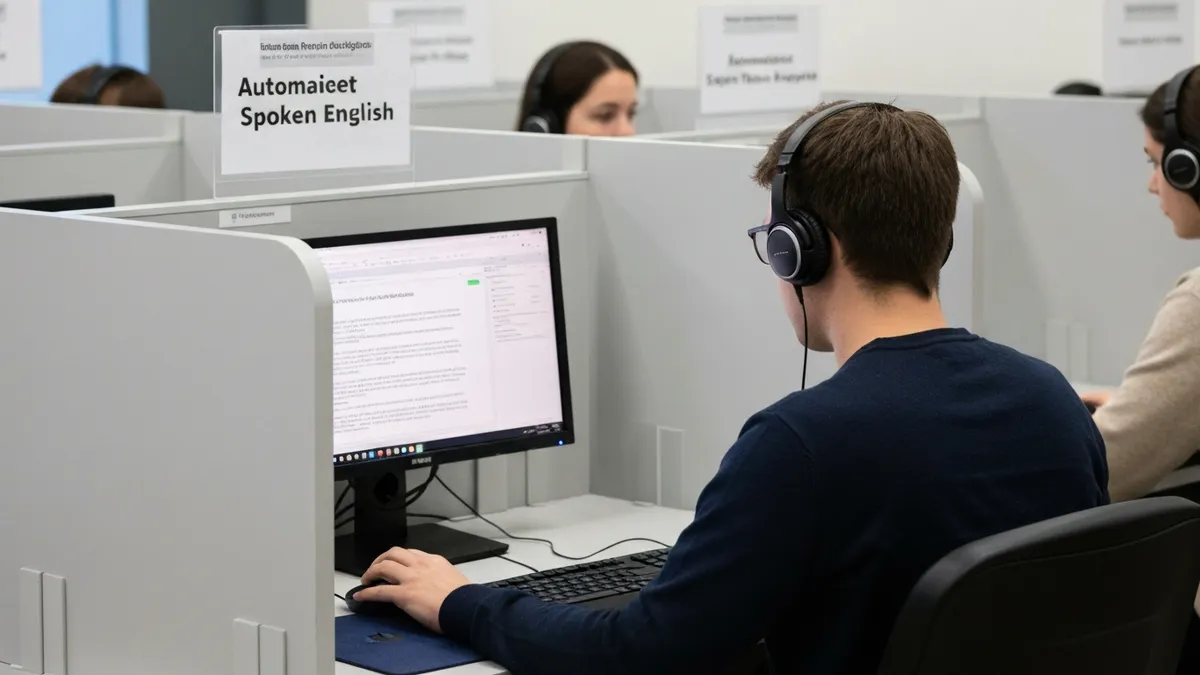
Versant Online vs. In-Person Testing: Key Differences
- +Test from home or any quiet location with a stable internet connection
- +Receive fully automated scores within minutes of completing the assessment
- +No travel time or testing center scheduling constraints
- +Consistent scoring environment unaffected by rater subjectivity
- +Available on weekends and evenings to fit busy professional schedules
- +Technical setup allows you to use your preferred microphone and headset
- −Technical issues like poor internet or microphone problems can disrupt your test session
- −Background noise at home can negatively affect speech recognition accuracy
- −No human proctor means you must be extra diligent about rules compliance
- −Some employers require in-person verification after an online Versant result
- −Automated scoring cannot account for regional accents the way a human rater might
- −Requires a modern browser and operating system that may need updates before test day
Pros and Cons at a Glance
| Pros | Cons |
|---|---|
| Test from home or any quiet location with a stable internet connection | Technical issues like poor internet or microphone problems can disrupt your test session |
| Receive fully automated scores within minutes of completing the assessment | Background noise at home can negatively affect speech recognition accuracy |
| No travel time or testing center scheduling constraints | No human proctor means you must be extra diligent about rules compliance |
| Consistent scoring environment unaffected by rater subjectivity | Some employers require in-person verification after an online Versant result |
| Available on weekends and evenings to fit busy professional schedules | Automated scoring cannot account for regional accents the way a human rater might |
| Technical setup allows you to use your preferred microphone and headset | Requires a modern browser and operating system that may need updates before test day |
Versant Online Test Preparation Checklist
- ✓Test your microphone and headset at least 48 hours before your scheduled exam session.
- ✓Confirm your internet connection speed is above 10 Mbps with a wired or strong Wi-Fi connection.
- ✓Complete at least three full-length timed practice tests before your actual exam date.
- ✓Record yourself during every Speaking practice session and review playback for pronunciation errors.
- ✓Practice the Dictation section daily by transcribing audio content at 120+ words per minute.
- ✓Study the six Versant subscores and identify your two weakest areas to target during prep.
- ✓Choose a testing environment that is completely free of background noise and visual distractions.
- ✓Review the specific Versant version your employer uses and obtain matching practice materials.
- ✓Warm up your voice for five minutes before starting the exam to improve early-section fluency.
- ✓Read the official Versant test instructions in advance so no directions surprise you on test day.

Fluency Beats Perfection: Keep Talking
The single most common mistake Versant test takers make is pausing to mentally correct themselves mid-sentence, which tanks the fluency subscore even when the rest of the answer is grammatically accurate. The Versant algorithm penalizes silence gaps above 0.3 seconds far more than it penalizes minor grammatical slips. Train yourself to keep speaking forward — natural self-correction through rephrasing is scored much more favorably than hesitation silence.
Employers across dozens of industries use Versant online scores as a standardized, objective measure of English communication ability that removes the inconsistency inherent in interview-based language assessments. In a typical hiring pipeline, your Versant score is reviewed alongside your resume and interview performance, functioning as a gating criterion that either advances you to the next stage or removes you from consideration. Understanding how different employers interpret Versant scores helps you set realistic preparation targets and prioritize the right subscores.
Customer service and contact center companies are among the heaviest users of Versant testing in the United States. Companies operating large inbound and outbound call centers typically set composite score floors between 40 and 55, with pronunciation often weighted independently because customers on phone calls are especially sensitive to accented or unclear speech. If you are applying to a US-based customer support role, your pronunciation subscore may be the single most scrutinized number in your report.
Healthcare organizations use the Versant for Healthcare version to screen clinical and administrative staff who interact directly with patients. In this sector, both comprehension accuracy and speaking clarity are critical for patient safety, so employers frequently require higher composite scores — often 55 or above — and may impose separate minimums on the Listening and Sentence Mastery subscores. Nurses, medical assistants, and patient services representatives are the roles most commonly assessed with this version of the exam.
Financial services firms use Versant to evaluate candidates for roles ranging from bank teller positions to investment advisor assistant roles. The vocabulary demands in financial settings are specific and technical, so Versant for Business versions used by these employers include passages and questions drawn from financial and professional contexts. Candidates preparing for financial sector roles benefit from supplementing their general English practice with industry-specific vocabulary drills using terms commonly encountered in banking, insurance, and investment services.
Government contractors and federal agencies have increasingly incorporated Versant testing for positions that require English fluency at a professional working proficiency level. These organizations often align Versant score ranges with the Interagency Language Roundtable scale, using Versant composite scores as a proxy for ILR Level 2 or Level 3 designations. If you are pursuing a federally contracted position, understanding how your target agency maps Versant scores to ILR levels can help you calibrate your preparation targets precisely.
Some employers request a follow-up human review of borderline Versant scores, particularly when a candidate's composite falls within a few points of the cutoff. In these cases, the quality of your Open Questions responses carries extra weight because they offer the most naturalistic evidence of communicative competence. Candidates who practice generating fluent, organized, topically relevant responses in Open Questions are best positioned to succeed in both the automated scoring and any subsequent human review.
It is also worth understanding what Versant scores do not measure. The exam does not evaluate content knowledge, customer service aptitude, problem-solving ability, or the cultural nuances of professional communication. A high Versant score signals English language fluency — it does not by itself predict job performance. Employers who use Versant responsibly treat it as one data point among many, and candidates should approach it the same way: a threshold to meet confidently rather than the sole determinant of their candidacy. Understanding your versant health across all communication modalities gives you the clearest picture of where to focus your energy.
At least 15% of first-time Versant online test takers report technical issues on exam day — microphone not recognized, browser compatibility errors, or background noise triggering false audio detection. Run a complete technical dry run 48 hours before your scheduled test using the same device, browser, and headset you plan to use during the actual exam. Most technical failures are preventable with a single practice session.
If you have already taken the Versant online test and received a score below your target threshold, you are not alone — and you are not without options. Many employers allow one or more retakes after a waiting period that typically ranges from 30 days to 90 days depending on company policy. Before scheduling a retake, invest time in a systematic analysis of your previous score report to identify which subscores dragged down your composite, then build a focused preparation plan that targets those specific areas rather than repeating a general review.
Pronunciation improvement is the subskill that most candidates find hardest to improve quickly, partly because pronunciation habits are deeply ingrained through years of first-language dominance. However, research consistently shows that targeted minimal-pairs training — in which you practice distinguishing and producing pairs of similar sounds like ship versus sheep or this versus these — can produce measurable improvement in as little as three weeks when practiced for 20 minutes per day. Apps that use speech recognition to give you real-time phoneme accuracy feedback are particularly effective for this type of targeted drilling.
Fluency improvement is generally faster than pronunciation improvement because it depends more on confidence and task familiarity than on phonological retraining. Candidates who score below 40 on fluency in their first attempt typically find that simply increasing their total speaking practice time — from less than an hour per week to 30 or more minutes per day — produces a meaningful score gain on a retake within six to eight weeks. The key is active speaking practice, not passive listening or reading, because fluency is a production skill that only improves through production repetition.
For candidates struggling with the Sentence Builds section, the underlying issue is usually slow syntactic processing speed rather than lack of grammatical knowledge. You already know the rules — you just aren't applying them fast enough under test conditions. The remedy is to practice sentence unscrambling with a strict 15-second time limit per item. As your processing speed increases, your accuracy will improve in parallel because you will have more cognitive capacity available for error-checking before you submit each answer.
Story Retellings is the section where retake candidates most consistently improve, often because they learn on their first attempt that memorization does not work and shift to narrative reconstruction strategies. Practice summarizing any spoken or written story you encounter in daily life — news articles, movie trailers, recipe instructions — using the three-part structure of situation, action, and outcome. This framework maps naturally onto the kinds of passages Versant uses and gives you a reliable scaffold to hang details on even when your memory of specific wording is incomplete.
Accessing versant provider login materials that match the exact format of your retake version is critical for efficient preparation. Generic English practice materials are useful for building general proficiency, but time-pressured Versant-specific drills are what will translate most directly to score gains on your retake. The PracticeTestGeeks platform offers section-specific drills for each of the six Versant sections, allowing you to focus your limited preparation time on the areas where additional points are most attainable given your starting subscore profile.
Finally, consider the conditions under which you will take your retake. If noise was a problem during your first attempt, invest in a better headset with noise-canceling microphone technology. If you felt rushed by the pacing, practice with a countdown timer running visibly in your peripheral vision so that time pressure becomes a familiar rather than jarring element of your study environment. Small environmental and equipment changes can have a surprisingly large impact on performance when the underlying English proficiency is already at or near the target level.
For a fuller set of questions on this topic, see our versant test practice online free resource.
For a fuller set of questions on this topic, see our deloitte versant test practice resource.
For a fuller set of questions on this topic, see our versant 4 skills essential test resource.
With your test date approaching, the final two weeks of preparation should shift emphasis from skill building to performance consolidation. This means reducing the volume of new material you introduce and increasing the proportion of full-length timed simulations in your daily practice schedule. The goal in the final stretch is not to learn new skills — it is to make existing skills automatic so that you can execute them under exam pressure without conscious effort depleting your working memory.
Sleep is one of the most undervalued performance factors in language assessment preparation. Linguistic fluency — particularly the speed of lexical retrieval and the accuracy of phonological production — is measurably worse after even a single night of reduced sleep. Aim for seven to nine hours of sleep every night during the two weeks before your exam, and under no circumstances should you sacrifice sleep for additional practice sessions in the 48 hours immediately preceding test day.
On the morning of your exam, spend 10 to 15 minutes doing gentle verbal warm-ups rather than intensive drilling. Read a paragraph aloud, have a brief conversation in English, or do a five-minute narration exercise about something you observed that morning. The purpose is to activate the phonological and syntactic circuits in your brain that the Versant exam will rely on, without fatiguing those circuits before the assessment begins. Athletes call this a warm-up; language testers call it priming — but the neurological principle is the same.
During the exam itself, pay attention to your posture and breathing. Sitting upright with relaxed shoulders supports diaphragmatic breathing, which in turn produces steadier, clearer speech than the shallow chest breathing that nervousness tends to induce. If you notice your heart rate rising before a particularly challenging section, take one slow breath before the prompt begins. That two-second intervention will not cost you points, and it meaningfully reduces the vocal tension that degrades fluency scores.
After the exam, resist the urge to immediately second-guess your performance. Most candidates significantly underestimate how well they did because they remember every hesitation and error while forgetting the many fluent, accurate responses they produced. Wait until you receive your official score report before drawing conclusions about your performance. If your score meets or exceeds the employer's threshold, you are done. If it falls short, you now have detailed subscore data to guide a targeted and efficient retake preparation plan.
Building a long-term English practice habit beyond your immediate Versant preparation will benefit you throughout your career, not just on this one exam. Professionals who engage daily with English-language podcasts, industry publications, and professional conversations maintain their fluency scores over time without conscious effort, while those who stop all English practice after their exam often experience score declines if they need to retest for a promotion or role change. Think of your Versant preparation as the catalyst for a sustainable language practice routine rather than a one-time sprint.
The combination of structured practice, technical readiness, subscore awareness, and performance consolidation strategies outlined in this guide gives you everything you need to perform at your best on the Versant online test. Start with the free practice quizzes on PracticeTestGeeks.com today, track your progress using the subscore framework, and arrive on test day knowing exactly what to expect and how to respond. Your preparation is your most reliable competitive advantage.
Sample Versant Practice Questions
Try these questions from our free Versant practice tests. The correct answer and an explanation follow each question.
What is the danger of choosing an answer in the VERSANT Reading Test that is 'true in general' but not supported by the passage?
- A. There is no danger — general knowledge answers are always correct
- B. This results in a wrong answer, because VERSANT reading questions require passage-supported answers only
- C. This only affects essay scores, not multiple-choice
- D. It is acceptable if the passage is ambiguous
Answer: B. This results in a wrong answer, because VERSANT reading questions require passage-supported answers only
Reading comprehension tests evaluate understanding of the specific passage, not general world knowledge. Answers must be directly supported by the text; selecting a true-in-general but unsupported statement is a common and costly error.
In the Versant Repeats section, the sentences gradually increase in length and complexity. This design is intended to primarily assess the test-taker's:
- A. Vocabulary range on diverse topics.
- B. Ability to sustain concentration over a long period.
- C. Auditory short-term memory and mastery of English sentence structure.
- D. Pronunciation of individual vowel and consonant sounds.
Answer: C. Auditory short-term memory and mastery of English sentence structure.
The ability to repeat a sentence, especially a long one, relies on more than just hearing the words; it requires the brain to process and hold the sentence in short-term memory. The increasing difficulty specifically challenges a non-native speaker's ability to 'chunk' phrases and clauses based on an internalized understanding of English syntax. This makes it a powerful tool for assessing both memory and deep knowledge of sentence structure.
Which memory strategy most helps test-takers perform well on Versant Passage Reconstruction?
- A. Focusing on the key nouns, verbs, and logical sequence while listening
- B. Trying to memorize every single word in the passage
- C. Ignoring details and summarizing only the title topic
- D. Writing notes on paper during the listening phase
Answer: A. Focusing on the key nouns, verbs, and logical sequence while listening
Chunking information around key content words and identifying the logical sequence (who did what, when, why) gives a mental framework for reconstruction, which is more effective than attempting verbatim memorization.
What makes the Open Questions section of the Versant test different from the Repeat Sentences section?
- A. Test-takers must generate their own responses rather than repeat a model sentence
- B. Test-takers write their answers instead of speaking them
- C. The questions are shorter and simpler than Repeat Sentences
- D. There is no time limit for answering Open Questions
Answer: A. Test-takers must generate their own responses rather than repeat a model sentence
Unlike Repeat Sentences—where the test-taker mimics a heard sentence—Open Questions require spontaneous speech production. The test-taker must formulate and deliver their own response to a prompt.
Versant Questions and Answers

What is the Versant Test? Format, Scoring & How to Prepare 2026

Email Writing for Versant Test: Complete Guide to Scoring High in 2026
Versant English Test Practice Test PDF (Free Printable 2026)

Versant Pearson Test Score: Complete Guide to Understanding Your Results in 2026

Versant Test Sections & Scoring Guide: All 8 Parts Explained (2026)
About the Author

Applied Linguist & Language Proficiency Exam Specialist
Georgetown UniversityDr. Yuki Tanaka holds a PhD in Applied Linguistics and an MA in TESOL from Georgetown University. A former language examiner with the British Council, she has 18 years of experience designing and teaching language proficiency preparation courses for TOEFL, IELTS, CELPIP, Duolingo English Test, JLPT, Cambridge FCE/CAE, and Versant assessments worldwide.