
Free Versant Test Practice: Prep Guide for 2026 October
Get free Versant test practice questions, scoring tips, and prep strategies. 🏆 Boost your English proficiency score fast with our free tin for versant test.

If you are searching for a free tin for versant test preparation, you have landed in the right place. The Versant English Proficiency Test is a widely used automated spoken and written English assessment adopted by employers, call centers, BPO companies, and universities across the United States and globally. Understanding what the test measures and how it is scored is the first step toward a competitive result, and free practice tools are the most accessible way to begin that preparation journey effectively.
The Versant test evaluates multiple dimensions of English communication in a single sitting, typically lasting between 15 and 60 minutes depending on the format your employer or institution has selected. Scores are delivered almost instantly, which makes it a favorite tool for high-volume hiring. Many job seekers are caught off guard by the automated nature of the test — there is no human evaluator on the other end, only sophisticated speech-recognition software that grades pronunciation, fluency, and sentence coherence with remarkable precision.
One of the most common concerns candidates raise is whether free practice resources can adequately mirror the real test environment. The answer is yes, provided you use structured, format-accurate practice materials. Our free quizzes replicate the dictation and reading-aloud components, giving you realistic exposure to the timing pressure and audio quality that define the actual exam. This kind of simulation is essential because performance anxiety is itself a measurable drag on fluency scores.
Understanding the versant power of consistent practice is key: research on language assessments consistently shows that test-takers who complete at least five timed practice sessions score between 8 and 15 percentile points higher than those who study only passively. Active, output-based practice — speaking aloud, writing under time pressure, and listening critically — trains the exact cognitive and motor pathways the Versant algorithm is designed to evaluate.
This guide walks you through every component of the free Versant practice experience available on PracticeTestGeeks.com. You will find detailed explanations of each test section, strategic tips matched to each task type, and direct links to our best free practice quizzes. Whether you are applying for a customer service role, a teaching position, or a university language placement, the preparation principles here apply universally to achieving the highest Versant score your current abilities support.
One important note before diving in: many candidates confuse the Versant test with other English proficiency assessments like IELTS, TOEFL, or Duolingo English Test. The Versant is distinct in that it is employer-administered rather than independently registered, it uses automated AI scoring rather than human raters, and it produces a single composite score alongside component subscores. Knowing these structural differences shapes how you practice — you focus more on speed and fluency than on essay construction or extended academic reading.
By the end of this guide you will have a clear practice plan, understand every section you will face on test day, know the scoring thresholds employers use to screen candidates, and have access to enough free Versant practice material to walk into your assessment with genuine confidence rather than guesswork.
Versant Test by the Numbers
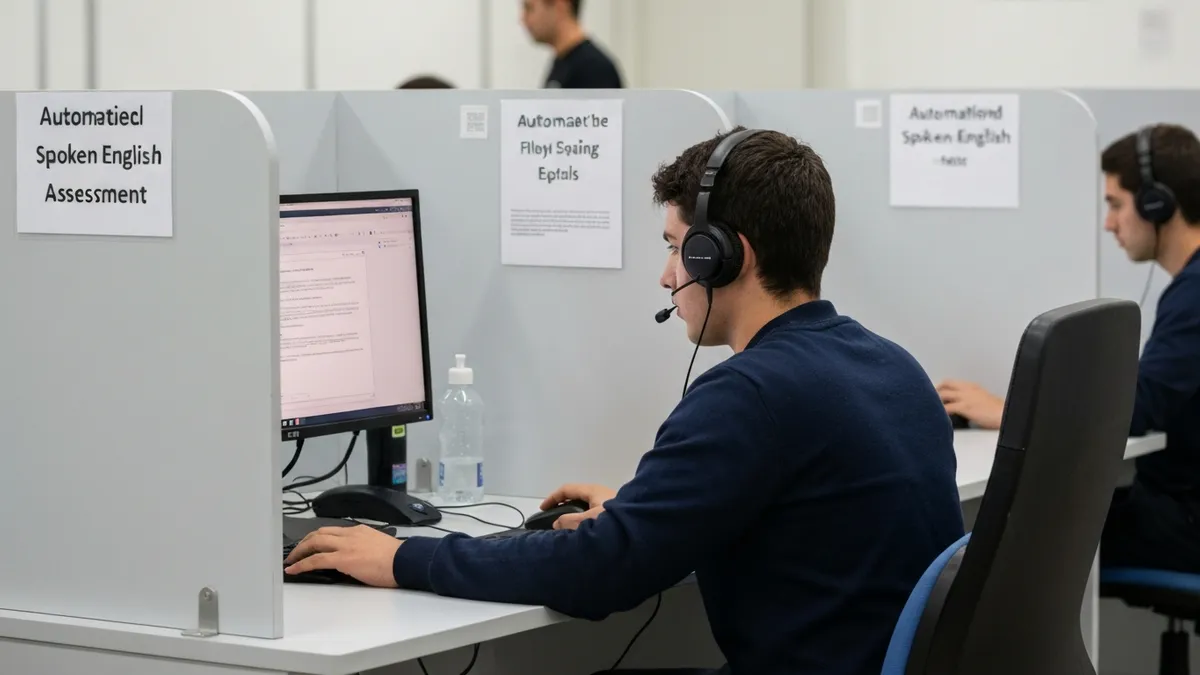
Versant Test Format Explained
| Section | Questions | Time | Weight | Notes |
|---|---|---|---|---|
| Read Aloud | 16 | 3 min | ~15% | Single sentences read aloud after a beep |
| Repeat | 16 | 4 min | ~15% | Hear and repeat spoken sentences verbatim |
| Short Answer Questions | 12 | 4 min | ~15% | Spoken answers to simple spoken questions |
| Sentence Builds | 14 | 5 min | ~15% | Rearrange scrambled words into correct sentences |
| Story Retellings | 3 | 5 min | ~15% | Listen to a story; retell it from memory |
| Open Questions | 3 | 4 min | ~10% | Extended spontaneous spoken responses |
| Dictation | 10 | 8 min | ~15% | Type sentences heard in audio clips exactly |
| Total | 80 | 15–60 minutes | 100% |
Free practice resources are not just a nice-to-have — they are a genuine competitive differentiator when you understand how the Versant algorithm scores responses. The test's AI engine does not simply check whether your answer is grammatically correct; it analyzes delivery rate in words per minute, the number and duration of hesitation pauses, pronunciation accuracy at the phoneme level, and the semantic completeness of your sentences. Each of these sub-metrics contributes to your overall score, which means targeted free practice can address each weakness individually and systematically.
The dictation section is particularly amenable to free practice because it tests a discrete, trainable skill: converting auditory input into accurate written text under time pressure. Unlike the open-ended speaking sections, dictation has objectively correct answers. Every word you miss, misspell, or add incorrectly counts against you. Our free dictation quizzes present audio clips at the same pace and accent variety as the real test, so your ears and fingers become calibrated to the specific demands of this high-weight section before you ever sit for the actual assessment.
For the reading-aloud and sentence-repeat sections, the practice mechanism that matters most is volume: the more sentences you read aloud under timed conditions, the lower your cognitive load during the actual test. Cognitive load directly impacts fluency — when you are struggling to decode written text at speed, your spoken delivery reflects that mental effort through more pauses, slower pace, and less natural intonation. Free practice eliminates the decoding effort so that fluency has room to emerge naturally during your real test session.
Understanding versant power outages in your performance — the specific sections where your score drops sharply — is one of the most valuable insights free practice delivers. After each practice session, review which question types you struggled with most. If sentence builds are costing you points, spend 20 minutes daily rearranging scrambled sentences. If story retellings are your weak point, practice listening to short news segments and summarizing them aloud immediately afterward. Targeted micro-practice like this yields faster score gains than generic English study.
Technology setup is another area where free practice delivers hidden value. The Versant test requires a reliable internet connection, a functioning microphone, and a quiet environment. Completing free practice sessions in your actual test environment — whether that is a home office or a testing facility — lets you troubleshoot technical issues before they affect your real score. Discovering that your laptop microphone produces background noise, or that your internet connection drops during audio playback, during a practice session is vastly preferable to discovering it on test day.
Scheduling matters more than most candidates realize. The Versant test measures your English proficiency in real time, which means your cognitive state during the test directly affects your score. Free practice sessions scheduled at the same time of day as your real test help calibrate your mental readiness. If your employer-scheduled test window is 9 AM to 11 AM, completing your free practice sessions during that same morning window trains your brain to perform at its best during those hours specifically.
Building consistency over a two-week preparation period produces far better results than cramming in the 48 hours before your test. A realistic free practice schedule looks like this: one full free quiz daily for 14 days, plus 15 minutes of reading English text aloud each morning. This totals roughly 30 to 45 minutes of daily active practice — a sustainable commitment that produces measurable fluency gains. Candidates who follow this structure routinely report score improvements of 5 to 12 points on a 20-to-80 scale, which often makes the difference between passing an employer threshold and being screened out.
Practice Strategies by Versant Test Section
Dictation practice requires a dual focus on listening accuracy and typing speed. Start each session by previewing common function words — articles, prepositions, conjunctions — because these small words are the most frequently dropped under time pressure. During practice, type exactly what you hear without pausing to second-guess spelling; your ears are often right when your conscious mind is uncertain. Aim for at least 40 words per minute typing speed to comfortably complete every dictation item within the allotted response window.
For the sentence-repeat section, the most effective free practice technique is shadowing: listen to a spoken sentence, then immediately speak the same sentence out loud, mimicking the speaker's rhythm and intonation as closely as possible. This trains both your phonological memory (how long you can hold a sentence in working memory) and your production accuracy. Most candidates can hold 8 to 10 syllables comfortably; shadowing practice routinely extends that to 14 or 15 syllables, which covers nearly all Versant repeat items at the intermediate difficulty level.

Free Versant Practice: Benefits and Limitations
- +Zero cost — removes financial barrier to structured exam preparation
- +Instant feedback on dictation accuracy after every practice quiz
- +Realistic format exposure reduces test-day anxiety significantly
- +Available 24/7 so you can practice at your optimal cognitive time
- +Builds typing speed and listening accuracy simultaneously
- +Helps identify your weakest sections before the real assessment
- −Free tools may not replicate the exact audio codec of official Versant software
- −No official Versant scoring rubric is publicly released, so practice scores are estimates
- −Cannot replicate the biometric or environment monitoring in some proctored versions
- −Free practice does not include the proprietary short-answer question bank
- −Self-study misses feedback from a human language coach on pronunciation errors
- −Overuse of a single free resource can create familiarity bias rather than true skill gain
Pros and Cons at a Glance
| Pros | Cons |
|---|---|
| Zero cost — removes financial barrier to structured exam preparation | Free tools may not replicate the exact audio codec of official Versant software |
| Instant feedback on dictation accuracy after every practice quiz | No official Versant scoring rubric is publicly released, so practice scores are estimates |
| Realistic format exposure reduces test-day anxiety significantly | Cannot replicate the biometric or environment monitoring in some proctored versions |
| Builds typing speed and listening accuracy simultaneously | Free practice does not include the proprietary short-answer question bank |
| Helps identify your weakest sections before the real assessment | Self-study misses feedback from a human language coach on pronunciation errors |
Your Complete Pre-Test Versant Prep Checklist
- ✓Complete at least one full free dictation practice quiz every day for two weeks before your test.
- ✓Record yourself reading aloud for 10 minutes daily and play back to catch pronunciation errors.
- ✓Test your microphone and internet connection in the exact room where you will sit the Versant test.
- ✓Practice shadowing — repeating spoken sentences immediately after hearing them — for at least 15 minutes daily.
- ✓Time yourself typing dictated sentences to ensure you can maintain 40+ words per minute under pressure.
- ✓Study 10 new English vocabulary words per day, focusing on terms common in your target industry or role.
- ✓Complete at least two full practice sets using QUIZ_3 and QUIZ_4 format to build endurance for longer sessions.
- ✓Sleep for at least 7 hours the night before your test; sleep deprivation measurably reduces verbal fluency scores.
- ✓Eat a light meal 90 minutes before the test to maintain energy without causing drowsiness.
- ✓Read the Versant test instructions page thoroughly so you know exactly what to expect from each section prompt.
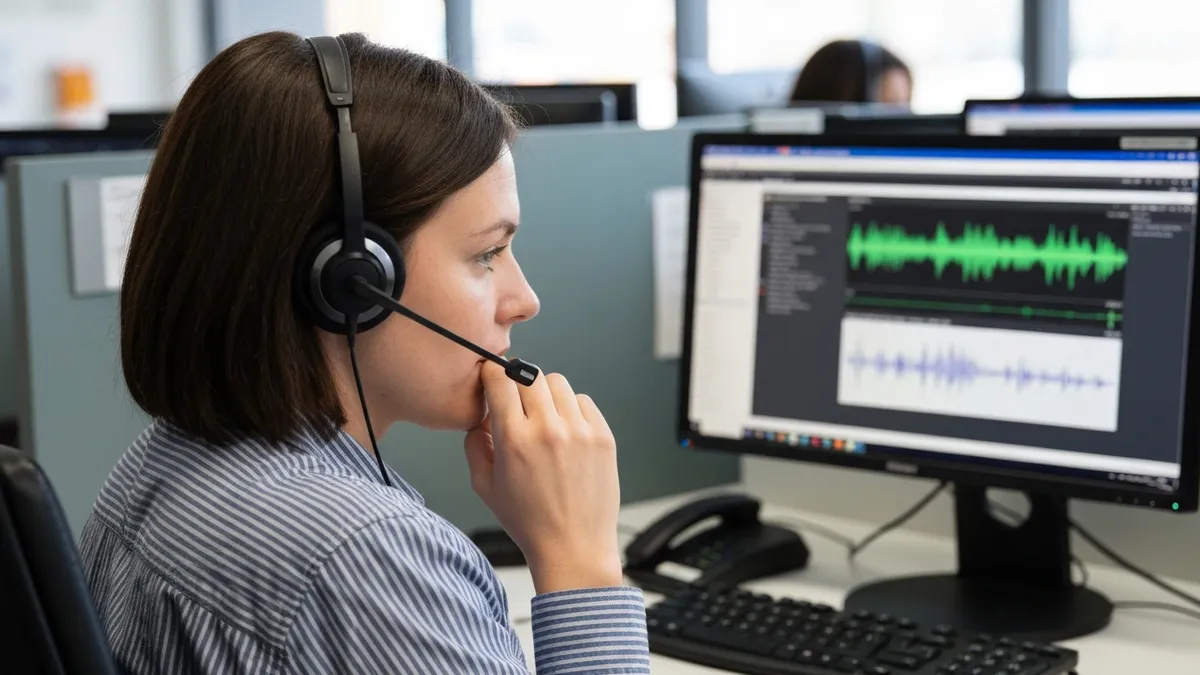
Speed Matters More Than Perfection on Versant
Versant's AI scoring algorithm penalizes long hesitation pauses more heavily than minor pronunciation errors. A confident, slightly imperfect sentence scores better than a perfectly correct sentence delivered slowly with multiple pauses. Train yourself to respond within 2 seconds of the beep on every section, even if your first attempt is not perfect.
Understanding how Versant scores are interpreted by employers is arguably as important as achieving a high score in the first place. The Versant English Test produces a composite score on a scale of 20 to 80, broken into proficiency bands that correspond to descriptive labels ranging from Elementary to Advanced.
Most customer service and call center roles in the United States require a minimum composite score of 50, which corresponds roughly to the B2 level on the Common European Framework of Reference for Languages. Roles requiring independent, complex communication — supervisory positions, training roles, content creation — typically demand scores of 60 or above.
Individual section subscores are equally important to understand because employers sometimes apply minimum thresholds at the subscore level rather than only at the composite level. A candidate with a composite score of 55 but a dictation subscore of 38 may be screened out of roles that require accurate written English, even though their spoken fluency is strong. This is why free dictation practice deserves a disproportionate share of your preparation time — it is both a high-weight section and one where targeted practice produces reliable score improvements.
Score validity is another practical consideration. Most Versant scores are considered valid for 12 months from the date of testing. If you took the Versant test for a previous employer and received a strong score, ask your new prospective employer whether they will accept a score from within the past year. Many do, particularly in high-volume hiring environments where the administrative overhead of retesting every candidate is significant. This is not universally true, but it is always worth asking, especially if your previous score was above your target employer's threshold.
Retesting policies vary by institution and employer. Some organizations allow candidates to retake the Versant test immediately if they did not meet the minimum threshold on a first attempt; others impose a waiting period of 30 days or longer to prevent score gaming through rapid retesting. If you expect you may need to retest, plan your preparation accordingly — use the waiting period to address specific weak sections identified from your first attempt rather than repeating general practice that already reached its effectiveness ceiling.
The relationship between Versant scores and actual job performance has been studied by Pearson, the company that develops and maintains the Versant test. Their validation research consistently shows that Versant scores above 55 correlate strongly with supervisor performance ratings for English-language communication roles, particularly those involving telephone interaction with customers. This means that employers are not using arbitrary score cutoffs — the thresholds are calibrated to predict real on-the-job language performance, which gives the test genuine predictive validity.
For candidates whose first language is not English, the Versant test presents specific challenges related to phonological interference — the tendency to substitute phoneme patterns from one's native language into English pronunciation. Free practice can help identify the most persistent interference patterns by providing audio playback of your own spoken responses. Common interference patterns for Spanish-first-language speakers include vowel reduction errors; for Mandarin-first-language speakers, consonant cluster simplification is the most frequent pattern. Knowing your specific phonological profile allows you to focus practice on those exact phoneme pairs that your accent most frequently distorts.
Finally, understanding what the Versant score does NOT measure is equally important for managing expectations. The test does not assess content knowledge, domain expertise, emotional intelligence, or cultural fluency. A score of 60 means you communicate in English at a strong independent user level — it says nothing about whether you understand the specific products your employer sells, the compliance requirements of your industry, or the interpersonal dynamics of your team.
This means that a good Versant score is a necessary but not sufficient condition for success in English-language professional roles, and your preparation energy beyond the test itself should address those complementary dimensions of job readiness.
Free practice quiz scores on PracticeTestGeeks.com are training benchmarks, not official Versant scores. Only scores generated by Pearson's official Versant platform are valid for employer submissions. Never present a practice score to an employer as your official test result, as Versant scores include a unique candidate identifier that employers can verify directly with Pearson.
The most frequently overlooked preparation resource for the Versant test is audio diversity — deliberately exposing your ears to a wide range of English accents, speaking speeds, and audio qualities during your free practice sessions. The Versant test uses native English speakers recorded under controlled studio conditions, but the accent pool includes American, British, and occasionally Australian English. If your free practice has only exposed you to one accent variety, switching accents mid-test can cause a momentary comprehension lag that disrupts your fluency and accuracy on the repeat and dictation sections.
To build accent flexibility, supplement your dictation quiz practice with 15 minutes of daily listening to diverse English-language audio. Podcasts, recorded lectures, and news broadcasts from BBC World Service, NPR, and ABC Australia each provide a distinct accent and register profile. Your goal is not to imitate these accents but to calibrate your auditory processing so that mild accent variation does not slow your comprehension speed during the actual assessment. Three weeks of diverse listening practice measurably reduces accent-related comprehension errors in controlled language testing studies.
Physical and environmental preparation for the Versant test is a dimension that many candidates underestimate until they have experienced a disrupted test session firsthand. The test requires a quiet room, but quiet is relative — background noise that you have habituated to and no longer consciously hear will still be picked up by your microphone and potentially affect speech recognition accuracy.
Test your microphone sensitivity in advance by recording yourself speaking at your normal volume from your normal test position, then playing it back to hear what ambient noise the microphone captures. Common culprits include HVAC systems, traffic, nearby conversations, and household appliances.
Review resources available through versant provider login channels can help you familiarize yourself with the administrative side of the test — how to log in, what the interface looks like, and what technical requirements your device must meet. Technical failures during the actual test are rare but not impossible, and knowing the support process in advance (who to contact, how to report an issue, what the retesting policy is for technical disruptions) prevents panic from compounding into a performance crisis if something goes wrong during your session.
Vocabulary depth deserves specific attention in the final week before your test. While the Versant does not include a vocabulary multiple-choice section, lexical richness — the variety of words you use in your open-question responses — is a real component of the fluency and grammar subscores.
Candidates who respond to open questions using only a narrow set of common words score lower than candidates who vary their word choices naturally. Spend 10 minutes per day in the final week reviewing synonyms for high-frequency verbs and adjectives: instead of always using "good," practice substituting "effective," "reliable," "consistent," and "productive" depending on context.
Grammar accuracy in the Versant test is evaluated in context rather than as isolated rule application. The algorithm is looking for consistent patterns of grammatical control, not perfection on every single utterance. This means that one grammatical error in an otherwise fluent response is treated differently from repeated errors of the same type.
Inconsistent subject-verb agreement, for example — saying "he go" once but "she goes" elsewhere — signals incomplete grammatical control rather than a single slip, and it affects your grammar subscore more significantly than a single isolated error would. Free practice sessions should include self-monitoring specifically for your most habitual grammatical errors.
Connecting your Versant preparation to your broader professional English development creates compound benefits that persist well beyond test day. Candidates who use free practice sessions as part of a larger commitment to English fluency — reading industry publications, participating in English-language professional communities, and writing clear professional emails — outperform candidates who treat the Versant as a one-time hurdle to clear and forget. The versant health of your overall English proficiency is the most durable predictor of both Versant scores and long-term career success in English-language professional environments.
In the 48 hours immediately before your Versant test, your preparation strategy should shift from skill-building to performance optimization. This means reducing the intensity and duration of your practice sessions rather than cramming more quizzes into your schedule. Cognitive fatigue — the mental tiredness that accumulates from sustained attention tasks — measurably reduces spoken fluency and working memory capacity, both of which the Versant directly evaluates. A 20-minute light review session on the evening before your test, followed by adequate sleep, produces better results than a three-hour marathon session that leaves you mentally depleted on test day.
Warm-up routines on the morning of your test are a practical technique borrowed from professional musicians and public speakers. Five minutes of speaking English aloud before your test begins — reading a news article, summarizing your morning plans, or completing one short dictation drill — activates the language production networks in your brain and reduces the cold-start latency that many candidates experience at the beginning of a timed speaking task. Think of it as loosening the muscles before a race rather than running extra miles the night before.
The emotional dimension of Versant test performance is real and measurable. Test anxiety triggers the same physiological responses as physical stress — elevated heart rate, shallow breathing, increased muscle tension — and these physical changes directly impair the fine motor control and working memory capacity that fluent speech requires.
If you experience significant test anxiety, free practice sessions in a simulated test environment (timed, formal, without pause or replay) build the emotional familiarity that desensitizes the anxiety response over time. The more the actual test feels like something you have done before, the lower your anxiety response will be during it.
Pacing yourself across sections is a skill that free practice develops implicitly. Candidates who perform well on the first few sections of the Versant but then fatigue noticeably during story retellings and open questions often have not built the sustained attention capacity that the full test duration requires. If your practice sessions always stop after 15 to 20 minutes, your brain is not trained for the cognitive demands of a 45-to-60-minute assessment. Deliberately extend some practice sessions to match the full expected duration of your specific test version to build this endurance.
After your Versant test is complete, resist the urge to immediately retake free practice quizzes in search of the score you wish you had earned. Give yourself 24 to 48 hours to reflect on the experience while the memory is fresh, note which sections felt most difficult or rushed, and use those observations to plan your improvement strategy if you need to retest. Immediate re-practice sessions after a high-stress assessment often reinforce anxiety-driven response patterns rather than confident, fluent ones.
For candidates who test well below their expected range, the most productive immediate next step is an honest self-assessment of the gap between your practiced performance and your actual test performance. Common causes of underperformance relative to practice scores include the unfamiliarity of the real test interface, audio quality differences between practice quizzes and the actual assessment, the psychological pressure of knowing the result matters, and technical issues that disrupted concentration. Identifying the specific cause shapes the most efficient remediation strategy, whether that means more practice, better equipment, relaxation techniques, or some combination of all three.
Our full library of free Versant practice resources at PracticeTestGeeks.com continues to expand based on candidate feedback. The dictation quizzes available here are updated regularly to reflect the sentence lengths, vocabulary levels, and audio characteristics that current test-takers report encountering in their actual Versant assessments. Bookmark this page and return before your test to ensure you are practicing with the most current materials available, giving yourself the best possible chance at the score your goals require.
Sample Versant Practice Questions
Try these questions from our free Versant practice tests. The correct answer and an explanation follow each question.
Which component of the Versant test requires test takers to describe a tale in their own words?
- A. Short Answer Questions
- B. Reading
- C. Repeats
- D. Story Retelling
Answer: D. Story Retelling
The Story Retelling component of the Versant test specifically requires test takers to listen to a short story and then retell it in their own words. This exercise assesses a range of skills, including listening comprehension, memory, vocabulary, grammar, and the ability to produce coherent, extended discourse. It provides insight into a speaker's narrative abilities and overall fluency.
In the Versant Reading Test, why is punctuation in the sentences useful for test-takers?
- A. Punctuation marks indicate which words to stress most heavily
- B. Punctuation marks signal intonation patterns and appropriate pausing
- C. Punctuation marks indicate the difficulty level of each sentence
- D. Punctuation marks show where the sentence will end and you should stop
Answer: B. Punctuation marks signal intonation patterns and appropriate pausing
Punctuation marks are direct signals for intonation and pausing: commas indicate brief pauses, periods signal falling intonation and full stops, question marks signal rising intonation, and exclamation marks indicate emphatic stress.
Which best practice applies to all sections of the VERSANT test?
- A. Speak slowly and pause between each word for clarity
- B. Respond quickly and completely without long silences, since hesitation affects fluency scoring
- C. Read prepared notes aloud to maximize accuracy
- D. Wait for a beep after each word before continuing
Answer: B. Respond quickly and completely without long silences, since hesitation affects fluency scoring
Across all VERSANT speaking sections, natural fluency is rewarded. Extended pauses and hesitations negatively impact fluency scores, so practicing smooth, continuous speech is essential.
During a full Versant English Proficiency test session, how does the test delivery system work?
- A. An automated telephony or computer system presents prompts and records responses without a human examiner
- B. A live examiner reads prompts aloud and rates responses in real time
- C. The test-taker reads a booklet and submits written answers only
- D. A panel of three raters evaluates performance simultaneously
Answer: A. An automated telephony or computer system presents prompts and records responses without a human examiner
Versant uses an automated system—originally telephone-based, now computer-delivered—that plays audio prompts, records the test-taker's spoken responses, and scores them algorithmically.
Versant Questions and Answers

What is the Versant Test? Format, Scoring & How to Prepare 2026

Email Writing for Versant Test: Complete Guide to Scoring High in 2026
Versant English Test Practice Test PDF (Free Printable 2026)

Versant Pearson Test Score: Complete Guide to Understanding Your Results in 2026

Versant Test Sections & Scoring Guide: All 8 Parts Explained (2026)
About the Author

Applied Linguist & Language Proficiency Exam Specialist
Georgetown UniversityDr. Yuki Tanaka holds a PhD in Applied Linguistics and an MA in TESOL from Georgetown University. A former language examiner with the British Council, she has 18 years of experience designing and teaching language proficiency preparation courses for TOEFL, IELTS, CELPIP, Duolingo English Test, JLPT, Cambridge FCE/CAE, and Versant assessments worldwide.