
Virginia DMV Practice Test 2026: Free VA Written Knowledge Test
Boost your Virginia DMV exam score with practice questions and detailed answer explanations. Track progress with instant feedback. ❓
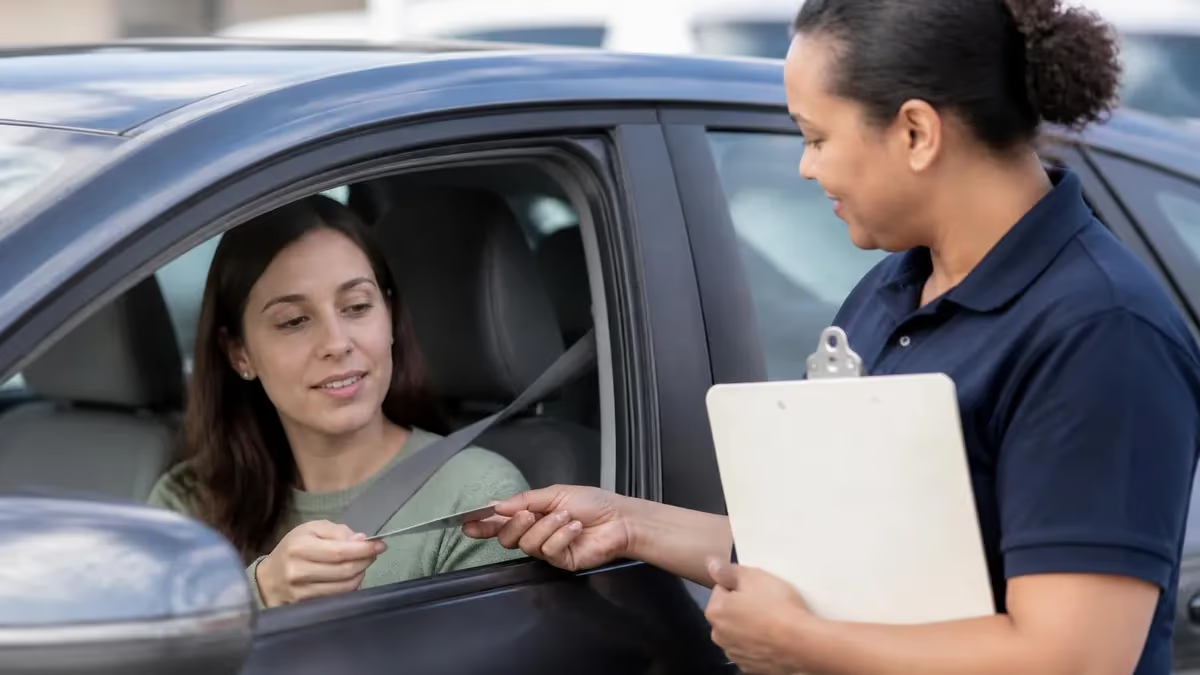
Passing the Virginia DMV written knowledge test is your first real step toward a driver's license — and it's not as intimidating as it sounds. You'll face 35 multiple-choice questions drawn from the Virginia Driver's Manual, and you need to answer at least 30 of them correctly. That's an 86% passing score. Miss more than five, and you'll have to schedule a retake.
The good news? Most people who study consistently pass on their first attempt. The ones who struggle usually walk in underprepared, assuming their real-world driving experience will carry them. It won't. The test focuses heavily on Virginia-specific laws — handheld device rules, DUI thresholds, speed limits in school zones, and right-of-way scenarios that can trip you up even if you've been driving for years in another state.
This guide covers everything: the test format, content areas, Virginia-specific laws you absolutely must know, the step-by-step licensing process, and the most common mistakes test-takers make. There's also a full set of free Virginia DMV practice tests below — use them to get comfortable with the question style before test day.
Virginia DMV Written Test Format
The Virginia knowledge test is administered at any DMV customer service center — on a computer terminal or, at some locations, on paper. Before you dive into studying, know exactly what you're facing. The test has no official time limit, but most people finish in 20–30 minutes. Questions are multiple-choice with four answer options, and you select one per question. You cannot go back to previous questions on most DMV computer systems, so read carefully before clicking.
The questions are pulled from the Virginia Driver's Manual. DMV examiners don't write trick questions, but they do test whether you know the specific rules — not just general driving common sense. A question might ask what the speed limit is in a business district when no signs are posted, or what BAC level triggers Virginia's aggravated DUI charge. These are details you need memorized, not reasoned through.
Don't underestimate any section. Test-takers who skip traffic signs assuming they already know them often miss 3–4 questions in that category alone — enough to fail by a single question. The knowledge test is included in your driver's license application fee, so there's no separate charge to take it.

What the Test Covers
~40% of the test (about 14 questions)
Road rules cover right-of-way, speed limits, following distance, lane changes, passing, and traffic control devices. This is the largest section — and the one where Virginia-specific rules trip up drivers from other states. Key topics: four-way stop order, who yields at uncontrolled intersections, when to yield to pedestrians, and default speed limits when no signs are posted. You need to know the exact numbers, not just the concepts.
Road Rules and Right-of-Way in Virginia
Road rules make up the largest chunk of the knowledge test. Virginia follows most standard traffic laws, but there are specific rules you need to know cold — and the test will probe the details in ways that real-world experience doesn't prepare you for.
Right-of-Way Scenarios
Right-of-way is the most-tested concept on the VA DMV exam. The test won't ask generic questions — it'll describe a specific scenario and ask who goes first. You need to know these scenarios cold:
- Four-way stops: The driver who stops first goes first. If two vehicles arrive at exactly the same time, the vehicle on the right has right-of-way. If they're directly across from each other and one is turning left, the straight-going vehicle has priority.
- Uncontrolled intersections: Yield to vehicles already in the intersection, then yield to the vehicle on your right.
- Left turns: A vehicle turning left must yield to all oncoming traffic going straight through the intersection.
- Emergency vehicles: Pull to the right and stop, even if you're in the middle of an intersection. Wait until the emergency vehicle has passed.
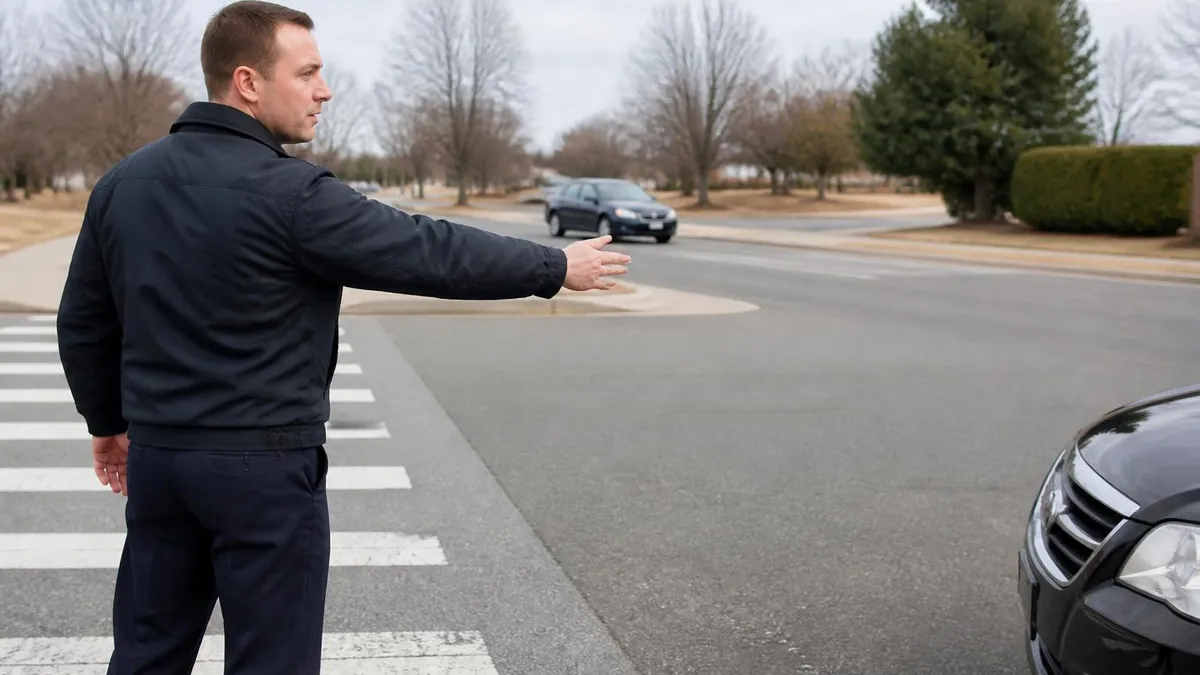
- Pedestrians: Yield in all crosswalks — marked or unmarked. This includes when you're turning at a green light. A green light does not give you the right-of-way over a pedestrian already in the crosswalk.
Right-of-way questions on the Virginia test are almost always scenario-based. Practice reading them carefully — our VA DMV Road Rules practice test uses the same scenario format — the specific details (which direction each car is traveling, who arrived first) determine the correct answer.
Virginia Default Speed Limits
When no speed limit signs are posted, Virginia's statutory limits apply. These are tested directly — the test may ask "What is the speed limit in a residential district when no signs are posted?" You either know it or you don't.
Following Distance and Stopping
Virginia law requires maintaining a reasonable following distance. For the test, know the 3-second rule: pick a fixed object, count three seconds after the car in front passes it — if you pass it before reaching three, you're too close. In poor weather, double it to six seconds. At highway speeds over 55 mph, use a minimum of four seconds. The test often frames this as a scenario question, so understand the principle along with the numbers.
Stopping distance questions also appear. At 55 mph on dry pavement, a typical passenger car needs about 300–350 feet to stop — roughly the length of a football field. Speed dramatically increases stopping distance: doubling your speed quadruples the stopping distance required.
Traffic Signs: What Virginia Tests You On
About 10–11 questions on your Virginia knowledge test focus on traffic signs, signals, and pavement markings. This section catches a lot of people off guard because the signs seem obvious — until the test asks about a specific color or shape combination you've driven past thousands of times without thinking about.
Sign Colors and What They Mean
Virginia uses the federal sign color system. Every color has a specific assigned meaning, and the test expects you to know all of them. Red means stop, yield, or prohibition (do not enter, wrong way signs). Yellow signals general warnings — hazard ahead, slow down. Orange designates construction and work zones where workers may be present.
Green provides guidance information — directions, distances, highway exits. Blue identifies motorist services like gas stations, food, lodging, and hospitals. Brown marks recreational and cultural sites such as parks, campgrounds, and historical landmarks. White covers all regulatory signs including speed limits, lane controls, and turn restrictions.
Sign Shapes
Shape is as important as color. The test may show you a sign silhouette without color and ask what type it is. Know these: octagon (8-sided) is always a stop sign. Inverted triangle is always a yield sign. Diamond shape indicates warning signs. A pentagon pointing upward (5-sided) means school zone or school crossing. Rectangle shapes are for regulatory or guide signs. Circle indicates a railroad crossing warning.
Pavement Markings
Yellow lines separate traffic moving in opposite directions. White lines separate traffic moving in the same direction. A solid yellow line on your side of the road means no passing. A broken yellow line on your side means passing is allowed when it's safe. Double solid yellow lines mean no passing for either direction of traffic. White dashed lines between lanes indicate that lane changing is permitted when it's safe to do so.
Virginia-Specific Laws You Must Know
This is where out-of-state transplants and even lifelong Virginia residents often stumble. Virginia has several laws that differ from other states — and the knowledge test will ask about them directly. There's no way to reason through these questions; you either studied them or you didn't.
Handheld Device Ban
Virginia enacted a strict hands-free driving law effective January 1, 2021. You cannot hold a phone or any handheld personal communications device while driving — even when stopped at a red light. No texting, no scrolling, no holding the phone to your ear. Hands-free use is permitted: Bluetooth, a speakerphone in a dashboard or windshield mount, or a single earpiece. The moment you pick up the device while the vehicle is in motion or stopped in traffic, you're violating the law.
Penalties: first offense is a $125 fine. Second and subsequent offenses are $250. Fines increase further if you're exceeding the speed limit or in a work zone when caught using a handheld device. Virginia traffic courts treat this as a primary offense — police can stop you for this alone, not just as an add-on to another charge.
DUI Thresholds by Driver Type
Virginia's standard DUI BAC threshold is 0.08% for drivers 21 and older. But the knowledge test specifically asks about the other thresholds, which differ significantly by driver category:
- Commercial vehicle drivers: 0.04% BAC — half the standard limit, because commercial vehicles pose greater risk to others
- Drivers under 21: 0.02% BAC — Virginia's near-zero tolerance for underage drinking and driving
- Aggravated DUI: A BAC of 0.15% or higher triggers mandatory minimum jail time, even on a first offense
For extra practice on these DUI rules, try the VA DMV Alcohol and Drug Laws practice test. Practice these scenarios with the VA DMV Alcohol and Drug Laws practice test. Virginia's implied consent law requires you to submit to a blood or breath test if lawfully arrested for DUI. Use the VA DMV Alcohol and Drug Laws practice test to master these thresholds. Refusal to test means automatic license suspension for one year on a first refusal — and refusal becomes a criminal charge starting with the second incident.
Move Over Law
When you're approaching a stopped emergency vehicle, police car, tow truck, or highway maintenance vehicle with its lights flashing on the side of the road, Virginia law requires you to move over one lane away from the vehicle — or, if a lane change isn't safe, to slow down significantly below the posted speed limit. This applies on any road with multiple lanes in the same direction. Violating the Move Over law results in a fine and demerit points on your Virginia license.
Child Passenger Safety
The driver is legally responsible for ensuring all passengers under 18 are properly restrained. Children under 8 years old must be secured in a child restraint system — an appropriate car seat or booster seat. Children ages 8–17 must wear a seatbelt. All front-seat passengers of any age must be buckled. Rear-seat passengers under 18 must also be buckled.
VA DMV Practice Test Questions
Prepare for the VA DMV - Virginia Department of Motor Vehicle exam with our free practice test modules. Each quiz covers key topics to help you pass on your first try.
VA DMV Driver's License
VA DMV Exam Questions covering Driver's License. Master VA DMV Test concepts for certification prep.
VA DMV Road Rules
Free VA DMV Practice Test featuring Road Rules. Improve your VA DMV Exam score with mock test prep.
VA DMV Safe Driving
VA DMV Mock Exam on Safe Driving. VA DMV Study Guide questions to pass on your first try.
VA DMV Traffic Signs
VA DMV Test Prep for Traffic Signs. Practice VA DMV Quiz questions and boost your score.
VA DMV Alcohol and Drug Laws
VA DMV Questions and Answers on VA DMV Alcohol and Drug Laws. Free VA DMV practice for exam readiness.
VA DMV Alcohol and Drug Laws Questions and...
VA DMV Mock Test covering VA DMV Alcohol and Drug Laws Questions and Answers. Online VA DMV Test practice with instant feedback.
VA DMV Parking and Stopping Rules
Free VA DMV Quiz on VA DMV Parking and Stopping Rules. VA DMV Exam prep questions with detailed explanations.
VA DMV Parking and Stopping Rules Question...
VA DMV Practice Questions for VA DMV Parking and Stopping Rules Questions and Answers. Build confidence for your VA DMV certification exam.
VA DMV Special Driving Conditions
VA DMV Test Online for VA DMV Special Driving Conditions. Free practice with instant results and feedback.
VA DMV Special Driving Conditions Question...
VA DMV Study Material on VA DMV Special Driving Conditions Questions and Answers. Prepare effectively with real exam-style questions.
VA DMV Speed Limits and Right of Way
Free VA DMV Test covering VA DMV Speed Limits and Right of Way. Practice and track your VA DMV exam readiness.
VA DMV Speed Limits and Right of Way Quest...
VA DMV Exam Questions covering VA DMV Speed Limits and Right of Way Questions and Answers. Master VA DMV Test concepts for certification prep.
How to Study for the VA DMV Test
- +Read the full Virginia Driver's Manual before taking any practice tests
- +Space out study sessions over several days — spaced repetition beats cramming
- +Review every wrong answer and understand why it's wrong
- +Take 3–5 full practice tests and aim for 90%+ before your appointment
- +Study Virginia-specific laws last, closest to test day, for best recall
- −Skipping the manual and only doing practice tests — misses content not in question banks
- −Relying on out-of-state driving knowledge — Virginia laws differ in key areas
- −Rushing through the test — no time limit means there's no reason to hurry
- −Assuming traffic signs are universal — Virginia tests specific shapes and colors
- −Cramming the night before — information doesn't consolidate well without sleep
Pros and Cons at a Glance
| Pros | Cons |
|---|---|
| Read the full Virginia Driver's Manual before taking any practice tests | Skipping the manual and only doing practice tests — misses content not in question banks |
| Space out study sessions over several days — spaced repetition beats cramming | Relying on out-of-state driving knowledge — Virginia laws differ in key areas |
| Review every wrong answer and understand why it's wrong | Rushing through the test — no time limit means there's no reason to hurry |
| Study Virginia-specific laws last, closest to test day, for best recall | Assuming traffic signs are universal — Virginia tests specific shapes and colors |
Step-by-Step: How to Get Your Virginia Driver's License
The knowledge test is one part of a multi-step process. Understanding the full sequence helps you plan your visit and avoid wasted trips to the DMV.
What Happens on Test Day
Knowing what to expect when you walk into the DMV reduces anxiety and helps you focus on the test itself rather than the logistics. When you arrive at a Virginia DMV customer service center, you'll check in at the front counter. The clerk will verify your documents and confirm your appointment if you made one. Then you'll be directed to a computer terminal — usually in a dedicated testing area separate from the main service floor.
The terminal displays one question at a time. Read the full question and all four answer choices before selecting. Some answers are deliberately close in meaning — the difference between a right answer and a wrong one might be a single word like "must" vs. "may." Pay attention to those details. You'll receive your result immediately after finishing — the terminal shows your score and whether you passed or failed.
If you pass, the DMV staff will guide you through the next steps, which typically include the vision test and, if you have all documents ready, beginning the license application process. If you fail, a staff member will explain the retake process and help you schedule another attempt.
A few practical things to keep in mind: dress comfortably, since you may wait a while even with an appointment. Bring something to drink. Turn your phone off or set it to silent — using it in the testing area isn't permitted. Take time to review the VA DMV Driver's License practice test before your appointment to build confidence. Most importantly, don't rush. The screen won't time out on you, and there's no prize for finishing first.

Common Test Mistakes
- ✓Skipping the Driver's Manual and relying only on practice tests — the manual has details that don't appear in standard question banks
- ✓Misreading key question wording — 'you must' (legal requirement) vs. 'you should' (recommended practice) changes the correct answer
- ✓Guessing on speed limits — the 25 mph default for business and residential districts must be memorized, not estimated
- ✓Skipping traffic sign study because signs seem universal — Virginia tests specific colors and shapes that are commonly misidentified
- ✓Rushing through the test — there is no time limit, so re-read every question before clicking your answer
Virginia DMV Safe Driving Rules to Know
Beyond the laws and signs, the Virginia knowledge test covers safe driving practices — the kind of content that requires understanding the reasoning behind the rules, not just memorizing specific numbers. These questions are often scenario-based, describing a driving situation and asking what you should do. Virginia tests safe driving in realistic contexts — not abstract theory.
Key safe driving topics that Virginia tests:
- Night driving: Use low beams in fog, rain, and snow — high beams reflect off precipitation and reduce your visibility rather than improving it. Switch to low beams within 500 feet of an oncoming vehicle and within 300 feet when following another vehicle.
- Work zone safety: Virginia doubles fines in active work zones. Speed limit signs in work zones are mandatory minimums, not advisory suggestions. The presence of workers increases the fine amount further.
- Motorcycles and cyclists: Give motorcycles a full lane — never pass in the same lane. They're legally entitled to the full width of their lane. When turning right at an intersection, yield to cyclists in any adjacent bike lane.
- Railroad crossings: Never stop on railroad tracks, even if traffic ahead forces a wait. If you can't fully clear the tracks, wait behind the crossing until space opens. Stop at least 15 feet from the nearest rail when a train is approaching or present.
- Skid recovery: Front-wheel skid — ease off the accelerator and steer in the direction you want to go. Rear-wheel skid — steer in the direction the rear of the vehicle is sliding until you regain control, then straighten.
The Virginia DMV knowledge test doesn't expect you to be a professional driver. It expects you to know the specific rules the state uses to keep roads safe — and to apply them correctly in the scenarios the test describes. Use the VA DMV Safe Driving practice test to prepare for these scenario-based questions. The VA DMV Safe Driving practice test covers these exact scenarios. The VA DMV Safe Driving practice test covers these exact scenarios. Safe driving questions reward studying the Driver's Manual carefully, not relying on habit or intuition built from years behind the wheel.
Sample VA DMV - Virginia Department of Motor Vehicle Practice Questions
Try these questions from our free VA DMV - Virginia Department of Motor Vehicle practice tests. The correct answer and an explanation follow each question.
When must you yield to a pedestrian in Virginia?
- A. Only in marked crosswalks
- B. Only when a crossing guard is present
- C. In any crosswalk, marked or unmarked, when the pedestrian is in your lane or adjacent lane
- D. Only when the pedestrian has a walk signal
Answer: C. In any crosswalk, marked or unmarked, when the pedestrian is in your lane or adjacent lane
Virginia law requires drivers to yield to pedestrians in any crosswalk — marked or unmarked — when the pedestrian is in the driver's lane or an adjacent lane.
How many demerit points within 12 months triggers a required Driver Improvement Clinic in Virginia?
- A. 8 points
- B. 10 points
- C. 12 points
- D. 15 points
Answer: C. 12 points
Accumulating 12 demerit points within 12 months requires the Virginia driver to complete a Driver Improvement Clinic.
How often must Virginia vehicle registrations be renewed?
- A. Every year or every two years
- B. Every 3 years
- C. Every 5 years
- D. Only when selling the vehicle
Answer: A. Every year or every two years
Virginia vehicle registrations can be renewed annually or for a two-year period, depending on the owner's choice.
What is Virginia's 'Basic Speed Rule'?
- A. Always drive at the posted speed limit regardless of conditions
- B. Never drive faster than is safe for current road and traffic conditions
- C. Always drive 10 mph below the speed limit in rain
- D. Match the speed of surrounding traffic at all times
Answer: B. Never drive faster than is safe for current road and traffic conditions
Virginia's Basic Speed Rule requires drivers to never drive faster than is safe for existing road, weather, and traffic conditions, even if below the posted limit.
Take the full VA DMV - Virginia Department of Motor Vehicle practice test
VA DMV Questions and Answers
About the Author

Educational Psychologist & Academic Test Preparation Expert
Columbia University Teachers CollegeDr. Lisa Patel holds a Doctorate in Education from Columbia University Teachers College and has spent 17 years researching standardized test design and academic assessment. She has developed preparation programs for SAT, ACT, GRE, LSAT, UCAT, and numerous professional licensing exams, helping students of all backgrounds achieve their target scores.