
Trump Administration Increases Requirements for US Citizenship Test: What Applicants Need to Know in 2026 September
Trump administration increases requirements for US citizenship test in 2026 September. Learn what changed, how to prepare, and pass. ✅ Full guide.

The Trump administration increases requirements for the US citizenship test in 2026, marking the most sweeping overhaul of the naturalization exam in more than two decades. USCIS announced expanded civics question banks, stricter English proficiency benchmarks, and new scoring thresholds that take effect for interviews scheduled after the implementation date. Applicants who have already filed Form N-400 but have not yet attended their interview must verify which version of the test applies to their case. For anyone navigating this process, understanding the exact changes is critical to avoiding unnecessary delays or denials.
The updated civics test now draws from a pool of 128 questions rather than the previous 100, and applicants must correctly answer 12 out of 20 questions asked — up from 6 out of 10 under the earlier format. USCIS officials have stated that the expanded pool reflects a broader commitment to ensuring that new citizens possess a thorough understanding of American democratic institutions, constitutional principles, and the rights and responsibilities of citizenship. The change mirrors a similar — though ultimately reversed — expansion attempted during the first Trump term in 2020 and 2021.
Beyond the civics component, the administration has also tightened English reading and writing requirements. Examiners now place greater weight on an applicant's ability to demonstrate conversational fluency, not merely recite rehearsed answers. USCIS officers are instructed to probe comprehension more deeply during the interview, asking follow-up questions if responses appear memorized rather than genuinely understood. This approach is intended to align naturalization standards with what the administration describes as the foundational expectation that citizens can actively participate in civic life.
The changes have generated significant interest — and concern — among immigration attorneys, advocacy groups, and the more than 800,000 people who apply for naturalization each year. Attorneys advise clients to update their us citizenship and immigration services change of address information promptly with USCIS to ensure all interview notices reach them without delay, especially given the volume of rescheduling that has accompanied the rule transition. Outdated addresses have resulted in missed notices and automatic case terminations for some applicants.
The debate over these changes intersects with broader legal and political battles over immigration policy. Federal courts are actively reviewing several administration initiatives related to naturalization, including controversial executive orders touching on birthright citizenship. Those legal proceedings have created additional uncertainty for applicants who are unsure whether pending rulings will affect their eligibility or the applicable test format at the time of their interview. Staying informed is more important now than at any previous point in recent immigration history.
Preparation strategy must therefore adapt to the new reality. Applicants who studied using older materials — those prepared for the 100-question pool — need to update their study plans immediately. The additional 28 questions cover topics including constitutional amendments beyond the Bill of Rights, the federal budget process, landmark Supreme Court decisions, and the structure of state governments. Many preparation resources have been slow to update, making it essential to use current, verified study materials and practice tests that reflect the 2026 question bank.
This guide walks through every major change, explains how each one affects your interview and overall application timeline, and provides a clear, actionable preparation plan. Whether you are just beginning the naturalization process or are weeks away from your interview date, the information here will help you approach the updated citizenship test with confidence and clarity.
US Citizenship Test 2026 by the Numbers

Key Changes to the US Citizenship Test Format
The question bank grew from 100 to 128 items, covering new topics such as landmark Supreme Court rulings, the federal budget process, state government structure, and constitutional amendments beyond the original Bill of Rights.
Applicants must now answer 12 of 20 randomly selected questions correctly, raising the passing bar from 60% to effectively the same 60% but over twice as many questions, reducing the role of luck in outcomes.
USCIS officers follow new guidance requiring deeper conversational probing during interviews. Memorized answers alone are no longer sufficient — examiners assess genuine comprehension through unprompted follow-up questions.
The vocabulary lists for the reading and writing portions have been updated to include more civically relevant terminology, replacing some everyday-language examples with terms directly tied to government and constitutional concepts.
Officers nationwide received updated training in early 2026, standardizing how interviews are conducted and scored to reduce inconsistency across field offices — a longstanding complaint from immigration attorneys.
Few immigration topics have generated as much public debate in 2026 as birthright citizenship in the US. Under the Fourteenth Amendment, any person born on American soil is automatically a citizen — a principle that has governed US law since 1868. The Trump administration issued an executive order in January 2025 seeking to limit this interpretation, specifically targeting children born to parents who are in the country unlawfully or on temporary visas. Federal courts moved swiftly to block the order, and the litigation escalated rapidly to the Supreme Court.
The concept of US birthright citizenship is now at the center of one of the most consequential constitutional debates in a generation. Supporters of the administration's position argue that the original drafters of the Fourteenth Amendment never intended to confer automatic citizenship on children of non-immigrants. Opponents — including the overwhelming majority of constitutional scholars — contend that the plain text of the amendment admits no such limitation, and that over a century of legal precedent firmly establishes universal jus soli citizenship on American soil.
Closely related to the birthright debate is the issue of US citizenship denaturalization — the legal process by which a previously granted citizenship is revoked. Denaturalization is extraordinarily rare, but the current administration has signaled an intent to use it more aggressively against individuals whose naturalizations are alleged to have been obtained through fraud or concealment of disqualifying facts. The Department of Justice launched a dedicated denaturalization task force that reviews cases flagged through biometric and background database cross-checks.
For most law-abiding applicants, us citizenship denaturalization is not a personal concern, but understanding its legal contours is increasingly relevant as USCIS scrutinizes naturalization applications more carefully. Any inconsistency between an applicant's N-400 responses and their prior immigration filings can trigger additional review. Immigration attorneys uniformly advise clients to review all prior USCIS and State Department records before submitting their naturalization application to catch and explain any discrepancies proactively.
The denaturalization task force has primarily targeted individuals with serious criminal histories, terrorism connections, or immigration fraud cases. However, civil liberties organizations have raised concerns that the broad investigative criteria could sweep in applicants with minor, long-resolved issues from decades past. Legal advocates recommend that any naturalized citizen or applicant who receives a notice related to their case status consult an immigration attorney immediately rather than attempting to respond independently.
The intersection of denaturalization law and the broader policy environment also affects how USCIS officers approach the discretionary aspects of naturalization interviews. Officers have authority to ask questions about an applicant's entire immigration history, employment record, and personal conduct during the statutory period. Under current administration priorities, officers are exercising that authority more fully, spending more time on the interview's biographical sections before proceeding to the civics and English components.
For applicants concerned about how these policy shifts may affect their specific case, the best approach is thorough documentation. Gather tax returns, employment records, travel histories, and any prior USCIS correspondence going back at least five years. Having this material organized and ready demonstrates good faith and allows the interview to proceed smoothly even if the officer asks detailed questions. The more complete your documentation, the less likely a single missing detail is to derail an otherwise strong application.
Oath of Citizenship in the US, Dual Citizenship, and USCIS Service Updates
The oath of citizenship in the US is the final and most symbolic step in the naturalization process. Administered at a formal ceremony, the Oath of Allegiance requires new citizens to renounce allegiance to foreign sovereigns, support and defend the Constitution, bear arms for the country if required by law, and perform noncombatant or civilian service when needed. The oath has been administered in essentially the same form since 1790, though the current administration has discussed adding new affirmations related to civic responsibility.
Naturalization ceremonies are conducted by federal courts or USCIS officers and can range from intimate gatherings of a dozen applicants to large public events attended by hundreds. After taking the oath, new citizens receive their Certificate of Naturalization — the foundational document for obtaining a US passport, registering to vote, and accessing other rights and privileges of full citizenship. Applicants should review the oath text carefully in advance, as examiners may ask whether the applicant understands and accepts each clause during the interview.

Updated Citizenship Test Requirements: Benefits and Drawbacks
- +Higher standards may produce citizens with genuinely deeper knowledge of US democratic institutions and civic responsibilities
- +Expanded question pool reduces the effectiveness of rote memorization strategies, rewarding real understanding
- +Standardized officer training reduces inconsistency and potential bias across different USCIS field offices
- +Updated English proficiency assessment better reflects real-world communication demands of civic participation
- +Broader question bank covers landmark Supreme Court cases and constitutional amendments applicants should know
- +Clearer pass/fail criteria (12/20) may reduce ambiguity about interview outcomes compared to older format
- −Longer question pool significantly increases preparation time and study burden for working applicants
- −Higher passing threshold may increase first-attempt failure rates, particularly among elderly and low-income applicants
- −Limited official USCIS study materials for the expanded 128-question pool have created a preparation gap
- −Stricter English evaluation disadvantages applicants who qualify for the language waiver but face difficult interview dynamics
- −Legal uncertainty around simultaneous executive orders on birthright citizenship creates confusion about eligibility
- −Processing delays at service centers like the Texas hub mean some applicants face prolonged uncertainty mid-transition
Pros and Cons at a Glance
| Pros | Cons |
|---|---|
| Higher standards may produce citizens with genuinely deeper knowledge of US democratic institutions and civic responsibilities | Longer question pool significantly increases preparation time and study burden for working applicants |
| Expanded question pool reduces the effectiveness of rote memorization strategies, rewarding real understanding | Higher passing threshold may increase first-attempt failure rates, particularly among elderly and low-income applicants |
| Standardized officer training reduces inconsistency and potential bias across different USCIS field offices | Stricter English evaluation disadvantages applicants who qualify for the language waiver but face difficult interview dynamics |
| Updated English proficiency assessment better reflects real-world communication demands of civic participation | Legal uncertainty around simultaneous executive orders on birthright citizenship creates confusion about eligibility |
| Broader question bank covers landmark Supreme Court cases and constitutional amendments applicants should know | Processing delays at service centers like the Texas hub mean some applicants face prolonged uncertainty mid-transition |
Citizenship Test Preparation Checklist for 2026 Applicants
- ✓Download the official USCIS 2026 civics study materials covering all 128 questions from the updated pool.
- ✓Verify your current address is on file with USCIS by checking your online account or submitting AR-11 if you have moved.
- ✓Confirm which version of the civics test applies to your case based on your interview scheduling date.
- ✓Practice answering all 128 civics questions aloud — not just reading them — to build genuine oral fluency.
- ✓Complete at least three full timed simulations of 20 questions, aiming for 12 or more correct each time.
- ✓Review the updated reading vocabulary list and practice writing sentences using civics-related terms.
- ✓Gather five years of tax returns, employment records, and travel history to bring to your interview.
- ✓Research the Oath of Allegiance text and confirm you understand and can affirm each of its clauses.
- ✓Consult an immigration attorney if you have any prior arrests, criminal charges, or immigration violations on your record.
- ✓Check whether your country of origin's laws affect your ability to retain that nationality after US naturalization.
The Transition Period Creates Two Active Test Versions
USCIS is running two versions of the civics test simultaneously during the 2026 transition period. Your interview date — not your application filing date — determines which version you take. Applicants who filed early but interview late may face the harder format. Confirm your version directly with USCIS or your attorney before finalizing your study plan.
The US Supreme Court's role in shaping citizenship law has never been more consequential than it is in 2026. The Court accepted expedited review of challenges to the administration's executive order on birthright citizenship, consolidating cases from multiple circuit courts that had unanimously blocked the order at the preliminary injunction stage.
The US Supreme Court birthright citizenship ruling — expected before the end of the October 2025 term — has the potential to reshape immigration law in ways not seen since the landmark 1898 decision in United States v. Wong Kim Ark, which first confirmed jus soli citizenship for children of non-citizen parents born on US soil.
Legal observers across the ideological spectrum have noted that the plain text of the Fourteenth Amendment's citizenship clause — "All persons born or naturalized in the United States, and subject to the jurisdiction thereof, are citizens" — presents a formidable textual barrier to the administration's position. The phrase "subject to the jurisdiction thereof" is the crux of the dispute: the administration argues it excludes children of undocumented immigrants, while the prevailing judicial interpretation holds that virtually everyone physically present in the US is subject to its jurisdiction except foreign diplomats.
For naturalization applicants, the birthright ruling does not directly affect their eligibility, since they are pursuing citizenship through the statutory naturalization process rather than claiming it by birth. However, the ruling matters indirectly for two reasons. First, it signals the broader direction of the Court's approach to constitutional citizenship questions, which could eventually affect naturalization statutes. Second, it has generated legislative proposals in Congress that, if passed, would amend the Immigration and Nationality Act in ways that could affect derivative citizenship claims for children of newly naturalized parents.
The us supreme court birthright citizenship litigation has also prompted renewed attention to the history of citizenship in the United States — a history that is now explicitly tested in the updated civics exam. New questions in the 128-question pool ask about the Fourteenth Amendment's post-Civil War origins, the specific historical context in which it was ratified, and the names and purposes of the Reconstruction Amendments. Applicants who develop a narrative understanding of this history — not just memorized facts — are better positioned to answer follow-up questions confidently during their interviews.
Beyond birthright citizenship, the Supreme Court has also agreed to hear cases touching on the denaturalization process and the evidentiary standards required before the government can revoke a naturalization grant. Current precedent from Maslenjak v. United States (2017) requires the government to show that any misrepresentation made during the naturalization process was material to the grant of citizenship — meaning a minor, immaterial omission cannot be the basis for denaturalization. The administration has urged the Court to revisit that standard, arguing for a broader fraud exception.
Immigration attorneys advise applicants not to allow the legal turbulence to paralyze their preparation. The naturalization process continues to function — USCIS is conducting interviews, administering tests, and scheduling oath ceremonies across the country every business day. The courts have maintained injunctions that prevent the most disruptive policy changes from taking immediate effect, providing a degree of stability for applicants in the pipeline. The most prudent course is to prepare thoroughly for the current version of the test, stay current on legal developments through reputable immigration news sources, and trust qualified legal counsel to navigate any case-specific complications.
One area of genuine uncertainty that applicants should monitor is the processing time variability at different USCIS field offices. The national average processing time for Form N-400 in early 2026 stood at approximately 14 to 18 months from filing to oath ceremony, though this varied significantly by region. Applicants in high-volume jurisdictions have reported waits of 20 months or more, while those in less busy regions have moved through the process in under 10 months. Checking the USCIS processing times tool online regularly and confirming your case assignment is the best way to manage expectations and plan accordingly.
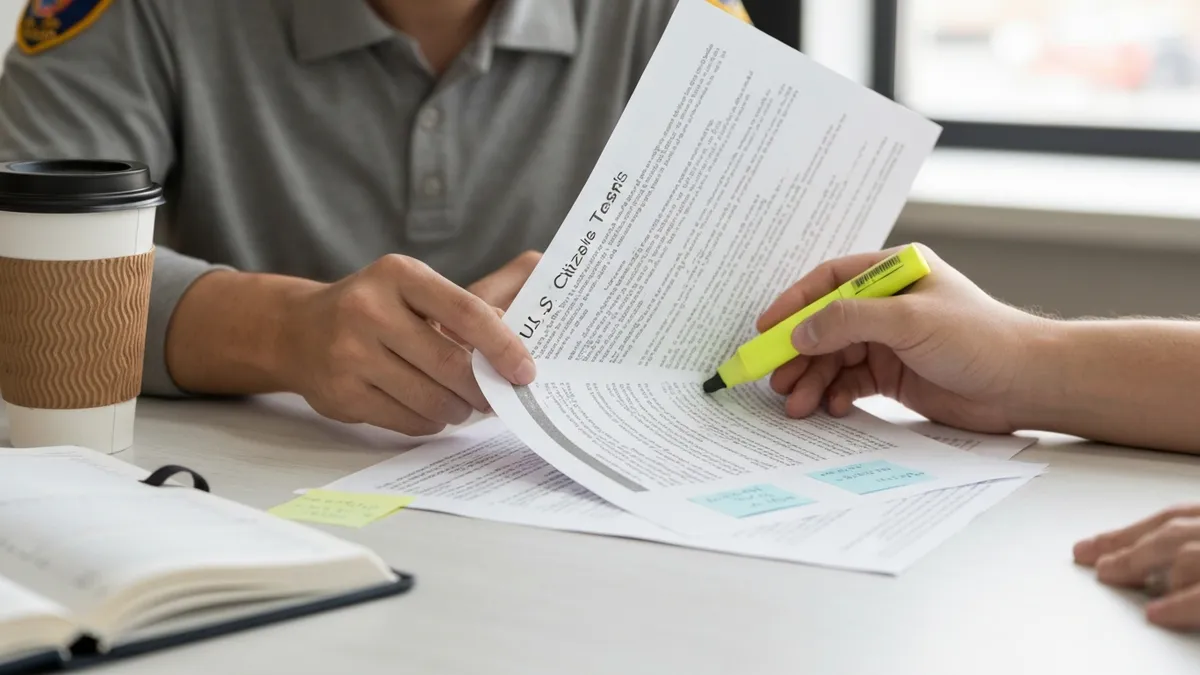
USCIS mails interview appointment notices to the address on file at the time of scheduling — not necessarily when you receive the letter. If your address is outdated, the notice may be delivered to a former address, and missing the appointment can result in automatic case termination. File Form AR-11 online immediately if you have moved at any point since filing Form N-400, and also update your address through your USCIS online account.
Walking into your USCIS naturalization interview prepared and organized is the single most effective thing you can do to maximize your chances of passing on the first attempt. The interview has three distinct components: a biographical review of your N-400 application, the English reading and writing test, and the civics examination. Under the updated 2026 protocols, officers are trained to conduct all three components in an integrated, conversational manner rather than as a series of disconnected segments. This means your English proficiency is being assessed continuously throughout the interview, not only during the dedicated reading and writing portion.
Arrive at the field office at least 30 minutes early. Bring your original green card, a government-issued photo ID, your appointment notice, and a complete copy of your N-400 application with all supporting documents organized in the same order as the form's questions. Officers frequently ask applicants to confirm biographical details directly from their application, and having your documents organized means you can respond efficiently without appearing flustered or disorganized. First impressions matter, and a calm, prepared demeanor sets a productive tone for the entire interview.
During the English reading portion, you will be asked to read aloud one sentence from a list of civics-related sentences. During the writing portion, you will write one sentence dictated by the officer. Both are assessed on comprehensibility rather than perfect grammar — a sentence that is clearly understandable even with minor errors generally passes. However, under the updated guidance, officers have more discretion to probe further if a response seems rehearsed or if the applicant appears not to understand the sentence's meaning after reading it aloud.
The civics portion draws 20 questions randomly from the 128-question pool. You must answer 12 correctly. Questions are asked orally, and you respond orally — there is no written test component for civics. If you answer 12 questions correctly before all 20 are asked, the officer will stop and mark you as passed. Practice answering every question from the full 128-question pool until you can respond accurately and promptly to any question in any order, because the randomized format means you cannot predict which questions will appear at your interview.
Officers who encounter answers that seem memorized without comprehension may ask a follow-up question to confirm understanding. For example, if you state that Congress has the power to declare war, an officer might ask which branch of government Congress belongs to, or how many senators each state sends to Congress. These clarifying questions are within officer discretion under the updated protocols and are not cause for alarm — they are an opportunity to demonstrate genuine knowledge. Applicants who understand the material contextually rather than through rote memorization handle these moments smoothly.
After the interview, most applicants receive a decision on the day — either a preliminary approval pending the oath ceremony, a continuance requesting additional documents, or a denial with explanation and appeal rights. Preliminary approvals are the most common outcome for well-prepared applicants. If you receive a continuance, the officer will provide specific instructions for what documents or information to supply and within what timeframe. Respond promptly and completely to any continuance request, as failure to do so within the deadline results in automatic denial.
For applicants who do not pass the civics or English portion on the first attempt, USCIS schedules a second interview typically within 60 to 90 days. At the second interview, only the failed component is retested — you do not repeat the portions you passed. If you fail the civics or English test at the second interview, your application is denied, and you must refile Form N-400 and pay the filing fee again to restart the process. This makes thorough first-attempt preparation not merely advisable but financially and practically essential.
Building an effective study plan for the updated citizenship test requires honest self-assessment and disciplined scheduling. Begin by downloading the full official USCIS 128-question civics study guide — the only authoritative source for the actual questions your officer will draw from. Read through the entire question bank once without studying, noting which topics feel familiar and which feel unfamiliar. This baseline assessment tells you where to concentrate your study time rather than spreading it evenly across material you already know well.
Organize your study sessions around thematic clusters rather than question numbers. The civics questions group naturally into six categories: American government, American history, integrated civics (geography, symbols, holidays), rights and responsibilities, the Constitution, and recent political developments including current officials. Studying by cluster builds associative memory — when you know that the Supreme Court interprets laws (a function of the judicial branch), related questions about the number of justices and their appointment process become naturally connected rather than isolated facts.
Dedicate the final two weeks before your interview exclusively to simulation practice. Each day, draw 20 questions randomly from the full pool — you can use a flashcard app, an online simulator, or a physical card deck — and attempt to answer all 20 correctly before checking your results. Track your scores daily. If you consistently score 16 or higher, you are in strong shape. If you are regularly scoring below 14, identify which categories are dragging your score down and return to targeted study in those areas before resuming full simulations.
Practice the English components daily even if English is your primary language. The reading and writing portions are evaluated on fluency and naturalness, and native speakers sometimes stumble under interview pressure. Practice reading civic sentences aloud at a clear, measured pace. Practice writing dictated sentences quickly and legibly — officers will dictate the sentence only twice, so writing speed and the ability to hold a sentence in working memory while writing are both important skills to develop explicitly.
Engage with US civics beyond your study materials by reading a short news article about Congress, the Supreme Court, or a state government every day. This habit accomplishes two things simultaneously: it builds genuine civic literacy that will serve you as a citizen, and it makes the civics questions feel connected to real events rather than abstract historical trivia. Applicants who follow current events tend to perform better on the discretionary follow-up questions officers ask when probing for genuine comprehension.
Attend a USCIS-recognized citizenship preparation class if one is available in your community. These classes — offered through libraries, community centers, adult education programs, and nonprofit organizations — are designed around the official study materials and are taught by instructors familiar with the interview process. Group study settings also allow you to practice speaking civics answers aloud in front of others, reducing the performance anxiety that silent, solo study does not address. Many programs are free or low-cost, and some include mock interview practice with experienced volunteers.
Finally, in the days immediately before your interview, prioritize rest over additional studying. Fatigue impairs recall and causes applicants to second-guess answers they actually know. The night before your interview, lay out your documents, confirm the field office location and transit route, and get a full night of sleep. Arrive calm, hydrated, and confident. You have prepared systematically — trust the work you have done, and approach the interview as a demonstration of knowledge you genuinely possess rather than a high-stakes performance you must execute perfectly.
US Questions and Answers




About the Author

Educational Psychologist & Academic Test Preparation Expert
Columbia University Teachers CollegeDr. Lisa Patel holds a Doctorate in Education from Columbia University Teachers College and has spent 17 years researching standardized test design and academic assessment. She has developed preparation programs for SAT, ACT, GRE, LSAT, UCAT, and numerous professional licensing exams, helping students of all backgrounds achieve their target scores.
Join the Discussion
Connect with other students preparing for this exam. Share tips, ask questions, and get advice from people who have been there.
View discussion (7 replies)