

TRSCP Practice Test
Updated October 2026Facts verified Oct 25, 2026 against Towcert
Earning your WreckMaster certification validates your expertise in complex recovery scenarios. From using WreckMaster gloves for safety to calculating resistance, certified operators are preferred by major agencies and law enforcement for incident management. Practice with the free TRSCP - WreckMaster Certification practice test on PracticeTestGeeks (9 questions with answer explanations).
WreckMaster Training Requirements for TRSCP Certification
WreckMaster training provides the foundational recovery techniques tested on the Towing and Recovery Safety Certification Program (TRSCP) exam, including winching angles, rigging ratios, and load securement. Candidates pursuing Level 2/5 or Level 3/6/7 credentials should complete WreckMaster training courses before attempting the TRSCP written and practical assessments, since concepts like working load limits and resultant force calculations appear directly on test questions.
Accessing Study Materials Through WreckMaster.com
WreckMaster.com hosts the official course catalog, recertification portal, and study resources that align with TRSCP exam domains such as casualty assessment, scene management, and equipment inspection. Registered operators can log in to wreckmaster.com to download reference sheets covering D-ring capacities, synthetic rope deration, and snatch block mechanical advantage—all high-yield topics on the TRSCP practice test.
Candidates preparing for safety-focused certifications often benefit from cross-training, and our Abrasive Wheels Training Certificate practice test reinforces the hazard recognition skills that carry over to TRSCP work.
If your role involves armed security duties in Pennsylvania, pair your TRSCP study with the ACT 235 practice test to cover firearms regulations and use-of-force standards.
TRSCP: upcoming dates and official changes
- Updated Oct 25, 2026: Delivery is now Third-party proctored (previously Online, scheduled, third-party proctored (ProctorU)).
- Updated Oct 25, 2026: Delivery is now Third-party proctored (previously Online, scheduled, proctored by a third party).
- Updated Oct 25, 2026: Eligibility is now No prerequisites; levels earned in order (previously No prerequisites; levels taken in order).
Facts verified Oct 25, 2026 against Towcert. Dates that have passed are removed automatically.
- Test takers have 90 minutes to complete a Towcert TROCP exam. (Towcert)
- The TRSCP Entry Level exam lasts 60 minutes. (Towcert)
- Test takers must score 75% or higher to pass the TROCP and TRSCP certification exams. (Towcert)
- The TROCP Level 1 exam is listed at $200.00. (Towcert)
- The TRSCP Entry Level exam costs $200 plus tax. (Towcert)
- Each Towcert test taker gets one attempt per certification level, and a further attempt can be bought at a discounted rate with a separate registration. (Towcert)
- A Towcert certification is valid for five years, after which recertification is required. (Towcert)
- The TRSCP Entry Level recertification exam costs $100 plus tax. (Towcert)
- All Towcert certification exams are proctored by a third party. (Towcert)
Facts verified Oct 25, 2026 against Towcert. Dates that have passed are removed automatically.
TRSCP Exam at a Glance
| Item | Detail | Official source |
|---|---|---|
| Time limit (TROCP) | 90 minutes | Towcert |
| Time limit (TRSCP Entry Level) | 60 minutes | Towcert |
| Passing score | 75% or higher | Towcert |
| Exam fee (TROCP Level 1 (WreckMaster 2/3)) | $200 per exam | Towcert |
| Exam fee (TRSCP Entry Level) | $200 (+tax) per exam | Towcert |
| Retake policy | 1 attempt per registration; retest at a discount | Towcert |
| Validity | 5 years | Towcert |
| Renewal (TRSCP Entry Level) | $100 (+tax) recertification exam | Towcert |
| Delivery | Third-party proctored | Towcert |
| Eligibility | No prerequisites; levels earned in order | Towcert |
Facts verified Oct 25, 2026 against Towcert. Dates that have passed are removed automatically.
Free TRSCP - WreckMaster Certification Study Tools
Interactive TRSCP - WreckMaster Certification resources on PracticeTestGeeks, free to start:
- TRSCP - WreckMaster Certification flashcards — review key terms and concepts card by card
- TRSCP - WreckMaster Certification study guide — topic-by-topic overview of what the exam covers
- TRSCP - WreckMaster Certification cheat sheet — one-page printable summary for last-minute review

TRSCP Practice Test Questions
Prepare for the TRSCP - WreckMaster Certification exam with our free practice test modules. Each quiz covers key topics to help you pass on your first try.
TRSCP Continuous Integration & Continuous ...
TRSCP Exam Questions covering Continuous Integration & Continuous Delivery. Master TRSCP Test concepts for certification prep.
TRSCP DevOps Principles & Practices
Free TRSCP Practice Test featuring DevOps Principles & Practices. Improve your TRSCP Exam score with mock test prep.
TRSCP Infrastructure as Code & Automation
TRSCP Mock Exam on Infrastructure as Code & Automation. TRSCP Study Guide questions to pass on your first try.
TRSCP Monitoring, Metrics & Incident Manag...
TRSCP Test Prep for Monitoring, Metrics & Incident Management. Practice TRSCP Quiz questions and boost your score.
TRSCP Best Practices & Methodologies
TRSCP Questions and Answers on Best Practices & Methodologies. Free TRSCP practice for exam readiness.
TRSCP Blueprint Reading & Interpretation
TRSCP Mock Test covering Blueprint Reading & Interpretation. Online TRSCP Test practice with instant feedback.
TRSCP Code Compliance & Standards
Free TRSCP Quiz on Code Compliance & Standards. TRSCP Exam prep questions with detailed explanations.
TRSCP Communication & Stakeholder Relations
TRSCP Practice Questions for Communication & Stakeholder Relations. Build confidence for your TRSCP certification exam.
TRSCP Core Concepts & Fundamentals
TRSCP Test Online for Core Concepts & Fundamentals. Free practice with instant results and feedback.
TRSCP Data Analysis & Reporting
TRSCP Study Material on Data Analysis & Reporting. Prepare effectively with real exam-style questions.
TRSCP Industry Regulations & Compliance
Free TRSCP Test covering Industry Regulations & Compliance. Practice and track your TRSCP exam readiness.
TRSCP Inspection & Quality Control
TRSCP Exam Questions covering Inspection & Quality Control. Master TRSCP Test concepts for certification prep.
TRSCP Installation & Assembly Techniques
Free TRSCP Practice Test featuring Installation & Assembly Techniques. Improve your TRSCP Exam score with mock test prep.
TRSCP Materials & Specifications
TRSCP Mock Exam on Materials & Specifications. TRSCP Study Guide questions to pass on your first try.
TRSCP Professional Standards & Ethics
TRSCP Test Prep for Professional Standards & Ethics. Practice TRSCP Quiz questions and boost your score.
TRSCP Risk Management & Assessment
TRSCP Questions and Answers on Risk Management & Assessment. Free TRSCP practice for exam readiness.
TRSCP Safety Practices & Regulations
TRSCP Mock Test covering Safety Practices & Regulations. Online TRSCP Test practice with instant feedback.
TRSCP Strategic Planning & Implementation
Free TRSCP Quiz on Strategic Planning & Implementation. TRSCP Exam prep questions with detailed explanations.
TRSCP Tools & Equipment Operation
TRSCP Practice Questions for Tools & Equipment Operation. Build confidence for your TRSCP certification exam.
WreckMaster Exam Flashcards
Quick review for essential towing concepts
🏗️What is resistance?
Resistance is the force that opposes motion. In towing, it includes rolling, damage, grade, and mire resistance.
START WRECKMASTER PRACTICE TEST📐How do you calculate Rolling Resistance?
Rolling Resistance is calculated as 5% of the vehicle's total weight on a hard, level surface.
REVIEW WRECKMASTER QUESTIONS🔩What is the Working Load Limit (WLL)?
WLL is the maximum load a piece of equipment is designed to handle safely, typically 1/4 or 1/3 of its breaking strength.
GET WRECKMASTER EXAM PREP🪢What is Mire Resistance?
Mire resistance occurs when a vehicle is stuck in mud or snow. It is calculated as 100% of weight for wheel depth.
TRY WRECKMASTER MOCK EXAM🚛What is Grade Resistance?
Grade Resistance is the force required to pull a vehicle up a slope, equal to 1% of vehicle weight per degree of incline.
ACCESS WRECKMASTER STUDY GUIDE⚠️Safe Zone definition?
The Safe Zone is the area around a recovery scene where no personnel should stand, typically twice the length of the cable used.
PRACTICE WRECKMASTER TEST NOWWreckMaster Certification Study Guide
Our WreckMaster study guide breaks down essential knowledge for every certification tier. From WreckMaster level 2 3 basics to advanced WreckMaster level 8 9 recovery techniques, review the key concepts needed to pass.
WreckMaster Score Calculator
Total Scored Questions
150
105 out of 150 correct
70%
Required to Pass: ~70% (Estimated)
How to Become WreckMaster Certified
The path to becoming a certified operator involves hands-on WreckMaster training and passing the written exam. WreckMaster classes are available nationwide, offering a clear progression from basic to advanced skills.
- Choose Your Level - Select from WreckMaster Level 2 3 up to Level 8/9 based on your experience.
- Find WreckMaster Classes - Use the WreckMaster com locator to find WreckMaster classes near me.
- Register for Training - Complete registration and pay the WreckMaster certification cost.
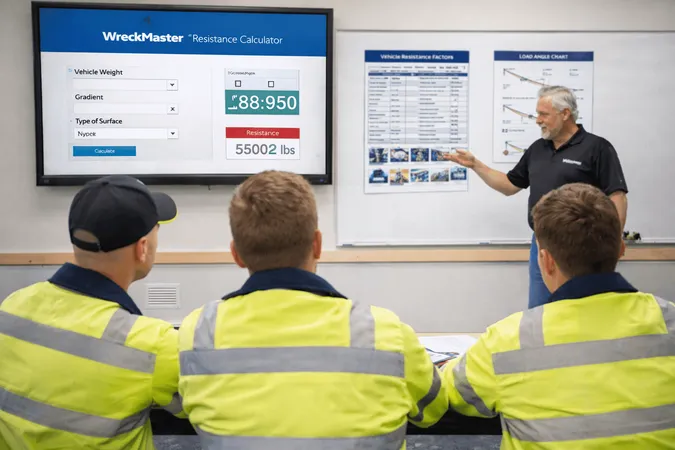
- Attend Training - Participate in the 2-day course covering theory and practical skills like using WreckMaster straps.
- Pass the Exam - Score 75% or higher on the WreckMaster test.
- Receive Credentials - Get your official ID and WreckMaster badge.
- Maintain Certification - Recertify every 3 years to stay current with safety standards.
WreckMaster Training for TRSCP Candidates
WreckMaster training is the industry-standard curriculum that underpins much of the TRSCP (Towing and Recovery Safety Certification Program) knowledge tested on certification exams. Courses are offered at levels 2/3 (light-duty), 4/5 (medium and heavy-duty recovery), 6/7 (advanced heavy recovery), and 8/9 (rotator operations), each covering rigging, load calculations, and scene safety.
Matching WreckMaster Levels to TRSCP Exam Content
TRSCP test questions draw heavily on WreckMaster Level 2/3 material, including winch line capacity, snatch block mechanics, and proper tie-down procedures under FMCSA 393.130. Reviewing the WreckMaster student manual alongside TRSCP study guides is the fastest way to cover overlapping topics like center of gravity and resistance factors.
WreckMaster Online Training Options Before the TRSCP Exam
WreckMaster online training delivers the classroom portion of Levels 2/3 and 4/5 through a self-paced web platform, letting TRSCP candidates complete theory modules on rigging math, recovery angles, and incident command before attending hands-on field days. The online component typically runs 16 to 24 hours and must be finished before the practical evaluation.
What the Online Modules Cover
Expect video lessons and quizzes on working load limits, D-ring capacities, resistance percentages for upright and rollover recoveries, and TIM (Traffic Incident Management) protocols that also appear on the TRSCP written test. Scores of 80% or higher on module quizzes are usually required to unlock the practical session.
Using WreckMaster.com as a TRSCP Study Resource
WreckMaster.com is the official portal for course registration, student login, and certification lookup, and it hosts the reference charts TRSCP candidates rely on for winch ratings, chain grades, and recovery formulas. The site also lists upcoming U.S. training dates in states like Texas, Florida, and Pennsylvania where TRSCP certification is frequently pursued.
Verifying Credentials Through WreckMaster.com
Employers and TRSCP proctors can confirm a technician's active WreckMaster level using the certification verification tool on WreckMaster.com, which returns the operator's ID number, current level, and expiration date. Recertification is required every four years, so check your expiration before scheduling a TRSCP exam.
WreckMaster Online Training and TRSCP Certification
WreckMaster offers online training courses that complement the Towing and Recovery Safety Certification Program (TRSCP) pathway for operators seeking industry-recognized credentials. While TRSCP is administered through the Towing and Recovery Association of America (TRAA) and focuses on three certification levels (Level 1 Light Duty, Level 2 Heavy Duty, and Level 3 Master Towing Recovery Specialist), WreckMaster provides its own parallel certification levels (1/2/A, 2/5, 4/6, 6/7, 7/8, 8/9) with online theory modules that operators often complete alongside TRSCP preparation. WreckMaster's online courses cover rigging principles, load calculations, winching angles, and recovery physics, which overlap heavily with the written knowledge tested on TRSCP Level 1 and Level 2 exams. Operators in the United States frequently pursue both credentials because insurance carriers, municipal rotation lists, and motor clubs like AAA increasingly require documented training from either program.
How WreckMaster Online Courses Compare to TRSCP Study Materials
WreckMaster online training is delivered through recorded video modules and digital workbooks, with written exams proctored remotely, whereas TRSCP certification requires candidates to pass a 50–60-question multiple-choice test plus a hands-on practical evaluation administered by a TRAA-approved instructor. The WreckMaster 1/2/A online course runs approximately 16 hours of coursework and costs around $495, while TRSCP Level 1 certification through TRAA typically costs $200 plus tax for the written exam and requires separate practical testing. Operators preparing for TRSCP often use WreckMaster's online rigging and recovery theory content as supplemental study, since TRAA does not sell a dedicated online prep course. Both programs reference the same core competencies drawn from the WreckMaster textbook and the TRAA Towing Operator's Manual, making cross-study an efficient path to dual certification.
While the WreckMaster certification cost may seem significant, the return on investment is high. Certified operators command higher wages, have lower insurance premiums, and are preferred for lucrative contracts.
WreckMaster Test Day Checklist
- ✓Valid Driver's License
- ✓Work Boots (Safety Toe)
- ✓WreckMaster Gloves
- ✓Safety Vest (High Vis)
- ✓Eye Protection
- ✓Notebook & Pen
- ✓Weather Appropriate Gear
- ✓Course Confirmation
Ready to Get WreckMaster Certified?
Join thousands of successful tow operators who have advanced their careers with WreckMaster certification. Start your preparation today with our free practice questions and study guide.
WreckMaster Certification Renewal
Frequency Every
3 Years
Cost
$195+
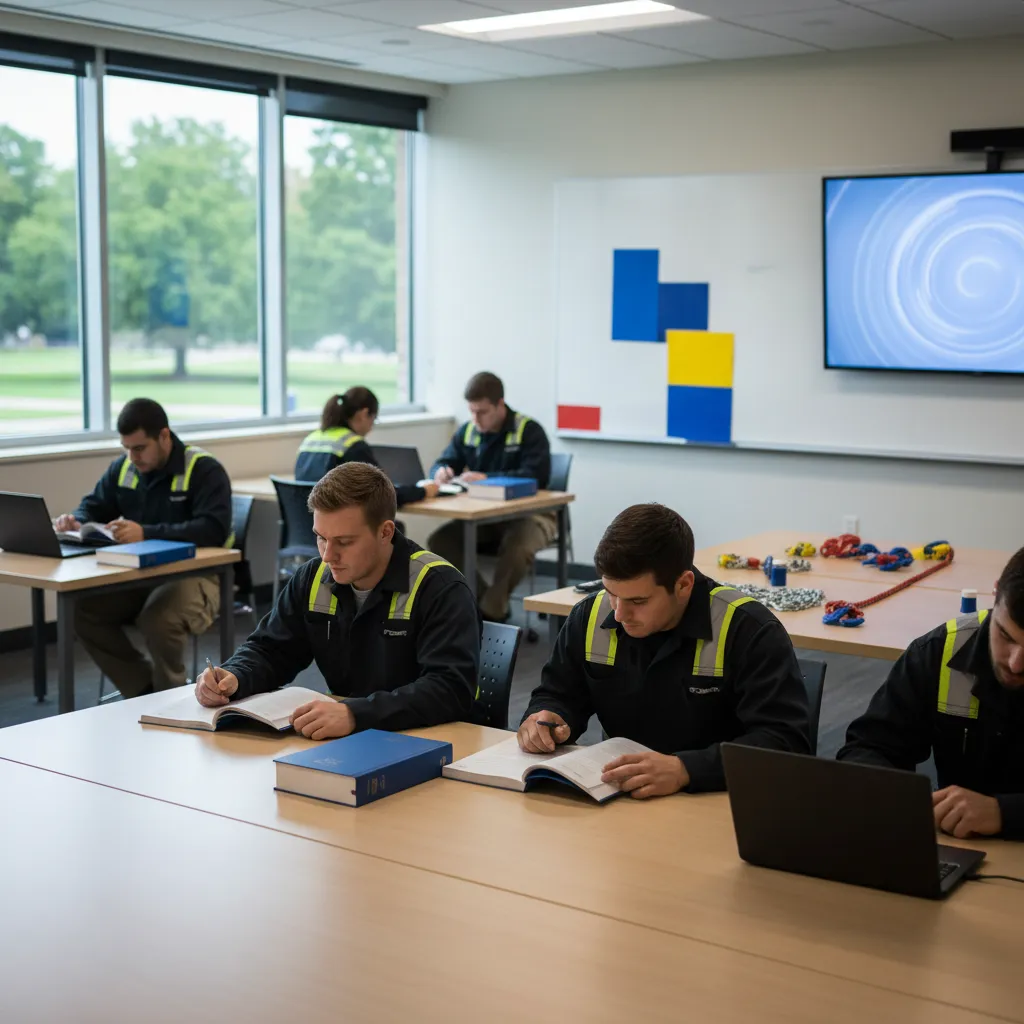
Keeping your WreckMaster certification active demonstrates your commitment to safety and professionalism. Expired certifications may require you to retake the full WreckMaster test.
- +Validates your knowledge and skills objectively
- +Increases job market competitiveness
- +Provides structured learning goals
- +Networking opportunities with other certified professionals
- −Study materials can be expensive
- −Exam anxiety can affect performance
- −Requires dedicated preparation time
- −Retake fees apply if you don't pass
Pros and Cons at a Glance
| Pros | Cons |
|---|---|
| Validates your knowledge and skills objectively | Study materials can be expensive |
| Increases job market competitiveness | Exam anxiety can affect performance |
| Provides structured learning goals | Requires dedicated preparation time |
| Networking opportunities with other certified professionals | Retake fees apply if you don't pass |
Sample TRSCP - WreckMaster Certification Practice Questions
Try these questions from our free TRSCP - WreckMaster Certification practice tests. The correct answer and an explanation follow each question.
What is the primary objective of WreckMaster Certification certification?
- A. To validate professional competence in wreckmaster
- B. To fulfill a government mandate
- C. To replace formal education requirements
- D. To provide tax benefits to employers
Answer: A. To validate professional competence in wreckmaster
The WreckMaster Certification certification validates that professionals have demonstrated competence and knowledge in their field.
In WreckMaster Certification, what is the purpose of preventive maintenance schedules?
- A. To identify and address potential issues before they cause equipment failure
- B. To create additional work for maintenance staff
- C. To comply with warranty requirements only
- D. To justify purchasing new equipment
Answer: A. To identify and address potential issues before they cause equipment failure
Preventive maintenance schedules are designed to identify and address potential issues before they lead to equipment failure, reducing downtime and extending equipment life.
In WreckMaster Certification practice, what should be done BEFORE operating any equipment?
- A. Perform a pre-operation safety inspection and verify all components are functioning
- B. Begin work immediately to maximize productivity
- C. Only inspect equipment after a malfunction occurs
- D. Rely on the previous operator's assessment
Answer: A. Perform a pre-operation safety inspection and verify all components are functioning
Pre-operation safety inspections are essential to identify potential issues before they become hazards, ensuring safe and efficient equipment operation.
Take the full TRSCP - WreckMaster Certification practice test
TRSCP Questions and Answers
How this page was made: written with AI tools and published by Nathan Beja, founder of Practice Test Geeks, who is responsible for its content. Exam facts are checked against the official sources listed below. Not reviewed by a subject-matter expert. Editorial policy
Sources & references
Exam facts on this page (fees, format, dates, passing scores) are checked against these official sources; the date is our last check. Editorial policy
- towcert.com — Renewal, score validity, fees, time limit, test delivery, eligibility, passing score, retake policy · verified Oct 2026