
TAPAS Personality Test: Complete Preparation Guide 2026
🔎 Pass the TAPAS Personality exam with confidence. Practice questions with detailed explanations and instant feedback on every answer.

What the Army Looks For on TAPAS
The Army developed TAPAS to predict three outcomes that directly affect its readiness: attrition (soldiers who quit or are discharged), misconduct (disciplinary incidents), and performance (soldiers who excel and advance). Research by the Army Research Institute identified specific personality trait profiles that predict each of these outcomes. Practice with the free TAPAS - Tailored Adaptive Personality Assessment System practice test on PracticeTestGeeks (11 questions with answer explanations).
The ideal TAPAS profile for Army service includes:
- High Conscientiousness and Achievement: Soldiers who follow through on commitments, take duty seriously, and work toward goals without constant supervision
- High Emotional Stability: Soldiers who manage stress without breaking down, maintain judgment under pressure, and do not overreact in difficult situations
- Moderate to High Cooperativeness: Team-oriented soldiers who can work effectively in close quarters with people they did not choose
- Low Negativism: Soldiers who do not chronically complain, undermine unit cohesion, or express cynicism about authority
- High Physical Conditioning commitment: Soldiers who take physical fitness standards seriously and maintain them between required tests
Understanding what the tapas personality test is actually measuring helps you answer authentically rather than randomly.
- TAPAS (Tailored Adaptive Personality Assessment System) is a computer-adaptive, forced-choice personality test made up of 120 statements. (U.S. Army)
- Under Army rules, applicants in the lowest AFQT category who score below the 10th percentile on TAPAS cannot enlist, and applicants without a high school diploma or equivalent must score above the 30th percentile on TAPAS. (U.S. Army)
- TAPAS is taken at Military Entrance Processing Stations (MEPS) across the United States, alongside the ASVAB, by initial-entry recruits. (U.S. Army)
- The Army's FY2026 budget says that applicants without a high school diploma are processed only if they score in the top 50th percentile on the ASVAB and pass two personality tests, TAPAS and the Assessment of Individual Motivation (AIM). (U.S. Army)
Facts verified Oct 18, 2026 against U.S. Army. Dates that have passed are removed automatically.
TAPAS Exam at a Glance
| Item | Detail | Official source |
|---|---|---|
| Number of questions | 120 forced-choice statements (computer-adaptive) | U.S. Army |
| Passing score | Below the 10th percentile = not eligible (lowest AFQT category); non-diploma applicants need above the 30th percentile | U.S. Army |
| Delivery | Taken at MEPS alongside the ASVAB | U.S. Army |
| Eligibility | Non-HSDG Army applicants must score in the top 50th percentile on the ASVAB and pass TAPAS and AIM | U.S. Army |
Facts verified Oct 18, 2026 against U.S. Army. Dates that have passed are removed automatically.
Free TAPAS - Tailored Adaptive Personality Assessment System Study Tools
Interactive TAPAS - Tailored Adaptive Personality Assessment System resources on PracticeTestGeeks, free to start:
- Free Introduction to TAPAS Questions and Answers 1 — 11 questions with instant scoring and answer explanations
- TAPAS - Tailored Adaptive Personality Assessment System flashcards — review key terms and concepts card by card
- TAPAS - Tailored Adaptive Personality Assessment System study guide — topic-by-topic overview of what the exam covers
- TAPAS - Tailored Adaptive Personality Assessment System cheat sheet — one-page printable summary for last-minute review
Key TAPAS Personality Traits Explained
Each TAPAS dimension is measured on a scale relative to the military population norm. Here is how the most critical traits manifest in actual test items:
Emotional Stability vs. Emotional Instability:
- Item example: A: I stay calm when plans change suddenly / B: Unexpected changes make it hard for me to focus
- The trait measures anxiety, irritability, and stress reactivity — not toughness or aggression
Conscientiousness vs. Impulsiveness:
- Item example: A: I always complete tasks before relaxing / B: I often move on to new things before finishing what I started
- Measures follow-through, organization, and self-discipline — core to completing training cycles
Negativism (reverse scored — low is better):
- Item example: A: I often feel that rules are made to be bent / B: Following the rules is usually the right thing to do
- High negativism scores are strongly predictive of disciplinary incidents and early discharge
Achievement:
- Item example: A: I set ambitious goals and push myself to reach them / B: I am content with meeting minimum requirements
- Predicts training completion and voluntary reenlistment — soldiers who push themselves tend to stay
For detailed walkthroughs of actual TAPAS question types and how to approach each trait section, use our army tapas test preparation guide.

The Forced-Choice Format Decoded
The TAPAS forced-choice format is intentionally designed to make faking difficult. Here is why:
- Both options are equally socially desirable: Item pairs are calibrated so neither option looks obviously better. You cannot simply pick whichever answer sounds more military.
- Adaptive sequencing exposes inconsistency: If you score high on Conscientiousness early in the test, subsequent items will probe conscientiousness more deeply. Inconsistent responses across a trait get flagged algorithmically.
- Response time is monitored: Extremely long response times (suggesting deliberate calculation) are noted. Suspiciously fast responses may also be flagged.
The practical implication: trying to fake good on TAPAS is more likely to produce a flagged result than an authentic answer would. The forced-choice design means the best strategy is honest, instinctive responding — which is exactly what the test designers intended.
Take our tapas test online practice to experience the forced-choice format under realistic conditions before your test date.
TAPAS Personality Test Preparation Checklist
- ✓Take a full TAPAS practice test to experience the forced-choice format before your real test
- ✓Read about each trait the test measures — knowing what 'Conscientiousness' means helps you answer consistently
- ✓Reflect honestly on your natural work style over the past year, not your aspirations or best moments
- ✓Avoid scripting answers — the adaptive format is designed to catch inconsistent pre-planned responses
- ✓Get a full night's sleep before the test — fatigue increases response inconsistency
- ✓Answer at a natural pace — very slow or very fast responses are both flagged
- ✓Don't discuss specific TAPAS questions with other recruits — the adaptive test gives everyone different item sequences
- ✓Understand your target MOS's trait requirements and reflect on whether your genuine profile aligns
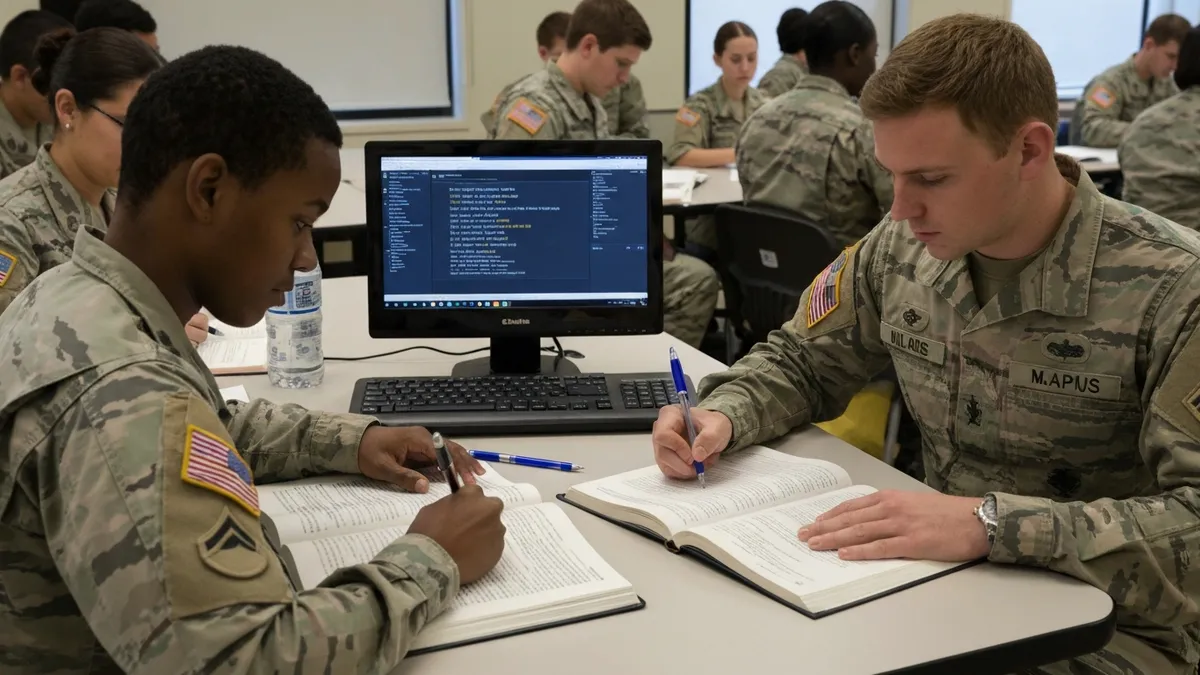
TAPAS for Special Duty Assignments
Beyond initial enlistment, the TAPAS personality test is used for several high-stakes Army career milestones. For special duty assignments, the score requirements and profile expectations are stricter:
- Drill Sergeant: Must demonstrate high conscientiousness, emotional stability, and low negativism — the traits required to mentor recruits under pressure without losing composure or morale
- Army Recruiter: High social orientation, cooperativeness, and achievement orientation — the profile of someone who builds relationships and stays goal-focused despite frequent rejection
- Ranger Assessment: High physical conditioning commitment, achievement, and emotional stability — critical for soldiers who must operate at the edge of their physical and psychological limits
- Special Forces Assessment and Selection (SFAS): Uses a modified personality battery that builds on TAPAS dimensions plus additional measures relevant to unconventional warfare roles
If you are preparing for a special duty TAPAS screening rather than initial accession, your profile expectations are higher and more specific. The general preparation principles apply — answer authentically, know your traits, understand what the role requires. For a full explanation of the test and who takes it, see our tapas test army overview guide.
If you want more targeted practice, the tapas practice test page covers the same material with additional questions and explanations.
If you want more targeted practice, the tapas test page covers the same material with additional questions and explanations.
- +Industry-recognized credential boosts your resume
- +Higher earning potential (10-20% salary increase on average)
- +Demonstrates commitment to professional development
- +Opens doors to advanced career opportunities
- −Exam preparation requires significant time investment (4-8 weeks)
- −Certification fees can be $100-$400+
- −May require continuing education to maintain
- −Some employers may not require certification
Sample TAPAS - Tailored Adaptive Personality Assessment System Practice Questions
Try these questions from our free TAPAS - Tailored Adaptive Personality Assessment System practice tests. The correct answer and an explanation follow each question.
Which personality framework primarily informed the development of TAPAS personality dimensions?
- A. Myers-Briggs Type Indicators (MBTI)
- B. Cattell's 16PF
- C. The Big Five / Five-Factor Model
- D. Eysenck's Three-Factor Model
Answer: C. The Big Five / Five-Factor Model
TAPAS dimensions are grounded in the well-validated Big Five (Five-Factor Model) personality framework, which includes traits like conscientiousness, agreeableness, and emotional stability.
A test-taker who is highly agreeable but only moderately conscientious completes a traditional ipsative personality battery. How will her conscientiousness score most likely appear relative to a test-taker who is equally conscientious but low in agreeableness?
- A. Her conscientiousness score will appear higher because her overall trait elevation raises all scores
- B. Her conscientiousness score will appear lower because high agreeableness consumes score points shared across all traits
- C. Her conscientiousness score will be identical since ipsative scoring isolates each trait independently
- D. Her conscientiousness score will be indeterminate without knowing her scores on all other traits
Answer: B. Her conscientiousness score will appear lower because high agreeableness consumes score points shared across all traits
In ipsative scoring, traits compete for a fixed pool of points. A test-taker with high agreeableness will have fewer points distributed to other traits, making her conscientiousness score appear lower than that of someone equally conscientious but with a flatter or lower profile on other traits — even if their absolute conscientiousness levels are the same.
To ensure the confidentiality and security of TAPAS test materials and results, what action must all personnel involved in the administration process complete?
- A. Pass the TAPAS assessment themselves.
- B. Undergo a background check.
- C. Receive annual training and sign an Oath of Test Security and Confidentiality.
- D. Be an active-duty military member.
Answer: C. Receive annual training and sign an Oath of Test Security and Confidentiality.
Standardized testing procedures universally require that any individual who administers tests or handles secure materials must be properly trained on security and administration protocols and formally agree to uphold them by signing a security oath.
TAPAS uses a forced-choice item format in which test-takers compare pairs of personality statements. What is the primary psychometric advantage of this design over traditional Likert-scale self-report measures?
- A. It reduces social desirability bias and faking by making it harder to identify the 'ideal' response
- B. It increases the total number of items that can be administered in a fixed time window
- C. It allows the military to assess cognitive reasoning alongside personality traits
- D. It eliminates the need for computer-based administration in field settings
Answer: A. It reduces social desirability bias and faking by making it harder to identify the 'ideal' response
Forced-choice formats present two equally desirable (or undesirable) statements, making it difficult for respondents to simply choose answers that appear socially favorable. This design counters response distortion, which is a critical concern when personality data influence high-stakes military placement decisions.
Take the full TAPAS - Tailored Adaptive Personality Assessment System practice test
TAPAS Personality Test Questions and Answers
More TAPAS Resources
How this page was made: written with AI tools and published by Nathan Beja, founder of Practice Test Geeks, who is responsible for its content. Exam facts are checked against the official sources listed below. Not reviewed by a subject-matter expert. Editorial policy
Sources & references
Exam facts on this page (fees, format, dates, passing scores) are checked against these official sources; the date is our last check. Editorial policy
- army.mil — Test delivery, exam format, passing score · verified Oct 2026
- asafm.army.mil — Eligibility · verified Oct 2026