
TABC License Texas: Permits, Certification, and Application Guide 2026 October
TABC license Texas guide — permit types, fees, eligibility, seller-server certification, renewal cycles, and dry vs wet county rules explained. 📝
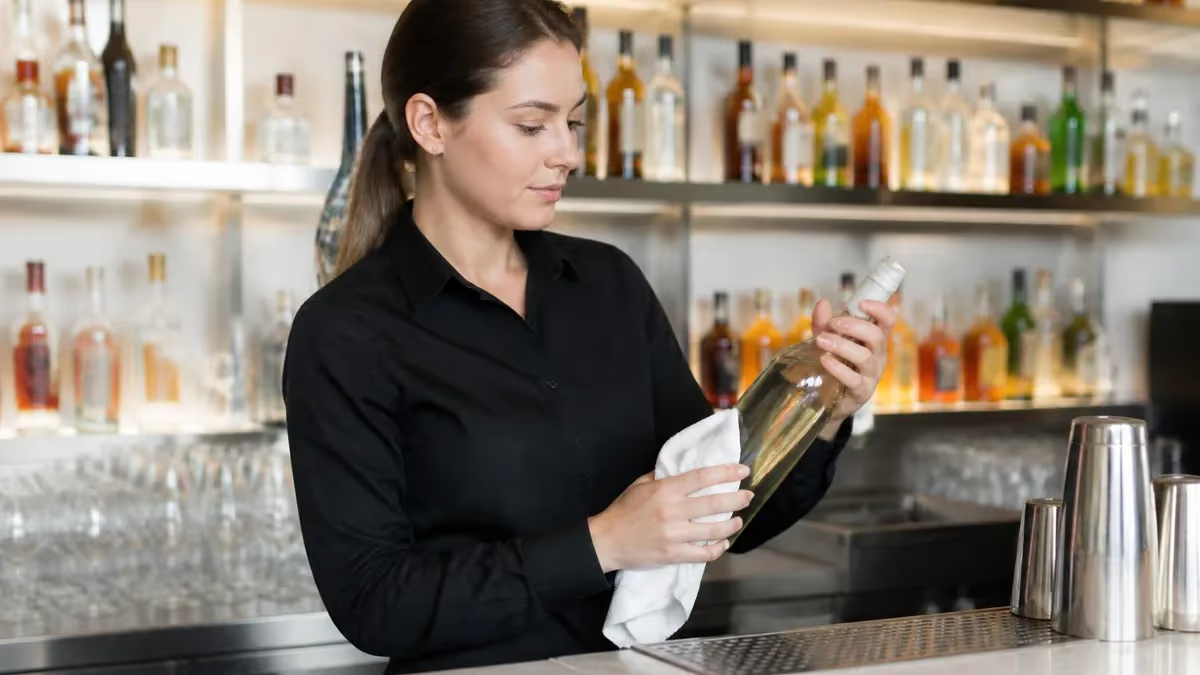
Selling alcohol in Texas isn't a casual side hustle. The Texas Alcoholic Beverage Commission — TABC for short — runs one of the strictest alcohol regulatory systems in the country, and the agency expects every business owner, bartender, and store clerk to know the rules cold. You want to open a bar in Austin? Stock beer at a Houston gas station? Pour wine at a winery near Fredericksburg? Each path runs through TABC, and each path needs a different license or permit.
The framework looks intimidating at first glance, but once you understand how it's structured, the pieces fall into place quickly. Texas issues more permits than almost any other state — partly because the market is enormous, partly because the rules have evolved through decades of legislative tweaks. The good news? Most of those permits don't apply to you. Narrow your focus to the two or three relevant to your situation and the rest can be ignored.
Here's the thing most people get wrong: there isn't just one "TABC license." There are dozens. The agency issues permits for businesses that manufacture, distribute, sell, or serve alcohol — and a separate certification for individual employees who handle it. Mix those two up and you'll waste weeks chasing the wrong application.
This guide walks you through both tracks, the fees, the eligibility rules, and the quirks (like dry counties and surety bonds) that trip up first-time applicants. By the end, you'll know exactly which permit fits your situation and what it takes to keep it active. We'll also cover the renewal cycle, what investigators look for during inspections, and the most common reasons applications get rejected — because nothing burns more time than restarting paperwork.
One quick note before we dive in. Texas alcohol law is built on a three-tier system inherited from post-Prohibition reforms. Producers sell to wholesalers. Wholesalers sell to retailers. Retailers sell to the public. The TABC sits on top, regulating all three tiers and keeping them separate. That structure shapes everything — which permits exist, who can hold which one, and why certain combinations are illegal. Knowing the three-tier logic makes the alphabet soup of permits make sense.

TABC License Texas By the Numbers
Key Facts at a Glance
| Item | Value | Details |
|---|---|---|
| Typical business permit fee | $1,000+ | |
| Seller-server certification cost | $10-15 | |
| Renewal cycle for most permits | 2 years | |
| Minimum age for most permits | 21+ |
Before you fill out a single form, you need to figure out which side of the fence you're on. Are you the business — the entity that owns the bar, store, restaurant, or warehouse? Or are you an employee who'll pour drinks and check IDs? Those are two completely different applications with completely different requirements, completely different price tags, and completely different timelines. Confusing them is the single biggest mistake first-time applicants make.
Business permits are issued to legal entities: LLCs, corporations, sole proprietors, partnerships. They authorize a specific location to do specific things with alcohol. Move the business across town? You need a new application. Add a second location? Another application. Change owners? Yet another.
Permits don't transfer the way real estate does — they're tied to entity, location, and scope all at once. Seller-server certification, on the other hand, is personal. It belongs to you, follows you from job to job, and proves you've been trained to spot fake IDs and refuse intoxicated patrons. Most employees who touch alcohol need it — and many employers won't even interview you without it.
Even if you own the business, you'll probably want both. Owner-operators who plan to spend time on the floor — pouring, ringing up sales, training staff — should hold their own seller-server card. It makes you a credible boss in front of employees and gives investigators confidence that the operation knows the rules from the top down.
The Two-Track System
Business permits cover the location and the entity. Seller-server certification covers the individual employee. Most operations need both — the business holds the permit, the staff holds the certification. Confusing them will delay your opening by weeks.
Let's talk permits. The TABC issues more than 75 different license types, but most applicants only need to understand a handful. The naming convention uses letters — BG, MB, NB, BF, W, and so on — and each letter combination unlocks a specific privilege. Knowing the alphabet soup matters because picking the wrong one can mean reapplying from scratch. The letters aren't random either — they roughly correspond to the type of beverage (B for beer, W for wine or wholesale, M for mixed) plus a tier indicator.
The most common permits cover retailers (the bars, restaurants, and stores you visit) and wholesalers (the middlemen who move product from manufacturers to retailers). Manufacturers — breweries, wineries, distilleries — have their own categories. And then there's a layer of temporary permits for special events, caterers, and private clubs that operate in dry areas. Each category answers a different question about your operation: where you sell, what you sell, and who you sell to. Get those three answers locked down before you open AIMS, and the permit selection becomes obvious within minutes. Skip that step, and you'll spin in circles.
A quick mention of consultants and brokers. Texas has a small ecosystem of license consultants who specialize in TABC filings — they shepherd applications through the agency, handle local approval coordination, and chase down missing documents. For a mixed beverage permit in a major metro, hiring a consultant for $2,000 to $4,000 can cut weeks off your timeline. For simpler permits or smaller markets, you can probably handle the paperwork yourself if you're patient and detail-oriented. Either approach works — just budget for whichever you choose from the start.
Common TABC Permit Types
On-premises sale of wine and beer at restaurants, cafes, and similar venues. One of the most common permits for restaurants that don't need a full liquor license. Lets you serve wine and beer with food.
The full liquor license — covers spirits, mixed drinks, wine, and beer for on-premises consumption. Required for bars, lounges, and restaurants serving cocktails. Higher fees and stricter local approval rules apply.
Lets convenience stores, grocery stores, and gas stations sell beer for off-site consumption. Common for chains like 7-Eleven or H-E-B. Doesn't cover wine or spirits — those need separate permits.
BF authorizes manufacturing beer; W lets distributors move alcohol from producers to retailers. Both sit higher in the three-tier system and carry larger fees, bonds, and reporting duties.

Each permit has its own application packet, its own fee schedule, and its own list of supplemental requirements. The mixed beverage permit (MB), for example, demands a surety bond — usually $3,750 to $7,500 — on top of the application fee. A wine and beer retailer (BG) doesn't need the bond but does require landlord consent if you're leasing.
Brewers face federal TTB approval before they can even apply at the state level. That last point catches a lot of brewery hopefuls — you can't even submit your TABC paperwork until the federal Tax and Trade Bureau has signed off, and TTB approval alone can take six to nine months.
Fees aren't trivial either. A two-year MB permit can run north of $3,000 once you add the state fee, the county surcharge, and any city assessment. Smaller permits like BG or NB land closer to $1,000 to $1,500. Renewal costs roughly the same as the initial issuance, so budget for it from day one. And don't forget the legal fees — many operators retain a TABC-savvy attorney to navigate the application, especially for mixed beverage or manufacturing permits where the stakes are higher. Add another $1,500 to $5,000 for legal counsel if you go that route.
TABC Application Essentials
You must be at least 21 to apply for most TABC permits. Felony convictions within the past five years are an automatic disqualifier, and certain misdemeanors involving moral turpitude or alcohol violations can also block you. Out-of-state applicants can hold permits, but the business itself must be authorized to operate in Texas. Corporate applicants must list all officers, directors, and shareholders holding 5% or more.
Seller-server certification works differently. It's not tied to a location or an entity — it's tied to you. The certification proves you've completed a two-hour training course covering Texas alcohol law, age verification, signs of intoxication, and refusal techniques. The course costs between $10 and $15 depending on the provider, and you can knock it out online in a single afternoon. TABC approves dozens of training vendors, so shop around. Some offer Spanish-language versions. Some throw in extra study materials. The certificate is the same regardless of provider — what differs is the user experience.
Here's why it matters: when TABC investigators show up — and they do, often undercover — they check certifications. An uncertified bartender serving a minor doesn't just create personal liability. The business itself can lose its permit. So even though Texas doesn't make certification mandatory statewide for every server, most employers require it because of the "safe harbor" defense it provides during enforcement actions. Get certified, and the business gets a legal cushion. Skip it, and one undercover sting can cost the bar everything.
The training itself isn't difficult, but pay attention. The exam at the end covers practical scenarios — how to handle a fake ID, what to do when a regular gets too drunk, what to say when an off-duty cop offers to buy a round for a 19-year-old. These aren't abstract rules. They're situations you'll face on shift, and getting them wrong has real consequences.
Texas employers who require seller-server certification, document training, and follow strict alcohol policies get a "safe harbor" defense if an employee violates the law. Without it, one bad night can cost the business its entire TABC permit. That's why certification is effectively mandatory even when the law says it's optional.
Ready to apply? Whether you're going after a business permit or your individual certification, the prep work matters more than the application itself. Pull together your documents before you start the online form — half-finished applications get flagged, and TABC won't hold your spot in the queue while you scramble for paperwork. Here's a practical checklist to work through before you click "submit." Treat it as a launch checklist, not a wish list. Each item is either required outright or required as soon as the agency asks for it, and a missing piece can stall the whole file.
If you're working with a TABC attorney or consultant, they'll usually have a similar list keyed to your specific permit type. Either way, the goal is the same: arrive with a complete package so the reviewer can move you through without sending the file back. Re-submission queues are slow, and the resubmitted application starts at the back of the line. Front-load the work and your launch date stays on schedule.

TABC Application Checklist
- ✓Confirm your business entity is registered with the Texas Secretary of State and in good standing — TABC verifies this automatically.
- ✓Gather identity documents for every principal: drivers license, Social Security number, and fingerprint cards processed through an approved vendor.
- ✓Secure your premises before applying — you'll need a signed lease or deed, a certificate of occupancy, and a scaled floor plan showing alcohol storage and service areas.
- ✓Check your county's wet/dry status and verify no schools, churches, or hospitals sit within the restricted distance from your front door.
- ✓Arrange the surety bond if your permit type requires one. Most insurance brokers can issue these in 24-48 hours once you provide entity details.
- ✓Complete seller-server certification yourself if you'll be on-site managing — owners who can't pass the training look bad in front of inspectors.
- ✓Set aside the full fee schedule in cash or trust funds — TABC won't accept partial payment, and rejected applications forfeit a portion of the fees.
One detail that catches newcomers off guard: Texas still has dry counties. Not as many as a generation ago, but enough that you can't assume alcohol sales are legal everywhere. Some counties are completely dry. Others are partially dry — wet for beer and wine, dry for spirits. Some allow off-premises sales but not on-premises. The rules are set at the precinct level through local option elections, and they change. A neighborhood that voted dry in 1982 might have flipped wet in 2018 — or vice versa.
Before you sign a lease or buy real estate, run the address through TABC's interactive wet/dry map. If your spot is dry, you might still be able to operate as a private club — but that's a separate permit (N or NE) with membership rules, fee structures, and reporting that look nothing like a normal retail license. Don't assume; verify. And if you're really set on a dry location, talk to a local attorney about petitioning for a local option election — they happen, but they're slow and politically charged.
TABC License Texas Pros and Cons
- +Texas has one of the largest alcohol markets in the United States — more than $30 billion in annual sales — so demand is strong.
- +Once you hold a TABC permit, the two-year renewal cycle is straightforward as long as you stay compliant.
- +Seller-server certification is cheap, fast, and portable — your credential follows you across jobs.
- +TABC publishes clear guidance and runs free compliance webinars throughout the year.
- +Mixed beverage holders can grow into catering, off-site events, and delivery with supplemental permits.
- −Application fees, bonds, and local assessments add up fast — budget at least $3,000 to $5,000 for a full mixed beverage launch.
- −Felony history within five years blocks most applicants — no exceptions, no waivers.
- −Dry counties and 300-foot rules near schools and churches can kill otherwise perfect locations.
- −Compliance audits happen without warning, and violations stack quickly — three strikes can revoke a permit.
- −The application process averages 45-60 days, longer if any documents are incomplete or contested.
Renewal is where a lot of permit holders trip themselves up. Both business permits and seller-server certifications run on roughly two-year cycles, but the renewal windows differ. TABC sends reminders, but you can't rely on them — set your own calendar alerts 90 days out. Late renewals trigger fines, and a lapsed permit means you cannot legally sell alcohol until it's reinstated. Even one day of non-compliance can mean a visit from an investigator and a citation. Bigger picture? Repeat lapses tag your file. Investigators notice patterns.
For seller-server certification, renewal just means retaking the course. Most providers store your record and will prompt you. For businesses, renewal involves updating your AIMS profile, confirming your bond, paying the renewal fee, and certifying that no material changes (new owners, new location, new license types) have occurred. Material changes require fresh applications, not renewals. If you've added partners, expanded the floor plan, or started selling new categories of alcohol, plan for a full re-review rather than a quick renewal click-through.
One more piece of the puzzle: restrictions on operations. TABC doesn't just decide who can sell — it sets rules about how, when, and where. Hours of sale vary by county and permit type. Most on-premises locations close at 2 a.m., though extended hours permits exist in certain cities.
Sunday morning sales have their own rules — beer and wine can be sold from grocery stores starting at 10 a.m. on Sundays in most counties, while spirits at liquor stores stay locked behind closed doors all day Sunday. Happy hour pricing is allowed but with strict guidelines around "unlimited drinks" promotions, which are banned outright. No "all-you-can-drink" specials. No drink-for-a-dollar Tuesdays without limits. The line between promotion and overservice gets walked carefully.
Marketing rules apply too. You can advertise prices, but not in ways that encourage overconsumption. Sponsoring sports teams, hosting charity events, even running a social media giveaway — each one has TABC implications. The agency publishes a Marketing Practices guide that's worth bookmarking. Violations here aren't just paperwork issues; they can trigger administrative actions that suspend your permit. Even simple things like the language on your menu board can draw scrutiny if it implies unlimited consumption or appeals to minors.
Then there's the matter of what happens when things go wrong. TABC violations are tiered. Minor issues — paperwork errors, expired certifications, signage problems — get warning letters or small fines. Serious violations — selling to minors, after-hours sales, sales during a permit lapse — trigger administrative cases that can suspend or revoke your permit. Three serious violations in a 12-month period is the unofficial threshold for revocation. The agency also publishes its enforcement actions monthly, so a revoked license becomes public record, which can hurt future applications and even unrelated business ventures.
The fastest way to stay on the safe side? Document everything. Train staff and keep training logs. Use ID-scanning technology where possible. Refuse service when in doubt and write down what happened. Investigators look at your records during inspections, and a well-kept paper trail is the difference between a warning and a citation. Operators who treat compliance as a continuous habit — not a one-time application — almost never see real enforcement problems.
So where does this leave you? If you're opening a business, start with the permit type, then layer in your local approval, your bond, and your employee training. If you're an individual looking to work in the industry, knock out your seller-server certification first — you'll be more employable, and you'll understand the law your employer has to follow. Either way, treat the TABC as a partner, not an adversary.
The agency runs a compliance-focused operation, and operators who play straight tend to renew without drama for decades. Cut corners, and you'll find out fast why Texas is famous for tough alcohol enforcement. Study the rules, build the right paperwork from day one, and your TABC license becomes a quiet asset rather than a constant worry.
Sample Texas Alcoholic Beverage Commission Certification (TABC) Practice Questions
Try these questions from our free Texas Alcoholic Beverage Commission Certification (TABC) practice tests. The correct answer and an explanation follow each question.
Can a business legally sell alcohol while its TABC license application is still pending approval?
- A. Yes, always
- B. No, it must wait until the license is granted
- C. Yes, if it pays a fee
- D. Yes, on weekends only
Answer: B. No, it must wait until the license is granted
A business may not sell alcohol until the TABC license or permit is actually issued.
Is TABC seller-server certification legally required to serve alcohol in Texas?
- A. Yes, always by state law for everyone
- B. No, but employers often require it and it provides legal protection
- C. Only for people over 40
- D. Only in dry counties
Answer: B. No, but employers often require it and it provides legal protection
Certification is not universally mandated but is widely required by employers and offers Safe Harbor protection.
How long is a TABC seller-server certification generally valid?
- A. 1 year
- B. 2 years
- C. 5 years
- D. It never expires
Answer: B. 2 years
TABC certification is typically valid for two years before renewal is required.
Where can a person obtain a valid TABC seller-server certification?
- A. Any liquor store
- B. A TABC-approved training school or program
- C. The local police department
- D. The county courthouse
Answer: B. A TABC-approved training school or program
Certification must come from a TABC-approved seller-server training program.
Take the full Texas Alcoholic Beverage Commission Certification (TABC) practice test
TABC Questions and Answers
About the Author

Educational Psychologist & Academic Test Preparation Expert
Columbia University Teachers CollegeDr. Lisa Patel holds a Doctorate in Education from Columbia University Teachers College and has spent 17 years researching standardized test design and academic assessment. She has developed preparation programs for SAT, ACT, GRE, LSAT, UCAT, and numerous professional licensing exams, helping students of all backgrounds achieve their target scores.
Join the Discussion
Connect with other students preparing for this exam. Share tips, ask questions, and get advice from people who have been there.
View discussion (8 replies)