
STCW Certification Guide for Seafarers 2026 October
Free STCW Certification Guide for practice test with instant ❓ feedback and detailed answer explanations. Prepare for your exam.

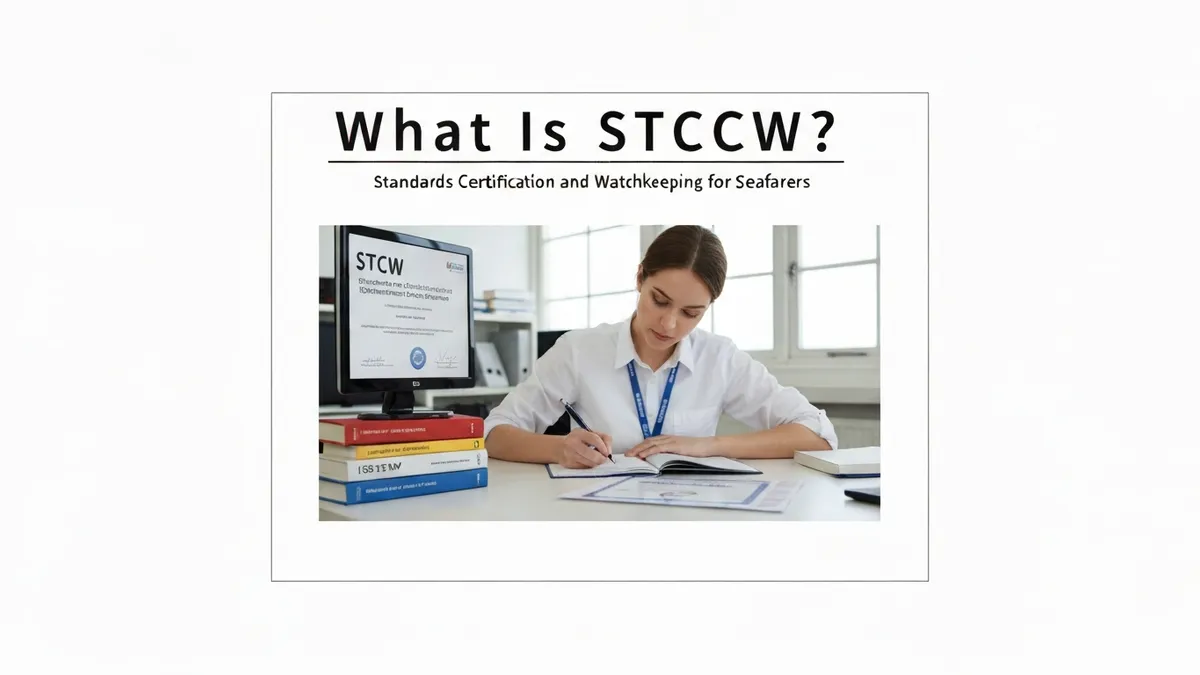
What Is STCW?
STCW stands for the International Convention on Standards of Training, Certification and Watchkeeping for Seafarers. Adopted by the International Maritime Organization (IMO) in 1978 and entering into force in 1984, the convention was overhauled in 1995 to add the STCW Code — a detailed set of mandatory and recommended standards — and again in 2010 with the Manila Amendments, which introduced new requirements for security, fatigue management, and proficiency in medical emergencies.
In the United States, the U.S. Coast Guard (USCG) administers STCW requirements through the National Maritime Center (NMC). Any mariner applying for a Merchant Mariner Credential (MMC) must hold valid STCW certificates. Flag states of other countries have equivalent national authorities. Because STCW is internationally recognized, a certificate issued in one signatory nation is generally accepted in all others, making it the global passport for seafaring careers. Safety-conscious industries like offshore oil and gas, passenger shipping, and government contracting treat STCW compliance as non-negotiable. Workers in land-based safety-critical roles sometimes compare this framework to OSHA 10 certification online in terms of its role as a mandatory baseline credential.
STCW Basic Safety Training (BST) Courses
STCW Basic Safety Training consists of four separate courses that must be completed at an approved maritime training institution. Each course combines classroom instruction with hands-on practical exercises, and all four must be passed before a BST certificate is issued. The certificate is valid for five years, after which a refresher or revalidation course is required to maintain its currency.
Personal Survival Techniques (PST) — Covers liferaft operations, survival craft equipment, abandoning ship procedures, personal lifesaving appliances, and sea-survival priorities. Trainees spend time in water to practice real rescue techniques.
Elementary First Aid (EFA) — Teaches CPR, bleeding control, fracture management, and immediate response to onboard medical emergencies until professional help arrives.
Fire Prevention and Firefighting (FPFF) — Addresses fire triangle theory, types of fires, extinguishing agents, firefighting equipment, and coordinated team firefighting exercises using live fire simulators.
Personal Safety and Social Responsibilities (PSSR) — A classroom-based module covering shipboard safety culture, emergency procedures, environmental protection regulations, and seafarer rights and obligations under the Maritime Labour Convention (MLC).
Total BST training time is typically 40–60 hours spread over five to seven days. Candidates interested in comparing structured certification study approaches may also find the ASE certification guide a useful reference for understanding multi-module exam preparation strategies.
Pro Tip: Focus your STCW study time on areas where you score lowest. Most exam questions test application of knowledge, not memorization.
Advanced STCW Endorsements
Beyond Basic Safety Training, STCW prescribes a range of advanced and specialized endorsements required for officers, watch officers, and mariners in specific roles. These are typically required as seafarers advance from ratings (unlicensed crew) to officers (licensed mariners).
Advanced Firefighting (AFF) — Required for officers. Builds on FPFF with incident command, advanced SCBA procedures, and damage control drills. Duration: 2–3 days.
Medical First Aid (MFA) and Medical Care (MC) — MFA is required for officers on vessels without a doctor; MC is for the designated medical officer. Both involve extended first aid scenarios, triage, and patient stabilization.
Proficiency in Survival Craft and Rescue Boats (PSCRB) — Required for officers and crew designated as in-charge of survival craft. Includes launching, recovering, and operating lifeboats and rescue boats under STCW Table A-VI/2-1.
Security Awareness Training (SAT) and Vessel Security Duties (VSD) — Added by the 2010 Manila Amendments. SAT is required for all crew; VSD is for those with designated security duties. Both address ISPS Code compliance, threat recognition, and reporting procedures.
GMDSS (Global Maritime Distress and Safety System) — Required for all officers standing a radio watch. Covers distress alerting, search and rescue communications, NAVTEX, and satellite communication systems. The GMDSS endorsement requires separate written and practical exams administered by the FCC (in the U.S.).
Bridge Resource Management (BRM) and Engine Room Resource Management (ERM) — Required for officers seeking officer-of-the-watch licenses. These courses focus on leadership, situational awareness, decision-making under pressure, and team communication in bridge or engine control room settings.
Specialized endorsements also exist for tanker operations (oil, chemical, and liquefied gas tankers), passenger vessel safety, polar waters operations, and dynamic positioning. Each requires specific sea service, approved training, and USCG or flag state approval.
STCW Career & Salary Outlook
Holding STCW certification opens the door to a wide range of maritime careers with strong earning potential. The U.S. Bureau of Labor Statistics (BLS) reports median wages for water transportation occupations, but actual seafarer salaries vary significantly by vessel type, rank, company, and trade route.
Entry-level ratings (Ordinary Seaman / Wiper) — $35,000–$55,000/year. BST is the primary credential required. Many companies offer on-the-job training for advancement.
Able Seaman (AB) / Qualified Member of the Engine Department (QMED) — $50,000–$75,000/year. Requires additional sea service and endorsements beyond BST.
Officers (3rd/2nd/Chief Mate, 3rd/2nd/Chief Engineer) — $80,000–$160,000/year depending on rank and vessel type. Requires a USCG license plus full STCW officer endorsements.
Master (Captain) — $120,000–$200,000+/year on large commercial vessels. Offshore supply vessel (OSV) masters on Gulf of Mexico routes often earn $140,000–$180,000.
Cruise ship officers — $70,000–$130,000/year with housing, meals, and travel included, making total compensation packages highly competitive.
The maritime industry faces a well-documented officer shortage. The International Chamber of Shipping (ICS) projects a global shortfall of approximately 90,000 officers by 2026, making STCW-certified mariners with advanced endorsements especially valuable in the current job market. U.S. flagged vessels, LNG carriers, and specialized offshore vessels typically offer the highest compensation packages.
- ✓Review the official STCW exam content outline
- ✓Take a diagnostic practice test to identify weak areas
- ✓Create a study schedule (4-8 weeks recommended)
- ✓Focus on your weakest domains first
- ✓Complete at least 3 full-length practice exams
- ✓Review all incorrect answers with detailed explanations
- ✓Take a final practice test 1 week before exam day

STCW: Pros and Cons
- +STCW certification validates expertise recognized by employers nationwide
- +Certified professionals typically earn 15-20% higher salaries
- +Opens doors to advanced positions and leadership roles
- +Demonstrates commitment to professional standards and ethics
- +Builds a strong professional network through certification communities
- −Exam preparation typically requires 2-4 months of dedicated study
- −Certification and exam fees can range from $150-$500+
- −Must complete continuing education to maintain active certification
- −Pass rates vary — thorough preparation is essential for success
- −Some certifications require prerequisite experience or education
Pros and Cons at a Glance
| Pros | Cons |
|---|---|
| STCW certification validates expertise recognized by employers nationwide | Must complete continuing education to maintain active certification |
| Opens doors to advanced positions and leadership roles | Pass rates vary — thorough preparation is essential for success |
| Demonstrates commitment to professional standards and ethics | Some certifications require prerequisite experience or education |
Sample Standards Certification and Watchkeeping for Seafarers Practice Questions
Try these questions from our free Standards Certification and Watchkeeping for Seafarers practice tests. The correct answer and an explanation follow each question.
What is the fundamental principle behind marine engineering in the STCW domain?
- A. Cost minimization at all costs
- B. Balancing performance, reliability, and efficiency
- C. Using the newest technology exclusively
- D. Following a single vendor solution
Answer: B. Balancing performance, reliability, and efficiency
Effective technical design requires balancing performance requirements with reliability needs and operational efficiency.
A STCW certified professional is asked to provide services outside their scope of competence. The CORRECT ethical response is to:
- A. Accept the work to gain new experience
- B. Decline and refer to a qualified professional
- C. Accept but charge a lower rate
- D. Accept and learn as they go
Answer: B. Decline and refer to a qualified professional
Ethical practice requires professionals to work within their scope of competence. Accepting work beyond one's qualifications can lead to substandard results and potential harm. Referring to qualified professionals ensures proper service delivery.
Which professional attribute is most valued in watchkeeping duties within the STCW field?
- A. Working in isolation
- B. Accountability and commitment to standards
- C. Avoiding challenging situations
- D. Prioritizing personal convenience
Answer: B. Accountability and commitment to standards
Accountability and commitment to professional standards build trust and ensure consistent, high-quality practice.
Under STCW, who is responsible for ensuring that fire drills are conducted on passenger ships at least once a week?
- A. The chief engineer
- B. The safety officer
- C. The master
- D. The officer of the watch
Answer: C. The master
The master is ultimately responsible for ensuring all required drills, including weekly passenger ship fire drills, are conducted per SOLAS requirements.
Take the full Standards Certification and Watchkeeping for Seafarers practice test