
Inside the State Police Troop System: Directory and Structure Explained
✏️ State police troop directory: Delaware Troops 1-9, Connecticut A-K, Louisiana A-L, Missouri & Nebraska. HQ locations, commanders & contact info.
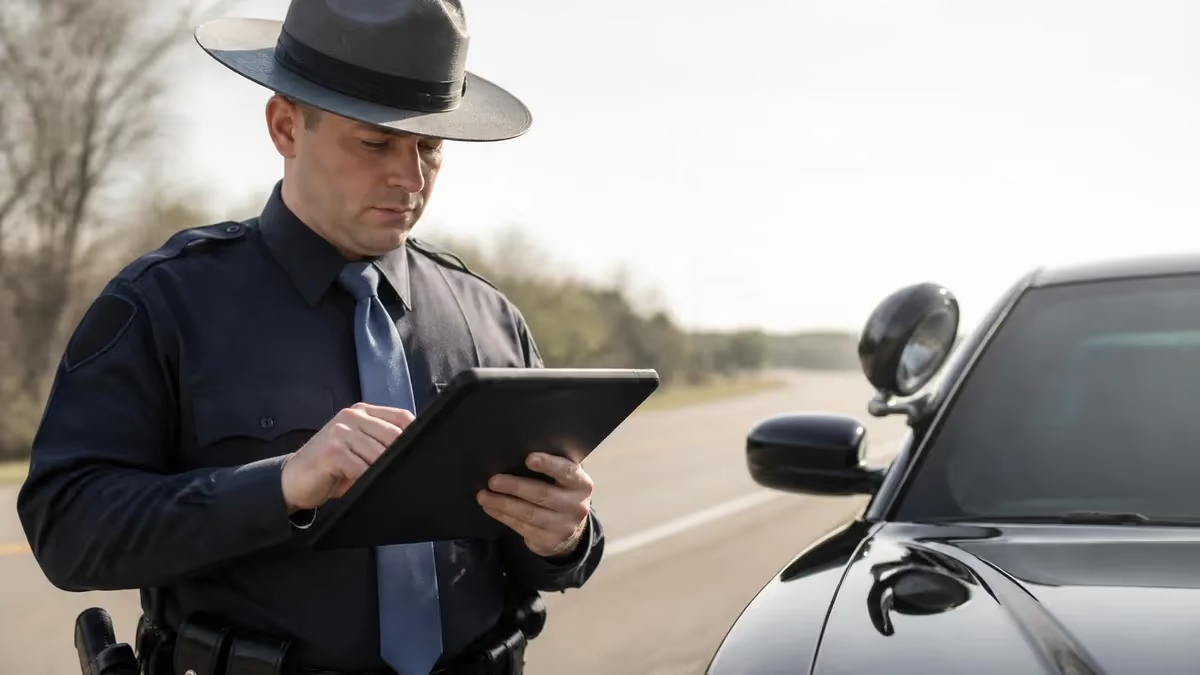
Pull up to a state police barracks anywhere from Wilmington to Baton Rouge and you'll see one word painted on the wall — Troop. Sometimes followed by a letter. Sometimes a number. It looks like military jargon, and historically it was — but today the troop designation is the everyday administrative unit state police agencies use to divide territory, command staff, and route calls.
If you've ever searched for delaware state police troop 4, state police troop b kenner la, or connecticut state police troop c tolland, you've already brushed up against this structure without anyone explaining how it actually works. This guide walks through it state by state — how troops are numbered or lettered, what each one covers, where to find the headquarters barracks, and how citizens contact the right troop for non-emergency reports.
Quick disclaimer up front. Always dial 911 for emergencies. The troop directory below is for routine reporting, records requests, accident reports, public information, and barracks visits — never for life-threatening situations. Different point entirely.
One more note. State police agencies reorganise. Boundaries shift. Troops get renumbered every decade or so. Treat the structure here as a working snapshot for 2026 — and verify directly with the agency's website before showing up at any barracks for a specific reason.

State Police Troop System by the Numbers
Why troops at all? The answer goes back to the cavalry origins of state policing in the early 20th century. Pennsylvania State Police, formed in 1905, organised its mounted patrols into geographic troops — the same word the US Army used for cavalry units. The terminology stuck. As other states built their highway patrol and state police agencies through the 1920s and 1930s, most adopted the troop model rather than reinventing it.
The administrative logic still works. A troop is a self-contained command — usually 80 to 250 sworn officers — with its own commanding officer (typically a captain or major), its own headquarters barracks, and a handful of satellite stations across the geographic area. The troop covers a defined slice of the state: a cluster of counties, a region, or in densely populated areas a single county. Within that area the troop handles highway patrol, accident investigation, criminal enforcement, and assistance to local police when requested.
Two main systems exist for naming troops. Lettered systems (A, B, C, D...) are slightly older and used in Connecticut, Louisiana, Missouri, Pennsylvania, and Nebraska among others. Numbered systems (1, 2, 3...) are used in Delaware, New York, and several others. Some agencies mix both — using letters for geographic troops and numbers for specialised units like traffic, K-9, or marine.
Delaware State Police runs the cleanest numbered system in the country. The state divides into nine geographic troops, numbered 1 through 9, plus a handful of specialised units. Each troop has a clear county or sub-county area and a single headquarters barracks where most administrative business happens.
Delaware's compact size — only three counties total — means troops here cover smaller territories than in most states. That's a feature, not a bug. Response times across all three counties are among the lowest in any state police agency. If you search for troop 1 delaware state police or troop 2 state police delaware, the smaller troop footprint is why you get a barracks within fifteen minutes drive of most of the state.
Here's the Delaware breakdown. Troop 1 covers Penny Hill and the northern New Castle County corridor, headquartered just outside Wilmington. Troop 2 is based in Newark and covers central New Castle County including the I-95 and Route 1 corridor — the busiest patrol area in the state by traffic volume. Troop 3 sits in Camden-Wyoming serving northern Kent County. Troop 4 — frequently searched as delaware state police troop 4 — is based in Georgetown and covers Sussex County's interior, including Seaford and the agricultural belt running west toward the Maryland line.
Troop 5 handles the Sussex County beach corridor from Bridgeville through Milton. Troop 6 covers Wilmington proper and Brandywine Hundred. Troop 7 is based in Lewes and serves the Rehoboth-Dewey beach communities — a population that triples between Memorial Day and Labor Day. Troop 8 sits in Smyrna covering north Kent and the I-95 to Route 13 transition. Troop 9 rounds out the numbered list in Odessa, covering southern New Castle County and the Middletown growth corridor that's exploded in the past decade.
Letter vs Number Systems
Two main schemes exist for naming geographic troops. Lettered systems (Troop A, B, C and on) appear in Connecticut, Louisiana, Missouri Highway Patrol, Pennsylvania, Nebraska, New York, and Florida among others — generally adopted by older agencies established in the 1920s and 1930s. Numbered systems (Troop 1, 2, 3) appear in Delaware, Kentucky (where they're called Posts), and several others. Both schemes do exactly the same job — divide the state into command areas with a barracks headquarters and a captain or major as troop commander. The choice between letter and number is historical, not operational.
Connecticut State Police uses a lettered system — Troops A through K — with eleven geographic troops covering the state. Connecticut runs the largest barracks footprint of any New England state and the lettered system has been stable since the 1970s with only minor boundary tweaks.
Troop A sits in Southbury covering western Connecticut along the I-84 corridor. Troop B — Canaan — handles the rural northwest including Litchfield County's western hills. Troop C — frequently searched as connecticut state police troop c tolland — is based in Tolland and covers the northeastern quiet corner including parts of Windham County. Troop D handles Danielson and the Quinebaug Valley toward the Rhode Island line.
Troop E covers Montville and southeastern Connecticut. Troop F handles Westbrook and the shoreline communities from Old Saybrook to Madison. Troop G sits in Bridgeport covering Fairfield County's coastal cities — the most densely populated troop in the state. Troop H — searchable as connecticut state police troop h hartford — is headquartered in Hartford and covers the capital metro plus parts of Hartford County. Troop I sits in Bethany handling New Haven County's inland communities. Troop K covers Colchester and the central rural belt. Troop J was retired in earlier reorganisations and never reissued.
Delaware State Police Troops 1 Through 9
Headquartered just outside Wilmington covering northern New Castle County including the Brandywine corridor. One of the busier troops by call volume due to dense suburban population and proximity to I-95.
Central New Castle County covering the I-95 and Route 1 corridor — busiest traffic enforcement zone in Delaware. Frequently searched as troop 2 state police by motorists requesting accident reports.
Northern Kent County including Dover suburbs. Handles state capitol perimeter security on a coordinated basis with the Dover Police Department and the Delaware Capitol Police unit.
Sussex County interior including Seaford and the agricultural belt running west toward the Maryland line. Frequently searched as delaware state police troop 4 by residents in the rural southwest.
Sussex County's Route 13 corridor from Bridgeville through Milton. Handles the agricultural and seasonal traffic patterns of southern Delaware's interior.
The Rehoboth-Dewey-Bethany beach communities. Population triples between Memorial Day and Labor Day, making this Delaware's most seasonal patrol footprint by far.

Louisiana State Police runs Troops A through L — twelve geographic troops plus several specialised units. Louisiana's troop boundaries follow parish clusters rather than highway corridors, which makes the troop map look a bit different from Connecticut's road-focused divisions.
Troop A covers Baton Rouge and East Baton Rouge Parish. Troop B — and this is where searches for state police troop b kenner la and troop b state police often land — is based in Kenner and handles Jefferson and Orleans parishes including the New Orleans metro highway corridors. The Troop B barracks at Kenner sits near Louis Armstrong International Airport and runs one of the busiest traffic enforcement zones in the state.
Troop C covers Gray and the Houma-Thibodaux area in southern Louisiana. Troop D handles Lake Charles and the southwestern parishes. Troop E — searched as louisiana state police troop e — is based in Alexandria and covers central Louisiana including Rapides and Avoyelles parishes. Troop F sits in Monroe handling northeast Louisiana.
Troop G covers Bossier City and the Shreveport metro in the northwest. Troop I handles Lafayette and the Acadiana parishes. Troop L — frequently searched as troop l state police — covers Mandeville and the north shore parishes including St. Tammany and Tangipahoa. Troops H, J, and K cover the remaining geographic gaps and several specialised investigative functions.
Missouri State Highway Patrol — note the different name, but the same troop structure — uses Troops A through I across nine geographic divisions. Missouri's troops cover larger areas than Delaware's because the state is bigger and more rural.
Troop A covers Lee's Summit and Kansas City metro. Troop B handles Macon and north-central Missouri. Troop C covers Weldon Spring and the St. Louis metro outer ring. Troop D handles Springfield and southwest Missouri. Troop E — frequently searched as missouri state highway patrol troop e — is based in Poplar Bluff and covers the southeastern bootheel parishes plus the Cape Girardeau corridor.
Troop F sits in Jefferson City covering the capital and central Missouri. Troop G handles Willow Springs and the south-central Ozarks. Troop H covers St. Joseph and the northwest counties. Troop I rounds it out at Rolla covering the south-central highway corridor along I-44.
Missouri's troops each operate one main headquarters plus three to five satellite zones depending on population density. The Troop A Kansas City metro footprint runs four times the staff of the most rural troops because the call volume justifies it. Same agency, same patch design, very different daily workload.
Troop Spotlights by State
Delaware uses a clean numbered system. Troop 1 covers Penny Hill and northern New Castle. Troop 2 sits in Newark on the I-95 corridor. Troop 3 handles north Kent from Camden-Wyoming. Troop 4 — Georgetown — covers Sussex interior. Troop 5 runs the southern Route 13 corridor. Troop 6 handles Wilmington proper. Troop 7 covers the beach communities from Lewes. Troop 8 sits in Smyrna. Troop 9 handles southern New Castle from Odessa, including the booming Middletown growth corridor.
Nebraska State Patrol takes the lettered approach across Troops A through H. Troop A — searched as nebraska state patrol troop a — covers Omaha and Douglas County, the largest population centre in the state. Troop B handles Norfolk and northeast Nebraska. Troop C covers Grand Island and central Nebraska.
Troop D sits in McCook serving the southwest counties. Troop E handles Scottsbluff and the Panhandle. Troop F covers North Platte and the western I-80 corridor. Troop G handles Lincoln and Lancaster County. Troop H is the state Capitol security and executive protection troop based in Lincoln but with statewide responsibility.
Nebraska's troop boundaries follow highway corridors more than county lines. I-80 cuts across multiple troops and the troop-to-troop handoff during highway pursuits is one of the most-rehearsed coordination drills in the agency's training schedule.
Several other states use the troop system worth knowing about. Pennsylvania State Police — the original troop agency — uses Troops A through T spread across 16 active geographic troops (some letters were retired in older reorganisations). New York State Police uses lettered Troops A through L, including the famous Troop NYC covering New York City and the Thruway. Florida Highway Patrol uses lettered troops A through L tied to regional commands. Kentucky State Police uses numbered Posts (1 through 16) — same concept, different label. Texas DPS uses Regional commands instead of troops but the underlying logic is identical.
The exam-relevant point is consistent across all of them. Each troop is led by a senior officer — usually a captain in smaller states, a major or lieutenant colonel in larger ones — who serves as the troop commander. Troop commanders report to a Field Operations Bureau commander at agency headquarters, who reports up to the agency superintendent or director.
The troop directory in this article is for non-emergency contact — accident report requests, records inquiries, public information, walk-in lobby business, and routine reporting. For any life-threatening situation, active crime in progress, or motor vehicle accident with injury, dial 911. The state's emergency communications system will route the call to the correct troop dispatch automatically. Calling a barracks main number for an emergency adds critical seconds to response time.
Citizen access to troop services is more standardised than most people realise. Every troop barracks handles the same core functions — accident reports, criminal complaints, motor vehicle records, public information, and lobby walk-in inquiries — even though the geographic territory varies. If you've been in an accident on a state highway, the troop covering that segment of road files the report and you'll request a copy from that troop's records section.
Lobby hours vary by troop. Major-metro troops usually staff lobby reception 24/7. Rural troops often run lobby hours 8 AM to 5 PM weekdays only, with after-hours calls routed through the dispatch line. Records requests typically take 7 to 21 days depending on the report type and whether the case is still active. Active investigation records are usually withheld until the case closes.
Accident reports specifically — the most-requested document type at every troop — typically run $5 to $25 depending on the state and whether you request paper or digital delivery. Some states (Delaware, Connecticut) run online portals that bypass the barracks entirely. Others (Louisiana, Missouri) still require an in-person or mail-in request with payment by cheque or money order. Check the state agency's website before you drive to a barracks — half the time you can complete the request online without leaving your couch.

Before You Visit a State Police Barracks
- ✓Confirm the correct troop using your state agency's online barracks locator before driving — the wrong barracks adds time
- ✓Check lobby hours — rural troops often staff lobby reception only weekdays 8 AM to 5 PM with no weekend coverage
- ✓Bring photo ID — driver's licence or state ID required for any records request or report copy purchase
- ✓Have your accident report number or case number ready — the records section can't pull a file without it
- ✓Carry payment in the form the agency accepts — many troops still require cheque or money order, not credit card
- ✓Check whether the request can be completed online — Delaware and Connecticut both run portal-based accident report systems
- ✓For active case inquiries, contact the detective bureau ahead of time — records will withhold active investigation files
- ✓Always dial 911 first for any emergency — never wait at a barracks lobby for life-threatening situations
Troop commander rank deserves a word. In Pennsylvania, troop commanders are typically captains. In Connecticut and Louisiana, they're often majors. In Delaware and Nebraska, captains. The rank gap matters for two reasons. First, salary and benefits scale with rank — a Pennsylvania troop captain runs a smaller team than a Louisiana troop major but for less pay. Second, promotion pathways differ — in some agencies you can't promote past captain without commanding a troop first, while in others troop command is a parallel track to bureau positions.
Most state police troopers spend their first eight to twelve years on patrol within a single troop before becoming eligible for promotion to corporal or sergeant. Lateral transfers between troops happen but they require approval and usually involve a hardship justification or specific posting needs. Once an officer makes sergeant, they often move troops as part of the promotion — broadening their experience for the next career step.
If you're studying for a state trooper exam, the troop structure for your specific state is fair game on the written test. Pennsylvania PSP candidates need to know all 16 Troop letters and where each one is headquartered. Connecticut candidates need to know A through K and which counties each covers. Same in every other troop-system state. Test your knowledge with the practice quizzes below before sitting the actual exam.
Troop System vs Other Command Structures
- +Clear geographic accountability — every square mile of the state falls under one named troop with one commander
- +Citizens can identify their troop quickly using the barracks locator and contact the correct command directly
- +Standardised command structure — troop commander rank and reporting line is consistent across the agency
- +Easier inter-state coordination — a Connecticut Troop C investigator knows exactly who to call at a Massachusetts equivalent
- +Troop pride and unit identity build cohesion among officers who serve the same territory for many years
- −Boundary lines occasionally split natural communities or interstate corridors, creating jurisdictional handoffs mid-pursuit
- −Specialised troops layered on top of geographic troops can confuse citizens trying to figure out which command handles what
- −Troop staffing imbalances develop over time as population shifts — rural troops shrink while urban troops grow
- −Retired troop letters create gaps in the lettering scheme that look arbitrary to outsiders trying to understand the map
- −Larger troops with many satellite stations sometimes struggle with internal coordination compared to single-barracks troops
Pros and Cons at a Glance
| Pros | Cons |
|---|---|
| Clear geographic accountability — every square mile of the state falls under one named troop with one commander | Boundary lines occasionally split natural communities or interstate corridors, creating jurisdictional handoffs mid-pursuit |
| Citizens can identify their troop quickly using the barracks locator and contact the correct command directly | Specialised troops layered on top of geographic troops can confuse citizens trying to figure out which command handles what |
| Standardised command structure — troop commander rank and reporting line is consistent across the agency | Troop staffing imbalances develop over time as population shifts — rural troops shrink while urban troops grow |
| Easier inter-state coordination — a Connecticut Troop C investigator knows exactly who to call at a Massachusetts equivalent | Retired troop letters create gaps in the lettering scheme that look arbitrary to outsiders trying to understand the map |
| Troop pride and unit identity build cohesion among officers who serve the same territory for many years | Larger troops with many satellite stations sometimes struggle with internal coordination compared to single-barracks troops |
Specialised troops complete the picture in many agencies. Beyond the geographic Troops A-Z or 1-N, most state police agencies run a parallel set of non-geographic troops handling specialised functions. Common examples: Troop Aviation (helicopter and fixed-wing units), Troop K-9, Troop Marine (waterborne patrol), Troop Capitol Police (state government building security), Troop Traffic (specialised highway enforcement), and Troop Communications (statewide dispatch coordination). These troops cover the entire state rather than a geographic zone — and they pull officers from the geographic troops for short-term specialised assignments.
The Pennsylvania State Police Troop T — Turnpike — is a famous example. It covers only the Pennsylvania Turnpike's 552 miles regardless of which geographic troop's territory the road crosses. Turnpike troopers report to Troop T command rather than to the local geographic troop. Same arrangement for the New Jersey Turnpike (NJ State Police Troop D handles the Garden State Parkway and Turnpike).
Citizens rarely interact with specialised troops directly. If you're calling about an aviation overflight complaint, an investigation involving a K-9 deployment, or a marine patrol issue, the call still goes to your geographic troop's dispatch — they coordinate with the specialised unit on the back end. From the public's point of view, the geographic troop remains the front door.
One final point about troop history. The lettered systems sometimes have gaps — Connecticut has no Troop J, Louisiana skipped a few letters in earlier reorganisations, Pennsylvania retired Troops X and Y decades ago. Don't read meaning into the gaps. They're administrative artifacts of mergers, boundary changes, and retired troops that never got reissued because the agency moved on to a different numbering scheme. The gap doesn't mean anything operational is missing — the territory once covered by retired troops is now covered by adjacent surviving troops.
If you're a citizen needing to contact your local state police, the simplest approach is to search your state's official agency website for "barracks locator" or "troop map." Every state police website has one. Enter your address or county and the site returns the troop number or letter plus the barracks address, phone, and lobby hours. That's the same lookup tool the agency uses internally to route 911 spillover calls and after-hours public inquiries.
Sample State Trooper Practice Questions
Try these questions from our free State Trooper practice tests. The correct answer and an explanation follow each question.
Which U.S. state established the first state police agency in 1905?
- A. Pennsylvania
- B. New York
- C. Texas
- D. California
Answer: A. Pennsylvania
Pennsylvania created the first state police force in the U.S. in 1905, setting the model for other states.
What is a 'consent decree' as it relates to state police departments?
- A. A voluntary agreement between officers and their union
- B. A court-ordered reform agreement binding a police agency
- C. Consent given by a suspect during interrogation
- D. A mutual aid agreement between two states
Answer: B. A court-ordered reform agreement binding a police agency
A consent decree is a judicially supervised agreement, often with the DOJ, requiring a police agency to implement specific reforms to address civil rights violations.
A directive states: 'Troopers must notify dispatch before entering any structure during an investigation unless exigent circumstances exist.' A trooper hears screaming from inside a house. She enters immediately without notifying dispatch. Her action was:
- A. A clear policy violation requiring disciplinary action
- B. Appropriate given the exigent circumstances
- C. Acceptable only if she notified dispatch after exiting
- D. Improper because screaming alone is not an emergency
Answer: B. Appropriate given the exigent circumstances
Screaming from inside a structure constitutes exigent circumstances, which the directive explicitly recognizes as an exception to the notification requirement.
You are the first to arrive at a structure fire with occupants still inside. Your agency is non-fire. What is your role?
- A. Enter the structure and attempt to rescue occupants
- B. Establish a perimeter, evacuate bystanders, call fire and EMS, and guide occupants who self-evacuate to safety
- C. Wait for fire units before taking any action
- D. Begin rescue using your vehicle's fire extinguisher
Answer: B. Establish a perimeter, evacuate bystanders, call fire and EMS, and guide occupants who self-evacuate to safety
Without fire training and equipment, officers protect the perimeter, facilitate evacuation, and summon appropriate resources rather than entering.
State Trooper Questions and Answers
About the Author

Educational Psychologist & Academic Test Preparation Expert
Columbia University Teachers CollegeDr. Lisa Patel holds a Doctorate in Education from Columbia University Teachers College and has spent 17 years researching standardized test design and academic assessment. She has developed preparation programs for SAT, ACT, GRE, LSAT, UCAT, and numerous professional licensing exams, helping students of all backgrounds achieve their target scores.
Join the Discussion
Connect with other students preparing for this exam. Share tips, ask questions, and get advice from people who have been there.
View discussion (3 replies)