
Virginia Standards of Learning Kindergarten: Complete Parent & Teacher Guide (2026 September)
🎯 Standards of learning virginia kindergarten explained — what kids learn, how to prepare, and free practice resources for SOL success.
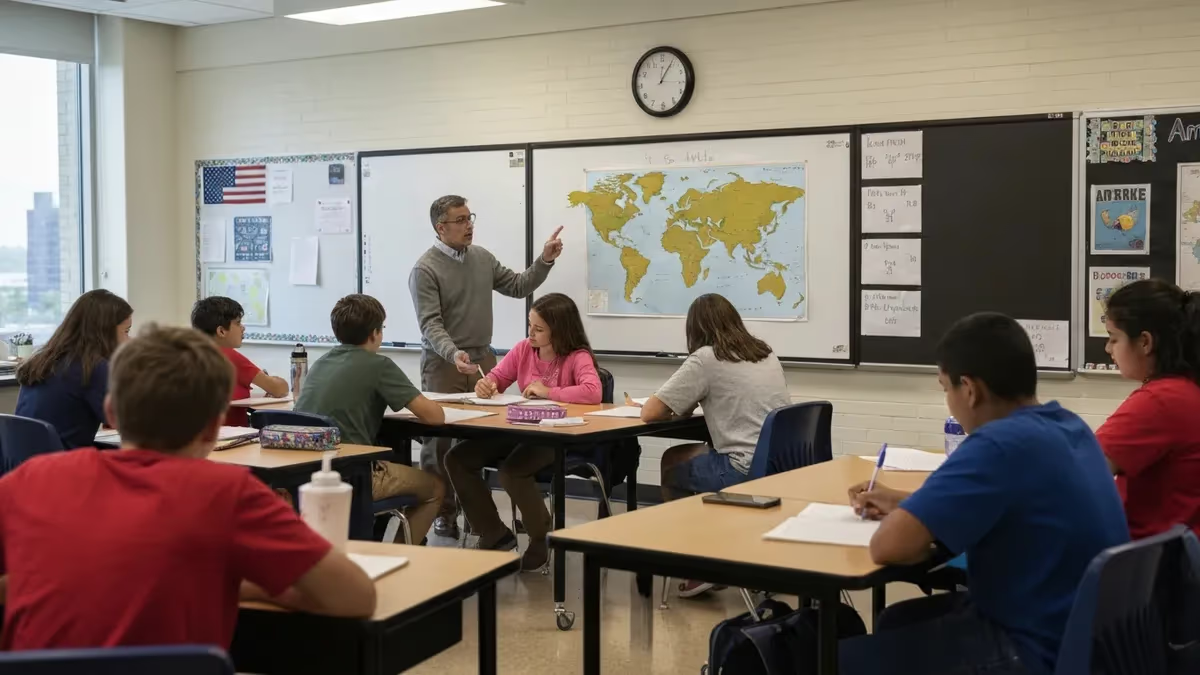
The standards of learning virginia kindergarten program establishes the foundational academic expectations every five- and six-year-old in Virginia's public schools must meet before advancing to first grade. These standards, developed and maintained by the Virginia Department of Education, cover four core domains: English language arts, mathematics, science, and history and social science. Understanding these benchmarks helps parents support learning at home and gives teachers a clear road map for classroom instruction throughout the school year.
Virginia's SOL framework is one of the most comprehensive state-level accountability systems in the United States. While formal standardized testing does not begin until third grade, the kindergarten standards lay the cognitive and academic groundwork that will be measured in those later assessments. Children who master kindergarten-level SOL expectations arrive in first grade prepared for phonics instruction, number operations, and early scientific inquiry — giving them a measurable head start in Virginia's rigorous academic pipeline.
Parents often wonder what a typical kindergartener is expected to know by the end of the school year. According to Virginia's current SOL framework, students should be able to recognize and produce letter sounds, blend simple consonant-vowel-consonant words, count and compare sets of objects up to at least 110, identify basic properties of matter, and describe family roles within their community. These are not aspirational goals — they are the minimum proficiency markers every student is expected to reach.
Teachers use the SOL standards as the backbone of their lesson planning, assessment calendars, and differentiated instruction strategies. Each standard is written in precise, measurable language so that educators across the state can evaluate student performance consistently. A kindergarten teacher in Richmond and one in Roanoke are working from the same benchmark document, which creates equity in educational expectations regardless of zip code or school district funding levels.
For families new to Virginia's school system, navigating the SOL landscape can feel overwhelming. The acronym itself — Standards of Learning — is sometimes confused with the SOL assessments taken in later grades, but the kindergarten standards are a curriculum guide rather than a high-stakes test. Think of them as a detailed syllabus that tells you exactly what your child's teacher is trying to accomplish between September and June. You can find the full virginia standards of learning kindergarten documents on the Virginia Department of Education website, organized by subject and grade level.
Research consistently shows that children who receive targeted support aligned to state standards in kindergarten demonstrate stronger academic trajectories through elementary school. A 2022 analysis by the Virginia Department of Education found that students who met or exceeded kindergarten readiness benchmarks were significantly more likely to pass third-grade reading SOL assessments. Early alignment between home learning activities and school-based standards is one of the most cost-effective educational interventions available to Virginia families.
This guide walks you through every major domain of the kindergarten SOL framework, explains how standards translate into classroom practice, and gives you concrete tools to support your child's progress at home. Whether you are a parent reviewing your child's progress report, a teacher building a unit plan, or an instructional coach supporting a new educator, you will find the structured detail and practical guidance you need right here.
Virginia Kindergarten SOL by the Numbers
The Four Core Domains of Virginia Kindergarten SOL Standards
Covers oral language, phonological awareness, phonics, reading comprehension, writing, and research. Students learn to blend sounds into words, retell stories, and form letters correctly. ELA is the largest single domain in the kindergarten SOL framework with the most individual benchmarks.
Focuses on number sense, counting, basic operations, geometry, measurement, and data. By year-end, students count to 110, compare quantities, identify two- and three-dimensional shapes, and use non-standard units to measure length and weight in hands-on activities.
Introduces scientific investigation, matter, energy, life science, and earth science. Students observe properties of objects, explore how pushes and pulls affect motion, describe animal life cycles, and identify weather patterns — building the inquiry skills needed for later SOL science assessments.
Builds civic knowledge and historical thinking through exploration of family, community, map skills, and national symbols. Students learn the roles of community helpers, identify Virginia and United States on maps, and develop an early sense of chronology and civic responsibility.
English Language Arts represents the largest and most intensively assessed domain within Virginia's kindergarten SOL framework. The ELA standards are divided into five strands: oral language, reading, writing, research, and communication. Each strand contains multiple individual benchmarks that progress in complexity as the school year advances. Teachers typically assess these benchmarks through running records, observation checklists, and portfolio samples rather than formal written tests, which allows for a more developmentally appropriate evaluation approach for five- and six-year-olds.
Phonological awareness is the cornerstone of early reading instruction and takes up a substantial portion of the kindergarten ELA standards. Students are expected to identify and produce rhyming words, segment spoken sentences into individual words, break words into syllables by clapping, and isolate individual phonemes — the smallest sound units in spoken language. Research from the National Reading Panel consistently identifies phonological awareness as the single strongest predictor of early reading success, which is why Virginia dedicates so much instructional time to this strand in kindergarten.
Phonics instruction in kindergarten builds directly on the phonological foundation. The SOL standards require students to master all 26 letter-sound correspondences for consonants, recognize short vowel sounds in simple words, and begin decoding consonant-vowel-consonant words like "cat," "sit," and "hop." Teachers use systematic, explicit phonics programs aligned to the Science of Reading — an evidence-based approach Virginia formally adopted as part of its READ Act legislation — to ensure all students receive consistent, research-backed decoding instruction throughout the school year.
Reading comprehension standards in kindergarten focus on listening comprehension as much as independent reading, which is developmentally appropriate. Students listen to stories read aloud and demonstrate understanding by retelling the beginning, middle, and end; identifying the main character and setting; and making simple predictions. The SOL standards also require exposure to informational texts, so teachers balance their read-aloud selections between literary and nonfiction titles. This dual exposure builds the academic vocabulary students will need for content-area reading in later grades.
Writing standards in kindergarten begin with the physical act of letter formation and progress toward composing simple sentences. Students are expected to hold a pencil correctly, form uppercase and lowercase letters, spell high-frequency sight words from an approved list, and write their first and last names independently. By the end of the year, most kindergarteners are expected to write one or two complete sentences with a capital letter at the beginning and a period at the end — a benchmark that reflects both fine motor development and early grammatical understanding.
Oral language and communication standards often receive less attention from parents than reading and writing, but they are equally important in the Virginia SOL framework. Students are expected to listen actively during whole-class and small-group instruction, follow multi-step directions, speak in complete sentences when sharing ideas, and take turns in structured conversations. These skills are directly assessed through teacher observation and contribute to kindergarten report card grades. Strong oral language skills also accelerate vocabulary growth, which in turn supports reading comprehension development through the elementary years.
Research skills in kindergarten may sound advanced, but the SOL standard at this level simply requires students to ask questions about a topic and gather information from pictures, books, and digital resources with teacher support. A typical kindergarten research project might involve choosing a favorite animal, looking at labeled diagrams, and dictating three facts to the teacher. This foundational inquiry habit — asking a question, locating information, and sharing findings — mirrors the research process students will execute independently in third, fifth, and eighth grade SOL assessments.
Mathematics, Science, and Social Studies SOL Standards Explained
Virginia's kindergarten mathematics SOL standards are organized around five big ideas: number and number sense, computation and estimation, measurement, geometry, and probability and statistics. The number sense strand is the most heavily weighted, requiring students to count forward to at least 110, count backward from 10, read and write numerals to 30, and compare sets of objects using terms like "greater than," "less than," and "equal to." Students also explore the concept of addition as combining groups and subtraction as separating groups using concrete manipulatives before any abstract notation is introduced.
Geometry and measurement round out the kindergarten math SOL requirements in engaging, hands-on ways. Students identify and describe flat shapes — circles, squares, rectangles, and triangles — as well as solid shapes including spheres, cubes, and cylinders. Measurement at this level uses non-standard units: children measure the length of a pencil in paper clips or the weight of a book in cubes. This non-standard approach builds proportional reasoning and measurement vocabulary before rulers and scales are introduced in first grade, giving students a conceptual foundation rather than a procedural shortcut.
Advantages and Challenges of Virginia's Kindergarten SOL Framework
- +Provides a clear, statewide standard ensuring every kindergartener in Virginia works toward the same academic benchmarks regardless of school location
- +Aligns kindergarten curriculum directly to third-grade SOL assessments, giving children a well-sequenced academic foundation over multiple years
- +Supports data-driven instruction by giving teachers measurable benchmarks for tracking individual student progress throughout the school year
- +Incorporates the Science of Reading principles into ELA standards, ensuring phonics and phonological awareness instruction is evidence-based
- +Covers all four core subject areas, preventing schools from narrowing curriculum to only literacy and math at the expense of science and social studies
- +Regular revision cycle (every 7 years) allows Virginia to incorporate new research and adjust standards based on student performance data statewide
- −The breadth of standards across four subject areas can feel overwhelming for classroom teachers, especially those new to kindergarten instruction
- −Standards documents can be difficult for parents without an education background to interpret without additional guidance or translation materials
- −Developmental variability among five- and six-year-olds means some children reach benchmarks later than the standard timeline without any underlying learning difficulty
- −The framework does not explicitly address social-emotional learning milestones, which are equally critical for kindergarten success and school readiness
- −Assessment of kindergarten standards relies heavily on teacher observation, creating potential for inconsistency across classrooms and schools
- −Families who move from other states mid-year may find their child is ahead in some SOL domains and behind in others due to different state sequencing
Virginia Kindergarten SOL Readiness Checklist for Parents
- ✓Read aloud to your child for at least 15 minutes daily to build vocabulary and listening comprehension skills aligned to ELA standards
- ✓Practice identifying all 26 uppercase and lowercase letters by name and sound using alphabet cards or letter tiles
- ✓Count objects together during everyday activities — toys, snacks, steps — to build number sense up to and beyond 30
- ✓Ask your child to retell a story you just read, focusing on who the characters are and what happened at the beginning, middle, and end
- ✓Practice writing the child's first and last name daily, focusing on correct letter formation and starting from left to right
- ✓Sort household objects by color, shape, size, and texture to reinforce the science SOL property observation standard
- ✓Point out community helpers — firefighters, librarians, mail carriers — and discuss their roles to build social studies knowledge
- ✓Use a simple calendar together to track the days of the week, months, and seasonal weather changes outdoors
- ✓Practice rhyming games and tongue twisters to strengthen phonological awareness — a key predictor of early reading success
- ✓Review high-frequency sight words (the, a, is, it, in, can, see, we, like, and) using flashcards for five minutes each day
Third-Grade Reading SOL Performance Starts in Kindergarten
Virginia Department of Education data shows that students who meet kindergarten ELA readiness benchmarks — particularly phonological awareness and letter-sound knowledge — are significantly more likely to pass the third-grade reading SOL assessment. Starting targeted, standards-aligned literacy practice in kindergarten is the highest-leverage investment Virginia families and teachers can make in long-term academic success.
Understanding how Virginia teachers actually use the SOL standards in daily classroom practice helps parents form more realistic expectations and more productive conversations during parent-teacher conferences. The standards themselves are not lesson plans — they are outcome statements that describe what students should know and be able to do. Teachers translate these outcome statements into unit plans, daily lessons, learning centers, and assessment tools using curriculum guides provided by their school division or purchased from approved vendors aligned to the Virginia SOL framework.
Formative assessment is the primary tool kindergarten teachers use to monitor SOL progress throughout the year. Unlike the formal pencil-and-paper tests administered in grades three through eight, kindergarten assessment relies heavily on teacher observation during instruction, one-on-one reading conferences, mathematical interviews where a teacher watches a child solve a problem and asks questions about their thinking, and portfolio collections of student work samples over time. These methods are more labor-intensive than bubble-sheet tests but provide far richer data about what a five-year-old actually understands versus what they can guess correctly.
Differentiated instruction is a legal and professional obligation for Virginia teachers, not an optional enhancement. When SOL benchmark data reveals that some students have already mastered a standard and others are still working toward it, teachers are expected to adjust their instruction accordingly. This might mean providing additional phonics small-group sessions for students who have not yet mastered letter-sound correspondences while simultaneously offering enrichment activities for students who are already blending words independently. The SOL framework supports this differentiation by providing clear, hierarchical benchmarks that show the progression from emerging to proficient to advanced performance.
Kindergarten teachers in Virginia are also expected to integrate the SOL standards across subject areas wherever possible. A lesson on community helpers, for example, simultaneously addresses the history and social science standard on community roles, the ELA standard on listening comprehension, and potentially the math standard on data collection if students survey classmates about their favorite community helper and create a simple pictograph. This cross-curricular integration maximizes instructional time and helps students see connections between disciplines, which is a cognitive skill that becomes increasingly important as SOL assessments grow more complex in upper elementary grades.
Professional development aligned to the SOL revision cycle plays a critical role in ensuring instructional quality across Virginia's 132 school divisions. When Virginia revises its standards — as it did in the 2023 cycle — the Department of Education provides training materials, implementation guides, and sample lessons to help teachers understand not just what changed but why the change was made and what evidence supports the revision. Teachers who participate in this professional development are better equipped to explain the standards to parents and to align their assessments accurately to the new benchmarks.
Data teams within schools use SOL benchmark data collected throughout the year to identify students who may need additional intervention before the formal testing window opens in grade three. In kindergarten, this early identification process is known as universal screening, and Virginia requires all divisions to administer a validated screener at the beginning of the school year to identify students who may be at risk for reading or math difficulties.
Students flagged by the screener receive additional support — often through the Multi-Tiered System of Supports (MTSS) framework — while continuing to receive core instruction aligned to the kindergarten SOL standards.
Parents play a direct and meaningful role in supporting SOL alignment at home, even without a background in education. The Virginia Department of Education publishes parent-friendly "curriculum frameworks" for each grade level and subject area that translate the technical standard language into plain English descriptions of what children should know and be able to do.
These free documents are available on the VDOE website and include sample activities families can use at home to reinforce what children are learning in school. When home and school instruction align to the same standards, children benefit from consistent expectations and double the practice time — a combination that research shows dramatically accelerates skill development.

Virginia's formal SOL assessments do not begin until third grade. Kindergarten SOL standards are a curriculum and instruction guide, not a testing mandate. Your child will not take a standardized state test in kindergarten — but the skills they build now directly determine how prepared they are when formal SOL testing begins in third grade reading and mathematics.
Supporting your kindergartener's SOL-aligned learning at home does not require expensive tutoring programs or elaborate materials. The most effective at-home strategies are simple, consistent, and grounded in authentic interaction. Reading together every day remains the single most impactful activity parents can do to support ELA standard development. Research published in the Journal of Educational Psychology found that children whose parents read with them daily for as little as ten minutes had vocabularies 40 percent larger than peers who were read to less frequently — a difference that directly predicts reading comprehension scores on SOL assessments in later grades.
Mathematical thinking can be reinforced during ordinary household routines without any worksheets or workbooks. Sorting laundry by color builds early data and classification skills. Counting stairs as you walk up them reinforces number sequence. Measuring ingredients while cooking introduces non-standard and standard measurement concepts in a meaningful context. Asking a child to set the table by figuring out how many forks, spoons, and plates are needed for each family member introduces one-to-one correspondence — a foundational number sense concept embedded in the kindergarten mathematics SOL standards.
Science curiosity is naturally high in kindergarten-age children, and parents can channel that curiosity directly toward SOL-aligned content. A walk around the neighborhood can become a science observation activity: ask your child to describe the properties of rocks they find (color, size, texture, shape), observe cloud formations and predict tomorrow's weather, or categorize leaves by their shape and size. These informal inquiry experiences build the vocabulary and observational habits that Virginia's kindergarten science standards explicitly target, without ever feeling like homework or test preparation.
Social studies concepts are also easy to reinforce at home through conversation and community experiences. Visiting the local library and speaking with the librarian, watching a fire station during community events, or volunteering at a food bank all give children concrete experience with the community helper roles described in Virginia's history and social science SOL standards. Looking at a map together when planning a trip — even pointing out where your neighborhood is relative to the state of Virginia — reinforces the geographic thinking skills that appear in kindergarten SOL benchmarks and grow in complexity through fifth grade.
Technology tools can be valuable supplements to home learning when used purposefully and in moderation. Several apps and websites offer early literacy and math practice aligned to Virginia's SOL standards, including Starfall, ABCmouse, and Khan Academy Kids. However, screen-based practice should complement rather than replace hands-on play, read-alouds, and real-world exploration. The American Academy of Pediatrics recommends limiting recreational screen time for kindergarten-age children to one hour per day, with co-viewing preferred so parents can extend learning by asking questions and making connections to daily life.
Communication with your child's teacher is the most underutilized resource available to Virginia families. Most kindergarten teachers welcome parent questions about the SOL standards and are happy to share specific activities tailored to your child's current performance level.
Asking at conferences, "Which SOL standards is my child working toward right now, and what can I do at home to support them?" gives the teacher an opportunity to personalize the guidance and gives you a concrete action plan rather than a generic suggestion to "read more." This partnership between home and school is one of the strongest predictors of kindergarten academic success in Virginia's research literature.
Finally, maintaining a positive and growth-oriented mindset around learning benchmarks protects children from the anxiety that can accompany academic expectations. Not every child reaches every kindergarten SOL benchmark at the same moment in the school year — development is not a race, and the standards describe end-of-year expectations, not September requirements.
Celebrating incremental progress, praising effort over outcome, and modeling a love of reading and curiosity about the world creates the motivational foundation children need to engage fully with the SOL-aligned instruction they receive in school every day. You can also explore comprehensive preparation support through resources on this site to help your family navigate Virginia's accountability framework with confidence.
As you look ahead to first grade and beyond, it helps to understand how kindergarten SOL mastery compounds over time. The reading skills developed in kindergarten — phonological awareness, phonics decoding, and listening comprehension — directly enable the fluency and reading comprehension skills assessed on the third-grade reading SOL.
The number sense and counting skills built in kindergarten underpin the addition and subtraction fact fluency measured in the second-grade math SOL and the multiplication concepts introduced in third grade. Virginia's SOL framework is a vertically aligned system, meaning each year's standards are deliberately designed to build on the previous year's foundation.
The science inquiry habits introduced in kindergarten — observing, questioning, predicting, and communicating findings — map directly to the scientific investigation standards tested on the fifth-grade science SOL. Children who spend kindergarten learning to describe what they observe and ask questions about why things happen are developing the procedural knowledge they will need to design controlled experiments independently in fourth and fifth grade. This vertical alignment across grade levels is one of Virginia's most thoughtful design choices and a key reason why early SOL alignment matters so much for long-term academic trajectories.
History and social science knowledge also builds cumulatively through Virginia's SOL framework. The community awareness and map skills introduced in kindergarten expand to Virginia geography and history in second and third grade, American history in fourth and fifth grade, and world history in sixth through ninth grade.
A child who can locate Virginia on a United States map in kindergarten and describe the role of a community helper has begun building the civic knowledge base that will be formally assessed on the Virginia and United States history SOL assessments in later years. The foundational knowledge installed in kindergarten is never wasted in Virginia's carefully sequenced curriculum.
Teachers and instructional coaches who work within the Virginia SOL framework often note that the kindergarten year is uniquely influential because it establishes children's identities as learners. A child who experiences early success with letter sounds and counting develops confidence that accelerates future learning.
Conversely, a child who struggles in kindergarten without adequate support can develop an avoidance mindset around reading or math that proves very difficult to reverse. This is why Virginia invests heavily in kindergarten teacher training, class size guidelines, and early intervention programs — the return on investment for catching and supporting struggling learners in kindergarten far exceeds the cost of remediation in upper elementary grades.
The 2023 revision of Virginia's SOL standards incorporated several significant enhancements to the kindergarten framework based on a decade of student performance data and advances in educational research. The ELA standards now more explicitly reflect the Science of Reading research base, with stronger emphasis on phonemic awareness sequencing and systematic phonics instruction.
The mathematics standards were refined to reduce overlap with first-grade content and to strengthen the number sense foundation. These revisions mean that resources and curriculum materials published before 2023 may not be fully aligned to the current standards, so parents and teachers should verify that any supplemental materials they use reflect the most recent version of the Virginia SOL framework.
Community organizations, libraries, and educational nonprofits across Virginia have stepped up to support SOL-aligned learning beyond the school day. Many public libraries in Virginia participate in programs that provide summer reading challenges specifically designed to maintain and extend the phonics and comprehension skills children develop in kindergarten.
Summer learning loss — the documented tendency for students to lose academic ground during the extended summer break — disproportionately affects early literacy skills, making summer reading programs a high-priority recommendation for all Virginia kindergarten families. Even reading three to four books per week during the summer months can significantly reduce regression and position children for a strong start in first grade.
Ultimately, the Virginia Standards of Learning kindergarten framework represents a comprehensive, evidence-informed vision of what five- and six-year-olds are capable of learning when given high-quality instruction and adequate support. The standards are ambitious but achievable, and the research base underlying each benchmark is stronger than it has ever been.
Whether you are a parent trying to understand your child's progress report, a teacher seeking to deepen your instructional alignment, or a policy advocate working to improve early childhood education across the commonwealth, the kindergarten SOL framework gives you a rigorous and equitable starting point. Investing in this foundational year pays educational dividends that compound across an entire academic career.
SOL Questions and Answers




About the Author

Educational Psychologist & Academic Test Preparation Expert
Columbia University Teachers CollegeDr. Lisa Patel holds a Doctorate in Education from Columbia University Teachers College and has spent 17 years researching standardized test design and academic assessment. She has developed preparation programs for SAT, ACT, GRE, LSAT, UCAT, and numerous professional licensing exams, helping students of all backgrounds achieve their target scores.
Join the Discussion
Connect with other students preparing for this exam. Share tips, ask questions, and get advice from people who have been there.
View discussion (8 replies)