
How Many Questions Are on the SHSAT? Complete 2026 October Guide
How many questions are on the SHSAT? 🎯 114 questions, 3 hours. Full format breakdown, scoring, prep tips, and free practice tests inside.

If you're preparing for the Specialized High Schools Admissions Test, one of the first questions every student and parent asks is: how many questions are on the SHSAT? The answer is 114 questions total — split across two sections covering English Language Arts and Math. Understanding the full scope of the shsat is the foundation of any smart prep strategy, because you can't plan your timing or pacing without knowing exactly what you're up against on test day.
The SHSAT is offered to 8th graders (and in some cases 9th graders) who want to gain admission to one of New York City's eight specialized high schools, including the highly competitive Stuyvesant High School, Bronx High School of Science, and Brooklyn Technical High School. Admission is based entirely on your SHSAT composite score — no grades, no interviews, no teacher recommendations. That single test determines your placement, which makes thorough, targeted preparation more critical than for almost any other admissions exam.
Many students underestimate the SHSAT because it doesn't have a passing or failing score in the traditional sense. Instead, your raw score is converted to a scaled score, and each specialized high school publishes annual cutoff scores. In recent years, those cutoffs have ranged from the low 400s at some schools to above 560 at Stuyvesant. This means every question counts — even a handful of extra correct answers can be the difference between your first-choice school and your backup.
The exam is administered on paper, not on a computer, which surprises some students who have grown used to digital testing. You'll receive a test booklet and a separate answer sheet, and all bubbling must be done carefully. Students taking the 9th grade SHSAT version face the same format and question count, though the schools available to 9th graders are more limited. Knowing these structural details before test day prevents costly surprises that can derail your performance.
Timing is one of the biggest challenges on the SHSAT. You have 180 minutes total — three full hours — to complete all 114 questions. That works out to roughly 95 seconds per question across both sections, but smart test-takers don't distribute time evenly. English Language Arts questions tied to long reading passages require careful reading, while certain math problems can be solved in under 30 seconds if you recognize the pattern. Building a personalized timing strategy is essential before you sit for the real exam.
One often-overlooked detail is that not all 114 questions count toward your score. The SHSAT includes a small number of unscored field-test questions embedded throughout both sections. You won't know which questions are experimental, so you must treat every single question as if it counts. This design is common across standardized tests and exists so that the test maker can evaluate new questions before including them in future scored versions of the exam.
This comprehensive guide will walk you through the full SHSAT test format, section-by-section breakdown, scoring mechanics, the specialized high schools that do and don't require the exam, study schedules, and the most effective practice strategies. Whether you're just starting your prep or fine-tuning your approach in the final weeks before the SHSAT test date 2025, everything you need is here.
SHSAT 2025 by the Numbers

SHSAT Exam Format
| Section | Questions | Time | Weight | Notes |
|---|---|---|---|---|
| English Language Arts (ELA) | 57 | No fixed per-section limit | 50% | Revising/Editing + Reading Comprehension passages |
| Mathematics | 57 | No fixed per-section limit | 50% | Grid-in and multiple-choice; no calculator allowed |
| Total | 114 | 3 hours (180 minutes) | 100% |
Understanding how SHSAT scoring works is just as important as knowing the question count. Your raw score — simply the number of questions you answer correctly — is converted to a scaled score that ranges from 200 to 800 for each section, and then those two scaled scores are combined into a single composite score.
There is no penalty for wrong answers on the SHSAT, which means you should never leave any question blank. Guessing gives you a chance at a point; leaving a bubble empty guarantees zero. Use the shsat score calculator to estimate your composite score based on raw performance.
The ELA section's 57 questions are divided into two distinct question types. Revising and Editing questions — approximately 20 of the 57 — ask you to identify and correct grammatical errors, improve sentence structure, and strengthen paragraph organization. These are standalone questions that don't require you to read a passage. The remaining questions in the ELA section are Reading Comprehension items tied to multiple passages of varying genres, including literary texts, informational pieces, and paired passages that ask you to compare two authors' perspectives on the same topic.
The Math section's 57 questions are split between two formats. The majority are standard five-option multiple-choice problems, but a subset — typically around 5 questions — are grid-in items where you must calculate a numerical answer and bubble it into a grid without any answer choices to guide you. Grid-in questions are often considered harder because there's no process of elimination, but they also represent an opportunity for students who are strong in computation to lock in reliable points. No calculator is permitted for any math question on the SHSAT.
The math content itself spans a wide range. Expect questions on arithmetic, fractions, decimals, percents, ratios, proportions, algebra, geometry, statistics, and probability. The SHSAT math is notably harder than most middle school curricula because it includes topics like coordinate geometry and systems of equations that some students won't encounter in class until 8th grade or later. This is one reason early preparation — starting in 7th grade or over the summer before 8th grade — gives students such a significant advantage over peers who begin cramming in October.
One of the most common mistakes students make is spending too long on difficult questions and running short on time for easier ones later in the test. Because the SHSAT does not enforce separate time limits for ELA and Math, you choose when to switch between sections. Most test-taking coaches recommend working through each section completely before moving on, but you should develop a consistent skipping strategy: mark tough questions, keep moving, and return with remaining time. Many students improve their scores significantly simply by mastering this skip-and-return technique before test day.
Raw scores are equated across different test administrations to ensure fairness, which is why the scaled score conversion can shift slightly from year to year. The test is designed so that an average 8th grade applicant would score roughly in the mid-range of the scaled score distribution. Students who score above approximately 500 composite are competitive for several of the specialized schools, though each school's cutoff varies considerably. Checking the most current cutoff data annually is essential because cutoffs can move by 10–20 points between testing cycles.
Practice tests are the single best predictor of your actual SHSAT performance. Taking a full-length timed practice test under real conditions — 180 minutes, no calculator, paper and pencil — gives you both a score estimate and invaluable insight into your pacing. After each practice test, spend at least as much time reviewing wrong answers as you spent taking the test itself. Understanding why you missed a question is more valuable than simply knowing you missed it.
SHSAT Prep Test Online: Section-by-Section Strategies
For the Revising and Editing portion, focus on recognizing the most common error types: subject-verb agreement, pronoun-antecedent agreement, misplaced modifiers, comma splices, and parallel structure. These six error types account for the majority of questions in this sub-section. Drilling grammar rules through targeted practice sets — rather than reading grammar textbooks passively — is the fastest route to improvement. Aim to answer each standalone grammar question in under 60 seconds so you have more time for reading passages.
Reading Comprehension on the SHSAT rewards close reading and evidence-based reasoning. Before reading each passage, skim the questions to know what to look for — this active reading technique prevents you from wasting time re-reading sections. For paired passages, read both texts completely before answering comparison questions, since those items require synthesis across both authors' arguments. Avoid answer choices that use extreme language like "always" or "never" unless the passage explicitly supports that level of certainty.

SHSAT Prep: Advantages and Challenges to Know
- +No penalty for wrong answers — always guess if unsure
- +Consistent format every year — practice tests closely mirror the real exam
- +Strong free prep resources available through NYC DOE and TestNav SHSAT practice test
- +Early preparation (7th grade) provides a major scoring advantage
- +Math content is defined and finite — every topic can be studied systematically
- +Scaled scoring means one difficult test administration won't uniquely disadvantage you
- −No calculator allowed for 57 math questions — arithmetic errors can be costly
- −Extremely competitive cutoffs at top schools like Stuyvesant make every point critical
- −9th grade SHSAT options are limited to fewer specialized schools
- −Test is paper-based, which can feel unfamiliar to students accustomed to digital exams
- −Long passages in ELA require sustained focus over a 3-hour testing window
- −Cutoff scores shift annually, making target scores harder to pin down precisely
Pros and Cons at a Glance
| Pros | Cons |
|---|---|
| No penalty for wrong answers — always guess if unsure | Extremely competitive cutoffs at top schools like Stuyvesant make every point critical |
| Consistent format every year — practice tests closely mirror the real exam | Test is paper-based, which can feel unfamiliar to students accustomed to digital exams |
| Strong free prep resources available through NYC DOE and TestNav SHSAT practice test | Cutoff scores shift annually, making target scores harder to pin down precisely |
SHSAT Study Checklist: 10 Must-Do Prep Steps
- ✓Take a full-length diagnostic SHSAT practice test under timed conditions to establish your baseline score.
- ✓Identify your three weakest math topics and dedicate two focused study sessions per week to each.
- ✓Complete at least one full Revising and Editing drill set every week throughout your prep period.
- ✓Read one SHSAT-style informational passage and one literary passage per week to build reading stamina.
- ✓Practice grid-in answer entry during every math practice session to prevent formatting errors on test day.
- ✓Use the TestNav SHSAT practice test platform to simulate the official testing interface and question style.
- ✓Review every wrong answer within 24 hours and write a one-sentence explanation of why you missed it.
- ✓Build a vocabulary list of 10 challenging words per week drawn from SHSAT reading passages.
- ✓Time yourself on at least two full-length practice tests in the four weeks before the actual exam.
- ✓Confirm your SHSAT test date 2025 registration, testing site address, and required identification documents.
Wrong Answers Cost You Nothing — So Always Bubble Something
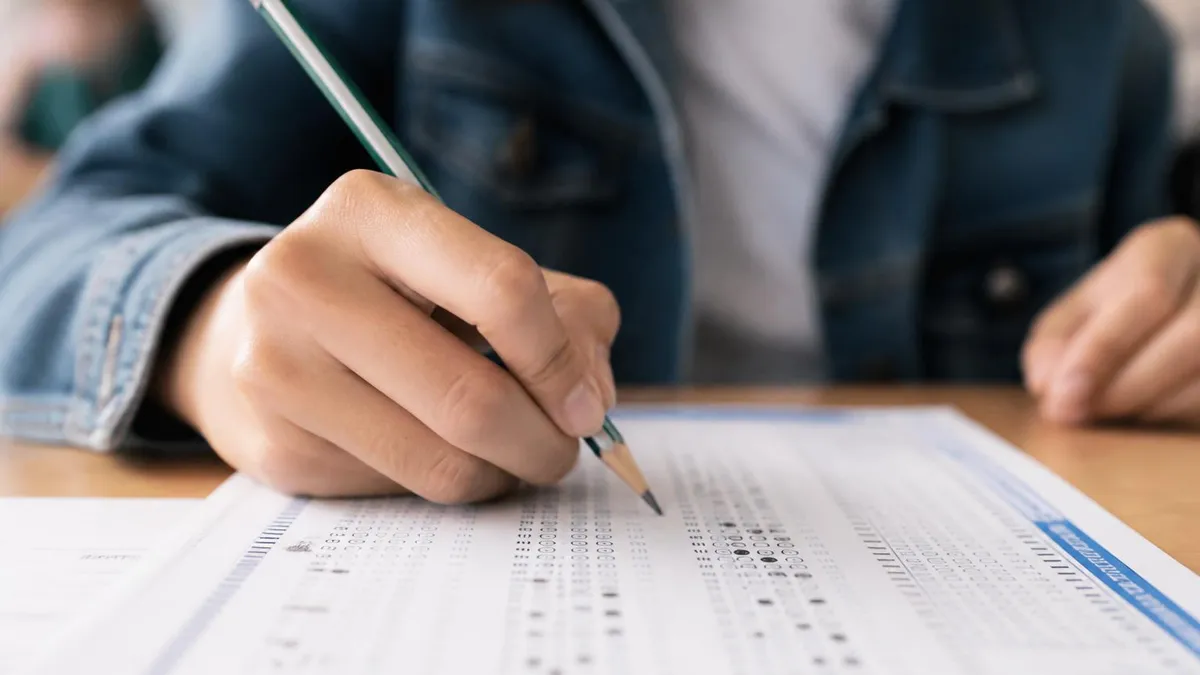
The SHSAT has no guessing penalty. Every blank answer is a guaranteed zero, while every guess gives you a 1-in-5 chance of earning a point. On a test where a single scaled-score point can separate you from your target school, leaving even one question blank is an unforced error. Develop the habit of bubbling your best guess before moving on, even when you plan to return to the question later.
New York City operates eight specialized high schools under state law, and seven of them require the SHSAT for admission. These seven schools are Stuyvesant High School, Bronx High School of Science, Brooklyn Technical High School, Staten Island Technical High School, High School of American Studies at Lehman College, Queens High School for the Sciences at York College, Brooklyn Latin School, and High School for Mathematics, Science and Engineering at City College.
Each school has a different admissions cutoff score, a different academic culture, and different program strengths, so researching each school's personality is just as important as chasing the highest score you can achieve.
The eighth specialized high school — Fiorello H. LaGuardia High School of Music and Art and Performing Arts — is the specialized high school that doesn't require shsat. LaGuardia instead requires an audition and portfolio review specific to each of its arts programs. Students interested in music, visual art, drama, or dance who may not be targeting SHSAT-based schools should research LaGuardia's separate audition process and timeline, which runs on a different calendar than the SHSAT registration and testing window.
The makeup of students admitted to specialized high schools through the SHSAT has been a topic of significant public debate in New York City for many years. Critics argue that the single-test admissions model underrepresents Black and Hispanic students, while defenders point to the test's objectivity and the availability of free city-sponsored prep programs like the DREAM-SHSAT initiative. For students currently preparing for the exam, what matters most is knowing that the SHSAT is the only factor in admissions to seven of the eight specialized schools — there is no supplemental application, no essay, and no extracurricular review.
Students who are not admitted to a specialized high school through the SHSAT still have access to excellent options. New York City's screened high school system includes dozens of competitive programs that use grades, attendance, and standardized test scores in combination. Some of these screened programs in areas like computer science, law, and health sciences are highly regarded and place students in top colleges at rates comparable to some specialized schools. The SHSAT is a high-stakes door, but it is not the only door to an excellent high school education in New York City.
For 9th grade applicants, the SHSAT opportunity is more limited. Only Staten Island Technical High School, Brooklyn Latin School, and High School of American Studies at Lehman College admit 9th grade students through the SHSAT, and available seats are far fewer than for 8th graders.
The 9th grade SHSAT is offered at a separate testing administration, and students must still score above each school's 9th grade cutoff, which is published separately from the 8th grade cutoff. If you're a current 8th grader who missed the exam or scored below your target school's cutoff, the 9th grade opportunity is worth exploring seriously.
Prep programs specifically designed for SHSAT preparation range from free city-run workshops to intensive private tutoring costing several thousand dollars per year. Research consistently shows that the quality of practice — focused, feedback-driven, mistake-reviewed practice — matters far more than the quantity of hours logged or the price tag of the program. A student who completes three full practice tests with thorough answer review will gain more than a student who attends 20 hours of lectures without ever working through their errors analytically.
The best way to approach SHSAT prep is to treat it as a skill-building endeavor rather than a knowledge-memorization task. The SHSAT is designed to test how well you think and reason, not simply what facts you have memorized. Students who internalize strategies for reading efficiently, recognizing math patterns, and managing time under pressure consistently outperform those who focus narrowly on content drill without developing those metacognitive skills.
The SHSAT is typically administered in October and November for 8th grade students, with a separate January administration for 9th graders. Registration opens through your NYC public school in September — missing the registration deadline means waiting a full year. Confirm your specific test date, testing site, and registration deadline through your school's guidance counselor or the NYC DOE website well in advance, as dates shift slightly each year.
Test preparation resources for the SHSAT have expanded significantly in recent years. The New York City Department of Education provides an official SHSAT Handbook, which includes sample questions and a full-length practice test. This handbook is the gold standard for realistic practice because its questions are written by the same test maker that produces the real exam. Beyond the official handbook, the TestNav SHSAT practice test platform allows students to simulate the online test-taking experience — though remember, the actual SHSAT is administered on paper, so online practice should supplement, not replace, paper-based full-length test practice.
For students seeking the most authentic online experience, the SHSAT prep test online environment should mirror real testing conditions as closely as possible. That means sitting at a desk, working through questions with pencil and paper rather than typing, setting a firm 180-minute timer, and avoiding distractions like music or phone notifications. Many students who practice casually — pausing to look things up, working in front of the television, or taking breaks mid-section — are shocked by how differently they perform under actual timed conditions. Simulating test day before test day is the most important preparation habit you can build.
In terms of what to study for the math section, the SHSAT tests arithmetic operations, number properties, fractions and decimals, percents and ratios, algebra and linear equations, geometry (including angles, triangles, circles, and coordinate geometry), statistics, probability, and logical reasoning. The exam does not test calculus or trigonometry. However, it does test some topics — like sequences and functional notation — that are not always covered thoroughly in 7th and 8th grade math classes. Supplementing your school curriculum with targeted SHSAT math content review is strongly recommended for students who want to compete for the highest cutoff schools.
For the ELA section, vocabulary knowledge plays a larger role than many students expect. The SHSAT's reading passages use sophisticated academic language, and students who read widely — news articles, long-form essays, science writing, literary fiction — consistently demonstrate stronger comprehension performance than students who limit their reading to school assignments alone. Building a reading habit of 20–30 minutes per day in the months leading up to the exam produces measurable improvements in both reading speed and comprehension accuracy.
Many families ask about SHSAT calculators and whether one is allowed. The answer is a definitive no — absolutely no calculator of any kind is permitted during the SHSAT, including the shsat calculator some students bring hoping for a last-minute exception. All arithmetic must be done by hand. This means students need to be comfortable with multi-digit multiplication and long division without a calculator, and should practice mental math shortcuts like estimating products and rounding strategically. Losing time on arithmetic because you're shaky without a calculator is one of the most preventable score drains on the math section.
Practice tests should be sourced carefully. The most accurate preparation materials include the official NYC DOE SHSAT Handbook tests, older released official tests available through the DOE, and high-quality third-party tests from established SHSAT prep publishers. Avoid using SAT or ACT practice tests as a substitute — while those tests improve general reasoning, their format and content differ meaningfully from the SHSAT's specific structure and difficulty calibration. Stick to SHSAT-specific materials as your primary practice source, and use other tests only as supplementary reading or math skill builders.
Finally, mental preparation is a real and underrated component of SHSAT readiness. Many students who have the subject-matter knowledge to score well underperform due to test anxiety, poor sleep the night before, or loss of confidence after a difficult early section. Building test-day mental resilience means practicing under pressure regularly during preparation, developing a consistent pre-test routine, and learning to reset emotionally between sections if something doesn't go perfectly. The student who stays composed through a tough reading passage or a confusing math problem will always outperform the equally knowledgeable student who spirals after the first setback.
The final weeks before your SHSAT test date 2025 are the most important for consolidating your preparation rather than learning new material. At this point, your focus should shift from content acquisition to performance optimization. That means taking at least one full-length practice test per week, spending the day after each test analyzing every wrong answer in detail, and fine-tuning your timing strategy based on what you observe in each practice run. Students who peak on test day are typically those who treated their final preparation phase as a performance refinement period, not a cramming sprint.
One of the most high-use strategies in the final three weeks is targeted weak-spot drilling. After your most recent practice test, identify the three to five specific question types or math topics where you lose the most points. Design short 20–30 minute daily drills focused exclusively on those areas. Research on skill acquisition consistently shows that concentrated, targeted practice on specific weaknesses produces faster improvement than broad, unfocused review. This approach also keeps your study sessions manageable and prevents the exhaustion that comes from trying to review everything at once.
Pacing on the actual test day should follow the strategy you've practiced — not a new one. Some students read about a test-taking strategy the night before the exam and try to implement it cold on the real test. This almost always backfires. The strategies that work on test day are the ones you've internalized through dozens of repetitions in practice. Trust your preparation, execute your tested strategy, and resist the temptation to improvise in the moment when anxiety spikes.
It's worth knowing how the SHSAT compares to other competitive middle school admissions tests. Relative to the ISEE or SSAT used by private schools, the SHSAT is more computationally intensive in math and places less emphasis on vocabulary lists and analogy questions in ELA. The SHSAT is also significantly more high-stakes in the sense that the score has one specific use: admission to one of seven SHSAT-required specialized high schools. That focused purpose means your preparation should be equally focused — SHSAT-specific practice materials, SHSAT-specific strategies, and SHSAT-specific timing drills.
Students who want to get a head start should know that the shsat practice test resources available at PracticeTestGeeks include ELA and Math quiz sets calibrated to the real exam's difficulty and format. Using these practice quizzes regularly — even for just 20 minutes per day — builds the question pattern recognition that separates good scores from great ones. The cumulative effect of consistent daily practice over months is vastly superior to occasional marathon study sessions, even when the total hours are equivalent.
Parents can support their student's SHSAT preparation most effectively by creating a consistent, low-distraction study environment at home, ensuring adequate sleep especially in the weeks leading up to the exam, and maintaining a realistic, growth-oriented perspective on the process. SHSAT prep is a multi-month commitment, and students who feel unconditional support regardless of their score outcome tend to perform better — not worse — than students who feel intense pressure to hit a specific number. Frame the goal as "do your best and let your preparation speak for itself" rather than "you must get into Stuyvesant."
Whatever score you achieve on the SHSAT, the months of disciplined preparation will have developed real academic skills — stronger reading comprehension, more systematic mathematical reasoning, better time management under pressure — that will serve you throughout high school, college, and beyond. The exam is the immediate goal, but the learning built during preparation is the lasting reward.
Start early, practice consistently, review everything you get wrong, and approach test day with the confidence that comes from genuine preparation. That combination gives every student their best possible chance at securing a seat in one of New York City's extraordinary specialized high schools.
Sample SHSAT Practice Questions
Try these questions from our free SHSAT practice tests. The correct answer and an explanation follow each question.
How many x values does the function not equal 1? f(x) = (x - 3)/(x - 3)
- A. 3
- B. 0
- C. 23
- D. infinitely many
- E. 3
Answer: D. infinitely many
Since the numerator and denominator are the same, we always get the value 1 for f(x). So, the answer is infinitely many.
Marcus used his $25 to go bowling. He paid $4.00 for each game after renting sneakers for $5.25. How many games could Marcus have played in total?
- A. 24
- B. 16
- C. 4
- D. 8
Answer: C. 4
This response represents the correct solution to the word problem. The student may have set up and solved the inequality as shown below, where x represents the number of games played: 4x + 5.25 4x X The student who selects this response understands that the greatest number of games played has to be a whole number less than 4.9375.
What is the best method for combining sentences together? (1) Scientists now believe that Jupiter may have as many as seventy-nine moons. (2) One of Jupiter’s moons is named Io. (3) Io has the greatest number of active volcanoes in the solar system.
- A. Scientists now believe that Jupiter may have as many as seventy-nine moons, and one of them is named Io, which has the greatest number of active volcanoes in the solar system.
- B. Io, which is one of Jupiter’s moons, has the greatest number of active volcanoes in the solar system, and scientists now believe that Jupiter may have as many as seventy-nine moons.
- C. Io, a moon with the greatest number of active volcanoes in the solar system, is one of Jupiter’s moons, and scientists now believe that Jupiter may have as many as seventy-nine moons.
- D. Scientists now believe that Jupiter may have as many as seventy-nine moons, including one named Io, which has the greatest number of active volcanoes in the solar system.
Answer: D. Scientists now believe that Jupiter may have as many as seventy-nine moons, including one named Io, which has the greatest number of active volcanoes in the solar system.
The correct answer, "Scientists now believe that Jupiter may have as many as seventy-nine moons, including one named Io, which has the greatest number of active volcanoes in the solar system," is the most effective combination. It logically connects the ideas by first stating the total number of moons, then introducing Io as one of them using "including," and finally adding Io's unique characteristic with a non-restrictive clause "which has...". This structure is concise, maintains clarity, and highlights the relationship between the facts.
Ms. Kelly's class has 28 pupils. In this class, there are 2 to 5 boys for every 5 girls. How many new boys must be added to the class in order for the boy-to-girl ratio to equal 1:2?
- A. 6
- B. 14
- C. 3
- D. 5
- E. 2
Answer: E. 2
Number of students in the class = 28 Number of boys = (2/(2+5)) ⋅ 28 = (2/7) ⋅ 28 = 2(4) = 8 Number of girls = 5/(2+5) ⋅ 28 = (5/7) ⋅ 28 = 5(4) = 20 (8 + y) : (20 + y) = 1 : 2 (8 + y) / (20 + y) = 1/2 2(8 + y) = 1 (20 + y) 16 + 2y = 20 2y = 20 - 16 2y = 4 y = 2 Hence the number of students to be added is 2.
SHSAT Questions and Answers



About the Author

Educational Psychologist & Academic Test Preparation Expert
Columbia University Teachers CollegeDr. Lisa Patel holds a Doctorate in Education from Columbia University Teachers College and has spent 17 years researching standardized test design and academic assessment. She has developed preparation programs for SAT, ACT, GRE, LSAT, UCAT, and numerous professional licensing exams, helping students of all backgrounds achieve their target scores.
Join the Discussion
Connect with other students preparing for this exam. Share tips, ask questions, and get advice from people who have been there.
View discussion (7 replies)