
RSO - Certified Range Safety Officer: Complete Study Guide 2026 October
Free RSO practice test with questions and answer explanations. 🟢 Prepare for the 2026 October exam with instant scoring.
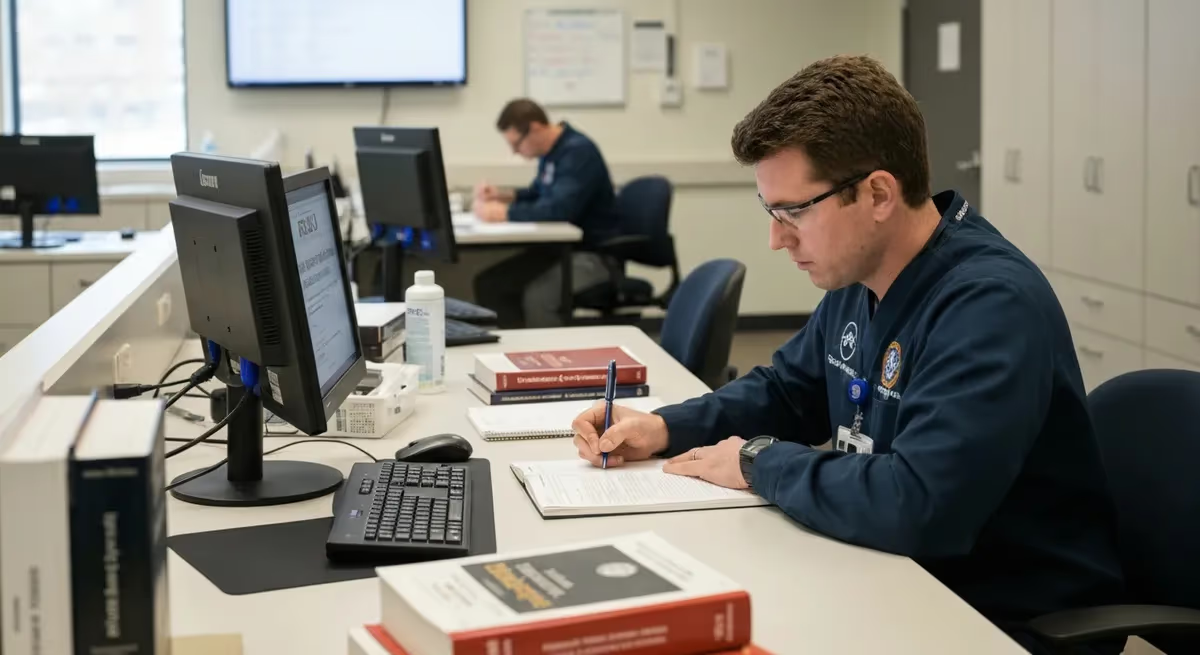
RSO Exam Overview
The RSO - Certified Range Safety Officer exam validates your knowledge and skills in the field. Understanding the exam format, duration, and passing requirements is the first step toward successful preparation.
Before diving into study materials, take a free RSO practice tests to assess your current knowledge level. This baseline assessment helps you identify which topics need the most attention and creates a more efficient study plan.
| Exam Detail | Information |
|---|---|
| Exam Format | Multiple choice and scenario-based questions |
| Duration | Varies by certification level |
| Passing Score | Determined by the certifying body |
| Prerequisites | Check official requirements for your level |
| Recertification | Periodic renewal required |
Key Topics and Domains
Success on the RSO exam requires thorough understanding of all tested domains. Focus your study time proportionally based on the weight each domain carries on the actual exam.
The exam covers both theoretical knowledge and practical application. Make sure you can not only recall facts but also apply concepts to real-world scenarios. Practice with RSO Range Safety & Risk Management and RSO Firearm Handling & Safety Procedures to test your understanding of these core topics.
Core Knowledge Areas
- Foundational Concepts — Understanding the fundamental principles, terminology, and frameworks that form the basis of the certification
- Practical Application — Applying theoretical knowledge to workplace scenarios, case studies, and problem-solving exercises
- Standards and Best Practices — Knowledge of industry standards, regulations, compliance requirements, and professional guidelines
- Analysis and Decision Making — Evaluating situations, interpreting data, and making informed professional decisions
- Professional Ethics — Understanding ethical considerations, professional responsibilities, and code of conduct requirements

RSO Study Plan and Timeline
A structured study plan significantly increases your chances of passing the RSO - Certified Range Safety Officer exam on your first attempt. Here is a recommended timeline based on your experience level:
| Experience Level | Recommended Study Time | Daily Study Hours | Focus Areas |
|---|---|---|---|
| Beginner | 8-12 weeks | 2-3 hours | All domains equally, extra time on fundamentals |
| Intermediate | 4-8 weeks | 1.5-2 hours | Weak areas identified through practice tests |
| Experienced | 2-4 weeks | 1-2 hours | Practice exams and scenario-based questions |
Week-by-Week Approach
- Weeks 1-2: Take a diagnostic practice test, review all domain objectives, gather study materials
- Weeks 3-4: Deep study of the highest-weighted domains, daily flashcard review
- Weeks 5-6: Cover remaining domains, begin timed practice tests
- Weeks 7-8: Full-length practice exams, review weak areas, focus on question patterns
Proven Preparation Strategies
These evidence-based strategies will help you study more effectively for the RSO certification:
- Active recall over passive reading — Test yourself frequently rather than re-reading notes. Practice tests are more effective than highlighting textbooks.
- Spaced repetition — Review material at increasing intervals (1 day, 3 days, 7 days, 14 days) to move knowledge into long-term memory.
- Focus on understanding, not memorization — The exam tests application of concepts. Understand why an answer is correct, not just what the answer is.
- Simulate exam conditions — Take practice tests in a quiet environment with the same time constraints as the actual exam.
- Join study groups — Discussing concepts with peers reinforces understanding and exposes you to different perspectives.
- Use official study materials — Start with the certifying body's recommended resources, then supplement with third-party materials.
- Track your progress — Keep a log of practice test scores to identify trends and weak areas that need additional review.

RSO Pros and Cons
- +Structured RSO study guides organize all required content in exam-aligned order, reducing time spent identifying what to study
- +Combining review guides with practice questions provides both content knowledge and test-taking fluency
- +Focused study plans allow candidates to allocate more time to weak areas rather than reviewing already-mastered content
- +Free and low-cost study resources mean comprehensive preparation is accessible at any budget level
- +Spaced repetition techniques (Anki, regular review sessions) significantly improve long-term retention of tested facts
- −No single study guide covers all tested content optimally — most candidates need 2–3 resources for complete preparation
- −Study guides can become outdated quickly when exam content is updated; verify edition currency before purchasing
- −Self-study requires self-discipline; candidates without structured external accountability often underallocate preparation time
- −Coverage breadth in comprehensive guides can create false confidence — recognizing content is not the same as answering questions correctly under timed conditions
- −Study time estimates in guides often assume ideal conditions; real preparation time is typically 30–50% longer due to life disruptions
Sample Certified Range Safety Officer Practice Questions
Try these questions from our free Certified Range Safety Officer practice tests. The correct answer and an explanation follow each question.
A certified RSO and a range owner disagree on enforcing a specific safety rule during a match. Who has final authority on safety matters during active range operations?
- A. The range owner always has final authority
- B. The RSO has authority over safety decisions during active operations
- C. The match director overrides both on competition days
- D. Safety decisions must be made by committee vote
Answer: B. The RSO has authority over safety decisions during active operations
The RSO holds authority over safety decisions during active range operations regardless of ownership hierarchy.
What is the primary and overriding responsibility of a Range Safety Officer (RSO) on a live firing range?
- A. Ensuring all shooters are using the correct ammunition for their firearms.
- B. Providing marksmanship instruction to new shooters.
- C. Organizing and scoring shooting competitions.
- D. Ensuring the safety of all individuals on and near the range.
Answer: D. Ensuring the safety of all individuals on and near the range.
The foremost duty of an RSO is to ensure the safe operation of the range. This includes enforcing all safety rules, monitoring firearm handling, and taking immediate action to stop any unsafe behavior. While other tasks may be performed, safety is always the top priority.
A Range Safety Officer observes smoke coming from inside a shooter's range bag. The most likely cause and correct response is:
- A. Defective or self-igniting ammunition — move the bag away from people and contact emergency services
- B. Overheated firearm — open the bag carefully and let it air out
- C. Chemical fire — smother the bag with a jacket to deprive it of oxygen
- D. Electrical fire — cut power to the range immediately
Answer: A. Defective or self-igniting ammunition — move the bag away from people and contact emergency services
Spontaneous combustion of faulty ammunition or primers in a bag requires evacuation of the area and emergency services, not manual intervention.
RSO Questions and Answers



About the Author

Certified Safety Professional & OSHA Compliance Expert
Indiana University of Pennsylvania Safety SciencesDr. William Foster holds a PhD in Safety Science from Indiana University of Pennsylvania and is a Certified Safety Professional (CSP) and Certified Hazardous Materials Manager. With 20 years of occupational health and safety management experience across construction, manufacturing, and chemical industries, he coaches safety professionals through OSHA certification, CSP, CHST, and safety management licensing programs.
Join the Discussion
Connect with other students preparing for this exam. Share tips, ask questions, and get advice from people who have been there.
View discussion (9 replies)