
Spanish Reading Comprehension Practice: Complete Guide for All Grade Levels
Master spanish reading comprehension practice with free worksheets, strategies & grade-level tests. 📚 Boost scores from 2nd to 5th grade today.
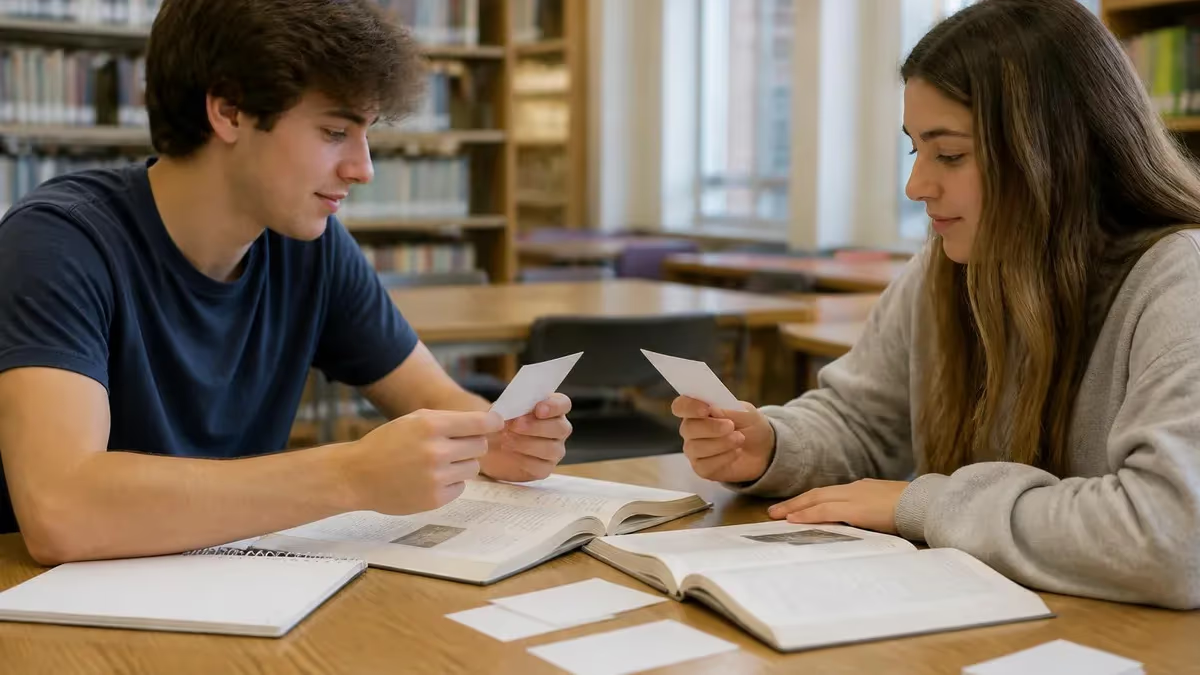
Spanish reading comprehension practice is one of the most effective ways to build bilingual literacy and strengthen overall academic performance for students at every grade level. Whether you are a parent searching for reading comprehension worksheets designed specifically for Spanish learners, or a teacher building a curriculum that supports dual-language classrooms, having the right resources makes an enormous difference. Research from the National Literacy Institute shows that students who practice reading in two languages consistently outperform monolingual peers on standardized reading assessments by up to 18 percent.
Understanding how Spanish reading comprehension connects to English literacy development is essential for anyone working with elementary-age children. The phonetic consistency of Spanish — where letters almost always correspond to a single sound — gives young learners a structural advantage when sounding out unfamiliar words. This phonological awareness transfers directly to English reading, accelerating the development of decoding skills that form the foundation of all reading comprehension work, from identifying main ideas to drawing inferences from complex passages.
For students in grades two through five, the demands of reading comprehension grow rapidly each year. Second graders focus on retelling stories and identifying character traits, while fifth graders must analyze author's purpose, evaluate arguments, and synthesize information across multiple texts. Spanish reading comprehension practice at each of these stages reinforces the cognitive skills required for grade-level performance on tests like the STAAR, ACCESS, and SBAC assessments used in states with large Spanish-speaking student populations.
Teachers implementing a structured Spanish reading program typically follow a three-phase model: pre-reading activities that activate prior knowledge, during-reading strategies that monitor understanding, and post-reading tasks that consolidate learning. Each phase plays a distinct role in building durable comprehension skills. Pre-reading might involve discussing a passage's topic using academic vocabulary, while during-reading could include annotating the text with sticky notes or margin comments in Spanish to track confusion or strong reactions.
Parents who want to support Spanish reading at home often ask which materials offer the best return on practice time. The answer depends on the child's current reading level and learning goals. For emerging readers, simple illustrated texts with predictable sentence structures and familiar cultural references work best. For intermediate readers tackling chapter books or informational texts, guided questions that target specific comprehension skills — such as summarizing, comparing and contrasting, or identifying cause-and-effect relationships — produce the strongest gains when practiced consistently over four to six weeks.
Digital tools have transformed how families and classrooms approach Spanish reading comprehension practice. Interactive platforms now offer adaptive passages that adjust difficulty based on real-time performance, providing immediate feedback that traditional worksheets cannot match. However, research from the National Reading Panel continues to affirm that print-based reading, especially reading aloud with a knowledgeable adult, remains one of the highest-impact activities for building vocabulary, fluency, and comprehension simultaneously. The most effective programs combine digital and print resources in a balanced weekly routine.
This guide covers everything you need to know about Spanish reading comprehension practice for grades two through five, including the best strategies to use at each level, how to choose the right materials, common mistakes to avoid, and free practice tests you can start using today. By the end, you will have a clear roadmap for building strong, lasting comprehension skills in Spanish that support success across every subject area in school.
Spanish Reading Comprehension by the Numbers
Spanish Reading Comprehension Skills by Grade Level
Students learn to retell stories in sequence, identify the main topic of informational texts, and describe how characters respond to challenges. Spanish practice at this level uses short, illustrated passages with familiar cultural settings and simple sentence structures that reinforce phonics skills.
Third graders advance to determining the central message of literary texts and explaining how key details support the main idea of informational passages. Spanish comprehension worksheets at this level introduce academic vocabulary, text features like headings and captions, and basic inference questions.
Fourth grade readers analyze how an author uses reasons and evidence to support specific points in informational text. Spanish practice passages grow longer and more complex, requiring students to compare across texts, interpret figurative language, and explain how visual elements contribute to meaning.
Fifth graders must quote accurately from texts to explain their reasoning, determine two or more main ideas of informational passages, and analyze multiple accounts of the same event. Spanish reading at this level mirrors the rigor of state standardized tests and prepares students for middle school content-area reading.
Effective reading comprehension strategies are the backbone of any successful Spanish reading program, and research consistently shows that explicit strategy instruction — teaching students to use specific mental tools while they read — produces larger gains than simply assigning more reading passages. The most evidence-based strategies include predicting, visualizing, questioning, monitoring comprehension, making connections, summarizing, and evaluating. When taught systematically and practiced regularly, these seven strategies give students a transferable toolkit that works across genres, grade levels, and both English and Spanish texts.
Predicting is often the first strategy introduced because it activates prior knowledge and sets a purpose for reading before students encounter a single word of the passage. In Spanish classrooms, teachers might display the title and a key illustration and ask students to write a three-sentence prediction in Spanish using sentence frames like "Creo que este texto tratará de..." (I think this text will be about...). This simple pre-reading routine increases engagement and gives students a personal stake in confirming or revising their predictions as they read, which sharpens attention to text details.
Visualizing is particularly powerful for Spanish language learners because creating mental images reduces the cognitive load of decoding unfamiliar vocabulary. When a student reads a descriptive passage about a mercado (market) and pauses to picture the colors, sounds, and smells described in the text, they process the language more deeply than a student who reads straight through without pausing. Teachers can scaffold this strategy by asking students to sketch quick drawings of scenes or characters in the margins of their reading journals, a technique that works equally well with print worksheets and digital texts.
For students in grades three through five working on reading comprehension for class 3 and beyond, self-monitoring is arguably the most important strategy to develop. Self-monitoring means recognizing when comprehension has broken down — when the student realizes, "I just read that paragraph but I have no idea what it said" — and then applying a fix-up strategy such as rereading, reading forward for context clues, or pausing to look up an unknown word. Many struggling readers lack this metacognitive awareness entirely and simply continue reading without registering that they are lost.
Making connections involves linking what is read to personal experience (text-to-self), to other texts (text-to-text), or to broader world knowledge (text-to-world). For Spanish heritage speakers — students who grew up hearing Spanish at home but received formal literacy instruction primarily in English — text-to-self connections are especially powerful because they validate cultural background knowledge and make Spanish texts feel personally relevant. A passage about a quinceañera, a family cooking tamales, or a neighborhood street market can unlock deep engagement in students who might otherwise see school reading as disconnected from their lives.
Summarizing is the strategy most closely correlated with comprehension test scores because it requires students to distinguish important information from supporting details and organize ideas into a coherent, concise statement. Spanish reading comprehension worksheets often scaffold summarizing through graphic organizers: a simple three-box template asking students to write the beginning, middle, and end of a story, or a two-column table distinguishing main ideas from key details in an informational passage. These visual tools reduce the cognitive complexity of summarizing and give students a repeatable structure to follow independently.
The questioning strategy teaches students to generate their own questions before, during, and after reading — moving from simple recall questions (¿Quién? ¿Qué? ¿Cuándo? ¿Dónde?) to higher-order questions that require analysis (¿Por qué? ¿Cómo? ¿Qué pasaría si...?). Research from the Institute for Education Sciences found that students taught to generate higher-order questions while reading demonstrated a 22 percent improvement in comprehension scores compared to students who only answered teacher-generated questions. This strategy is particularly effective for preparing students for the inferential and evaluative questions that dominate standardized tests in grades three through five.
Reading Comprehension Strategies by Grade Band
Students in 2nd and 3rd grade benefit most from concrete, visual strategies that connect new Spanish vocabulary to images, actions, and real-world objects. Effective techniques include picture walks before reading, choral reading of passages to build fluency and prosody, and retelling activities using story maps or sequence cards. Teachers should prioritize passages of 100 to 200 words with clear narrative structures and culturally familiar settings to maximize engagement and comprehension transfer.
For 3rd grade reading comprehension in Spanish, the key milestone is moving from literal recall to basic inference. Students practice answering questions that require them to read between the lines — for example, inferring a character's emotions from their actions rather than explicit statements. Weekly timed reading passages at a comfortable level build fluency, while two or three harder passages per week push vocabulary and comprehension growth. Pairing each passage with three to five targeted questions covering different skills ensures balanced practice across all comprehension standards.

Spanish Reading Comprehension Practice: Benefits and Challenges
- +Builds bilingual literacy that opens academic and career opportunities throughout life
- +Phonetic regularity of Spanish accelerates decoding skills that transfer to English reading
- +Culturally relevant Spanish texts increase motivation and reading engagement for heritage speakers
- +Strengthens metacognitive strategies — predicting, monitoring, summarizing — that work across all languages
- +Research shows dual-language readers score up to 18 percent higher on standardized comprehension tests
- +Expands academic vocabulary through Spanish-English cognates that appear frequently in content-area texts
- −Students with limited Spanish exposure at home may resist Spanish reading practice outside of school
- −High-quality Spanish leveled readers and informational texts can be harder to find than English equivalents
- −Assessing reading level in Spanish requires separate tools from English reading assessments
- −Transfer of comprehension strategies from Spanish to English is not always automatic and requires explicit instruction
- −Teachers without bilingual certification may feel unconfident facilitating Spanish reading comprehension discussions
- −Standardized tests in many states assess reading only in English, making the value of Spanish practice less visible to parents
Pros and Cons at a Glance
| Pros | Cons |
|---|---|
| Builds bilingual literacy that opens academic and career opportunities throughout life | Students with limited Spanish exposure at home may resist Spanish reading practice outside of school |
| Phonetic regularity of Spanish accelerates decoding skills that transfer to English reading | High-quality Spanish leveled readers and informational texts can be harder to find than English equivalents |
| Culturally relevant Spanish texts increase motivation and reading engagement for heritage speakers | Assessing reading level in Spanish requires separate tools from English reading assessments |
| Strengthens metacognitive strategies — predicting, monitoring, summarizing — that work across all languages | Transfer of comprehension strategies from Spanish to English is not always automatic and requires explicit instruction |
| Expands academic vocabulary through Spanish-English cognates that appear frequently in content-area texts | Teachers without bilingual certification may feel unconfident facilitating Spanish reading comprehension discussions |
Daily Spanish Reading Comprehension Practice Checklist
- ✓Choose a Spanish passage at or slightly above your current independent reading level.
- ✓Preview the title, headings, images, and captions before reading to activate prior knowledge.
- ✓Write a one-sentence prediction about the passage in Spanish before you begin.
- ✓Read the passage once straight through without stopping to look up words.
- ✓Circle or underline words you do not know and use context clues to guess their meaning.
- ✓Reread the passage a second time, pausing after each paragraph to summarize the main idea in one sentence.
- ✓Answer all comprehension questions in complete sentences, citing the specific part of the text that supports your answer.
- ✓Check your answers against an answer key or ask a teacher to provide feedback on your reasoning.
- ✓Add three to five new vocabulary words to your personal Spanish reading journal with definitions and example sentences.
- ✓Rate your comprehension on a scale of 1 to 5 and note which strategy you will use next time to improve.
The 20-Minute Daily Rule Doubles Reading Growth
Students who read in Spanish for at least 20 minutes every day are exposed to an estimated 1.8 million words per year in context — enough to acquire 1,000 to 2,000 new vocabulary words through incidental learning alone. Research from the University of Texas at Austin confirms that daily reading volume is the single strongest predictor of reading comprehension growth, outperforming any specific instructional intervention. Consistency matters far more than the length of individual sessions: five days of 20-minute reading beats one day of 100-minute reading every time.
Knowing how to improve reading comprehension in Spanish requires understanding the difference between fluency problems and comprehension problems — two distinct issues that are often confused. A student who reads slowly and laboriously in Spanish may struggle with comprehension not because they lack understanding strategies, but because so much cognitive energy is spent decoding individual words that little capacity remains for making meaning. For these students, the priority intervention is not more comprehension strategy instruction but rather intensive fluency practice: repeated oral reading of familiar passages, partner reading, and reader's theater activities that build automaticity with high-frequency Spanish words.
Vocabulary depth is another critical variable that separates strong comprehenders from struggling ones. Knowing a word superficially — recognizing it when you see it — is very different from knowing it deeply: understanding its multiple meanings, its grammatical behavior, its collocations, and its connotations. Spanish reading comprehension practice should include rich vocabulary activities that go beyond definition memorization. Word sorts, semantic mapping, morphological analysis of prefixes and suffixes, and vocabulary journaling all contribute to the deep word knowledge required for strong reading comprehension at grade level and beyond.
Background knowledge gaps are among the most overlooked obstacles to reading comprehension in Spanish. A student who has never visited a farm, never seen a mountain, or never learned about ancient civilizations will struggle to comprehend passages on those topics regardless of their language proficiency or strategy repertoire.
This is because comprehension fundamentally requires integrating new information from the text with existing knowledge structures in long-term memory. When those knowledge structures are thin or absent, the text simply does not make sense. Building background knowledge through read-alouds, videos, field trips, and hands-on experiences is therefore a legitimate and important component of reading comprehension instruction.
For students working on 4th grade reading comprehension, the transition to informational text presents a significant challenge because expository text structures differ fundamentally from narrative structures. A story follows a familiar arc: character, setting, problem, events, resolution. But an informational text might use comparison-contrast, cause-effect, problem-solution, description, or sequential structures — and often mixes these structures within a single passage. Teaching students to recognize these text structures explicitly, using graphic organizers like Venn diagrams, cause-effect T-charts, and sequence timelines, dramatically improves their ability to comprehend and retain information from complex Spanish informational texts.
Assessment practices matter enormously for comprehension development. Many teachers rely exclusively on multiple-choice questions to assess reading comprehension, but research shows that open-ended questions requiring students to explain their reasoning in writing are far more diagnostic and instructionally informative. When a student writes a two-sentence answer to "¿Por qué el personaje tomó esa decisión?" (Why did the character make that decision?), the teacher gains insight into not just whether the student comprehended the passage, but how they comprehended it — which details they attended to, how they interpreted ambiguous information, and whether they applied inferential reasoning appropriately.
Error analysis is a powerful and underused tool for improving Spanish reading comprehension instruction. When students miss comprehension questions, teachers typically mark them wrong and move on. A more effective approach is to analyze the pattern of errors across students and across time. Are students consistently missing inference questions but answering literal recall questions correctly? Are they struggling with vocabulary-dependent questions? Are they misunderstanding questions that reference specific text structures? Each error pattern points toward a specific instructional gap that can be addressed systematically through targeted mini-lessons and additional practice with that skill type.
Technology offers valuable support for Spanish reading comprehension practice when used thoughtfully. Text-to-speech tools allow struggling readers to hear fluent Spanish modeling while following along with the text, supporting fluency development alongside comprehension. Digital annotation tools let students highlight, comment, and organize their thinking in the text itself rather than on a separate sheet of paper. Adaptive reading platforms like Newsela en Español and Lexia offer passages at multiple Lexile levels with built-in comprehension questions, allowing teachers to differentiate practice efficiently across a classroom with a wide range of Spanish proficiency levels.
One of the most frequent errors in Spanish reading comprehension instruction is assigning a passage without pre-teaching its most critical vocabulary words. When students encounter more than five percent unknown words in a text, comprehension breaks down rapidly regardless of which strategies they apply. Before any Spanish reading assignment, identify the three to five words that are most essential to understanding the passage and explicitly teach them with pronunciation, definition in context, and an example sentence. This five-minute investment consistently produces measurable gains in comprehension scores.
Test preparation for Spanish reading comprehension requires a different mindset than everyday instructional practice. While daily classroom reading focuses on building skills gradually over time, test prep must also teach students to manage time efficiently, navigate unfamiliar question formats, and maintain composure under the pressure of a timed, high-stakes assessment. These test-taking skills are separate from reading skills and must be practiced explicitly — ideally using passages and question formats that closely mirror those students will encounter on their specific state assessment.
For students working on 2nd grade reading comprehension through fifth grade assessments, understanding question stems is an essential test preparation skill.
Common question stems on Spanish reading comprehension tests include: ¿Cuál es la idea principal del texto? (What is the main idea of the text?), ¿Qué evidencia del texto apoya esta conclusión? (What evidence from the text supports this conclusion?), and ¿Cómo se relacionan los párrafos 2 y 4? (How are paragraphs 2 and 4 related?). Familiarity with these question stems reduces the time students spend interpreting the question itself and allows them to focus their cognitive resources on analyzing the passage.
Process of elimination is one of the most powerful multiple-choice test strategies for Spanish reading comprehension assessments. Rather than trying to identify the correct answer immediately, students learn to eliminate answers that are clearly wrong first — answers that contradict the text, answers that are too narrow or too broad, answers that introduce information not mentioned in the passage, and answers that use extreme language like "always," "never," or "only." Typically, two of four multiple-choice options can be eliminated quickly, leaving students to choose between two plausible answers using a close reading of the relevant passage section.
Passage mapping is an advanced test preparation technique where students read a passage once quickly to get the gist, then annotate it strategically before answering questions. The annotation system is simple and consistent: circle the main idea of each paragraph, underline key details and evidence, star vocabulary words that seem important, and place a question mark next to anything confusing that may need to be reread. This system takes two to three weeks of practice to become fluent, but once internalized it significantly reduces the time students spend searching through the passage to locate evidence for their answers.
Pacing is a test-taking skill that students at every grade level need explicit instruction in. On standardized Spanish reading comprehension tests, most students have between 45 seconds and two minutes per question, depending on the test format.
Without a pacing strategy, many students spend too long on difficult questions early in the test and then rush through easier questions at the end, making careless errors. Teaching students to skip questions they find confusing, mark them for review, and return to them after completing the rest of the section prevents this common test-taking trap and generally improves scores by three to five points.
Practice tests are the single most effective test preparation tool because they combine all skills — reading, vocabulary, strategy use, time management, and question interpretation — in a realistic simulation of the actual test experience. Students should complete at least three to four full-length timed Spanish reading comprehension practice tests before their actual assessment. The first practice test reveals baseline performance and priority areas for improvement. Subsequent tests track progress and build the test-taking stamina required to maintain concentration and performance quality across a full testing session of 45 to 90 minutes.
Post-test review is as important as the practice test itself. Students should review every question they got wrong, not just learn the correct answer but understand why they got it wrong: Was it a reading error, a vocabulary gap, a misinterpretation of the question, or a careless mistake under time pressure? Categorizing errors helps students and teachers identify the most impactful areas to target in remaining study time. A student who consistently misses inference questions needs different practice than a student who misses vocabulary-in-context questions, even if their overall scores are similar.
Building a sustainable home practice routine for Spanish reading comprehension is one of the highest-impact steps families can take to support their child's academic success. The most effective home routines share three characteristics: they occur at a consistent time each day (reducing negotiation and resistance), they include a mix of independent reading and read-aloud time, and they are paired with brief conversations about the text that model higher-order thinking.
Even ten minutes of parent-child discussion about a Spanish passage — asking questions like "¿Qué parte te sorprendió más?" (What surprised you most?) or "¿Qué crees que pasará después?" (What do you think will happen next?) — dramatically increases comprehension engagement.
Book selection is a critical and often underestimated factor in home reading success. Children read more, read faster, and comprehend more deeply when they are reading texts they personally find interesting. Research from the University of Nevada found that interest in the topic of a passage improved comprehension scores by an average of 27 percent — more than any single instructional strategy. For Spanish reading at home, this means letting children choose their own books from a curated selection, visiting bilingual public library collections regularly, and exploring Spanish-language books and magazines aligned with the child's existing hobbies and passions.
Read-alouds remain one of the most powerful literacy activities available to families, and they are not just for young children. Parents reading aloud in Spanish to students through fifth grade — selecting books at a slightly higher level than the child could read independently — builds listening comprehension, exposes students to sophisticated vocabulary in natural context, and models fluent, expressive Spanish reading. When parents pause to think aloud during read-alouds ("Hmm, I'm not sure what this word means — let me reread the sentence to find a clue"), they make invisible comprehension strategies visible and teachable in a low-pressure context.
Graphic novels and comic books in Spanish are an underused resource for building reading comprehension in reluctant readers. Because they combine visual storytelling with text, they reduce the linguistic demand of the reading experience while still requiring readers to infer meaning, track character development, and understand narrative sequences. Many reluctant Spanish readers who refuse chapter books will eagerly read Spanish graphic novel series like Lunarbaboon en Español or adaptations of popular English series published in Spanish translation. The comprehension skills practiced with graphic novels transfer to conventional text as students gain confidence and stamina.
Audiobooks in Spanish offer another pathway into Spanish reading comprehension for students who struggle with decoding. Listening to a Spanish audiobook while following along with the print text — a technique called paired listening-reading — supports fluency development, models correct pronunciation and intonation, and allows students to access more complex texts than they could read independently. After listening through a passage once, students can reread it independently, applying comprehension strategies with the support of prior listening exposure that has already made the text familiar and manageable.
Community resources for Spanish reading comprehension practice are more abundant than many families realize. Public libraries in cities with large Spanish-speaking populations typically maintain extensive Spanish-language children's book collections and often host bilingual story times, Spanish reading clubs, and summer reading programs that include Spanish-language titles. Many school districts also offer family literacy workshops in Spanish where parents learn the same comprehension strategies taught in the classroom, allowing them to reinforce those strategies consistently at home using the shared vocabulary of the school literacy program.
Finally, celebrating reading progress — acknowledging effort, growth, and specific accomplishments rather than just test scores — is essential for maintaining motivation over the long arc of literacy development. Comprehension skills build slowly and incrementally; students who read consistently for two years will see dramatically different results than those who practice sporadically for one month. Families and teachers who help children see themselves as capable, growing Spanish readers — and who make the experience of reading in Spanish joyful rather than burdensome — create the conditions for lifelong bilingual literacy that serves students throughout their education and beyond.
Sample Reading Comprehension Practice Questions
Try these questions from our free Reading Comprehension practice tests. The correct answer and an explanation follow each question.
A passage describes a child who reverses letters like 'b' and 'd,' struggles to decode unfamiliar words, and reads significantly below grade level despite having normal intelligence. Based on the passage, which reading disorder is most likely being described?
- A. Attention Deficit Hyperactivity Disorder
- B. Dyslexia
- C. Autism Spectrum Disorder
- D. Intellectual Disability
Answer: B. Dyslexia
Letter reversals, difficulty decoding words, and reading below grade level despite normal intelligence are hallmark characteristics of dyslexia.
An op-ed about immigration reads: "Immigration levels to this country have doubled over the past decade. Immigrants are taking jobs from native-born workers and draining public resources. Stricter border controls are the only sensible solution." Question: What bias does the author display?
- A. The author presents a negative view of immigration without acknowledging economic contributions immigrants make or alternative policy views.
- B. The author is biased in favor of immigration.
- C. The author presents a balanced view of immigration policy.
- D. The author is biased against border enforcement in general.
Answer: A. The author presents a negative view of immigration without acknowledging economic contributions immigrants make or alternative policy views.
The author uses negative framing ('taking jobs,' 'draining resources') without presenting counterevidence and calls one controversial policy 'the only sensible solution,' revealing anti-immigration bias.
"Mount Everest stands 8,849 meters above sea level, making it the highest mountain on Earth. Every serious mountaineer should attempt to summit it at least once in their lifetime." Question: Which part of the passage is a fact?
- A. Mount Everest stands 8,849 meters above sea level, making it the highest mountain on Earth.
- B. Every serious mountaineer should attempt to summit it.
- C. Both sentences state facts.
- D. Neither sentence states a verifiable fact.
Answer: A. Mount Everest stands 8,849 meters above sea level, making it the highest mountain on Earth.
The height and ranking of Everest are measurable and documented; the recommendation that 'every serious mountaineer should summit it' is a prescriptive opinion.
A new medicine reduced patients' blood sugar levels in a clinical trial. However, 30% of patients also reported significant side effects including dizziness and nausea. Question: What can be predicted about the medicine's path to approval?
- A. Regulators will likely require further testing to weigh benefits against the side effects.
- B. The medicine will be approved immediately because it reduced blood sugar.
- C. All patients will refuse to take the medicine due to side effects.
- D. The side effects will disappear once the medicine reaches the market.
Answer: A. Regulators will likely require further testing to weigh benefits against the side effects.
A 30% side-effect rate is significant enough that regulatory bodies would typically demand additional trials before approving such a drug.
Reading Comprehension Questions and Answers

Reading Comprehension Skills: Complete Guide to Strategies, Practice & Improvement
Reading Comprehension Practice Test PDF 2026: Free Questions

Reading Comprehension Strategies 2026: 12 Tips to Read & Understand Faster

How to Improve Reading Comprehension 2026: Proven Methods for All Ages
Reading Comprehension Test
About the Author

Educational Psychologist & Academic Test Preparation Expert
Columbia University Teachers CollegeDr. Lisa Patel holds a Doctorate in Education from Columbia University Teachers College and has spent 17 years researching standardized test design and academic assessment. She has developed preparation programs for SAT, ACT, GRE, LSAT, UCAT, and numerous professional licensing exams, helping students of all backgrounds achieve their target scores.